seats Abarth 500 2018 Owner handbook (in English)
[x] Cancel search | Manufacturer: ABARTH, Model Year: 2018, Model line: 500, Model: Abarth 500 2018Pages: 192, PDF Size: 5.86 MB
Page 11 of 192
KNOWING YOUR CAR
In-depth knowledge of your new vehicle
starts here.
The handbook that you are reading
simply and directly explains how it
is made and how it works.
That’s why we advise you to read it
seated comfortably on board, so that
you can see what is described here for
yourself.INSTRUMENT PANEL ..................... 10
KEYS .............................................. 11
IGNITION DEVICE ........................... 12
FIAT CODE SYSTEM ....................... 13
DOORS ........................................... 14
SEATS ............................................ 15
HEADRESTS ................................... 18
STEERING WHEEL ......................... 18
REAR VIEW MIRRORS .................... 19
EXTERIOR LIGHTS ......................... 20
ROOF LIGHTS ................................ 22
WINDOW WASHING ....................... 23
MANUAL CLIMATE CONTROL
SYSTEM ......................................... 25
AUTOMATIC CLIMATE CONTROL
SYSTEM ......................................... 27
WINDOW WINDERS ....................... 29
ELECTRIC SUNROOF ..................... 29
SOFT TOP ...................................... 31
ENGINE BONNET ........................... 35
LUGGAGE COMPARTMENT ........... 36
9
Page 17 of 192
SEATS
FRONT SEATS
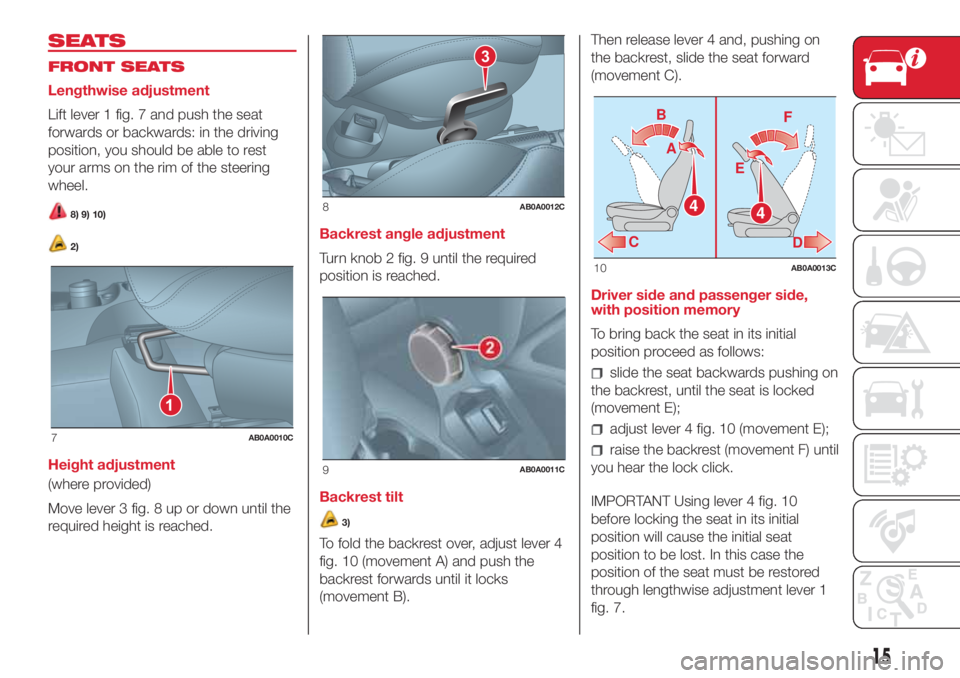
Lengthwise adjustment
Lift lever 1 fig. 7 and push the seat
forwards or backwards: in the driving
position, you should be able to rest
your arms on the rim of the steering
wheel.
8) 9) 10)
2)
Height adjustment
(where provided)
Move lever 3 fig. 8 up or down until the
required height is reached.Backrest angle adjustment
Turn knob 2 fig. 9 until the required
position is reached.
Backrest tilt
3)
To fold the backrest over, adjust lever 4
fig. 10 (movement A) and push the
backrest forwards until it locks
(movement B).Then release lever 4 and, pushing on
the backrest, slide the seat forward
(movement C).
Driver side and passenger side,
with position memory
To bring back the seat in its initial
position proceed as follows:
slide the seat backwards pushing on
the backrest, until the seat is locked
(movement E);
adjust lever 4 fig. 10 (movement E);
raise the backrest (movement F) until
you hear the lock click.
IMPORTANT Using lever 4 fig. 10
before locking the seat in its initial
position will cause the initial seat
position to be lost. In this case the
position of the seat must be restored
through lengthwise adjustment lever 1
fig. 7.
1
7AB0A0010C
3
8AB0A0012C
9AB0A0011C
44
A B
C
D EF
10AB0A0013C
15
Page 18 of 192
Passenger side without position
memory
To bring back the seat in its initial
position proceed as follows:
slide the seat backwards pushing on
the backrest to the desired position
(movement D);
adjust lever 4 fig. 10 (movement E);
raise the backrest (movement F) until
you hear the lock click.
The type of reattachment manoeuvre
has been chosen to guarantee the
safety of the occupant. In fact, if there
is an obstacle (e.g. a bag) that prevents
the seat from returning to its start
position, just using lever 4, the
mechanism guarantees that the seat is
fastened to its guides.
SPORT FRONT SEATS
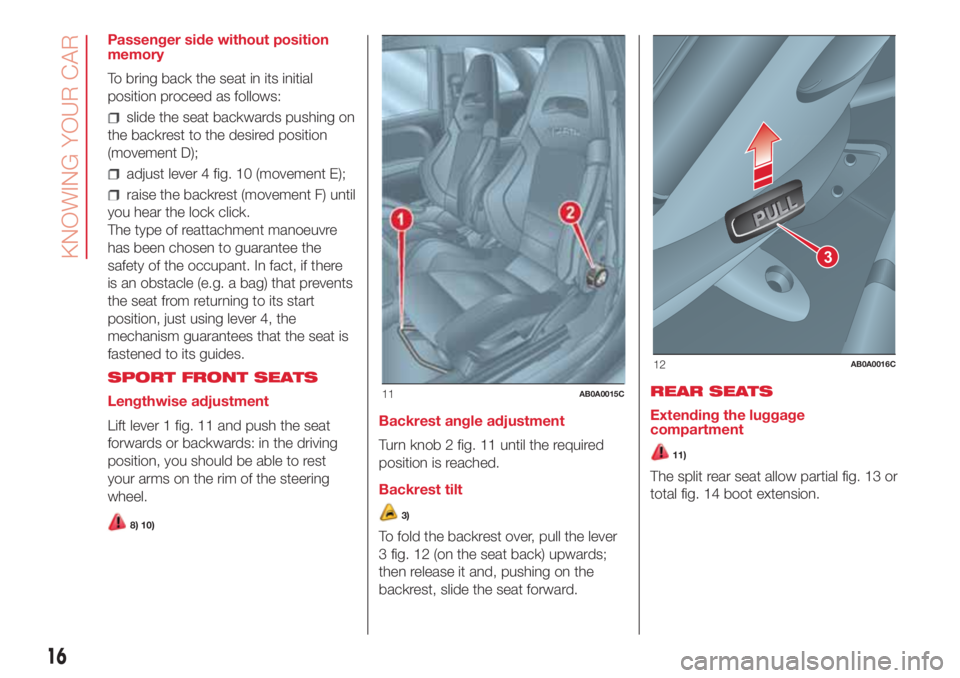
Lengthwise adjustment
Lift lever 1 fig. 11 and push the seat
forwards or backwards: in the driving
position, you should be able to rest
your arms on the rim of the steering
wheel.
8) 10)
Backrest angle adjustment
Turn knob 2 fig. 11 until the required
position is reached.
Backrest tilt
3)
To fold the backrest over, pull the lever
3 fig. 12 (on the seat back) upwards;
then release it and, pushing on the
backrest, slide the seat forward.REAR SEATS
Extending the luggage
compartment
11)
The split rear seat allow partial fig. 13 or
total fig. 14 boot extension.
11AB0A0015C
3
12AB0A0016C
16
KNOWING YOUR CAR
Page 20 of 192
10)Once you have released the
adjustment lever, always check that the
seat is locked on the guides by trying
to move it back and forth. Failure to lock
the seat in place could result in the seat
moving suddenly and the driver losing
control of the car.
11)Make sure the backrests are properly
secured at both sides to prevent them from
moving forward, in the event of sharp
braking, and hurting the passengers.
WARNING
2)The fabric upholstery of the seats has
been designed to withstand long-term
wear deriving from normal use of the car.
Some precautions are however required.
Avoid prolonged and/or excessive rubbing
against clothing accessories such as
metal buckles and Velcro strips which, by
applying a high pressure on the fabric in
a small area, could cause it to break,
thereby damaging the upholstery.
3)Before tilting the backrest, remove any
objects on the seat cushion.
HEADRESTS
REAR
(where provided)
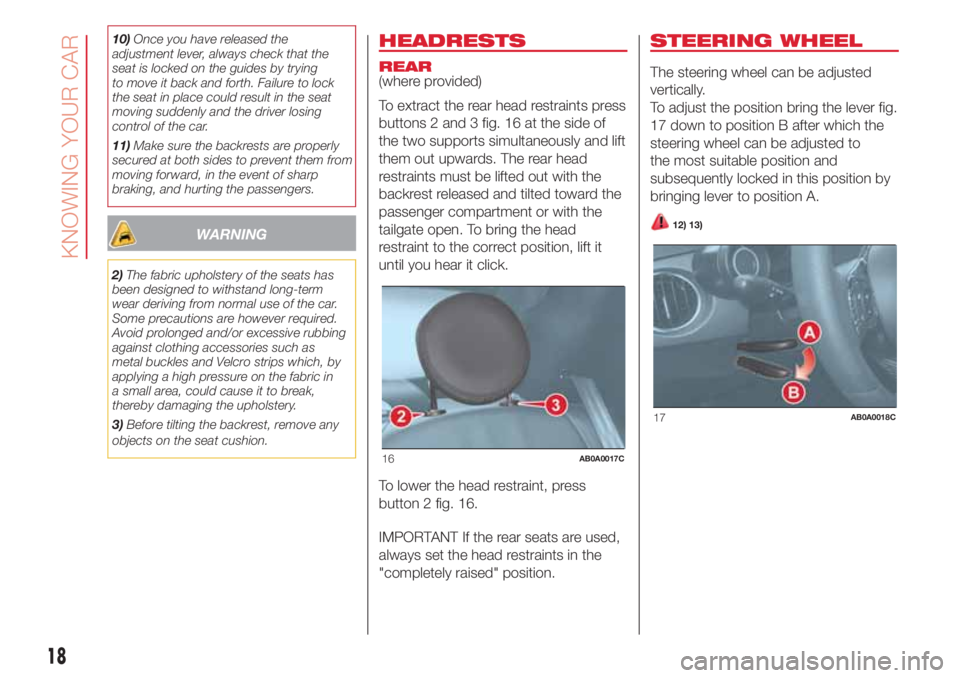
To extract the rear head restraints press
buttons 2 and 3 fig. 16 at the side of
the two supports simultaneously and lift
them out upwards. The rear head
restraints must be lifted out with the
backrest released and tilted toward the
passenger compartment or with the
tailgate open. To bring the head
restraint to the correct position, lift it
until you hear it click.
To lower the head restraint, press
button 2 fig. 16.
IMPORTANT If the rear seats are used,
always set the head restraints in the
"completely raised" position.
STEERING WHEEL
The steering wheel can be adjusted
vertically.
To adjust the position bring the lever fig.
17 down to position B after which the
steering wheel can be adjusted to
the most suitable position and
subsequently locked in this position by
bringing lever to position A.
12) 13)
16AB0A0017C
17AB0A0018C
18
KNOWING YOUR CAR
Page 24 of 192
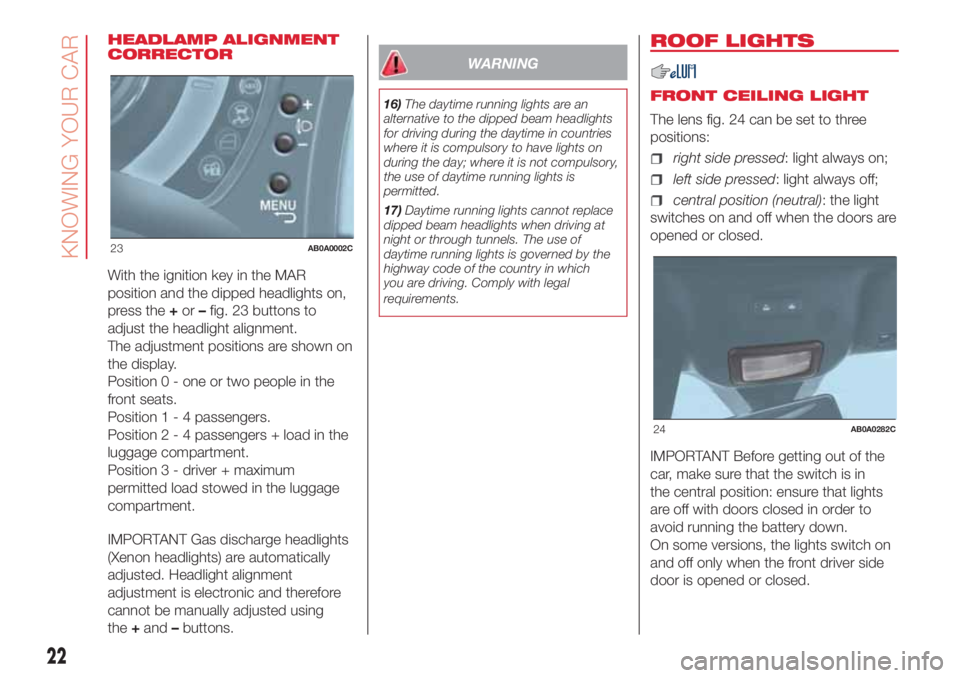
HEADLAMP ALIGNMENT
CORRECTOR
With the ignition key in the MAR
position and the dipped headlights on,
press the+or–fig. 23 buttons to
adjust the headlight alignment.
The adjustment positions are shown on
the display.
Position 0 - one or two people in the
front seats.
Position1-4passengers.
Position2-4passengers + load in the
luggage compartment.
Position 3 - driver + maximum
permitted load stowed in the luggage
compartment.
IMPORTANT Gas discharge headlights
(Xenon headlights) are automatically
adjusted. Headlight alignment
adjustment is electronic and therefore
cannot be manually adjusted using
the+and–buttons.
WARNING
16)The daytime running lights are an
alternative to the dipped beam headlights
for driving during the daytime in countries
where it is compulsory to have lights on
during the day; where it is not compulsory,
the use of daytime running lights is
permitted.
17)Daytime running lights cannot replace
dipped beam headlights when driving at
night or through tunnels. The use of
daytime running lights is governed by the
highway code of the country in which
you are driving. Comply with legal
requirements.
ROOF LIGHTS
FRONT CEILING LIGHT
The lens fig. 24 can be set to three
positions:
right side pressed: light always on;
left side pressed: light always off;
central position (neutral): the light
switches on and off when the doors are
opened or closed.
IMPORTANT Before getting out of the
car, make sure that the switch is in
the central position: ensure that lights
are off with doors closed in order to
avoid running the battery down.
On some versions, the lights switch on
and off only when the front driver side
door is opened or closed.
23AB0A0002C
24AB0A0282C
22
KNOWING YOUR CAR
Page 36 of 192
FRONT SPOILER
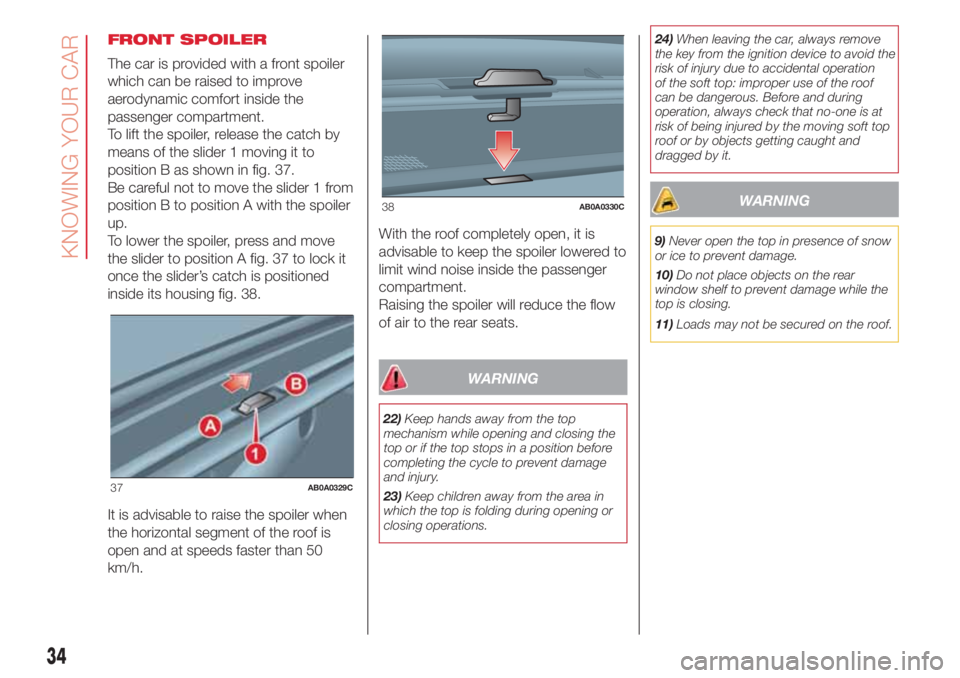
The car is provided with a front spoiler
which can be raised to improve
aerodynamic comfort inside the
passenger compartment.
To lift the spoiler, release the catch by
means of the slider 1 moving it to
position B as shown in fig. 37.
Be careful not to move the slider 1 from
position B to position A with the spoiler
up.
To lower the spoiler, press and move
the slider to position A fig. 37 to lock it
once the slider’s catch is positioned
inside its housing fig. 38.
It is advisable to raise the spoiler when
the horizontal segment of the roof is
open and at speeds faster than 50
km/h.With the roof completely open, it is
advisable to keep the spoiler lowered to
limit wind noise inside the passenger
compartment.
Raising the spoiler will reduce the flow
of air to the rear seats.
WARNING
22)Keep hands away from the top
mechanism while opening and closing the
top or if the top stops in a position before
completing the cycle to prevent damage
and injury.
23)Keep children away from the area in
which the top is folding during opening or
closing operations.24)When leaving the car, always remove
the key from the ignition device to avoid the
risk of injury due to accidental operation
of the soft top: improper use of the roof
can be dangerous. Before and during
operation, always check that no-one is at
risk of being injured by the moving soft top
roof or by objects getting caught and
dragged by it.
WARNING
9)Never open the top in presence of snow
or ice to prevent damage.
10)Do not place objects on the rear
window shelf to prevent damage while the
top is closing.
11)Loads may not be secured on the roof.
37AB0A0329C
38AB0A0330C
34
KNOWING YOUR CAR
Page 39 of 192
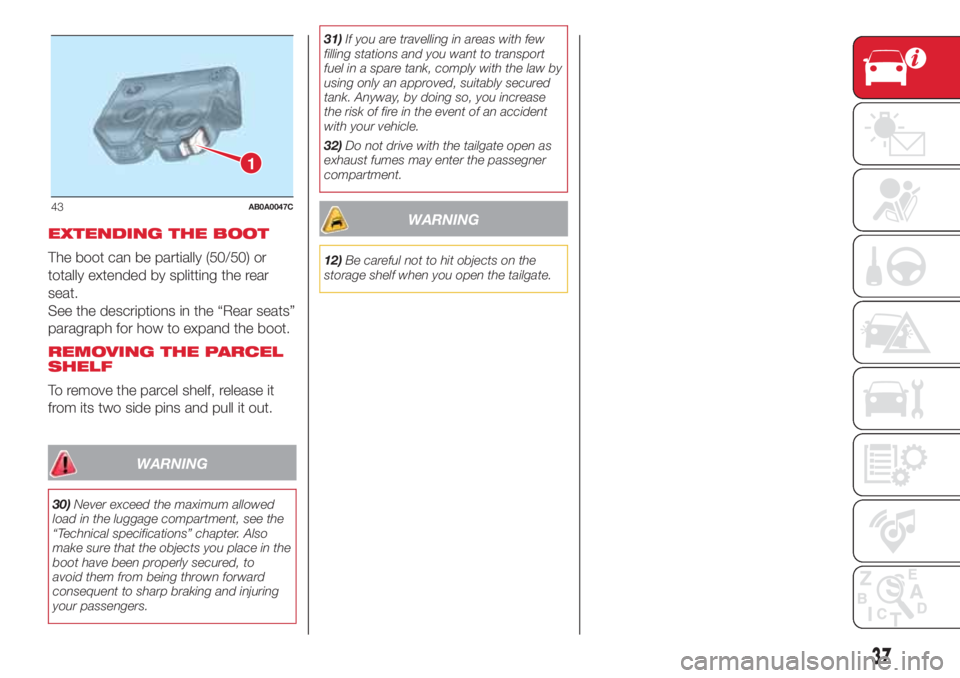
EXTENDING THE BOOT
The boot can be partially (50/50) or
totally extended by splitting the rear
seat.
See the descriptions in the “Rear seats”
paragraph for how to expand the boot.
REMOVING THE PARCEL
SHELF
To remove the parcel shelf, release it
from its two side pins and pull it out.
WARNING
30)Never exceed the maximum allowed
load in the luggage compartment, see the
“Technical specifications” chapter. Also
make sure that the objects you place in the
boot have been properly secured, to
avoid them from being thrown forward
consequent to sharp braking and injuring
your passengers.31)If you are travelling in areas with few
filling stations and you want to transport
fuel in a spare tank, comply with the law by
using only an approved, suitably secured
tank. Anyway, by doing so, you increase
the risk of fire in the event of an accident
with your vehicle.
32)Do not drive with the tailgate open as
exhaust fumes may enter the passegner
compartment.
WARNING
12)Be careful not to hit objects on the
storage shelf when you open the tailgate.
1
43AB0A0047C
37
Page 66 of 192

SEAT BELTS
USING THE SEAT BELTS
All vehicle seats are equipped with seat
belts with three anchor points and a
retractor.
The driver is responsible for respecting,
and ensuring that all the other
occupants of the vehicle also respect,
the local laws in force in relation to
the use of the seat belts.
Always fasten the seat belts before
setting off.
The belt should be worn keeping the
torso straight and rested against the
backrest.
To fasten the seat belts, hold the tab 1
fig. 52 and insert it into the buckle 2
fig. 52, until it clicks into place.
On removal, if the belt jams, let it rewind
for a short stretch, then pull it out
again without jerking.
Press button 3 fig. 52 to release the
belt.
Guide the belt while it is rewinding to
prevent it from twisting.The retractor mechanism operates
locking the belt in the event of sharp
braking or strong deceleration due
to an impact. This allows the belt strap
to slide freely and to adapt to the body
of the occupant. In the event of an
accident, the belt will lock reducing the
risk of impact inside the passenger
compartment and of being projected
outside the vehicle.
The retractor may lock when the vehicle
is parked on a steep slope: this is
perfectly normal. Furthermore, the reel
mechanism locks the belt if it is pulled
sharply or in the event of sudden
braking, collisions and high-speed
bends.
72) 73)
The rear seat is fitted with inertia seat
belts with three anchor points and a
retractor.Wear the rear seat belts as shown in
fig. 53.
IMPORTANT When putting the seats
back to their normal position, make
sure the seat belts are positioned
so they are ready to use.
WARNING
72)Never press button 3 when travelling.
73)Remember that in the event of an
accident, the rear seat passengers not
wearing seat belts are exposed to a very
serious risk and also represent a serious
danger for the front seat occupants.
1
32
52AB0A0059C
53AB0A0354C
64
SAFETY
Page 68 of 192
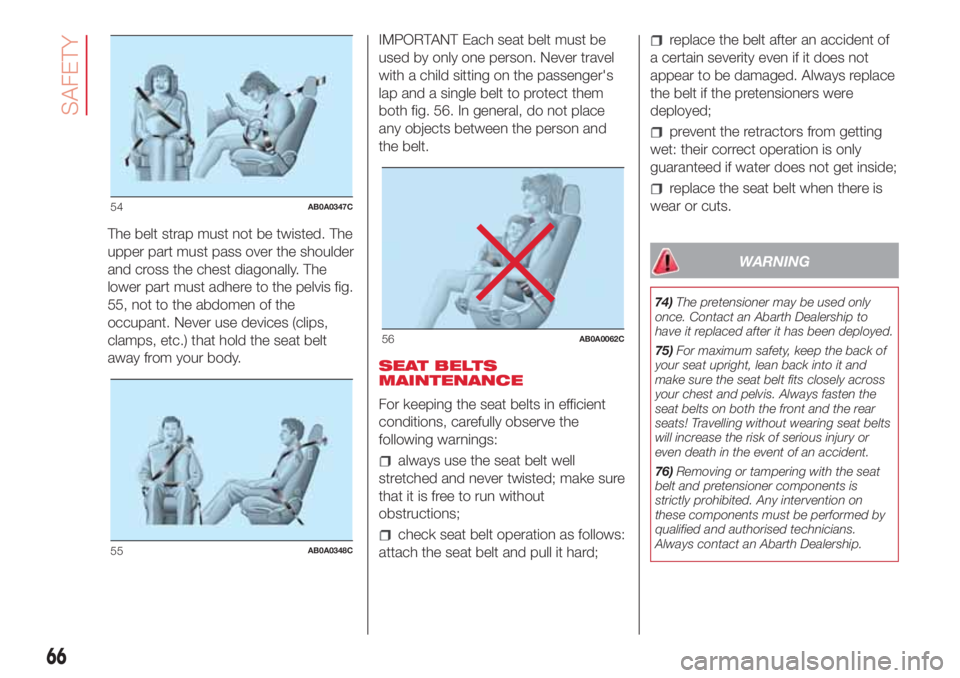
The belt strap must not be twisted. The
upper part must pass over the shoulder
and cross the chest diagonally. The
lower part must adhere to the pelvis fig.
55, not to the abdomen of the
occupant. Never use devices (clips,
clamps, etc.) that hold the seat belt
away from your body.IMPORTANT Each seat belt must be
used by only one person. Never travel
with a child sitting on the passenger's
lap and a single belt to protect them
both fig. 56. In general, do not place
any objects between the person and
the belt.
SEAT BELTS
MAINTENANCE
For keeping the seat belts in efficient
conditions, carefully observe the
following warnings:
always use the seat belt well
stretched and never twisted; make sure
that it is free to run without
obstructions;
check seat belt operation as follows:
attach the seat belt and pull it hard;
replace the belt after an accident of
a certain severity even if it does not
appear to be damaged. Always replace
the belt if the pretensioners were
deployed;
prevent the retractors from getting
wet: their correct operation is only
guaranteed if water does not get inside;
replace the seat belt when there is
wear or cuts.
WARNING
74)The pretensioner may be used only
once. Contact an Abarth Dealership to
have it replaced after it has been deployed.
75)For maximum safety, keep the back of
your seat upright, lean back into it and
make sure the seat belt fits closely across
your chest and pelvis. Always fasten the
seat belts on both the front and the rear
seats! Travelling without wearing seat belts
will increase the risk of serious injury or
even death in the event of an accident.
76)Removing or tampering with the seat
belt and pretensioner components is
strictly prohibited. Any intervention on
these components must be performed by
qualified and authorised technicians.
Always contact an Abarth Dealership.
54AB0A0347C
55AB0A0348C
56AB0A0062C
66
SAFETY
Page 69 of 192
77)If the seat belt has been subjected to a
high level of stress, for example after an
accident, it must be completely replaced
together with the anchorages, anchorage
fixing screws and pretensioner. In fact,
even if the seat belt has no visible defects,
it could have lost its resilience.
WARNING
14)Operations which lead to impacts,
vibrations or localised heating (over 100°C
for a maximum of six hours) in the area
around the pretensioner may damage or
deploy it. Contact an Abarth Dealership
should intervention be necessary on these
components.
CHILD PROTECTION
SYSTEMS
CARRYING CHILDREN
SAFELY
78) 79) 80) 81)
For optimal protection in the event of an
impact, all occupants must be seated
and wearing adequate restraint
systems, including newborn and
children!
This prescription is compulsory in all EC
countries according to EC Directive
2003/20/EC.
Children below the height of 1.50
metres and up to 12 years must be
protected with suitable restraint
systems and be seated on the rear
seats.
Statistics on accidents indicate that the
rear seats offer greater safety for
children.
Compared with an adult, a child's head
is larger and heavier in proportion to
their body and the child's muscular and
bone structures are not fully developed.
Therefore, correct restraint systems
other than adult seat belts are
necessary to reduce as much as
possible the risk of injuries in the event
of an accident, braking or a sudden
manoeuvre.Children must be seated safely and
comfortably. As far as the
characteristics of the child seats used
allow, you are advised to keep children
in rear facing child seats for as long
as possible (at least until 3–4 years old),
since this is the most protected
position in the event of an impact.
The choice of the most suitable child
restraint system depends on the weight
and size of the child. There are various
types of child restraint systems, which
can be secured to the car by means
of the seat belts or with the ISOFIX
anchorages.
It is recommended to always choose
the restraint system most suitable
for the child; for this reason always refer
to the Owner Handbook provided with
the child restraint system, to be sure
that it is of the right type for the children
it is intended for.
In Europe the characteristics of child
restraint systems are ruled by the
regulation ECE-R44, dividing them into
five weight groups:
Group Weight range
Group 0up to 10 kg in
weight
Group 0+up to 13 kg in
weight
67