airbag Acura CL 2002 User Guide
[x] Cancel search | Manufacturer: ACURA, Model Year: 2002, Model line: CL, Model: Acura CL 2002Pages: 335
Page 22 of 335

If they do, they
could be very seriously injured in a
crash. Carrying hard or sharp
objects on your lap, or driving with
a pipe or other sharp object in
your mouth, can result in injuries
if your f ront airbag inf lates.
If your
hands or arms are close to the
airbag cover in the center of the
steering wheel or on top of the
dashboard, they could be injured if
the f ront airbags inflate.
Any object
attached to or placed on the covers
marked ‘‘SRS AIRBAG’’ in the
center of the steering wheel and
on top of the dashboard could
interf ere with the proper operation
of the airbags. Or, if the airbags
inf late, the objects could be
propelled inside the car and hurt
someone.
Devices intended to improve
occupant comf ort or reposition the
shoulder part of a seat belt can
severely compromise the
protective capability of the seat
belt and increase the chance of
serious injury in a crash. If a side airbag
inflates,acupholderorotherhard
object attached on or near the
door could be propelled inside the
car and hurt someone.
Additional Saf ety Precautions
T wo people should never use t he
same seat belt . Do not place hard or sharp object s
bet ween yourself and a f rontairbag.
K eep your hands and arms awayf rom t he airbag covers.
Do not at t ach or place object s on
the f ront airbag covers.
Do not put any accessories on seat
belts. Do not at t ach hard object s on or
near a door.
Protecting Adults
Driver and Passenger Saf ety19
Page 24 of 335
According to accident statistics,
children of all ages and sizes are
saf er when they are restrained in the
back seat, not the f ront seat. The
National Highway Traf f ic Saf ety
Administration and Transport
Canada recommend that all children
ages 12 and under be properly
restrained in the back seat.
In the back seat, children are less
likely to be injured by striking hard
interior parts during a collision or
hard braking. Also, children cannot
be injured by an inf lating airbag
when they ride in the back.Front airbags have been designed to
help protect adults in a moderate to
severe f rontal collision. To do this,
the passenger’s f ront airbag is quite
large, and it inf lates with tremendous
speed.
If
the airbag inf lates, it can hit the back
of the child seat with enough force
to kill or very seriously injure an
inf ant. If the vehicle seat is
too far forward, or the child’s head is
thrown f orward during a collision, an
inflating front airbag can strike the
child with enough f orce to kill or
very seriously injure a small child.
Whenever possible,
larger children should sit in the back
seat, properly restrained with a seat
belt. (See page f or important
inf ormation about protecting larger
children.) 35
CONT INUED
Small Children
Larger Children
Never put a rear-f acing child seat in
t he f ront seat of a vehicle equippedwit h a passenger’s f ront airbag.
Inf ant s Placing a f orward-f acing child seat in
t he f ront seat of a vehicle equippedwit h a passenger’s f ront airbag canbe hazardous.
Children who have outgrown childseat s are also at risk of being injuredor killed by an inf lat ing passenger’sfront airbag.Children Should Sit in the Back
Seat The Passenger’s Front Airbag
Poses Serious Risks to Children
Protecting Children
Driver and Passenger Saf ety21
Page 25 of 335
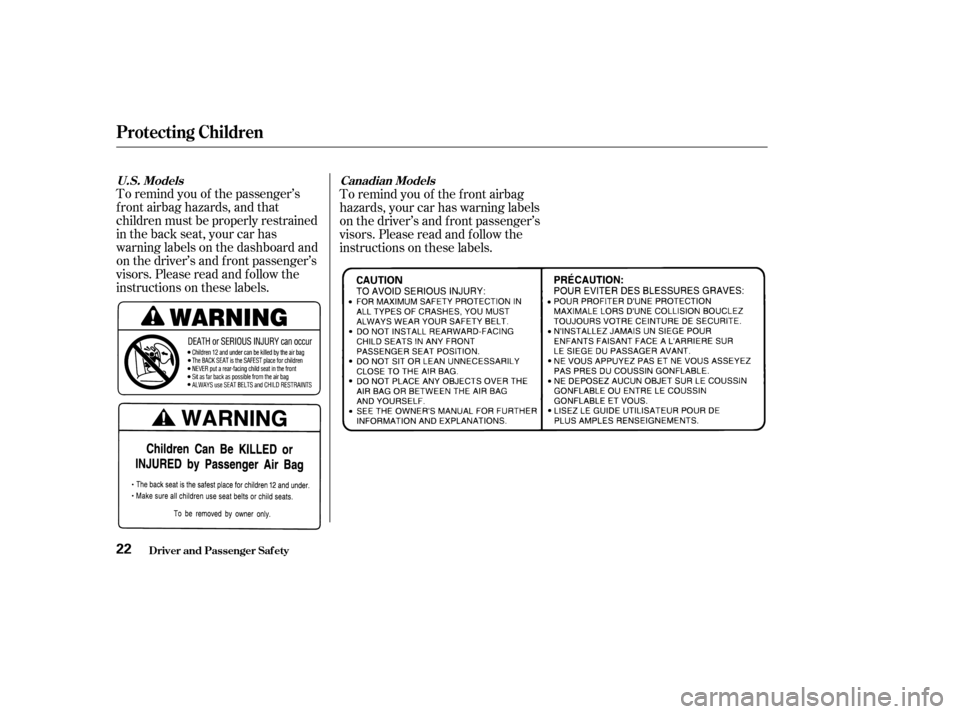
To remind you of the passenger’s
f ront airbag hazards, and that
children must be properly restrained
in the back seat, your car has
warninglabelsonthedashboardand
on the driver’s and f ront passenger’s
visors. Please read and f ollow the
instructions on these labels.To remind you of the f ront airbag
hazards, your car has warning labels
on the driver’s and f ront passenger’s
visors. Please read and f ollow the
instructions on these labels.
U.S. Models
Canadian Models
Protecting Children
Driver and Passenger Saf ety22
Page 26 of 335
Many parents say they pref er to put
an inf ant or small child in the f ront
passenger seat so they can watch the
child, or because the child requires
attention.
Placing a child in the f ront seat
exposes the child to hazards f rom
the passenger’s f ront airbag, and
paying close attention to a child
distracts the driver f rom the
important tasks of driving, placing
both of you at risk.
If a child requires physical attention
or f requent visual contact, we
strongly recommend that another
adult ride with the child in the back
seat. The back seat is far safer for a
child than the front.
Place the largest child in the f ront
seat, provided the child is large
enough to wear a seat belt
properly (see page ).
Move the vehicle seat as far to the
rear as possible (see page ).
Have the child sit upright and well
backintheseat(seepage ).
Make sure the seat belt is properly
positioned and secured (see page
). Leaving children without
adult supervision is illegal in most
states and Canadian provinces,
and can be very hazardous. For
example, inf ants and small
childrenleftinavehicleonahot
day can die f rom heatstroke. And
children lef t alone with the key in
the ignition can accidentally set
the vehicle in motion, possibly
injuring themselves or others.
Your car has two seating positions in
the back seat where children can be
properly restrained.
If you ever have to carry more than
twochildreninyourcar:
Children who play in cars can
accidentally get trapped inside the
trunk. Teach your children not to
play in or around cars. Know how
to operate the emergency trunk
opener (US models only) and
decide if your children should be
shown how to use this f eature (see
page ).
35
17
15 13
84
CONT INUED
If a Child Requires Close
Attention
If You Must Drive with Several
Children Additional Saf ety Precautions
Protecting Children
Driver and Passenger Saf ety
Do not leave children alone in your
vehicle.
Lock both doors and the trunkwhen your car is not in use.
23
Page 29 of 335
If a small child must ride in the
f ront, f ollow the instructions
provided in this section.
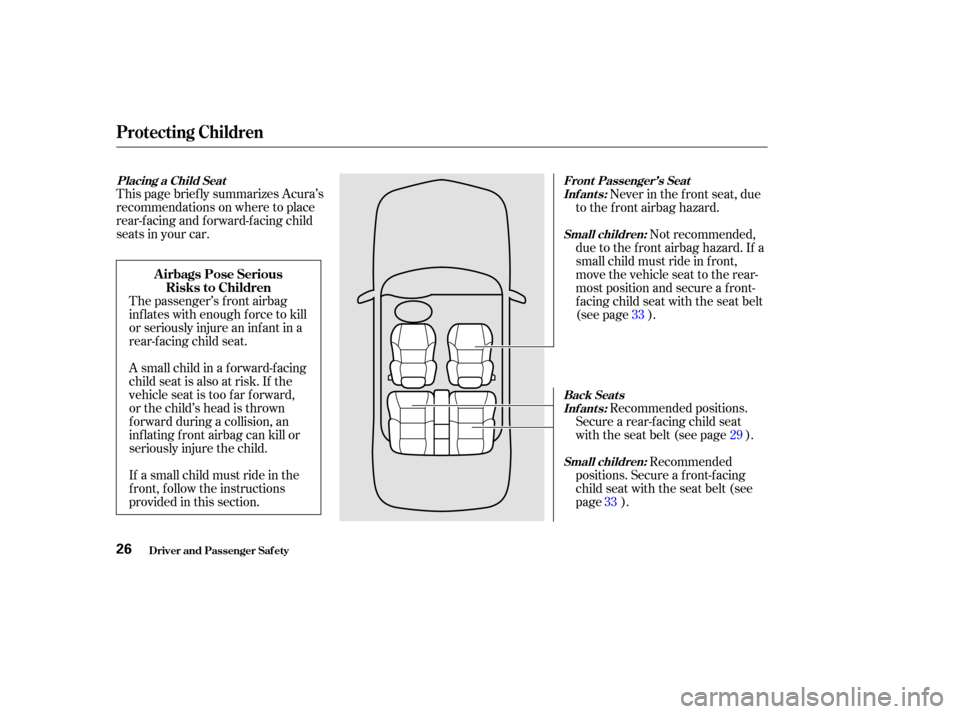
This page brief ly summarizes Acura’s
recommendations on where to place
rear-f acing and f orward-f acing child
seats in your car.
The passenger’s f ront airbag
inf lates with enough f orce to kill
or seriously injure an inf ant in a
rear-facing child seat.
A small child in a f orward-f acing
child seat is also at risk. If the
vehicle seat is too f ar f orward,
or the child’s head is thrown
f orward during a collision, an
inf lating f ront airbag can kill or
seriously injure the child. Never in the f ront seat, due
to the f ront airbag hazard.
Not recommended,
due to the f ront airbag hazard. If a
small child must ride in f ront,
move the vehicle seat to the rear-
most position and secure a f ront-
f acing child seat with the seat belt
(see page ).
Recommended positions.
Secure a rear-f acing child seat
with the seat belt (see page ).
Recommended
positions. Secure a f ront-f acing
child seat with the seat belt (see
page ). 33
29
33
Placing a Child Seat Front Passenger’s Seat
Inf ant s:
Small children:
Back Seat sInf ant s:
Small children:
Airbags Pose SeriousRisks to Children
Protecting Children
Driver and Passenger Saf ety26
Page 31 of 335
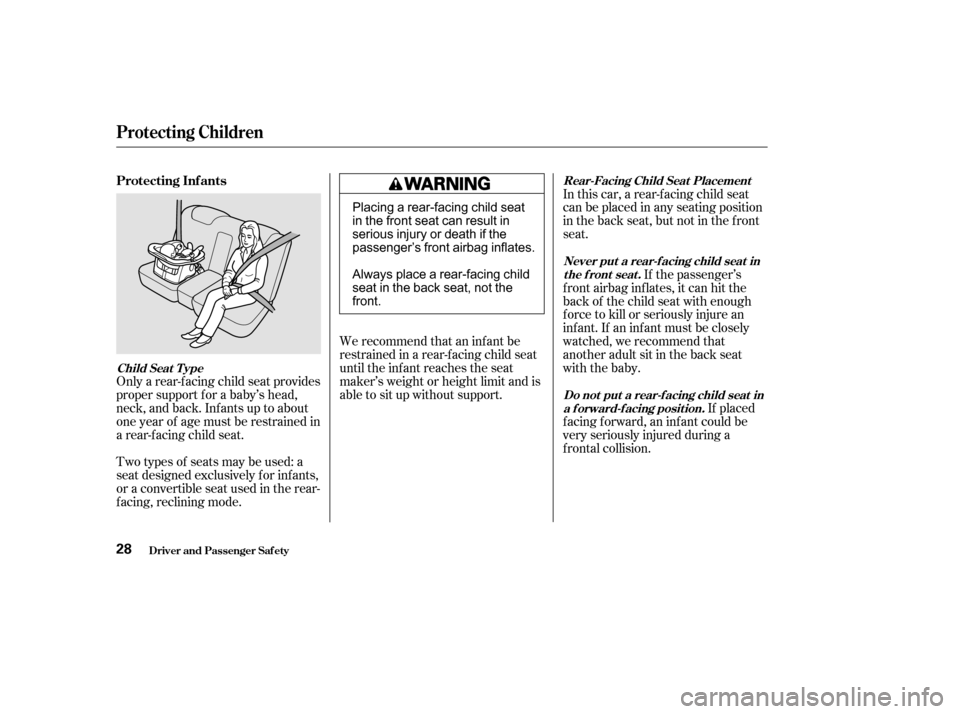
Only a rear-f acing child seat provides
proper support f or a baby’s head,
neck, and back. Inf ants up to about
one year of age must be restrained in
a rear-f acing child seat.In this car, a rear-f acing child seat
can be placed in any seating position
in the back seat, but not in the front
seat.
We recommend that an inf ant be
restrained in a rear-f acing child seat
until the inf ant reaches the seat
maker’s weight or height limit and is
able to sit up without support.
Two types of seats may be used: a
seat designed exclusively f or inf ants,
or a convertible seat used in the rear-
f acing, reclining mode. If the passenger’s
f ront airbag inf lates, it can hit the
back of the child seat with enough
f orce to kill or seriously injure an
inf ant. If an inf ant must be closely
watched, we recommend that
another adult sit in the back seat
with the baby.
If placed
f acing f orward, an inf ant could be
very seriously injured during a
f rontal collision.
Protecting Inf ants
Child Seat T ype
Rear-Facing Child Seat Placement
Never put a rear-f acing child seat inthe front seat.
Do not put a rear-f acing child seat ina f orward-f acing position.
Protecting Children
Driver and Passenger Saf ety28
Placing a rear-facing child seat
in the front seat can result in
serious injury or death if the
passenger’s front airbag inflates.
Always place a rear-facing child
seat in the back seat, not the
front.
Page 35 of 335
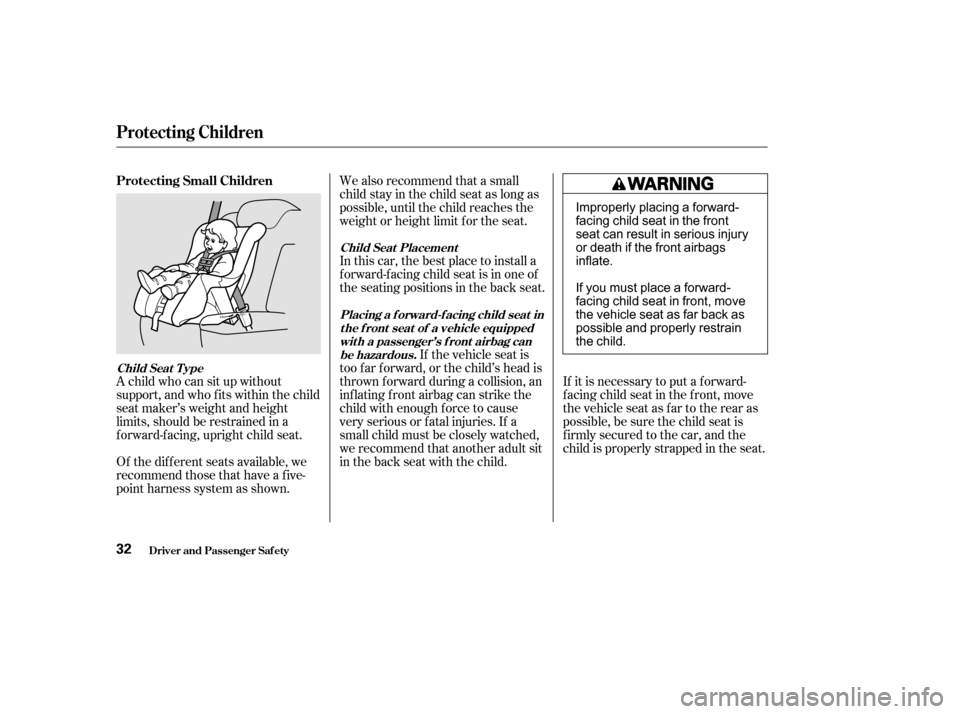
A child who can sit up without
support, and who f its within the child
seat maker’s weight and height
limits, should be restrained in a
f orward-f acing, upright child seat.
Of the different seats available, we
recommend those that have a f ive-
point harness system as shown.We also recommend that a small
child stay in the child seat as long as
possible, until the child reaches the
weight or height limit f or the seat.
In this car, the best place to install a
f orward-f acing child seat is in one of
the seating positions in the back seat.
If the vehicle seat is
too far forward, or the child’s head is
thrown f orward during a collision, an
inflating front airbag can strike the
child with enough f orce to cause
very serious or f atal injuries. If a
small child must be closely watched,
we recommend that another adult sit
in the back seat with the child. If it is necessary to put a f orward-
f acing child seat in the f ront, move
the vehicle seat as far to the rear as
possible, be sure the child seat is
f irmly secured to the car, and the
child is properly strapped in the seat.
Protecting Small Children
Child Seat T ype
Child Seat Placement
Placing a f orward-f acing child seat int he f ront seat of a vehicle equippedwit h a passenger’s f ront airbag canbe hazardous.
Protecting Children
Driver and Passenger Saf ety32
Improperly placing a forward-
facing child seat in the front
seat can result in serious injury
or death if the front airbags
inflate.
Ifyoumustplaceaforward-
facing child seat in front, move
the vehicle seat as far back as
possible and properly restrain
the child.
Page 38 of 335

When a child reaches the
recommended weight or height limit
for a forward-facing child seat, the
child should sit in the back seat and
wear a lap/shoulder belt.
If you are not wearing a seat
belt in a crash, you could be
thrown f orward into the
dashboard and crush the child.
During a crash, the
belt could press deep into the child
and cause very serious injuries. If youarewearingaseatbelt,the
child can be torn f rom your arms
during a crash. For example, if
your car crashes into a parked
vehicleat30mph(48km/h),a
30-lb (14 kg) child will become a
900-lb (410 kg) f orce, and you will
not be able to hold on. If a child is too short f or the shoulder
part of the belt to properly f it, we
recommend that the child use a
booster seat until the child is tall
enough to use the seat belt without a
booster.
The f ollowing pages give
instructions on how to check proper
seat belt f it, what kind of booster
seat to use if one is needed, and
important precautions f or a child
who must sit in the f ront seat.
CONT INUED
Protecting L arger ChildrenA ddit ional Precaut ions f or Small
Children Never hold a small child on yourlap.
Never put a seat belt over yourselfand a child.
Protecting Children
Driver and Passenger Saf ety35
Allowing a larger child to sit
improperly in the front seat can
result in injury or death if the
passenger’s front airbag inflates.
If a larger child must sit in front,
make sure the child moves the
seat as far back as possible
and wears the seat belt properly.
Page 40 of 335
The back seat is the safest place for
a child of any age or size.
In addition, the passenger’s f ront
airbag poses serious risks to children.
If the seat is too f ar f orward, or the
child’s head is thrown f orward
during a collision, or the child is
unrestrained or out of position, an
inf lating f ront airbag can kill or
seriously injure the child.
The side airbag also poses risks. If
any part of a larger child’s body is in
the path of a deploying airbag, the
child could receive possibly serious
injuries.
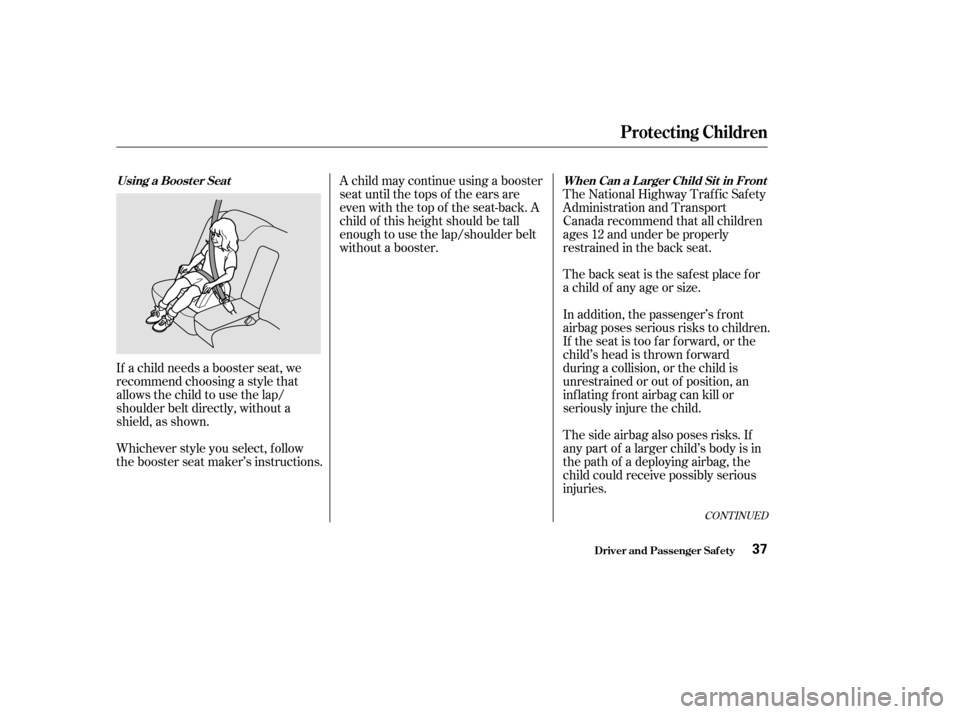
A child may continue using a booster
seat until the tops of the ears are
even with the top of the seat-back. A
child of this height should be tall
enough to use the lap/shoulder belt
without a booster.
Whichever style you select, f ollow
the booster seat maker’s instructions. If a child needs a booster seat, we
recommend choosing a style that
allows the child to use the lap/
shoulder belt directly, without a
shield, as shown. The National Highway Traffic Safety
Administration and Transport
Canada recommend that all children
ages 12 and under be properly
restrained in the back seat.
CONT INUED
When Can a Larger Child Sit in Front
Using a Boost er Seat
Protecting Children
Driver and Passenger Saf ety37
Page 44 of 335
If the shoulder part of the belt is
pulled all the way out, the locking
mechanism will activate. The belt
will retract, but it will not allow the
passenger to move f reely.
To deactivate the locking
mechanism, unlatch the buckle and
let the seat belt f ully retract. To
ref asten the belt, pull it out only as
f ar as needed.
See page f or instructions on how
to wear the lap/shoulder belt
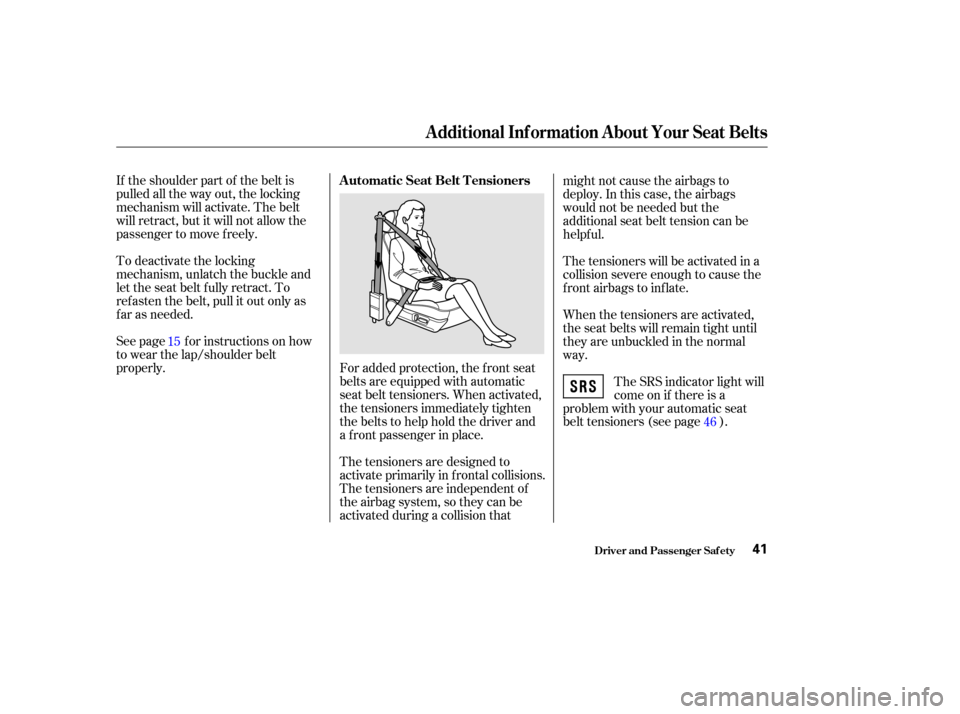
properly.For added protection, the f ront seat
belts are equipped with automatic
seat belt tensioners. When activated,
the tensioners immediately tighten
the belts to help hold the driver and
a f ront passenger in place.
The tensioners are designed to
activate primarily in f rontal collisions.
The tensioners are independent of
the airbag system, so they can be
activated during a collision that might not cause the airbags to
deploy. In this case, the airbags
would not be needed but the
additional seat belt tension can be
helpf ul.
The tensioners will be activated in a
collision severe enough to cause the
f ront airbags to inf late.
The SRS indicator light will
come on if there is a
problem with your automatic seat
belt tensioners (see page ). When the tensioners are activated,
the seat belts will remain tight until
they are unbuckled in the normal
way.
15
46
Driver and Passenger Saf ety
Additional Inf ormation About Your Seat Belts
A utomatic Seat Belt T ensioners
41