battery Acura Integra 2000 Hatchback User Guide
[x] Cancel search | Manufacturer: ACURA, Model Year: 2000, Model line: Integra, Model: Acura Integra 2000Pages: 279, PDF Size: 3.57 MB
Page 217 of 279
Storin
g You r Ca r
If you need to park your car for an
extended period (more than one
month), there are several things you should do to prepare it for storage.
Proper preparation helps prevent deterioration and makes it easier to
get your car back on the road. If
possible, store your car indoors.
Fill the fuel tank.Change the engine oil and filter (see page 173). Wash and dry the exterior
completely.
Clean the interior. Make sure the
carpeting, floor mats, etc. are
completely dry.
Leave the parking brake off. Put
the transmission in Reverse (5- speed manual) or Park (automatic). Block the rear wheels.
If the car is to be stored for a
longer period, it should be supported on jackstands so the
tires are off the ground. Leave one window open slightly (if
the car is being stored indoors). Disconnect the battery.
Support the front and rear wiper
blade arms with a folded towel or rag so they do not touch the
windshield.
To minimize sticking, apply a
silicone spray lubricant to all door
and hatch seals. Also, apply a body
wax to the painted surfaces that mate with the door and hatch seals. Cover the car with a "breathable"
cover, one made from a porous
material such as cotton.
Nonporous materials, such as
plastic sheeting, trap moisture,
which can damage the paint. If possible, run the engine for a
while periodically (preferably once a month).
If you store your car for 12 months or longer, have your Acura dealer
perform the inspections called for in
the 24 months/30,000 miles (48,000
km) maintenance schedule (Normal Conditions) as soon as you take it
out of storage (see page 162 ). The
replacements called for in the
maintenance schedule are not needed unless the car has actually
reached that time or mileage.
Maintenanc e
Page 233 of 279
I
f You r Engin e Won' t Star t
Nothin g Happen s o r th e Starte r
Moto r Operate s Ver y Slowl y
When you turn the ignition switch to START (III), you do not hear the
normal noise of the engine trying tostart. You may hear a clicking sound
or series of clicks, or nothing at all.Check these things: Your car has the Immobilizer
System. You should use a
properly-coded master or valet key
to start the engine (see page 72 ).
A key that is not properly coded will cause the immobilizer systemindicator in the dash panel to blink
rapidly. Check the transmission interlock.
If you have a manual transmission,
the clutch pedal must be pushed all the way to the floor or thestarter will not operate. With an
automatic transmission, it must be
in Park or Neutral. Turn the ignition switch to ON (II).
Turn on the headlights and check
their brightness. If the headlightsare very dim or don't light at all,
the battery is discharged. See
Jum p Startin g on page 231. Turn the ignition switch to START
(III). If the headlights do not dim,
check the condition of the fuses. If
the fuses are OK, there is proba-
bly something wrong with the electrical circuit for the ignition
switch or starter motor. You will
need a qualified technician to determine the problem. (See
Emergenc y Towin g on page 245.)
If the headlights dim noticeably or
go out when you try to start the
engine, either the battery is dis-
charged or the connections are
corroded. Check the condition of
the battery and terminal connec-
tions (see page 189). You can
then try jump starting the car from a booster battery (see page
231).
Takin g Car e o f th e Unexpecte d
Page 234 of 279
I
f You r Engin e Won' t Start , Jum p Startin g
Th e Starte r Operate s Normall y
In this case, the starter motor's speed sounds normal, or even faster
than normal, when you turn the ignition switch to START (III), but
the engine does not run. Are you using the proper starting
procedure? Refer to Startin g th e
Engin e on page 137. Do you have fuel? Turn the
ignition switch to ON (II) for a
minute and watch the fuel gauge.
The low fuel level warning light may not be working, so you were
not reminded to fill the tank. There may be an electrical
problem, such as no power to the
fuel pump. Check all the fuses (see page 240).
If you find nothing wrong, you will
need a qualified technician to find
the problem. See Emergenc y
Towin g on page 245 . Jum
p Startin g
If your car's battery has run down,
you may be able to start the engine
by using a booster battery. Although this seems like a simple procedure,
you should take several precautions.
You cannot start an Acura with an automatic transmission by pushing
or pulling it. To jump start your car, follow these
directions closely:
1. Open the hood and check the
physical condition of the battery(see page 189). In very cold
weather, check the condition of
the electrolyte. If it seems slushy or like ice, do not try jump starting
until it thaws.
If a battery sits in extreme cold, the
electrolyte inside can freeze.
Attempting to jump start with a frozen battery can cause it to rupture.
2. Turn off all the electrical acces-
sories: heater, A/C, stereo system,
lights, etc.
Put the transmission in Neutral or
Park and set the parking brake.
CONTINUED
Takin g Car e o f th e Unexpecte d
NOTIC
E
A battery can explode if you do
not follow the correct procedure,
seriously injuring anyone
nearby.
Keep all sparks, open flames,
and smoking materials away
from the battery.
Page 235 of 279
Jum
p Startin g
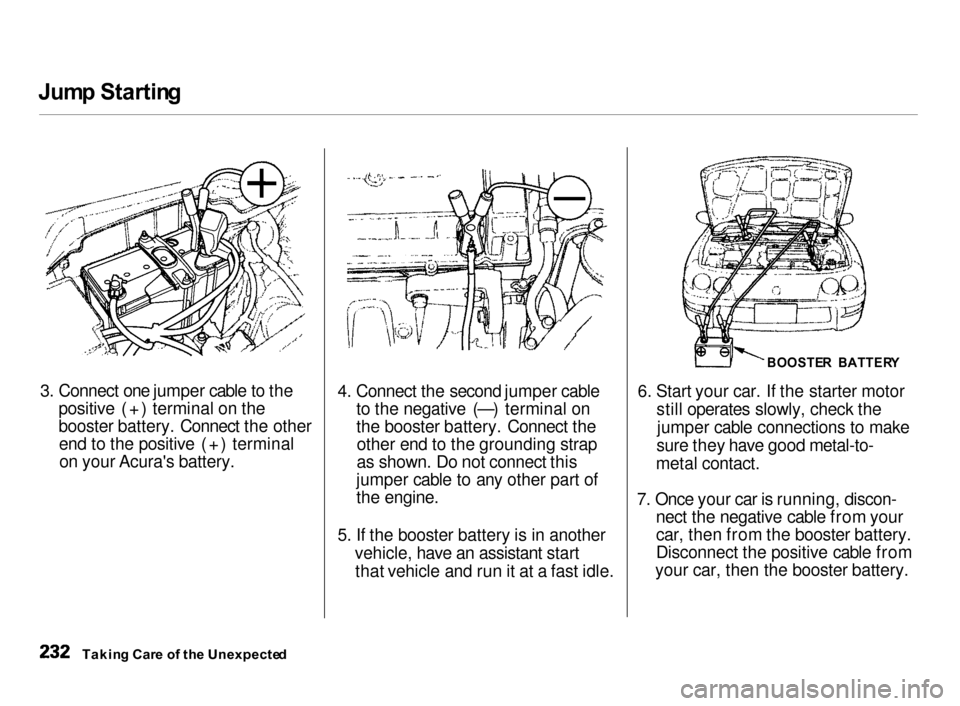
3. Connect one jumper cable to the
positive (+) terminal on the
booster battery. Connect the other end to the positive (+) terminalon your Acura's battery.
4. Connect the second jumper cable
to the negative (—) terminal on
the booster battery. Connect theother end to the grounding strap
as shown. Do not connect this
jumper cable to any other part of the engine.
5. If the booster battery is in another
vehicle, have an assistant start
that vehicle and run it at a fast idle.
6. Start your car. If the starter motor
still operates slowly, check the jumper cable connections to make
sure they have good metal-to-
metal contact.
7. Once your car is running, discon-
nect the negative cable from your
car, then from the booster battery.
Disconnect the positive cable from
your car, then the booster battery.
Takin g Car e o f th e Unexpecte d
BOOSTE
R BATTER Y
Page 239 of 279

Chargin
g Syste m Indicato r
This indicator should come on when the ignition switch is ON (II), and goout after the engine starts. If it
comes on brightly when the engine
is running, it indicates that the charging system has stopped
charging the battery. Immediately turn off all electrical
accessories: radio, heater, A/C, rear
defogger, cruise control, etc. Try not
to use other electrically-operated controls such as the power windows.
Keep the engine running and take
extra care not to stall it. Starting the
engine will discharge the battery
rapidly. By eliminating as much of the
electrical load as possible, you can
drive several miles (kilometers)
before the battery is too discharged
to keep the engine running. Drive to a service station or garage where
you can get technical assistance.
Takin g Car e o f th e Unexpecte d
CHARGIN
G SYSTE M INDICATO R
Page 243 of 279
Fuse
s
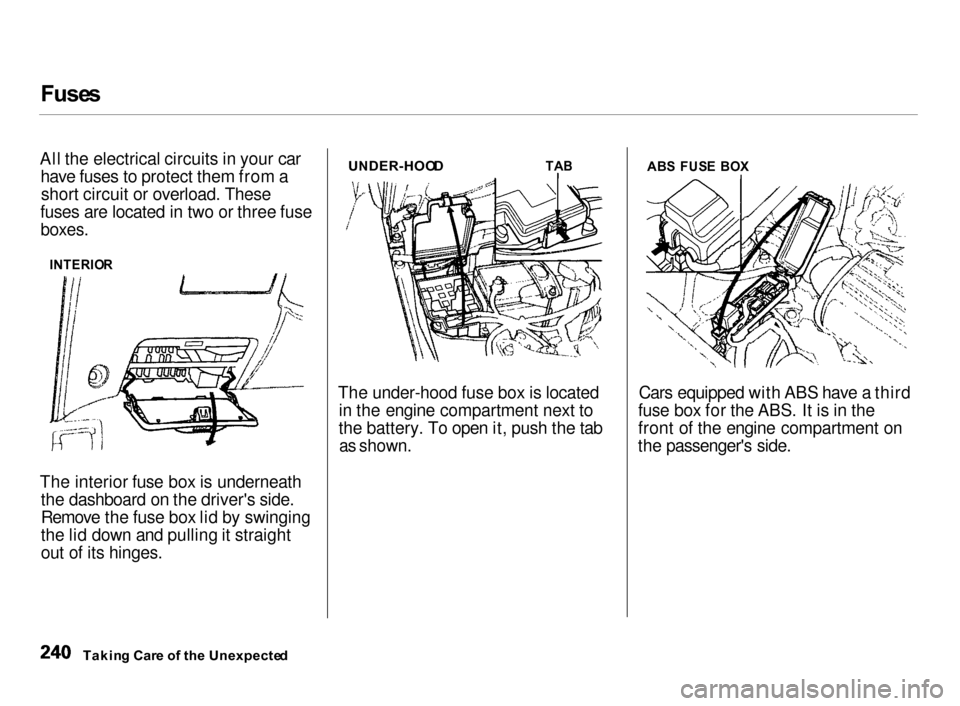
All the electrical circuits in your car have fuses to protect them from ashort circuit or overload. These
fuses are located in two or three fuse
boxes.
The interior fuse box is underneath the dashboard on the driver's side.
Remove the fuse box lid by swinging
the lid down and pulling it straight
out of its hinges. The under-hood fuse box is located
in the engine compartment next to
the battery. To open it, push the tab
as shown.
Cars equipped with ABS have a third
fuse box for the ABS. It is in the
front of the engine compartment on
the passenger's side.
Takin g Car e o f th e Unexpecte d
INTERIO
R
UNDER-HOO
D
TAB
ABS FUS E BO X
Page 249 of 279
Emergenc
y Towin g
If you decide to tow your vehicle
with all four wheels on the ground, make sure you use a properly-designed and attached tow bar.
Prepare the vehicle for towing as described above, and leave the
ignition switch in Accessory (I) so
the steering wheel does not lock. Make sure the radio and any items
plugged into the accessory power socket are turned off so they do not
run down the battery.
The steering wheel system can be
damaged if the steering wheel is locked.
Leave the ignition switch in Accessory (I), and make sure the steering wheel
turns freely before you begin towing. Trying to lift or tow your vehicle by the
bumpers will cause serious damage.
The bumpers are not designed to support the vehicle's weight.
Takin g Car e o f th e Unexpecte d
NOTIC
E
NOTIC E
Page 265 of 279
Warrant
y Coverage s
U.S . Owner s
Your new Acura is covered by these
warranties:
New Car Limited Warranty — covers
your new vehicle, except for the
battery, emissions control systems
and accessories, against defects in
materials and workmanship.
Emissions Control Systems Defects
Warranty and Emissions Performance Warranty — these two
warranties cover your vehicle's emis- sions control systems. Time, mileage,
and coverage are conditional. Please
read the warranty manual for exact
information.
Original Equipment Battery Limited
Warranty — this warranty gives up
to 100 percent credit toward a
replacement battery.
Seat Belt Limited Warranty — a seat
belt that fails to function properly is covered for the useful life of the
vehicle.
Rust Perforation Limited Warranty
— all exterior body panels are
covered for rust-through from the
inside for the specified time period
with no mileage limit.
Accessory Limited Warranty —
Genuine Acura Accessories are
covered under this warranty. Time
and mileage limits depend on the
type of accessory and other factors. Please read your warranty manual
for details.
Replacement Parts Limited
Warranty — covers all Genuine
Honda replacement parts against defects in materials and workman-
ship.
Replacement Battery Limited
Warranty — provides prorated
coverage for a replacement battery
purchased from an Acura dealer.
Replacement Muffler Lifetime
Limited Warranty — provides
coverage for as long as the pur-
chaser of the muffler owns the car.
Restrictions and exclusions apply to all these warranties. Please read the
2000 Acura Warranty Information
booklet that came with your car for
precise information on warranty
coverages. Your Acura's original
tires are covered by their manufacturer. Tire warranty infor-
mation is in a separate booklet.
Canadia n Owner s
Please refer to the 2000 Warranty
Manual that came with your car.
Warrant y an d Custome r Relation s
Page 270 of 279
Inde
x
Accessories and Modifications.... 130 Accessories................................. 130
Additional Safety Precaution.... 131Modifications............................. 131
ACCESSORY (Ignition Key Position)........................................ 74
Adding Automatic Transmission Fluid........................................ 182
Brake Fluid................................. 184
Clutch Fluid................................ 184
Engine Coolant........................... 176
Engine Oil................................... 171
Manual Transmission Fluid..... 183
Power Steering Fluid................. 185
Windshield Washer Fluid......... 181
Additional Information About
Your Seat Belts........................ 42
Lap/Shoulder Belt....................... 42
Seat Belt Maintenance................ 43
Seat Belt System Components... 42
Additional Information About
Your SRS................................... 45
Additional Safety Precautions.... 48
How Your Airbags Work............ 45
How the SRS Indicator Light
Works........................................ 47
SRS Components......................... 45
Additives, Engine Oil..................... 173
Adjustments
Headlights.................................. 205
Head Restraints........................... 82
Mirrors.......................................... 86
Seats.............................................. 79
Steering Wheel............................ 66
Airbag (SRS)...............................
9, 45
Air Cleaner Element...................... 186
Air Conditioning System................. 94
Maintenance............................... 194
Usage............................................. 94
Air Outlets (Vents).......................... 96
Air Pressure, Tires........................ 196
Alcohol in Gasoline........................ 254
Antifreeze....................................... 176
Anti-lock Brakes (ABS)
Indicator Light..................... 55, 148Operation.................................... 146
Anti-theft Steering Column
Lock............................................... 74
Appearance Care........................... 215 Ashtrays............................................ 91
Audio System................................. 102
Automatic Speed Control................ 67
Automatic Transmission............... 140
Capacity, Fluid........................... 251
Checking Fluid Level................ 182
Shifting........................................ 140
Shift Lever Position Indicator.. 140
Shift Lever Positions................. 140
Shift Lock Release..................... 143
Battery Charging SystemIndicator............................ 54, 236
Jump Starting............................. 231 Maintenance............................... 189
Specifications............................. 251
Before Driving............................... 121
Belts, Seat..................................... 8, 42
Beverage Holder.............................. 89
Body Repair.................................... 221
CONTINUED
Page 271 of 279
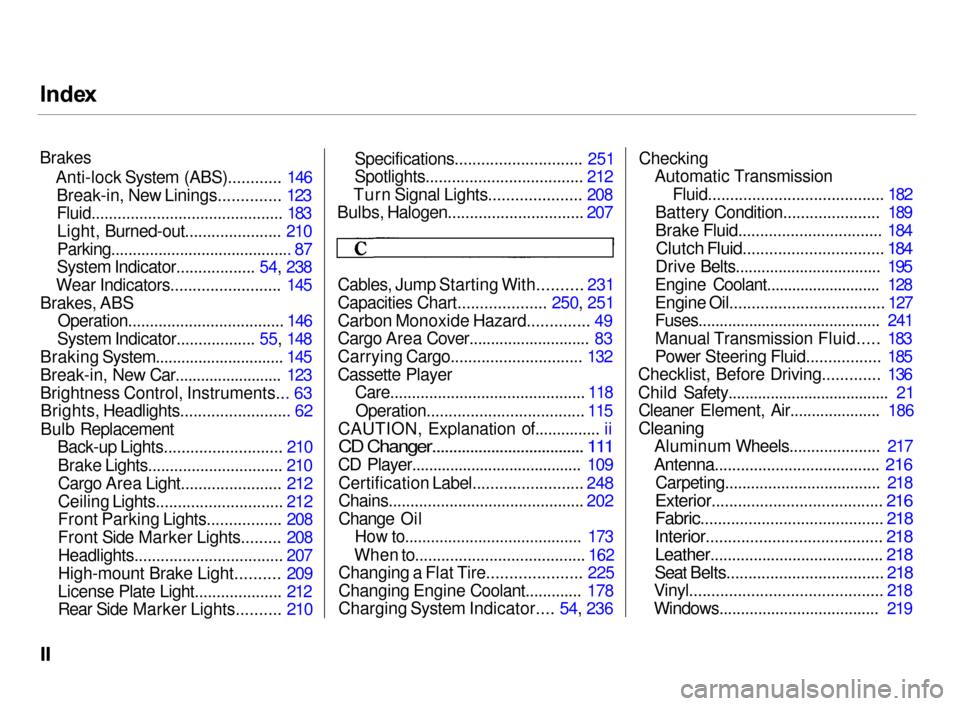
Inde
x
Brakes Anti-lock System (ABS)............ 146Break-in, New Linings.............. 123
Fluid............................................ 183
Light, Burned-out...................... 210
Parking.......................................... 87
System Indicator.................. 54, 238
Wear Indicators......................... 145
Brakes, ABS Operation.................................... 146
System Indicator.................. 55, 148
Braking System.............................. 145
Break-in, New Car......................... 123
Brightness Control, Instruments... 63 Brights, Headlights......................... 62
Bulb Replacement Back-up Lights........................... 210
Brake Lights............................... 210
Cargo Area Light....................... 212
Ceiling Lights............................. 212
Front Parking Lights................. 208
Front Side Marker Lights......... 208
Headlights.................................. 207
High-mount Brake Light.......... 209
License Plate Light.................... 212
Rear Side Marker Lights.......... 210 Specifications............................. 251
Spotlights.................................... 212
Turn Signal Lights..................... 208
Bulbs, Halogen............................... 207
Cables, Jump Starting With.......... 231
Capacities Chart.................... 250, 251
Carbon Monoxide Hazard.............. 49
Cargo Area Cover............................ 83
Carrying Cargo.............................. 132
Cassette Player Care............................................. 118
Operation.................................... 115
CAUTION, Explanation of............... ii
CD Changer.................................... 111
CD Player........................................ 109
Certification Label......................... 248
Chains............................................. 202
Change Oil
How to......................................... 173
When to....................................... 162
Changing a Flat Tire..................... 225
Changing Engine Coolant............. 178
Charging System Indicator.... 54, 236 Checking
Automatic Transmission
Fluid........................................ 182
Battery Condition...................... 189
Brake Fluid................................. 184
Clutch Fluid................................ 184
Drive Belts.................................. 195
Engine Coolant........................... 128
Engine Oil................................... 127
Fuses........................................... 241
Manual Transmission Fluid..... 183
Power Steering Fluid................. 185
Checklist, Before Driving............. 136
Child Safety...................................... 21 Cleaner Element, Air..................... 186
Cleaning
Aluminum Wheels..................... 217
Antenna...................................... 216
Carpeting.................................... 218
Exterior....................................... 216
Fabric.......................................... 218
Interior........................................ 218
Leather........................................ 218
Seat Belts.................................... 218
Vinyl............................................ 218
Windows..................................... 219