belt Acura Integra 2000 Sedan Service Manual
[x] Cancel search | Manufacturer: ACURA, Model Year: 2000, Model line: Integra, Model: Acura Integra 2000Pages: 273, PDF Size: 4.4 MB
Page 78 of 273

Key
s an d Locks , Sea t Adjustment s
Glov e Bo x
Open the glove bohx by pulling the
bottom of the handle. Close it with a
firm push. Lock or unlock the glove
box with the master key. The glove box light comes on only
when the instrument panel lights are
on.
Sea
t Adjustment s
See pages 12 — 13 for important safety
information and warnings about how to properly position seats and seat-backs.
Adjust the seat before you start
driving.
To adjust the seat forward and
backward, pull up on the lever under the seat cushion's front edge. Move
the seat to the desired position and
release the lever. Try to move the seat to make sure it is locked in
position.
Instrument s an d Control s
CONTINUED
An open glove box can cause
serious injury to your passenger
in a crash, even if the
passenger is wearing the seat
belt.
Always keep the glove box
closed while driving.
Page 135 of 273

Preparin
g to Driv e
You should do the following checks and adjustments every day before
you drive your car.
1. Make sure all windows, mirrors, and outside lights are clean and
unobstructed. Remove frost, snow,
or ice.
2. Check that the hood and trunk are fully closed.
3. Visually check the tires. If a tire looks low, use a gauge to check its
pressure.
4. Check that any items you may be carrying with you inside are stored
properly or fastened down
securely.
5. Check the adjustment of the seat
(see page 75 ).
6. Check the adjustment of the inside and outside mirrors (see
page 81 ).
7. Check the adjustment of the steering wheel (see page 65 ).
8. Make sure the doors are securely
closed and locked.
9. Fasten your seat belt. Check that
your passengers have fastened
their seat belts (see page 15 ). 10.Turn the ignition switch ON (II).
Check the indicator lights in the
instrument panel.
11.Start the engine (see page 133 ).
12.Check the gauges and indicator lights in the instrument panel (see
page 53 ).
Drivin g
Page 156 of 273
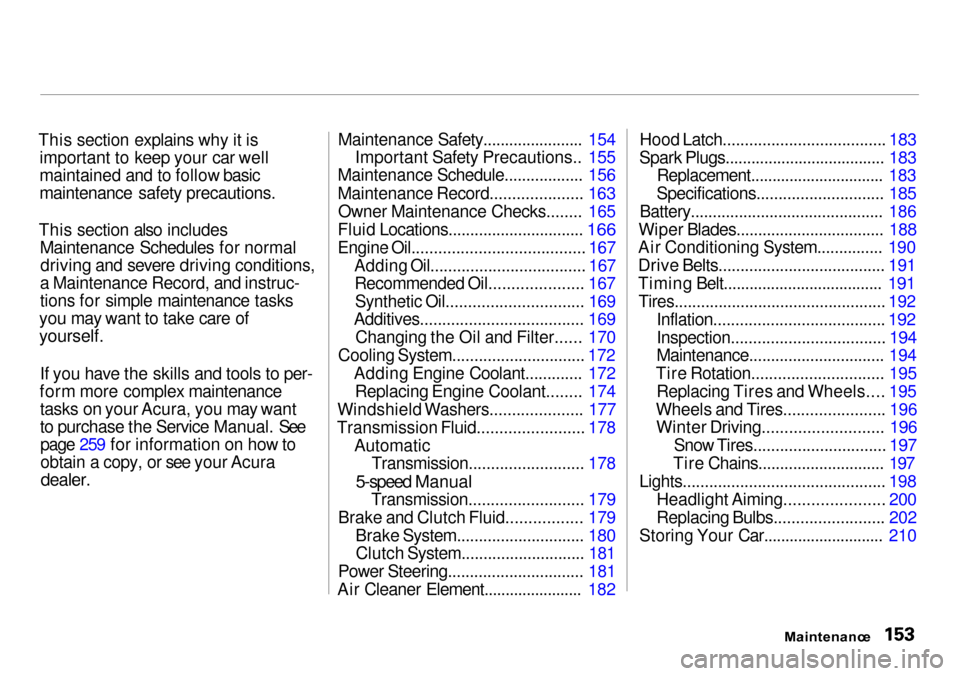
This section explains why it is important to keep your car well
maintained and to follow basic
maintenance safety precautions.
This section also includes Maintenance Schedules for normaldriving and severe driving conditions,
a Maintenance Record, and instruc-
tions for simple maintenance tasks
you may want to take care of
yourself.
If you have the skills and tools to per-
form more complex maintenance tasks on your Acura, you may want
to purchase the Service Manual. Seepage 259 for information on how to
obtain a copy, or see your Acura
dealer.
Maintenance Safety....................... 154
Important Safety Precautions.. 155
Maintenance Schedule.................. 156
Maintenance Record..................... 163
Owner Maintenance Checks........ 165
Fluid Locations............................... 166
Engine Oil......................................
. 167
Adding Oil................................... 167
Recommended Oil..................... 167
Synthetic Oil............................... 169
Additives..................................... 169
Changing the Oil and Filter...... 170
Cooling System.............................. 172 Adding Engine Coolant............. 172Replacing Engine Coolant........ 174
Windshield Washers..................... 177
Transmission Fluid........................ 178 AutomaticTransmission.......................... 178
5-speed Manual
Transmission.......................... 179
Brake and Clutch Fluid................. 179 Brake System............................. 180Clutch System............................
181
Power Steering..............................
. 181
Air Cleaner Element....................... 182 Hood Latch..................................... 183
Spark Plugs..................................... 183 Replacement............................... 183
Specifications............................. 185
Battery............................................ 186
Wiper Blades.................................. 188
Air Conditioning System............... 190
Drive Belts...................................... 191
Timing Belt..................................... 191
Tires................................................ 192 Inflation....................................... 192
Inspection...................................
194
Maintenance............................... 194
Tire Rotation.............................. 195 Replacing Tires and Wheels.... 195
Wheels and Tires....................... 196 Winter Driving........................... 196
Snow Tires.............................. 197
Tire Chains............................. 197
Lights.............................................. 198
Headlight Aiming.....................
. 200
Replacing Bulbs......................... 202
Storing Your Car............................ 210
Maintenance
Page 162 of 273

Service at the indicated distance or time, whichever comes first. Do the items in A
, B , C as required for each distance/time interval Follow this
schedule if the severe driving conditions described in the Severe Conditions Schedule on the next page do not apply.
#: See information on maintenance and emissions warranty, lastcolumn, page 157.*: See Timing Belt on page 191 to determine need for replacement.
Maintenance
page 195 ).
Page 165 of 273

*: See Timing Belt on page 191 to determine need for replacement.
Maintenanc e
Page 194 of 273
Driv
e Belts , Timin g Bel t
Driv e Belt s
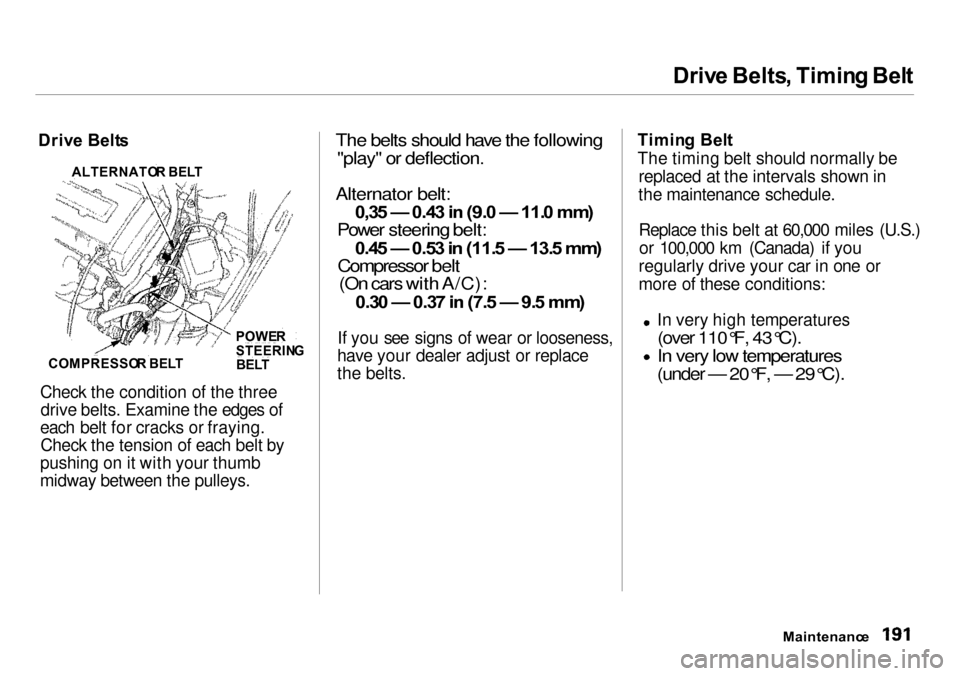
Check the condition of the three drive belts. Examine the edges of
each belt for cracks or fraying. Check the tension of each belt by
pushing on it with your thumb
midway between the pulleys.
The belts should have the following
"play" or deflection.
Alternator belt: 0,3 5 — 0.4 3 in (9. 0 — 11. 0 mm )
Power steering belt:
0.4 5 — 0.5 3 in (11. 5 — 13. 5 mm )
Compressor belt
(On cars with A/C):
0.3 0 — 0.3 7 in (7. 5 — 9.5 mm )
If you see signs of wear or looseness,
have your dealer adjust or replace
the belts. Timin
g Bel t
The timing belt should normally be replaced at the intervals shown in
the maintenance schedule.
Replace this belt at 60,000 miles (U.S.)or 100,000 km (Canada) if you
regularly drive your car in one or
more of these conditions: In very high temperatures
(over 110°F, 43°C).
In very low temperatures
(under — 20°F, — 29°C).
Maintenance
ALTERNATO
R BEL T
POWER
STEERIN G
BEL T
COMPRESSO
R BEL T
Page 214 of 273

Appearanc
e Car e
Regular cleaning and polishing of
your Acura helps to keep it "new" looking. This section gives you hintson how to clean your car and
preserve its appearance: the paint,
brightwork, wheels and interior. Also included are several things you cando to help prevent corrosion. Exterior Care.................................. 212
Washing...................................... 212Waxing........................................ 213
Aluminum Wheels..................... 213
Paint Touch-up........................... 213
Interior Care................................... 214 Carpeting.................................... 214
Fabric.......................................... 214
Vinyl............................................ 214
Leather........................................ 214
Seat Belts.................................... 214
Windows..................................... 215
Air Fresheners........................... 215
Corrosion Protection..................... 216
Body Repairs.................................. 217
Appearance Car e
Page 217 of 273
Interio
r Car e
Carpetin g
Vacuum the carpeting frequently to remove dirt. Ground-in dirt will makethe carpet wear out faster.
Periodically shampoo the carpet to
keep it looking new. Use one of the foam-type carpet cleaners on the
market. Follow the instructions thatcome with the cleaner, applying it
with a sponge or soft brush. Keep
the carpeting as dry as possible by not adding water to the foam.
Fabri c
Vacuum dirt and dust out of the material frequently. For generalcleaning, use a solution of mild soap
and lukewarm water, letting it air dry.
To clean off stubborn spots, use a commercially-available fabric cleaner.
Test it on a hidden area of the fabric first, to make sure it does not bleachor stain the fabric. Follow the
instructions that come with the
cleaner.
Viny
l
Remove dirt and dust with a vacuum
cleaner. Wipe the vinyl with a soft
cloth dampened in a solution of mild soap and water. Use the same
solution with a soft-bristle brush on
more difficult spots. You can also use commercially-available spray or
foam-type vinyl cleaners.
Leathe r
On some models
Vacuum dirt and dust from the leather frequently. Pay particularattention to the pleats and seams.Clean the leather with a soft cloth
dampened with clear water, then
buff it with a clean, dry cloth. If
further cleaning is needed, use a soap specifically for leather, such as
saddle soap. Apply this soap with a
damp, soft cloth. Wipe down and
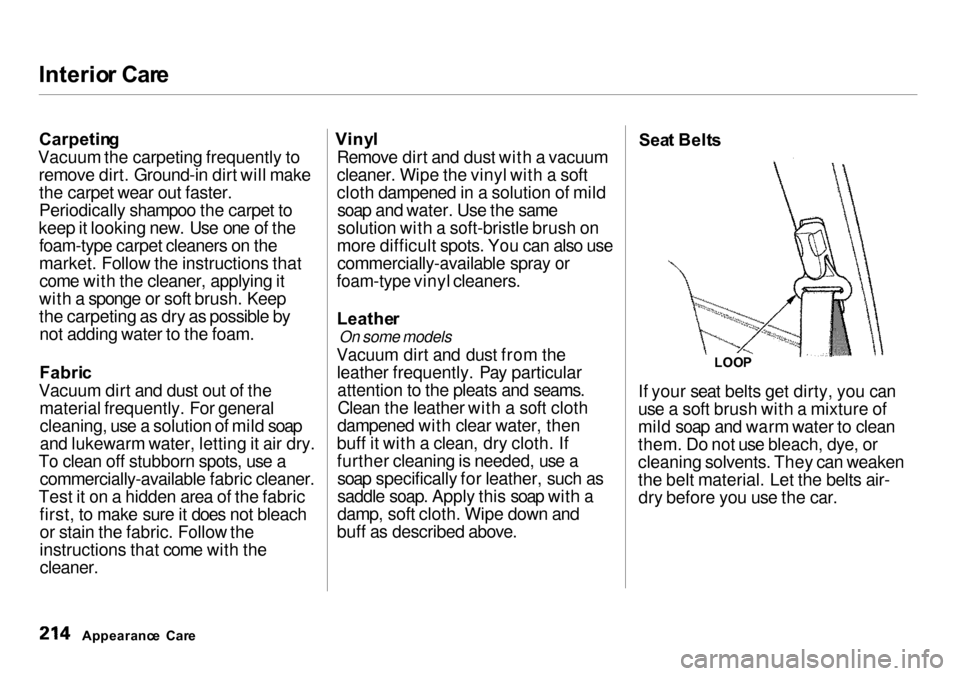
buff as described above. If your seat belts get dirty, you can
use a soft brush with a mixture of
mild soap and warm water to clean
them. Do not use bleach, dye, or
cleaning solvents. They can weaken
the belt material. Let the belts air- dry before you use the car.
Appearanc e Car e LOO
P
Sea
t Belt s
Page 218 of 273
Interio
r Car e
Dirt build-up in the loops of the seat
belt anchors can cause the belts to
retract slowly. Wipe the insides of
the loops with a clean cloth
dampened in mild soap and warm water or isopropyl alcohol. Window
s
Clean the windows, inside and out,
with a commercially-available glass cleaner. You can also use a mixtureof one part white vinegar to ten parts
water. This will remove the haze that
builds up on the inside of the
windows. Use a soft cloth or paper
towels to clean all glass and clear plastic surfaces.
The rear window defogger and
antenna wires are bonded to the inside of the glass. Wiping vigorously up-and-
down can dislodge and break thesewires. When cleaning the rear window, use gentle pressure and wipe side-to-
side. Ai
r Freshener s
If you want to use an air freshener/
deodorizer in the interior of your car,
it is best to use a solid type. Some liquid air fresheners contain chemi-
cals that may cause parts of the
interior trim and fabric to crack or discolor.
If you use a liquid air freshener,
make sure you fasten it securely so it
does not spill as you drive.
Appearance Car e
NOTIC
E
Page 260 of 273

Warrant
y Coverage s
U.S . Owner s
Your new Acura is covered by these
warranties:
New Car Limited Warranty — covers
your new vehicle, except for the
battery, emissions control systems and accessories, against defects in
materials and workmanship.
Emissions Control Systems Defects
Warranty and Emissions
Performance Warranty — these two
warranties cover your vehicle's emis-
sions control systems. Time, mileage,
and coverage are conditional. Please
read the warranty manual for exact
information.
Original Equipment Battery Limited
Warranty — this warranty gives up
to 100 percent credit toward a
replacement battery.
Seat Belt Limited Warranty — a seat
belt that fails to function properly is
covered for the useful life of the vehicle.
Rust Perforation Limited Warranty — all exterior body panels are
covered for rust-through from the
inside for the specified time period
with no mileage limit.
Accessory Limited Warranty —
Genuine Acura Accessories are
covered under this warranty. Time and mileage limits depend on the
type of accessory and other factors.
Please read your warranty manual
for details.
Replacement Parts Limited
Warranty — covers all Genuine
Honda replacement parts against
defects in materials and workman-
ship.
Replacement Battery Limited
Warranty — provides prorated
coverage for a replacement battery
purchased from an Acura dealer.
Replacement Muffler Lifetime
Limited Warranty — provides
coverage for as long as the pur-
chaser of the muffler owns the car.
Restrictions and exclusions apply to all these warranties. Please read the
2000 Acura Warranty Information
booklet that came with your car for precise information on warrantycoverages. Your Acura's original
tires are covered by their manufacturer. Tire warranty infor-
mation is in a separate booklet.
Warrant y an d Custome r Relation s