fuse Acura Integra 2000 Sedan Owner's Manual
[x] Cancel search | Manufacturer: ACURA, Model Year: 2000, Model line: Integra, Model: Acura Integra 2000Pages: 273, PDF Size: 4.4 MB
Page 103 of 273
Audi
o Syste m
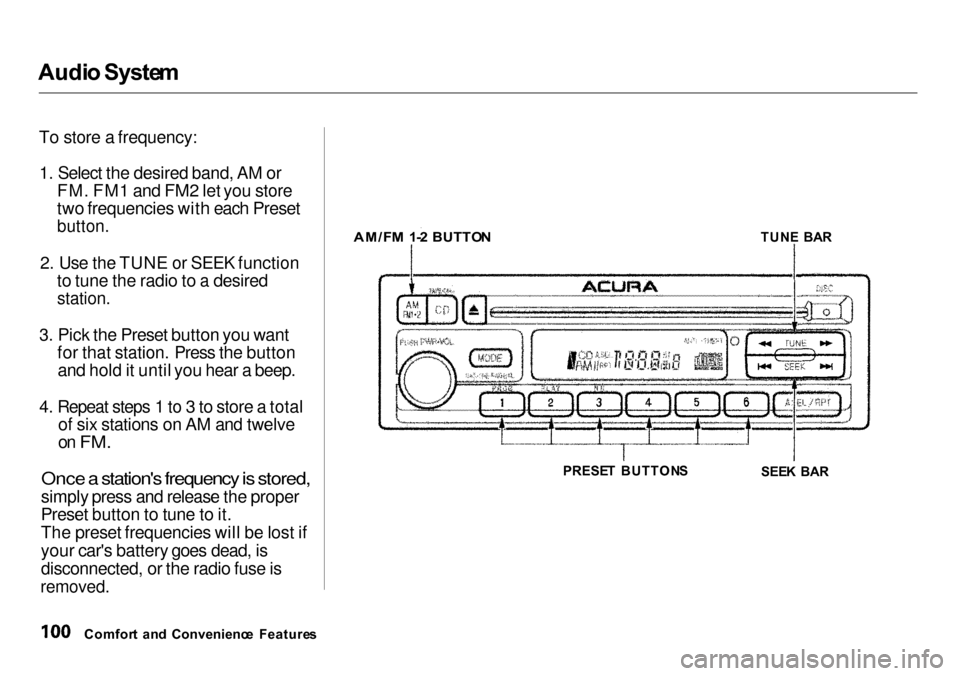
To store a frequency: 1. Select the desired band, AM or FM. FM1 and FM2 let you store
two frequencies with each Preset
button.
2. Use the TUNE or SEEK function to tune the radio to a desired
station.
3. Pick the Preset button you want for that station. Press the buttonand hold it until you hear a beep.
4. Repeat steps 1 to 3 to store a total of six stations on AM and twelve
on
FM.
Once a station's frequency is stored,
simply press and release the proper
Preset button to tune to it.
The preset frequencies will be lost if
your car's battery goes dead, is
disconnected, or the radio fuse is
removed.
Comfor t an d Convenienc e Feature s
AM/F
M 1- 2 BUTTO N
TUNE BA R
PRESE T BUTTON S
SEEK BA R
Page 118 of 273

Thef
t Protectio n
Your car's audio system will disable itself if it is disconnected fromelectrical power for any reason. To
make it work again, the user must
enter a specific five-digit code in the Preset buttons. Because there are
hundreds of number combinations possible from five digits, making the
system work without knowing the
exact code is nearly impossible.
You should have received a card that
lists your audio system's codenumber and serial number. It is best
to store this card in a safe place at
home. In addition, you should write the audio system's serial number in
this Owner's Manual. If you should
happen to lose the card, you must
obtain the code number from your
Acura dealer. To do this, you will
need the system's serial number. If your car's battery is disconnected
or goes dead, or the radio fuse is
removed, the audio system will
disable itself. If this happens, you
will see "Code" in the frequency
display the next time you turn on the
system. Use the Preset buttons to
enter the five-digit code. If it is
entered correctly, the radio will start
playing.
If you make a mistake entering the
code, do not start over or try to
correct your mistake. Complete the five-digit sequence, then enter the correct code. You have three tries to
enter the correct code. If you are
unsuccessful in three attempts, you
must then leave the system on for
one hour before trying again. You will have to store your favorite
stations in the Preset buttons after
the system begins working. Your original settings were lost when
power was disconnected.
Comfor t an d Convenienc e Feature s
Page 144 of 273

Th
e Brakin g Syste m
Your Acura is equipped with disc brakes at all four wheels. A power
assist helps reduce the effort needed
on the brake pedal.
Put your foot on the brake pedal only
when you intend to brake. Resting
your foot on the pedal keeps the
brakes applied lightly, causing them
to build up heat. Heat build-up can reduce how well your brakes work. Italso keeps your brake lights on all
the time, confusing drivers behind
you.
Constant application of the brakes
when going down a long hill builds
up heat and reduces their effective-
ness. Use the engine to assist the
brakes by downshifting to a lower
gear and taking your foot off the
accelerator pedal.
Check your brakes after driving
through deep water. Apply the
brakes moderately to see if they feel
normal. If not, apply them gently and
frequently until they do. Since a
longer distance is needed to stop with wet brakes, be extra cautious
and alert in your driving. Brak
e Wea r Indicator s
All four brakes have audible brake
wear indicators.
When the brake pads need replacing, you will hear a distinctive metallic"screeching" sound when you apply
the brakes. If you do not have the
brake pads replaced, they will begin screeching all the time.
Your brakes may sometimes squeal or squeak when you apply them
lightly. Do not confuse this with the
brake wear indicators. They make a
very audible "screeching."
Driving
Page 222 of 273
Takin
g Car e o f th e Unexpecte d
This section covers the more- common problems that motoristsexperience with their vehicles. It
gives you information about how to safely evaluate the problem and what
to do to correct it. If the problem has stranded you on the side of the road,
you may be able to get going again. If not, you will also find instructionson getting your car towed. Compact Spare Tire....................... 220
Changing a Flat Tire..................... 221
If Your Engine Won't Start........... 226
Nothing Happens or theStarter Motor OperatesVery Slowly......................... 226
The Starter Operates Normally................................. 227
Jump Starting................................. 227
If Your Engine Overheats............. 229Low Oil Pressure Indicator.......... 231
Charging System Indicator........... 232
Malfunction Indicator Lamp........ 233
Brake System Indicator................ 234
Closing the Moonroof................... 235
Fuses............................................... 236 Checking and Replacing........... 237
Emergency Towing...................... 241
Takin g Car e o f th e Unexpecte d
Page 229 of 273

I
f You r Engin e Won' t Star t
Diagnosing why your engine won't start falls into two areas, depending
on what you hear when you turn the
key to START (III): You hear nothing, or almost
nothing. The engine's starter
motor does not operate at all, or
operates very slowly. You can hear the starter motor
operating normally, or the starter
motor sounds like it is spinning faster than normal, but the engine
does not start up and run.
Nothin g Happen s o r th e Starte r
Moto r Operate s Ver y Slowl y
When you turn the ignition switch to
START (III), you do not hear the
normal noise of the engine trying to start. You may hear a clicking sound
or series of clicks, or nothing at all.
Check these things: Your car has the Immobilizer
System. You should use a
properly-coded master or valet key
to start the engine (see page 69 ).
A key that is not properly coded will cause the immobilizer system indicator in the dash panel to blink
rapidly. Check the transmission interlock.
If you have a manual transmission,
the clutch pedal must be pushed all the way to the floor or thestarter will not operate. With an
automatic transmission, it must be in Park or Neutral. Turn the ignition switch to ON (II).
Turn on the headlights and check
their brightness. If the headlightsare very dun or don't light at all,
the battery is discharged. See
Jum p Startin g on page 227. Turn the ignition switch to START
(III). If the headlights do not dim, check the condition of the fuses. If
the fuses are OK, there is proba-
bly something wrong with the electrical circuit for the ignitionswitch or starter motor. You will
need a qualified technician to determine the problem. (See
Emergenc y Towin g on page 241 .)
If the headlights dim noticeably or
go out when you try to start the engine, either the battery is dis-
charged or the connections are corroded. Check the condition of
the battery and terminal connec-
tions (see page 186 ). You can
then try jump starting the car from a booster battery (see page 227 ).
Takin g Car e o f th e Unexpecte d
Page 230 of 273

I
f You r Engin e Won' t Start , Jum p Startin g
Th e Starte r Operate s Normall y
In this case, the starter motor's speed sounds normal, or even faster
than normal, when you turn the ignition switch to START (III), but
the engine does not run. Are you using the proper starting
procedure? Refer to Startin g th e
Engin e on page 133 . Do you have fuel? Turn the
ignition switch to ON (II) for a
minute and watch the fuel gauge.
The low fuel level warning light may not be working, so you were
not reminded to fill the tank. There may be an electrical
problem, such as no power to the
fuel pump. Check all the fuses (see page 237).
If you find nothing wrong, you will
need a qualified technician to find
the problem. See Emergenc y
Towin g on page 241. Jum
p Startin g
If your car's battery has run down,
you may be able to start the engine
by using a booster battery. Although this seems like a simple procedure,
you should take several precautions.
You cannot start an Acura with an automatic transmission by pushing
or pulling it. To jump start your car, follow these
directions closely:
1. Open the hood and check the physical condition of the battery
(see page 187). In very cold weather, check the condition of the electrolyte. If it seems slushyor like ice, do not try jump starting
until it thaws.
If a battery sits in extreme cold, the
electrolyte inside can freeze.
Attempting to jump start with a frozen
battery can cause it to rupture.
2. Turn off all the electrical acces- sories: heater, A/C, stereo system,
lights, etc.
Put the transmission in Neutral or
Park and set the parking brake.
CONTINUED
Takin g Car e o f th e Unexpecte d
A battery can explode if you do
not follow the correct procedure,
seriously injuring anyone
nearby.
Keep all sparks, open flames,
and smoking materials away
from the battery.
NOTIC
E
Page 238 of 273

Closin
g th e Moonroo f
If the electric motor will not close
the moonroof, do the following:
1. Check the fuse for the moonroof motor (see page 237). If the fuse
is blown, replace it with one of thesame or lower rating.
2. Try closing the moonroof. If the new fuse blows immediately or the
moonroof motor still does notoperate, you can close the
moonroof manually.
3. Get the sunroof wrench out of the tool kit in the trunk. 4. Remove the plug in the spotlight
assembly.
5. Insert the moonroof wrench into
the socket behind this plug. Turnthe wrench until the moonroof is
fully closed.
6. Remove the wrench. Replace the
plug.
Takin g Car e o f th e Unexpecte d
SOCKE
T
PLU
G
Page 239 of 273

Fuse
s
All the electrical circuits in your car have fuses to protect them from ashort circuit or overload. These
fuses are located in three fuse boxes.
INTERIO
R
The interior fuse box is underneath the dashboard on the driver's side.
Remove the fuse box lid by swinging
the lid down and pulling it straight out of its hinges. The under-hood fuse box is located
in the engine compartment next to
the battery. To open it, push the tab
as shown.
Takin g Car e o f th e Unexpecte d
UNDER-HOO
D
TA
B
Page 240 of 273

Fuse
s
Cars equipped with ABS have a third
fuse box for the ABS. It is in the
front of the engine compartment on the passenger's side. Checkin
g an d Replacin g Fuse s
If something electrical in your car
stops working, the first thing you should check for is a blown fuse.
Determine from the chart on pages 239 and 240, or the diagram on the
fuse box lid, which fuse or fuses control that component. Check those
fuses first, but check all the fuses
before deciding that a blown fuse is
not the cause. Replace any blown
fuses and check the component's
operation.
1. Turn the ignition switch to LOCK (0). Make sure the headlights and
all other accessories are off.
2. Remove the cover from the fuse box. 3. Check each of the large fuses in
the under-hood fuse box bylooking through the top at the wire
inside. Removing these fuses requires a Phillips-head screw-
driver.
CONTINUED
Takin g Car e o f th e Unexpecte d
BLOW
N
AB
S FUS E BO X
Page 241 of 273

Fuse
s
4. Check the smaller fuses in the under-hood fuse box and all thefuses in the interior fuse box by
pulling out each fuse with the fuse
puller provided in the interior fuse
box. 5. Look for a burned wire inside the
fuse. If it is burned, replace it withone of the spare fuses of the same
rating or lower.
If you cannot drive the car without fixing the problem, and you do not
have a spare fuse, take a fuse of the same rating or a lower rating from
one of the other circuits. Make sure
you can do without that circuit temporarily (such as the cigarette
lighter or radio). If you replace the blown fuse with a
spare fuse that has a lower rating, it
might blow out again. This does not
indicate anything wrong. Replace the
fuse with one of the correct rating as soon as you can.
Replacing a fuse with one that has a higher rating greatly increases the
chances of damaging the electrical
system. If you do not have a replace-
ment fuse with the proper rating for the circuit, install one with a lower rating.
6. If the replacement fuse of the same rating blows in a short time,
there is probably a serious electrical problem in your car.
Leave the blown fuse in that
circuit and have your car checked
by a qualified mechanic.
Takin g Car e o f th e Unexpecte d
NOTIC
E
FUS
E PULLE R BLOW
N