wheel Acura MDX 2006 Owner's Guide
[x] Cancel search | Manufacturer: ACURA, Model Year: 2006, Model line: MDX, Model: Acura MDX 2006Pages: 311, PDF Size: 3.94 MB
Page 207 of 311

The variable torque management
4WD (VTM-4) system automatically
transf ers varying amounts of engine
torque to the rear wheels under
lower traction conditions.The vehicle must be stopped with
the engine running.
If more traction is needed when your
vehicle is stuck, or is likely to
become stuck, you can use the
VTM-4 lock button to increase
torque to the rear wheels. Move the shift lever to first (1),
second (2), or reverse (R) gear.
Press the VTM-4 lock button. The
indicator in the button comes on.
do
any of the f ollowing: Press the VTM-4 LOCK button.
Move the shift lever to D , D or
D.
Turn the ignition switch to the
LOCK (0) position.
The VTM-4 lock will temporarily
disengage when the vehicle speed
exceeds 18 mph (30 km/h). It will
automatically engage again as the
speed slows below 18 mph (30
km/h). The indicator in the button
will remain on.
To get unstuck, apply light pressure
to the accelerator pedal. Do not spin
the f ront tires f or more than a f ew
seconds. Because of the amount of
torque applied to the rear tires, they
should not spin. This is normal. If
you are not able to move the vehicle,
stop and reverse direction. 1.
2.
3.
54
3
To Engage the VTM-4 Lock To Disengage the VTM-4 Lock,
VTM-4 System
206
Do not continuously spin the f ront tires
of your vehicle. Continuously spinning
the f ront tires can cause transmission
or rear dif f erential damage.
Do not use the VTM-4 LOCK button on
dry, paved roads. Driving on dry,
paved roads with VTM-4 Lock ON may
damage the rear dif f erential when
making a turn. Strange noise and
vibration can also result.
Page 209 of 311

The appropriate tire indicator and
low tire pressure indicator comes on
if a tire becomes signif icantly
underinf lated. Seeon page .
This indicator comes on and stays on
if there is a problem with the tire
pressure monitoring system.
If this happens, the system will shut
of f and no longer monitor tire
pressures. Have the system checked
by your dealer as soon as possible.
If you have a f lat tire, the low tire
pressure and tire monitor indicators
will come on. Replace the indicated
flat tire with the compact spare tire
(see page ). Each wheel is equipped with a tire
pressure sensor mounted inside the
tire behind the valve stem. You must
use TPMS specif ic wheels. It is
recommended that you always have
your tires serviced by your dealer or
qualif ied technician.
Af ter you replace the f lat tire, the
low tire pressure indicator stays on.
This is normal; the system is not
monitoring the spare tire pressure.
Manually check the spare tire
pressure to be sure it is correct.
Never use a puncture-repairing agent
in a f lat tire. If used, you will have to
replace the tire pressure sensor.
Havetheflattirerepairedbyyour
dealer as soon as possible.
207
261
As required by the FCC: This device complies with Part 15 of theFCC rules. Operation is subject to thef ollowing two conditions: (1) This devicemay not cause harmf ul interf erence, and(2) this device must accept anyinterf erence received, includinginterf erence that may cause undesiredoperation.
Changes or modif ications not expresslyapproved by the party responsible f orcompliance could void the user’sauthority to operate the equipment.
This device complies with IndustryCanada Standard RSS-210.Operation is subject to the f ollowing twoconditions: (1) this device may not causeinterf erence, and (2) this device mustaccept any interf erence that may causeundesired operation of the device.
Tire Pressure Monitoring System (TPMS)
Tire Pressure Monitor
Low Tire
Pressure Indicator
Tire Pressure Monitoring
System (T PMS) Indicator
Changing a T ire with T PMS
208
Page 210 of 311

Always use the parking brake when
you park your vehicle. Make sure
the parking brake is set f irmly or
your vehicle may roll if it is on an
incline.
Set the parking brake bef ore you put
the transmission in Park. This keeps
the vehicle from moving and putting
pressure on the parking mechanism
in the transmission.Make sure the moonroof and the
windows are closed.
Turn of f the lights.
Place any packages, valuables, etc.
in the cargo area or take them
with you.
Lock the doors.
Never park over dry leaves, tall
grass, or other f lammable
materials. The hot three way
catalytic converter could cause
these materials to catch on fire.
Make sure the parking brake is
f ully released bef ore driving away.
Driving with the parking brake
partially set can overheat or
damage the rear brakes. If the vehicle is f acing uphill, turn
the front wheels away from the
curb, and set the parking brake.
If the vehicle is f acing downhill,
turn the front wheels toward the
curb, and set the parking brake.
Parking T ips
Parking
Driving
209
Page 211 of 311

Check the brakes after driving
through deep water. Apply the
brakes moderately to see if they f eel
normal. If not, apply them gently and
f requently until they do. Be extra
cautious in your driving.
Your vehicle is equipped with disc
brakes at all f our wheels. A power
assist helps reduce the ef f ort needed
on the brake pedal. The anti-lock
brake system (ABS) helps you retain
steering control when braking very
hard.
The hydraulic system that operates
the brakes has two separate circuits.
Each circuit works diagonally across
the vehicle (the lef t-f ront brake is
connected with the right-rear brake,
etc.). If one circuit should develop a
problem, you will still have braking
at two wheels.If the brake pads need replacing, you
will hear a distinctive, metallic
screeching sound when you apply
the brake pedal. If you do not have
the brake pads replaced, they will
screech all the time. It is normal f or
the brakes to occasionally squeal or
squeak when you apply them.
Constant application of the brakes
when going down a long hill builds
up heat and reduces their ef f ective-
ness. Use the engine to assist the
brakes by taking your f oot of f the
accelerator and downshif ting to a
lower gear. Resting your f oot on the pedal keeps
the brakes applied lightly, builds up
heat, and reduces their ef f ectiveness.
It also keeps your brake lights on all
the time, conf using drivers behind
you. Braking System DesignBrake Wear Indicators
Braking System
210
Page 213 of 311

on loose or
uneven surf aces, such as gravel or
snow, than a vehicle without anti-
lock.
If the ABS indicator and the brake
system indicator come on together
and the parking break is f ully
released, the front-to-rear braking
distribution system may also shut
down.
It only helps with steering
control during braking.
such as trying to take a
corner too f ast or making a sudden
lane change.
Always steer moderately
when you are braking hard. Severe
or sharp steering wheel movement
can still cause your vehicle to veer
into oncoming traffic or off the road. Important Saf ety Reminders A vehicle with A BS may require a longer distance to stop
A BS does not reduce the time or
distance it takes to stop the
vehicle.
A BS will not prevent a skid that
results f rom changing direction
abruptly,
A BS cannot prevent a loss of
stability.
Anti-lock Brakes (ABS)
212
Page 215 of 311
Without VSA, your vehicle will have
normal braking and cornering ability,
but it will not have VSA traction and
stability enhancement.VSA is turned on every time you
start the engine, even if you turned it
off the last time you drove the
vehicle.
Driving with varying tire or wheel
sizes may cause the VSA to
malf unction. When replacing tires,
make sure they are of the same size
and type as your original tires (see
page ).
Deactivate the VSA system if you
need to drive with the compact spare
tire installed (see page ).
If you install winter tires, make sure
they are the same size as those that
were originally supplied with your
vehicle. Exercise the same caution
during winter driving as you would if
your vehicle was not equipped with
VSA.
When VSA is off, the VSA activation
indicator comes on as a reminder.
If the indicator does not come on
when the ignition switch is turned to
the ON (II) position, there may be a
problem with the VSA system. Have
your dealer inspect your vehicle as
soon as possible.
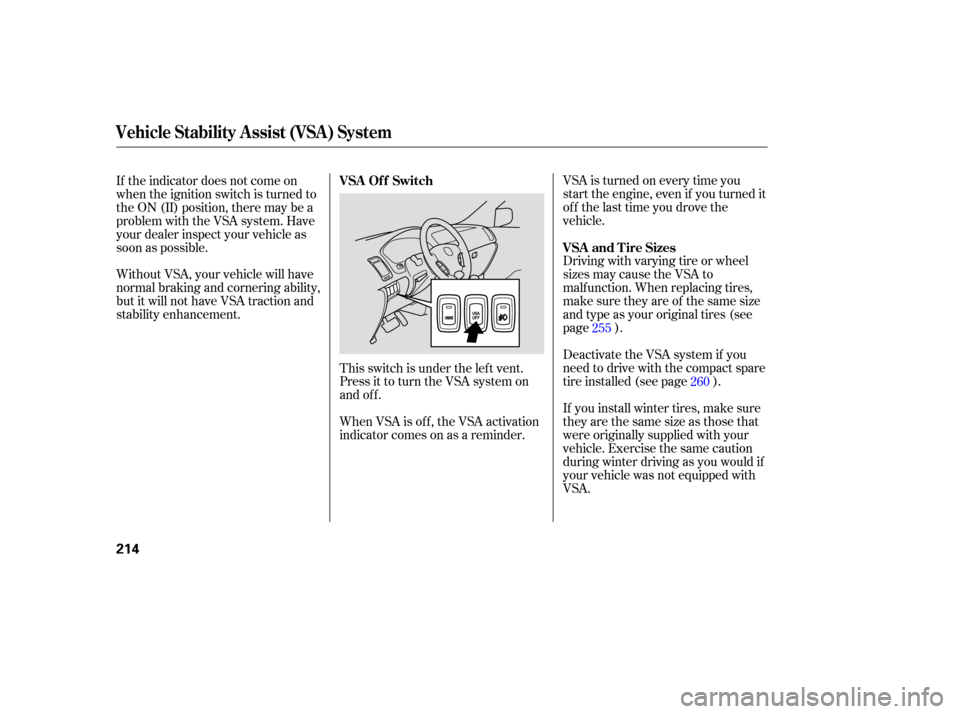
This switch is under the lef t vent.
Press it to turn the VSA system on
and off. 255
260
VSA Of f Switch
VSA and Tire Sizes
Vehicle Stability Assist (VSA) System
214
Page 221 of 311

Acura requires that any trailer with a
total trailer weight of 1,000 lbs (455
kg) or more have its own brakes.
There are two common types of
trailer brakes: surge and electric.
Surge brakes are common f or boat
trailers, since the brakes will get wet.
If you choose electric brakes, be
sure they are electrically actuated.
Do not attempt to tap into your
vehicle’s hydraulic system. No
matter how successf ul it may seem,
any attempt to attach trailer brakes
to your vehicle’s hydraulic system
will lower braking ef f ectiveness and
create a potential hazard.
Seeyourtrailermanufacturerfor
more inf ormation on installing
electric brakes.Always use saf ety chains when you
tow a trailer. Make sure the chains
are secured to the trailer and hitch,
and that they cross under the tongue
and can catch the trailer if it
becomes unhitched. Leave enough
slack to allow the trailer to turn
corners easily, but do not let the
chains drag on the ground.
This device is recommended if your
trailer tends to sway. Your trailer
maker can tell you what kind of sway
control you need and how to install it.
Many states and provinces require
special exterior mirrors when towing
a trailer. Even if they don’t, you
should install special mirrors if you
cannot clearly see behind you, or if
the trailer creates a blind spot.When towing a trailer, we
recommend that you carry a f ull-size
spare wheel and tire for your vehicle
and trailer. See page f or proper
tire size, page f or how to store a
full size wheel and tire, and page
f or inf ormation on changing a
flat tire.
Remember to unhitch the trailer
bef ore changing a f lat. Ask your
trailer sales or rental agency where
and how to store the trailer’s spare
tire. 255
266
261
Towing a Trailer
Trailer Brakes Saf ety Chains
Sway Cont rolTrailer Mirrors Spare Tires
220
Page 224 of 311

When climbing hills, closely watch
your temperature gauge. If it nears
the red (hot) mark, turn the air
conditioning of f , reduce speed and, if
necessary, pull to the side of the
road to let the engine cool.
If the transmission shif ts f requently
while going up a hill, shif t to D3.
If you must stop when f acing uphill,
use the f oot brake or parking brake.
Do not try to hold the vehicle in
placebypressingontheaccelerator,
as this can cause the automatic
transmission to overheat.
When driving down hills, reduce
your speed and shif t down to D . Do
not ‘‘ride’’ the brakes.Crosswinds and air turbulence
caused by passing trucks can disrupt
your steering and cause trailer to
sway. When being passed by a large
vehicle, keep a constant speed, and
steer straight ahead. Do not try to
make quick steering or braking
corrections.
Always drive slowly and have
someone guide you when backing up.
Grip the of the steering wheel,
then turn the wheel to the left to get
the trailer to move to the lef t. Turn
the wheel to the right to move the
trailer to the right.
Follow all normal precautions when
parking, including putting the
transmission in Park and f irmly
setting the parking brake. Also, place
wheel chocks at each of the trailer’s
tires.If the vehicle’s tires slip when
retrieving a boat f rom the water,
shif t to f irst gear, and turn on VTM-4
Lock (see page ). Disengage
VTM-
4Lock as soon as the boat is
out of the water to prevent damage
to the VTM- 4system. 206
3
bottom
Towing a Trailer
Driving on Hills
Handling Crosswinds and Buf f et ing
Backing UpParking Ret rieving a Boat
Remember, it
takes longer to slow down and
stop when towing a trailer.
Driving
223
Page 225 of 311

To avoid loss of control or rollover,
be sure to f ollow all precautions and
recommendations.Be sure to store cargo properly
and do not exceed your cargo load
limits (see page and ).
Your vehicle has been designed
primarily f or use on pavement. But
its higher ground clearance and f our-
wheel drive VTM-4 system allow you
to occasionally travel on unpaved
roads, to campgrounds, picnic sites,
and similar locations. It is not
designed f or trailblazing, mountain
climbing, or other challenging of f -
road activities.
If you decide to drive on unpaved
roads, you will f ind that it requires
somewhat dif f erent driving skills.
Your vehicle will also handle
somewhat dif f erently than it does on
pavement. Be sure to pay extra
attention to the precautions and tips
in this section, and get acquainted
with your vehicle bef ore leaving the
pavement. Whenever you drive, make sure
you and your passengers always
wear seat belts.
Keep your speed low, and never
go faster than the conditions allow.
It’s up to you to continually assess
the situation and drive within the
limits.
196 215
Important Saf ety Precautions
Of f -Highway Driving Guidelines
224
Improperly operating this
vehicle on or off-pavement can
cause an accident or rollover in
which you and your passengers
could be seriously injured or
killed.
Follow all instructions and
guidelines in this owner’s
manual.
Keep your speed low, and
don’t drive faster than
conditions permit.
Page 226 of 311

Before you leave the pavement, be
sure to do all scheduled maintenance
and service, and inspect your vehicle
f or any problems. Pay special
attention to the condition of the tires,
and check the tire pressures.
After you return to the pavement,
caref ully inspect your vehicle to
make sure there is no damage that
could make driving it unsaf e.
Recheck the condition of the tires
and the tire pressures.
The route presents limits (too steep
or bumpy roads). You have limits
(driving skill and comfort). And your
vehicle has limits (traction, stability,
and power).
Driving of f -highway can be
hazardous if you f ail to recognize
limits and take the proper
precautions.Forbettertractiononallsurfaces,
accelerate slowly and gradually build
up speed. If you try to start too fast
on wet soil, mud, snow, or ice, you
might not have enough traction to
get underway, and you may dig
yourself a hole. Starting with the
shif t lever in second (2) gear will
help you have a smoother start on
snow or ice.
Keep in mind that you will usually
need more time and distance to
brake to a stop on unpaved surf aces.
Avoid hard braking. Do not ‘‘pump’’
the brakes; let the anti-lock braking
system pump them f or you.
Debris in the road can damage your
suspension or other components.
Because your vehicle has a high
center of gravity, driving over a large
obstacle, or allowing a wheel to drop
into a deep hole can cause yourvehicle to tip or roll over.
If you can’t clearly see all conditions
or obstacles on a slope, walk the
slope bef ore you drive on it. If you
have any doubt whether or not you
can saf ely drive on the slope, don’t
do it. Find another route.
The water is not deep enough to
cover your wheel hubs, axles, or
exhaust pipe. You could stall and
not be able to restart your engine.
The water can also damage
important vehicle components.
If you are driving up a hill and f ind
that you cannot continue,
. Your vehicle could roll
over. Slowly back down the hill,
f ollowing the same route you took up
the hill.
Bef ore driving through water, stop,
get out if necessary, and make sure
that:
do not try to
turn around
Check Out Your Vehicle
Remember Accelerating and Braking
Avoiding ObstaclesDriving on Slopes
Crossing a Stream
Of f -Highway Driving Guidelines
Driving
225