flat tire Acura MDX 2009 User Guide
[x] Cancel search | Manufacturer: ACURA, Model Year: 2009, Model line: MDX, Model: Acura MDX 2009Pages: 489, PDF Size: 11.91 MB
Page 377 of 489

Pre-Tow Checklist
When preparing to tow, and before
driving away, be sure to check the
following:●The vehicle has been properly
serviced, and the suspension and
the cooling system are in good
operating condition.●The trailer has been properly
serviced and is in good condition.●All weights and loads are within
limits.●The hitch, safety chains, and any
other attachments are secure.●All items on and in the trailer are
properly secured and cannot shift
while you drive.
●The lights and brakes on your
vehicle and the trailer are working
properly.●Your vehicle tires and spare are in
good condition and properly
inflated.●The trailer tires and spare are in
good condition and inflated as
recommended by the trailer
maker.Driving Safely With a Trailer
The added weight, length, and
height of a trailer will affect your
vehicle's handling and performance,
so driving with a trailer requires
some special driving skills and
techniques.
For your safety and the safety of
others, take time to practice driving
maneuvers before heading for the
open road, and follow the guidelines
in this section.
CONTINUED
Towing a Trailer
373
Driving
08/06/06 16:58:07 09 ACURA MDX MMC North America Owner's M 50 31STX620 enu
2009 MDX
Page 419 of 489

To safely operate your vehicle, your
tires must be the proper type and
size, in good condition with adequate
tread, and correctly inflated.
The following pages give more
detailed information on how to take
care of your tires and what to do
when they need to be replaced.
Using tires that are excessively
worn or improperly inflated can
cause a crash in which you can
be seriously hurt or killed.
Follow all instructions in this
owner's manual regarding tire
inflation and maintenance.Inflation Guidelines
Keeping the tires properly inflated
provides the best combination of
handling, tread life, and riding
comfort.
●Underinflated tires wear unevenly,
adversely affect handling and fuel
economy, and are more likely to
fail from being overheated.●Overinflated tires can make your
vehicle ride more harshly, are
more prone to damage from road
hazards, and wear unevenly.
The tire pressure monitoring system
(TPMS) warns you when a tire
pressure is low. See page351for
more information.
Even though your vehicle is
equipped with TPMS, we
recommend that you visually check
your tires every day. If you think a
tire might be low, check it
immediately with a tire gauge. Use a gauge to measure the air
pressure in each tire at least once a
month. Even tires that are in good
condition may lose 1 to 2 psi (10 to
20 kPa, 0.1 to 0.2 kgf/cm
2) per
month. Remember to check the
spare tire at the same time.CONTINUED
Tires
415
Maint enance
08/06/06 16:58:07 09 ACURA MDX MMC North America Owner's M 50 31STX620 enu
2009 MDX
Page 420 of 489

Check the air pressures when the
tires are cold. This means the vehicle
has been parked for at least 3 hours,
or driven less than 1 mile (1.6 km).
Add or release air, if needed, to
match the recommended cold tire
pressures.
If you check air pressures when the
tires are hot [driven for several miles
(kilometers)], you will see readings 4
to 6 psi (30 to 40 kPa, 0.3 to 0.4
kgf/cm
2) higher than the cold
readings. This is normal. Do not let
air out to match the recommended
cold air pressure. The tire will be
underinflated. While tubeless tires have some
ability to self-seal if they are
punctured, you should look closely
for punctures if a tire starts losing
pressure.
You should get your own tire
pressure gauge and use it whenever
you check your tire pressures. This
will make it easier for you to tell if a
pressure loss is due to a tire problem
and not due to a variation between
gauges.
Recommended Tire Pressures
The following chart shows the
recommended cold tire pressures for
most normal and high-speed driving
conditions.
Tire Size Cold Tire Pressure
for Normal Driving
P255/55R18 104H Front/Rear:
32 psi (220 kPa, 2.2
kgf/cm
2)
The compact spare tire pressure is:
60 psi (420 kPa, 4.2 kgf/cm
2)
For convenience, the recommended
tire sizes and cold tire pressures are
on a label on the driver's doorjamb.
For additional information about your
tires, see page454.
Tires41608/06/06 16:58:07 09 ACURA MDX MMC North America Owner's M 50 31STX620 enu
2009 MDX
Page 421 of 489
Tire Inspection
Every time you check inflation, you
should also examine the tires for
damage, foreign objects, and wear.
You should look for:●Bumps or bulges in the tread or
side of the tire. Replace the tire if
you find either of these conditions.●Cuts, splits, or cracks in the side of
the tire. Replace the tire if you can
see fabric or cord.●Excessive tread wear.
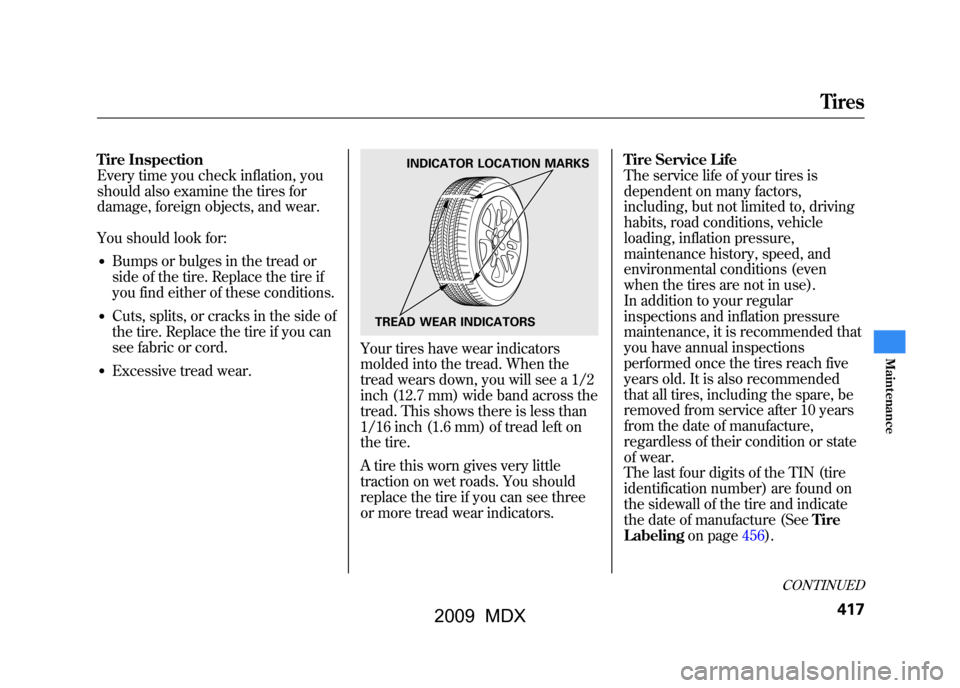
Your tires have wear indicators
molded into the tread. When the
tread wears down, you will see a 1/2
inch (12.7 mm) wide band across the
tread. This shows there is less than
1/16 inch (1.6 mm) of tread left on
the tire.
A tire this worn gives very little
traction on wet roads. You should
replace the tire if you can see three
or more tread wear indicators.Tire Service Life
The service life of your tires is
dependent on many factors,
including, but not limited to, driving
habits, road conditions, vehicle
loading, inflation pressure,
maintenance history, speed, and
environmental conditions (even
when the tires are not in use).
In addition to your regular
inspections and inflation pressure
maintenance, it is recommended that
you have annual inspections
performed once the tires reach five
years old. It is also recommended
that all tires, including the spare, be
removed from service after 10 years
from the date of manufacture,
regardless of their condition or state
of wear.
The last four digits of the TIN (tire
identification number) are found on
the sidewall of the tire and indicate
the date of manufacture (See
Tire
Labeling on page456).
INDICATOR LOCATION MARKS
TREAD WEAR INDICATORS
CONTINUED
Tires
417
Maint enance
08/06/06 16:58:07 09 ACURA MDX MMC North America Owner's M 50 31STX620 enu
2009 MDX
Page 422 of 489
Tire Maintenance
In addition to proper inflation, correct
wheel alignment helps to decrease
tire wear. If you find a tire is worn
unevenly, have your dealer check the
wheel alignment.
Have your dealer check the tires if
you feel a consistent vibration while
driving. A tire should always be
rebalanced if it is removed from the
wheel. When you have new tires
installed, make sure they are
balanced. This increases riding
comfort and tire life. For best results,
have the installer perform a dynamic
balance.Improper wheel weights can damage
your vehicle's aluminum wheels. Use
only Acura wheel weights for
balancing.Tire Rotation
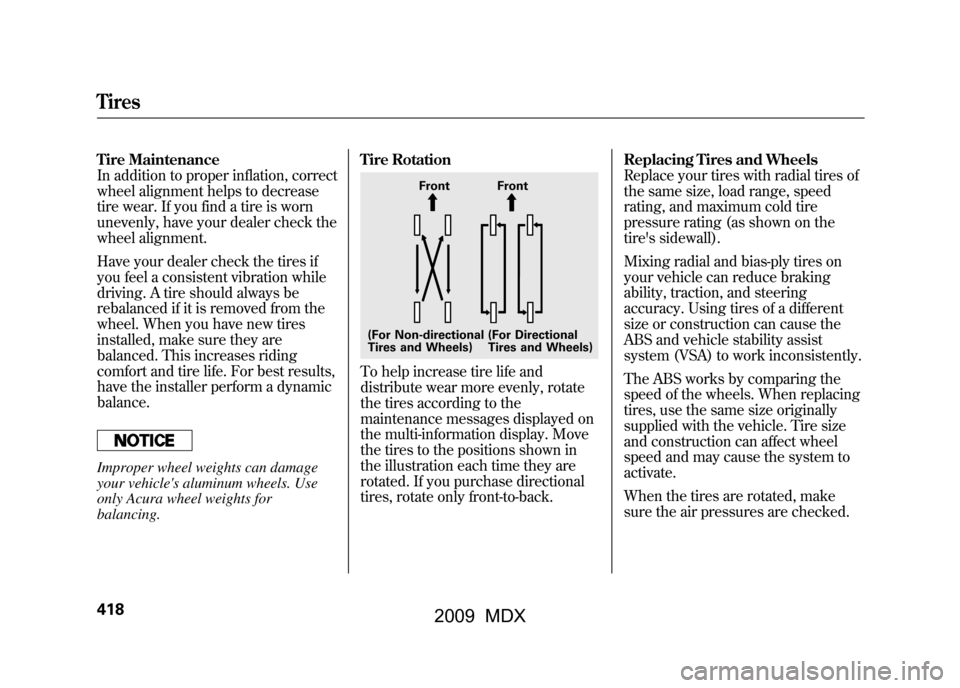
To help increase tire life and
distribute wear more evenly, rotate
the tires according to the
maintenance messages displayed on
the multi-information display. Move
the tires to the positions shown in
the illustration each time they are
rotated. If you purchase directional
tires, rotate only front-to-back.
Replacing Tires and Wheels
Replace your tires with radial tires of
the same size, load range, speed
rating, and maximum cold tire
pressure rating (as shown on the
tire's sidewall).
Mixing radial and bias-ply tires on
your vehicle can reduce braking
ability, traction, and steering
accuracy. Using tires of a different
size or construction can cause the
ABS and vehicle stability assist
system (VSA) to work inconsistently.
The ABS works by comparing the
speed of the wheels. When replacing
tires, use the same size originally
supplied with the vehicle. Tire size
and construction can affect wheel
speed and may cause the system to
activate.
When the tires are rotated, make
sure the air pressures are checked.
Front Front
(For Non-directional
Tires and Wheels) (For Directional
Tires and Wheels)
Tires41808/06/06 16:58:07 09 ACURA MDX MMC North America Owner's M 50 31STX620 enu
2009 MDX
Page 427 of 489

This section covers the more
common problems that motorists
experience with their vehicles. It
gives you information about how to
safely evaluate the problem and what
to do to correct it. If the problem has
stranded you on the side of the road,
you may be able to get going again. If
not, you will also find instructions on
getting your vehicle towed.Compact Spare Tire
....................
424
Changing a Flat Tire
...................
425
If the Engine Won't Start
.............
431
Jump Starting
..............................
432
If the Engine Overheats
..............
434
Low Oil Pressure Indicator
.........
436
Charging System Indicator
.........
436
Malfunction Indicator Lamp
........
437
Brake System Indicator
...............
438
Fuses
..........................................
439
Fuse Locations
............................
443
Opening the Fuel Fill Door Manually
.................................
446
Emergency Towing
.....................
446
If Your Vehicle Gets Stuck
..........
447
Taking Care of the Unexpected
423
T aking Care of t he Unexpect ed
08/06/06 16:58:07 09 ACURA MDX MMC North America Owner's M 50 31STX620 enu
2009 MDX
Page 428 of 489

Use the compact spare tire as a
temporary replacement only. Get
your regular tire repaired or
replaced, and put it back on your
vehicle as soon as you can.
Check the inflation pressure of the
compact spare tire every time you
check the other tires. It should be
inflated to:
60 psi (420 kPa, 4.2 kgf/cm
2)
Follow these precautions:
●Never exceed 50 mph (80 km/h).●This tire gives a harsher ride and
less traction on some road
surfaces. Use greater caution while
driving.
●Do not mount snow chains on a
compact spare.●Do not use your compact spare tire
on another vehicle unless it is the
same make and model.●After the flat tire is replaced with
the spare tire, the low tire
pressure/TPMS indicator stays on.
After several miles (kilometers)
driving with the spare, this
indicator begins to flash, then
stays on again. You will also see a
‘‘ CHECK TPMS SYSTEM’’
message on the multi-information
display (see page354).
Replace the tire when you can see
the tread wear indicator bars. The
replacement should be the same size
and design tire, mounted on the
same wheel. The spare tire is not
designed to be mounted on a regular
wheel, and the spare wheel is not
designed for mounting a regular tire.INDICATOR LOCATION MARK
TREAD WEAR INDICATOR BAR
Compact Spare Tire42408/06/06 16:58:07 09 ACURA MDX MMC North America Owner's M 50 31STX620 enu
2009 MDX
Page 429 of 489

If you have a flat tire while driving,
stop in a safe place to change it.
Drive slowly along the shoulder until
you get to an exit or an area to stop
that is far away from the traffic lanes.
The vehicle can easily roll off
the jack, seriously injuring
anyone underneath.
Follow the directions for
changing a tire exactly, and
never get under the vehicle
when it is supported only by the
jack.
1. Park the vehicle on firm, level, and non-slippery ground. Put the
transmission in Park. Apply the
parking brake.
2. Turn on the hazard warning lights,and turn the ignition switch to the
LOCK (0) position. Have all
passengers get out of the vehicle
while you change the tire.
3. Open the tailgate. 4. Push the rear edge of the handle
to raise the handle loop and pull up
the loop to raise the cargo area
floor.
CARGO AREA
FLOOR
TOOLS
SPARE TIRE JACK
CONTINUED
Changing a Flat Tire
425
T aking Care of t he Unexpect ed
08/06/06 16:58:07 09 ACURA MDX MMC North America Owner's M 50 31STX620 enu
2009 MDX
Page 430 of 489

5. The tools and jack are under thecargo area behind a cover on the
driver's side. Remove the cover by
turning the knobs
counterclockwise, then pulling out
the cover.
6. Turn the jack's end bracketcounterclockwise to loosen it, then
remove the jack.
7. The spare tire is storedunderneath the rear cargo area.
Remove the plastic cover on the
cargo area lining to access the
shaft for the spare tire hoist.
KNOB COVER
PLASTIC COVER
Changing a Flat Tire42608/06/06 16:58:07 09 ACURA MDX MMC North America Owner's M 50 31STX620 enu
2009 MDX
Page 431 of 489
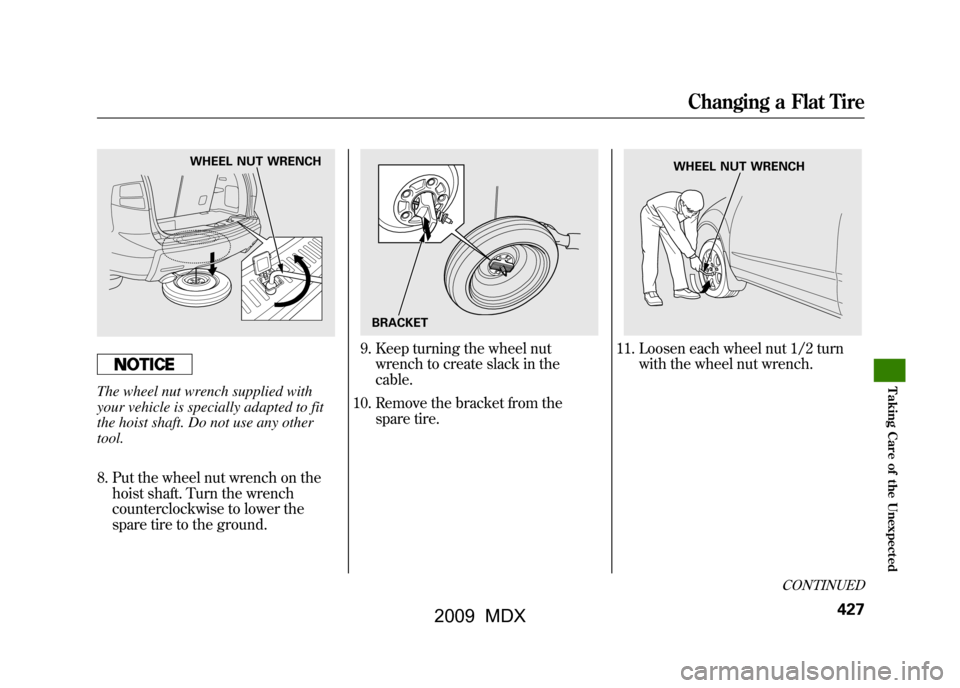
The wheel nut wrench supplied with
your vehicle is specially adapted to fit
the hoist shaft. Do not use any other
tool.8. Put the wheel nut wrench on the hoist shaft. Turn the wrench
counterclockwise to lower the
spare tire to the ground.
9. Keep turning the wheel nutwrench to create slack in the
cable.
10. Remove the bracket from the spare tire.
11. Loosen each wheel nut 1/2 turnwith the wheel nut wrench.
WHEEL NUT WRENCH
BRACKET
WHEEL NUT WRENCH
CONTINUED
Changing a Flat Tire
427
T aking Care of t he Unexpect ed
08/06/06 16:58:07 09 ACURA MDX MMC North America Owner's M 50 31STX620 enu
2009 MDX