brake Acura MDX 2012 Repair Manual
[x] Cancel search | Manufacturer: ACURA, Model Year: 2012, Model line: MDX, Model: Acura MDX 2012Pages: 621, PDF Size: 11.15 MB
Page 553 of 621

Snow Tires
If you mount snow tires on your
vehicle, make sure they are radial
tires of the same size and load range
as the original tires. Mount snow
tires on all four wheels. The traction
provided by snow tires on dry roads
may be lower than your original tires.
Check with the tire dealer for
maximum speed recommendations.
Tire Chains
Mount tire chains on your tires when
required by driving conditions or
local laws. Install them only on the
front tires.
Because your vehicle has limited tire
clearance, Acura strongly
recommends using the chains listed
below.
SCC Super Z-6#SC 435When installing chains, follow the
manufacturer's instructions and
mount them as tightly as you can.
Drive slowly with chains installed. If
you hear them contacting the body
or chassis, stop and investigate.
Make sure the chains are installed
tightly, and that they are not
contacting the brake lines or
suspension. Remove the chains as
soon as you start driving on cleared
roads.
Using the wrong chains, or not
properly installing chains, can
damage the brake lines and
cause a crash in which you can
be seriously injured or killed.
Follow all instructions in this
owner's manual regarding the
selection and use of tire chains.
Traction devices that are the wrong size
or improperly installed can damage
your vehicle's brake lines, suspension,
body, and wheels. Stop driving if they
are hitting any part of the vehicle.
Wheels
Clean the wheels as you would the
rest of the exterior. Wash them with
the same solution, and rinse them
thoroughly.
Aluminum alloy wheels have a
protective clear-coat that keeps the
aluminum from corroding and
tarnishing. Cleaning the wheels with
harsh chemicals (including some
commercial wheel cleaners) or a stiff
brush can damage the clear-coat. To
clean the wheels, use a mild
detergent and a soft brush or sponge.
Tires546
Page 555 of 621

If you need to park your vehicle for
an extended period (more than 1
month), there are several things you
should do to prepare it for storage.
Proper preparation helps prevent
deterioration and makes it easier to
get your vehicle back on the road. If
possible, store your vehicle indoors.●
Fill the fuel tank.
●
Wash and dry the exterior
completely.
●
Clean the interior. Make sure the
carpeting, floor mats, etc., are
completely dry.
●
Leave the parking brake off. Put
the transmission in Park.
●
Block the rear wheels.
●
If the vehicle is to be stored for a
longer period, it should be
supported on jackstands so the
tires are off the ground.
●
Leave one window open slightly (if
the vehicle is being stored
indoors).
●
Disconnect the battery.
●
Support the front and rear wiper
blade arms with a folded towel or
rag so they do not touch the
windshield.
●
To minimize sticking, apply a
silicone spray lubricant to all door
and tailgate seals. Also, apply a
vehicle body wax to the painted
surfaces that mate with the door
and tailgate seals.
●
Cover the vehicle with a
‘‘breathable’’cover, one made from
a porous material such as cotton.
Non-porous materials, such as
plastic sheeting, trap moisture,
which can damage the paint.
●
If possible, periodically run the
engine until it reaches full
operating temperature (the cooling
fans cycle on and off twice).
Preferably, do this once a month.
Vehicle Storage548
Page 556 of 621

This section covers the more
common problems that motorists
experience with their vehicles. It
gives you information about how to
safely evaluate the problem and what
to do to correct it. If the problem has
stranded you on the side of the road,
you may be able to get going again. If
not, you will also find instructions on
getting your vehicle towed.Compact Spare Tire
....................
550
Changing a Flat Tire
...................
551
If the Engine Won't Start
.............
557
Jump Starting
..............................
558
If the Engine Overheats
..............
560
Low Oil Pressure Indicator
.........
562
Charging System Indicator
.........
562
Malfunction Indicator Lamp
........
563
Brake System Indicator
...............
564
Fuses
..........................................
565
Fuse Locations
............................
569
Opening the Fuel Fill Door
Manually
.................................
572
Emergency Towing
.....................
572
If Your Vehicle Gets Stuck
..........
573
Taking Care of the Unexpected
549
Taking Care of the Unexpected
Page 558 of 621

If you have a flat tire while driving,
stop in a safe place to change it.
Drive slowly along the shoulder until
you get to an exit or an area to stop
that is far away from the traffic lanes.
The vehicle can easily roll off
the jack, seriously injuring
anyone underneath.
Follow the directions for
changing a tire exactly, and
never get under the vehicle
when it is supported only by the
jack.
1. Park the vehicle on firm, level, and
non-slippery ground. Put the
transmission in Park. Apply the
parking brake.
2. Turn on the hazard warning lights,
and turn the ignition switch to the
LOCK (0) position. Have all
passengers get out of the vehicle
while you change the tire.
3. Open the tailgate.4. Push the rear edge of the handle
to raise the handle loop and pull up
the loop to raise the cargo area
floor.
CARGO AREA
FLOOR
TOOLS
SPARE TIREJACK
CONTINUED
Changing a Flat Tire
551
Taking Care of the Unexpected
Page 561 of 621

12. Place the jack under the jacking
point nearest the tire you need to
change. Turn the end bracket
clockwise until the top of the jack
contacts the jacking point. Make
sure the jacking point tab is
resting in the jack notch.
13. Use the extension and the wheel
nut wrench as shown to raise the
vehicle until the flat tire is off the
ground.
14. Remove the wheel nuts, then
remove the flat tire.
15. Before mounting the spare tire,
wipe any dirt off the mounting
surface of the wheel and hub with
a clean cloth. Wipe the hub
carefully; it may be hot from
driving.
JACKING POINT
EXTENSION
WHEEL NUT WRENCH
BRAKE HUB
Changing a Flat Tire554
Page 565 of 621

●
Are you using the proper starting
procedure? Refer toStarting the
Engineon page 442.
●
Do you have fuel? Check the fuel
gauge; the warning indicator may
not be working.
●
There may be an electrical
problem, such as no power to the
fuel pump. Check all the fuses (see
page 566).
If you find nothing wrong, you will
need a qualified technician to find the
problem. SeeEmergency Towingon
page 572.Jump Starting
Although this seems like a simple
procedure, you should take several
precautions.
A battery can explode if you do
not follow the correct
procedure, seriously injuring
anyone nearby.
Keep all sparks, open flames,
and smoking materials away
from the battery.
You cannot start your vehicle by
pushing or pulling it.
To Jump Start Your Vehicle:1. Open the hood, and check the
physical condition of the battery.
In very cold weather, check the
condition of the electrolyte. If it
seems slushy or frozen, do not try
jump starting until it thaws.If a battery sits in extreme cold, the
electrolyte inside can freeze. Attempting
to jump start with a frozen battery can
cause it to rupture.
2. Turn off all the electrical
accessories: heater, A/C, climate
control, audio system, lights, etc.
Put the transmission in neutral or
Park, and set the parking brake.
If the Engine Won't Start, Jump Starting558
Page 567 of 621

The pointer of your vehicle's
temperature gauge should stay in the
midrange under most conditions. If it
climbs to the red mark, you should
determine the reason (hot day,
driving up a steep hill, etc.).
If the vehicle overheats, you should
take immediate action. The only
indication may be the temperature
gauge climbing to or above the red
mark. Or you may see steam or spray
coming from under the hood.Driving with the temperature gauge
pointer at the red mark can cause
serious damage to the engine.
Steam and spray from an
overheated engine can
seriously scald you.
Do not open the hood if steam
is coming out.1. Safely pull to the side of the road.
Put the transmission in Park, and
set the parking brake. Turn off all
accessories, and turn on the
hazard warning indicators.
2. If you see steam and/or spray
coming from under the hood, turn
off the engine. Wait until you see
no more signs of steam or spray,
then open the hood.
3. If you do not see steam or spray,
leave the engine running and
watch the temperature gauge. If
the high heat is due to
overloading, the engine should
start to cool down almost
immediately. If it does, wait until
the temperature gauge comes
down to the midpoint, then
continue driving.
If the Engine Overheats560
Page 571 of 621

U.S. Canada
The brake system
indicator normally
comes on when you turn the ignition
switch to the ON (II) position, and as
a reminder to check the parking
brake. It will stay on if you do not
fully release the parking brake.
If the brake system indicator comes
on while driving, the brake fluid level
is probably low. Press lightly on the
brake pedal to see if it feels normal. If
it does, check the brake fluid level
the next time you stop at a service
station (see page 525).
You will also see a‘‘LOW BRAKE
FLUID’’message on the multi-
information display (see page 87).If the fluid level is low, take your
vehicle to a dealer, and have the
brake system inspected for leaks or
worn brake pads.
However, if the brake pedal does not
feel normal, you should take
immediate action. A problem in one
part of the system's dual circuit
design will still give you braking at
two wheels. You will feel the brake
pedal go down much farther before
the vehicle begins to slow down, and
you will have to press harder on the
pedal.
You will also see a‘‘CHECK BRAKE
SYSTEM’’message on the multi-
information display (see page 87).Slow down by shifting to a lower
gear, and pull to the side of the road
when it is safe. Because of the long
distance needed to stop, it is
hazardous to drive the vehicle. You
should have it towed, and repaired as
soon as possible (seeEmergency
Towingon page 572).
If you must drive the vehicle a short
distance in this condition, drive
slowly and carefully.
If the ABS indicator and the VSA
system indicator come on with the
brake system indicator, have your
vehicle inspected by your dealer
immediately.
Brake System Indicator564
Page 576 of 621

PRIMARY UNDER-HOOD FUSE BOX
No. Amps. Circuits Protected
1 120 A Main fuse
-Not Used
2-1 30 A ADS
ᤳ2
2-2 30 A SH-AWD
2-3 30 A Rear Blower Motor
2-4 40 A ABS VSA
2-5 40 A Trailer Main
2-6 40 A Power Seats, Driver's Position
Memory System, Subwoofer,
Telescopic Steering Wheel
2-7 40 A Front Heated Seat, TPMS,
Moonroof, Driver's Lumbar
Support
2-8--
3-1 60 A Fog Lights, Front Blower
Motor, Interior Light
3-2 40 A Headlights, Daytime Running
Lights
3-3 60 A Cooling Fan, Condenser Fan,
MG Clutch, Headlight
Washer
ᤳ1
3-4 50 A Ignition Switch Main
ᤳ1: Canadian model
ᤳ2: If equippedNo. Amps. Circuits Protected
3-5 50 A Power Window
3-6 60 A Power Tailgate Opener/Closer,
Rear ACC Socket, Interior
Light,
Rear Defroster
3-7 30 A ECU (PCM)
3-8 30 A TECH
4 40 A Audio, Door Lock, Interior
Lights, Front ACC Socket
5 30 A EPT-L
ᤳ2
6 30 A EPT-R
ᤳ2
7 30 A FI ECU
8 30 A Audio Amplifier
9 7.5 A Battery Sensor
10 15 A Hazard
11 15 A Horn, Stop
12 20 A ABS VSA
13 20 A Trailer (Brake)
14 20 A Rear Heated Seat
ᤳ2
15 20 A A/C Inverter
CONTINUED
Fuse Locations
569
Taking Care of the Unexpected
Page 586 of 621
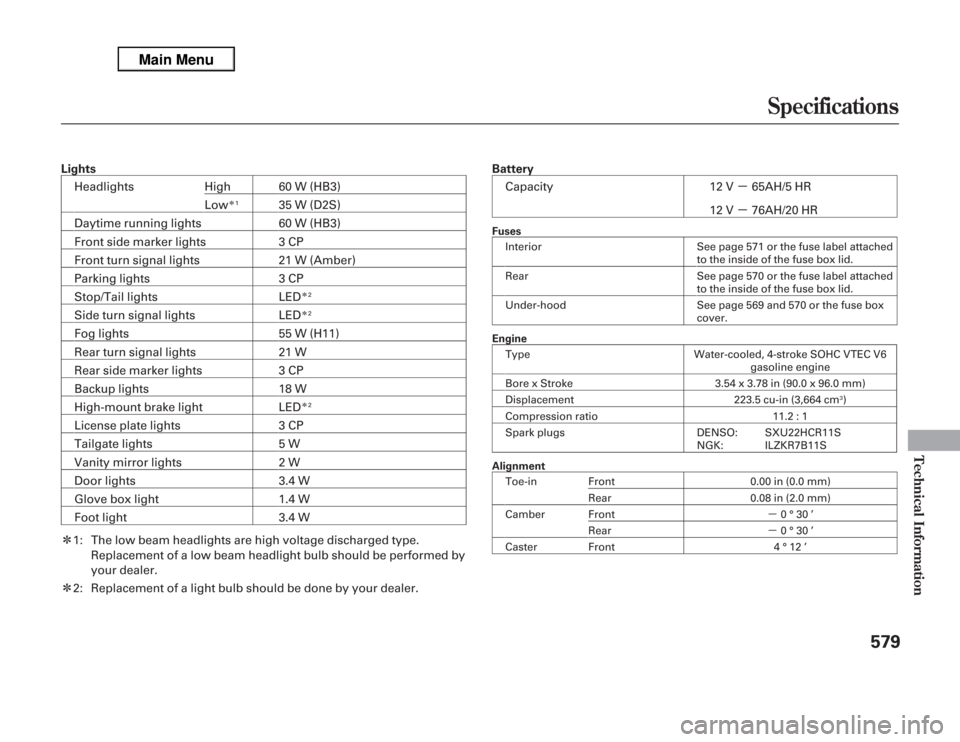
Lights
Headlights High 60 W (HB3)
Low
ᤳ1
35 W (D2S)
Daytime running lights 60 W (HB3)
Front side marker lights 3 CP
Front turn signal lights 21 W (Amber)
Parking lights 3 CP
Stop/Tail lights LED
ᤳ2
Side turn signal lights LED
ᤳ2
Fog lights 55 W (H11)
Rear turn signal lights 21 W
Rear side marker lights 3 CP
Backup lights 18 W
High-mount brake light LED
ᤳ2
License plate lights 3 CP
Tailgate lights 5 W
Vanity mirror lights 2 W
Door lights 3.4 W
Glove box light 1.4 W
Foot light 3.4 W
ᤳ1: The low beam headlights are high voltage discharged type.
Replacement of a low beam headlight bulb should be performed by
your dealer.
ᤳ2: Replacement of a light bulb should be done by your dealer.Battery
Capacity 12 V-65AH/5 HR
12 V-76AH/20 HR
Fuses
Interior See page 571 or the fuse label attached
to the inside of the fuse box lid.
Rear See page 570 or the fuse label attached
to the inside of the fuse box lid.
Under-hood See page 569 and 570 or the fuse box
cover.
Engine
Type Water-cooled, 4-stroke SOHC VTEC V6
gasoline engine
Bore x Stroke 3.54 x 3.78 in (90.0 x 96.0 mm)
Displacement 223.5 cu-in (3,664 cm
3)
Compression ratio 11.2 : 1
Spark plugs DENSO:
NGK:SXU22HCR11S
ILZKR7B11S
Alignment
Toe-in Front 0.00 in (0.0 mm)
Rear 0.08 in (2.0 mm)
Camber Front-0°30’
Rear-0°30’
Caster Front 4 ° 12’
Specifications
579
Technical Information