spark Acura MDX 2012 Owner's Manual
[x] Cancel search | Manufacturer: ACURA, Model Year: 2012, Model line: MDX, Model: Acura MDX 2012Pages: 621, PDF Size: 11.15 MB
Page 431 of 621

Refueling1. Park with the driver's side closest
to the service station pump.
2. Open the fuel fill door by pressing
the button in the driver's door. (To
open the fuel fill door manually,
see page 572.)
3. Remove the fuel fill cap slowly.
You may hear a hissing sound as
pressure inside the tank equalizes.
Place the cap in the holder on the
fuel fill door.
4. Stop filling the tank after the fuel
nozzle automatically clicks off. Do
not try to‘‘top off’’the tank. Leave
some room for the fuel to expand
with temperature changes.If the fuel nozzle keeps clicking off
even though the tank is not full,
there may be a problem with your
vehicle's fuel vapor recovery system.
The system helps keep fuel vapor
from going into the atmosphere. Try
filling at another pump. If this does
not fix the problem, consult your
dealer.
Gasoline is highly flammable
and explosive. You can be
burned or seriously injured
when handling fuel.●
Stop the engine, and keep
heat, sparks, and flame
away.
●
Handle fuel only outdoors.
●
Wipe up spills immediately.
Push
FUEL FILL CAP
TETHER
HOLDER
Service Station Procedures424
Page 513 of 621
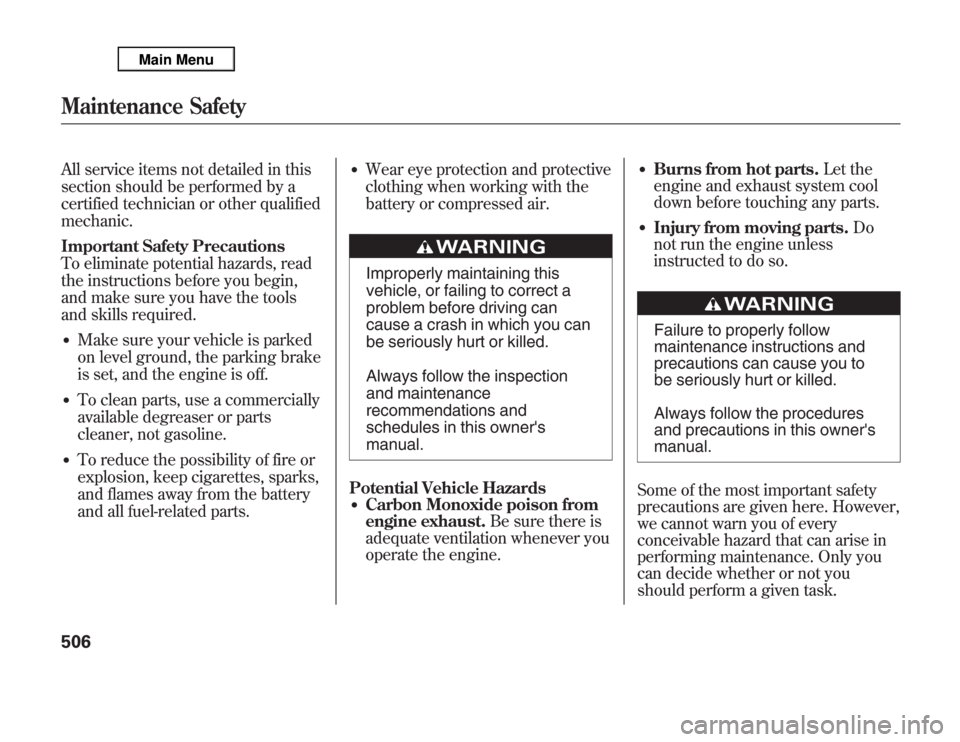
All service items not detailed in this
section should be performed by a
certified technician or other qualified
mechanic.
Important Safety Precautions
To eliminate potential hazards, read
the instructions before you begin,
and make sure you have the tools
and skills required.●
Make sure your vehicle is parked
on level ground, the parking brake
is set, and the engine is off.
●
To clean parts, use a commercially
available degreaser or parts
cleaner, not gasoline.
●
To reduce the possibility of fire or
explosion, keep cigarettes, sparks,
and flames away from the battery
and all fuel-related parts.
●
Wear eye protection and protective
clothing when working with the
battery or compressed air.Improperly maintaining this
vehicle, or failing to correct a
problem before driving can
cause a crash in which you can
be seriously hurt or killed.
Always follow the inspection
and maintenance
recommendations and
schedules in this owner's
manual.
Potential Vehicle Hazards
●
Carbon Monoxide poison from
engine exhaust.Be sure there is
adequate ventilation whenever you
operate the engine.
●
Burns from hot parts.Let the
engine and exhaust system cool
down before touching any parts.
●
Injury from moving parts.Do
not run the engine unless
instructed to do so.Failure to properly follow
maintenance instructions and
precautions can cause you to
be seriously hurt or killed.
Always follow the procedures
and precautions in this owner's
manual.
Some of the most important safety
precautions are given here. However,
we cannot warn you of every
conceivable hazard that can arise in
performing maintenance. Only you
can decide whether or not you
should perform a given task.
Maintenance Safety506
Page 521 of 621

Symbol Maintenance Main Items
A
●Replace engine oil
1
B
●Replace engine oil
1and oil filter
●Inspect front and rear brakes●Check parking brake adjustment●Inspect these items:●Tie rod ends, steering gear box, and boots●Suspension components●Driveshaft boots●Brake hoses and lines (including ABS/VSA)●All fluid levels and condition of fluids●Exhaust system
#
●Fuel lines and connections
#
1: If the message‘‘SERVICE DUE NOW’’does not appear more than
12 months after the display is reset, change the engine oil every
year.
#: See information on maintenance and emissions warranty in the
first column on page 512.
NOTE:
●Independent of the Maintenance Midner information, replace
the brake fluid every 3 years.●Inspect idle speed every 160,000 miles (256,000 km).●Adjust the valves during services A, B, 1, 2, or 3 if they are
noisy.Symbol Maintenance Sub Items
1
●Rotate tires
2●Replace air cleaner element
If you drive in dusty conditions, replace every 15,000
miles (24,000 km).●Replace dust and pollen filter
If you drive primarily in urban areas that have high
concentrations of soot in the air from industry and from
diesel-powered vehicles, replace every 15,000 miles
(24,000 km).●Inspect drive belt
3●Replace transmission and transfer fluid
4●Replace spark plugs●Replace timing belt and inspect water pump
If you drive regularly in very high temperatures (over
110°F, 43°C), in very low temperatures (under-20°F,-
29°C), or towing a trailer, replace every 60,000 miles (U.
S.)/100,000 km (Canada).●Inspect valve clearance
5●Replace engine coolant
6●Replace rear differential fluid
Driving in mountainous areas at very low vehicle
speeds or trailer towing results in higher level of
mechanical (shear) stress to fluid. This requires
differential fluid changes more frequently than
recommended by the Maintenance Minder. If you
regularly drive your vehicle under these conditions,
have the differential fluid changed at 7,500 miles (12,000
km), then every 15,000 miles (24,000 km).
Maintenance Minder
TM
Maintenance Minder
514
Page 554 of 621

The sensor on the negative terminal
monitors your vehicles battery
condition.
If there is a problem with the sensor,
you will see a‘‘CHECK BATTERY
SENSOR’’message on the
multiinformation display. Have the
vehicle checked by your dealer.
Check the terminals for corrosion (a
white or yellowish powder). To
remove it, cover the terminals with a
solution of baking soda and water. It
will bubble up and turn brown. When
this stops, wash it off with plain
water. Dry off the battery with a cloth
or paper towel. Coat the terminals
with grease to help prevent further
corrosion.If additional battery maintenance is
needed, see your dealer or a
qualified technician.
WARNING:Battery posts,
terminals, and related accessories
contain lead and lead compounds.
Wash your hands after handling.
If you need to connect the battery to
a charger, disconnect both cables to
prevent damaging your vehicle's
electrical system. Always disconnect
the negative (-) cable first, and
reconnect it last.
The battery gives off explosive
hydrogen gas during normal
operation.
A spark or flame can cause the
battery to explode with enough
force to kill or seriously hurt
you.
Wear protective clothing and a
face shield, or have a skilled
technician do the battery
maintenance.
If the radio fuse is removed, the
audio system will disable itself. The
next time you turn on the radio you
will see‘‘ENTER CODE’’in the
frequency display. Use the preset
buttons to enter the digit code (see
page 308).
Checking the Battery
547
Maintenance
Page 565 of 621

●
Are you using the proper starting
procedure? Refer toStarting the
Engineon page 442.
●
Do you have fuel? Check the fuel
gauge; the warning indicator may
not be working.
●
There may be an electrical
problem, such as no power to the
fuel pump. Check all the fuses (see
page 566).
If you find nothing wrong, you will
need a qualified technician to find the
problem. SeeEmergency Towingon
page 572.Jump Starting
Although this seems like a simple
procedure, you should take several
precautions.
A battery can explode if you do
not follow the correct
procedure, seriously injuring
anyone nearby.
Keep all sparks, open flames,
and smoking materials away
from the battery.
You cannot start your vehicle by
pushing or pulling it.
To Jump Start Your Vehicle:1. Open the hood, and check the
physical condition of the battery.
In very cold weather, check the
condition of the electrolyte. If it
seems slushy or frozen, do not try
jump starting until it thaws.If a battery sits in extreme cold, the
electrolyte inside can freeze. Attempting
to jump start with a frozen battery can
cause it to rupture.
2. Turn off all the electrical
accessories: heater, A/C, climate
control, audio system, lights, etc.
Put the transmission in neutral or
Park, and set the parking brake.
If the Engine Won't Start, Jump Starting558
Page 586 of 621
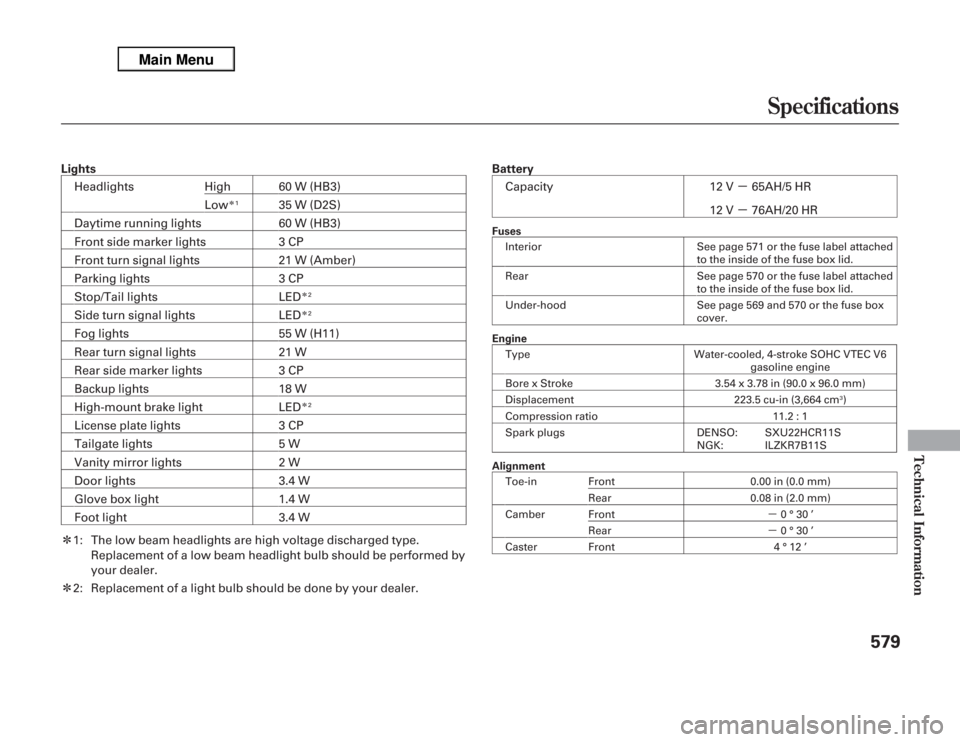
Lights
Headlights High 60 W (HB3)
Low
ᤳ1
35 W (D2S)
Daytime running lights 60 W (HB3)
Front side marker lights 3 CP
Front turn signal lights 21 W (Amber)
Parking lights 3 CP
Stop/Tail lights LED
ᤳ2
Side turn signal lights LED
ᤳ2
Fog lights 55 W (H11)
Rear turn signal lights 21 W
Rear side marker lights 3 CP
Backup lights 18 W
High-mount brake light LED
ᤳ2
License plate lights 3 CP
Tailgate lights 5 W
Vanity mirror lights 2 W
Door lights 3.4 W
Glove box light 1.4 W
Foot light 3.4 W
ᤳ1: The low beam headlights are high voltage discharged type.
Replacement of a low beam headlight bulb should be performed by
your dealer.
ᤳ2: Replacement of a light bulb should be done by your dealer.Battery
Capacity 12 V-65AH/5 HR
12 V-76AH/20 HR
Fuses
Interior See page 571 or the fuse label attached
to the inside of the fuse box lid.
Rear See page 570 or the fuse label attached
to the inside of the fuse box lid.
Under-hood See page 569 and 570 or the fuse box
cover.
Engine
Type Water-cooled, 4-stroke SOHC VTEC V6
gasoline engine
Bore x Stroke 3.54 x 3.78 in (90.0 x 96.0 mm)
Displacement 223.5 cu-in (3,664 cm
3)
Compression ratio 11.2 : 1
Spark plugs DENSO:
NGK:SXU22HCR11S
ILZKR7B11S
Alignment
Toe-in Front 0.00 in (0.0 mm)
Rear 0.08 in (2.0 mm)
Camber Front-0°30’
Rear-0°30’
Caster Front 4 ° 12’
Specifications
579
Technical Information
Page 613 of 621
Parking Brake and Brake System
Indicator
...........................
69, 564
Parking Lights
...........................
128
Parking Over Things that
Burn
................................
454, 589
Passenger Airbag Off Indicator
....
37
PGM-FI System
..........................
588
Playing a Disc
............................
235
Playing an iPod
®.........................
278
Playing a USB Flash Memory
Device
....................................
287
Playing Disc
...............................
203
Playing Hard Disc Drive (HDD)
Audio (Models with navigation
system)
...............................
250
Playing the AM/FM
Radio
...............................
193, 213
Playing the XM
®Radio
........
197, 226
Pollen Filter
...............................
534
Power Seat Adjustments
............
149
Power Socket Locations
.............
177
Power Steering Fluid
.................
526
Power Windows
.........................
160
Pregnancy, Using Seat Belts
........
19
Preparing to Drive
......................
441
Proper Seat Belt Usage
................
16Protecting Adults and Teens
........
12
Additional Safety Precautions
...
20
Advice for Pregnant Women
....
19
Protecting Children
......................
40
General Guidelines
..................
40
Protecting Infants
.....................
45
Protecting Larger Children
......
57
Protecting Small Children
........
46
Using Child Seats with
Tethers
.................................
54
Using LATCH
..........................
50
R
Radiator Overheating
.................
560
Radio/CD Sound System
...........
192
Radio/Disc Sound
System
............................
193, 213
Radio Theft Protection
...............
308
Readiness Codes
........................
590
Rear A/C Unit
............................
187
Rear Audio Control Panel
...........
315
Rear Entertainment System
.......
310
Rear Lights, Bulb
Replacement
...........................
531Rearview Mirror
.........................
165
Rearview Mirror with Rearview
Camera Display
......................
417
Rear Window Defogger
..............
132
Rear Window Wiper and
Washer
...................................
127
Recalling a Memorized Driving
Position
..................................
148
Reclining the Seat Backs
............
149
Reclining the Second Seats
........
153
Refueling
....................................
424
Reminder Indicators
.....................
68
Remote Audio Controls
..............
305
Remote Control (RES)
...............
334
Remote Transmitter
...................
145
Replacement Information
Dust and Pollen Filter
.............
534
Engine Oil and Filter
...............
518
Fuses
......................................
565
Schedule
.................................
514
Spark Plugs
.............................
579
Timing Belt
.............................
526
Tires
.......................................
544
Wiper Blades
..........................
536
Replacing Seat Belts After a
Crash
........................................
25
IndexVIII
Page 615 of 621

Spare Tire
..................................
550
Inflating
...........................
540, 550
Specifications
..........................
580
Spark Plugs
................................
579
Specifications
.............................
578
Speed Control
............................
345
Speed Limiter
.............................
446
Speedometer
................................
78
SRS, Additional Information
.........
27
Additional Safety Precautions
...
39
Airbag Service
..........................
38
Airbag System Components
.....
27
How the Side Airbag Off
Indicator Works
...................
36
How the SRS Indicator Works
..
36
How Your Front Airbags
Work
....................................
30
How Your Side Airbags Work
..
33
How Your Side Curtain Airbags
Work
....................................
35
SRS Indicator
.........................
36, 70
START (Ignition Key
Position)
.................................
139
Starting the Engine
....................
442
Auto Control Mode
.................
442In Cold Weather at High
Altitude
................................
442
With a Dead Battery
................
558
State Emissions Testing
.............
590
Steam Coming from Engine
.......
560
Steering Wheel
Adjustments
............................
134
Anti-theft Column Lock
...........
139
Buttons
...........................
305, 345
Position Memory
....................
168
Stereo Sound System
..........
192, 212
Storage Compartment
................
175
Storing Your Vehicle
..................
548
Sunglasses Holder
.....................
176
Sun Visor
...................................
176
Super Handling-All Wheel Drive™
(SH-AWD
®) System
................
452
Supplemental Restraint
System
............................
10, 27
Servicing
..................................
38
SRS Indicator
......................
36, 70
System Components
................
27
Synthetic Oil
..............................
518T
Tachometer
..................................
78
Tailgate
......................................
141
Open Indicator
.........................
76
Opening the
............................
141
Power
......................................
142
Taillights, Changing Bulbs in
.....
531
Taking Care of the
Unexpected
............................
549
Technical Descriptions
DOT Tire Quality Grading (U.S.
Vehicles)
.............................
581
Emissions Control Systems
.....
587
Three Way Catalytic
Converter
............................
589
Tire Labeling
...........................
583
Tire Pressure Monitoring System
(TPMS)-Required Federal
Explanation
......................
585
Temperature Gauge
.....................
78
Temperature, Inside Sensor
.......
191
Temperature, Outside
..................
82
Tensioners, Seat Belts
..................
23
Tether Anchorage Points
.............
54
IndexX