fuel pressure Acura MDX 2013 Owner's Manual
[x] Cancel search | Manufacturer: ACURA, Model Year: 2013, Model line: MDX, Model: Acura MDX 2013Pages: 617, PDF Size: 10.82 MB
Page 7 of 617
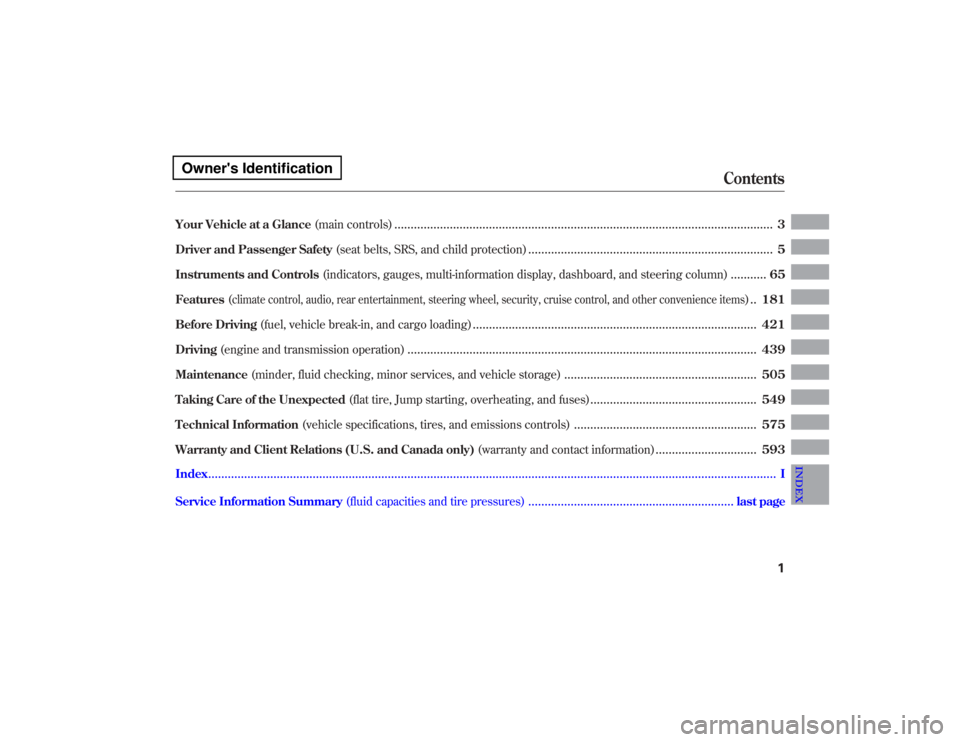
Your Vehicle at a Glance(main controls)
....................................................................................................................
3
Driver and Passenger Safety (seat belts, SRS, and child protection)
...........................................................................
5
Instruments and Controls (indicators, gauges, multi-information display, dashboard, and steering column)
...........
65
Features (
climate control, audio, rear entertainment, steering wheel, security, cruise control, and other convenience items
)..181
Before Driving (fuel, vehicle break-in, and cargo loading)
.......................................................................................
421
Driving (engine and transmission operation)
...........................................................................................................
439
Maintenance (minder, fluid checking, minor services, and vehicle storage)
...........................................................
505
Taking Care of the Unexpected (flat tire, Jump starting, overheating, and fuses)
...................................................
549
Technical Information (vehicle specifications, tires, and emissions controls)
........................................................
575
Warranty and Client Relations (U.S. and Canada only) (warranty and contact information)
...............................
593
Index
..............................................................................................................................................................................
I
INDEX
Service Information Summary (fluid capacities and tire pressures)
...............................................................
last page
Contents
1
12/07/17 18:10:57 13 ACURA MDX MMC North America Owner's M 50 31STX660 enu
Page 73 of 617
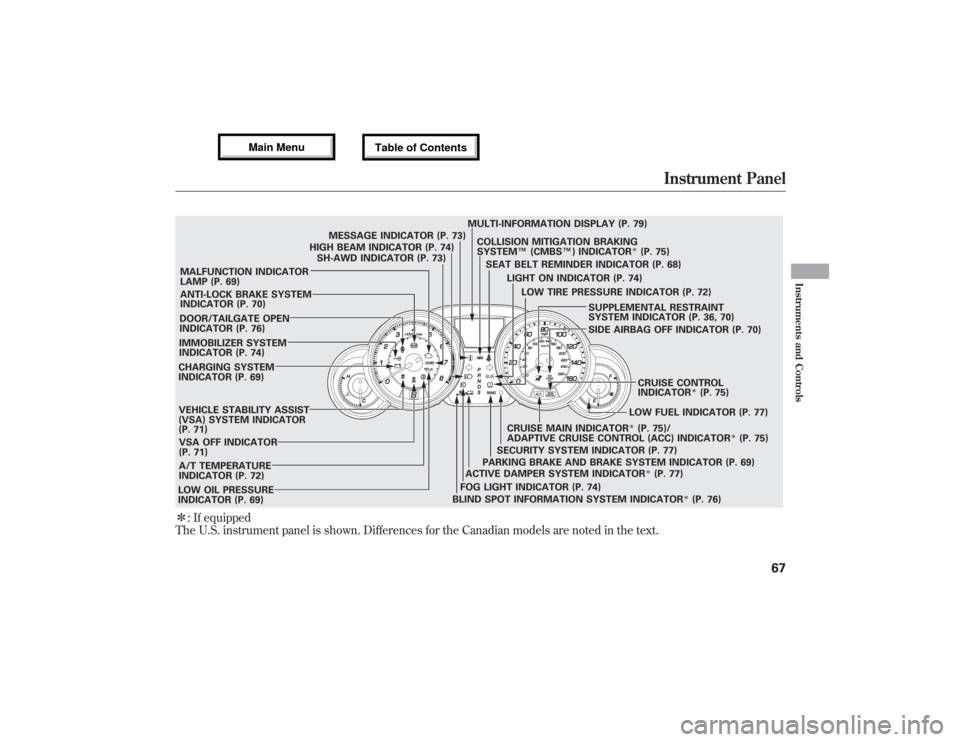
ᤳ: If equipped
The U.S. instrument panel is shown. Differences for the Canadian models are noted in the text.
MESSAGE INDICATOR (P. 73)
HIGH BEAM INDICATOR (P. 74)
SH-AWD INDICATOR (P. 73)
ANTI-LOCK BRAKE SYSTEM
INDICATOR (P. 70)
FOG LIGHT INDICATOR (P. 74) DOOR/TAILGATE OPEN
INDICATOR (P. 76)
IMMOBILIZER SYSTEM
INDICATOR (P. 74)
CHARGING SYSTEM
INDICATOR (P. 69)
VEHICLE STABILITY ASSIST
(VSA) SYSTEM INDICATOR
(P. 71)
SECURITY SYSTEM INDICATOR (P. 77)
ACTIVE DAMPER SYSTEM INDICATOR
ᤳ(P. 77) PARKING BRAKE AND BRAKE SYSTEM INDICATOR (P. 69)LOW FUEL INDICATOR (P. 77) SEAT BELT REMINDER INDICATOR (P. 68) COLLISION MITIGATION BRAKING
SYSTEM™(CMBS™) INDICATOR
ᤳ(P. 75)
SUPPLEMENTAL RESTRAINT
SYSTEM INDICATOR (P. 36, 70)
CRUISE MAIN INDICATORᤳ(P. 75)/
ADAPTIVE CRUISE CONTROL (ACC) INDICATOR
ᤳ(P. 75) MALFUNCTION INDICATOR
LAMP (P. 69)
VSA OFF INDICATOR
(P. 71)
A/T TEMPERATURE
INDICATOR (P. 72)
BLIND SPOT INFORMATION SYSTEM INDICATOR
ᤳ(P. 76) CRUISE CONTROL
INDICATORᤳ(P. 75) MULTI-INFORMATION DISPLAY (P. 79)
LOW TIRE PRESSURE INDICATOR (P. 72)
LOW OIL PRESSURE
INDICATOR (P. 69)LIGHT ON INDICATOR (P. 74)
SIDE AIRBAG OFF INDICATOR (P. 70)
Instrument Panel
67
Instruments and Controls
12/07/17 18:10:57 13 ACURA MDX MMC North America Owner's M 50 31STX660 enu
Page 430 of 617

Refueling1. Park with the driver's side closest
to the service station pump.
2. Open the fuel fill door by pressing
the button in the driver's door. (To
open the fuel fill door manually,
see page 572.)
3. Remove the fuel fill cap slowly.
You may hear a hissing sound as
pressure inside the tank equalizes.
Place the cap in the holder on the
fuel fill door.
4. Stop filling the tank after the fuel
nozzle automatically clicks off. Do
not try to‘‘top off’’the tank. Leave
some room for the fuel to expand
with temperature changes.If the fuel nozzle keeps clicking off
even though the tank is not full,
there may be a problem with your
vehicle's fuel vapor recovery system.
The system helps keep fuel vapor
from going into the atmosphere. Try
filling at another pump. If this does
not fix the problem, consult your
dealer.
Gasoline is highly flammable
and explosive. You can be
burned or seriously injured
when handling fuel.●Stop the engine, and keep
heat, sparks, and flame
away.●Handle fuel only outdoors.●Wipe up spills immediately.
Push
FUEL FILL CAP
TETHER
HOLDER
Service Station Procedures42412/07/17 18:10:57 13 ACURA MDX MMC North America Owner's M 50 31STX660 enu
Page 461 of 617

Your vehicle is equipped with a tire
pressure monitoring system (TPMS)
that turns on every time you start the
engine and monitors the pressure in
your tires while driving.
Each tire has its own pressure
sensor. If the air pressure of a tire
becomes significantly low, the sensor
in that tire immediately sends a
signal that causes the low tire
pressure/TPMS indicator in the
instrument panel to come on. If this
happens, you will see which tire is
losing pressure on the multi-
information display along with a
‘‘CHECK TIRE PRESSURE’’
message.
Low Tire Pressure/
TPMS Indicator
When the low tire pressure/TPMS
indicator is on, one or more of your
tires is significantly underinflated.
You should stop and check your tires
as soon as possible, and inflate them
to the proper pressure as indicated
on the vehicle's tire information
placard.
It is possible that the pressures
shown on the multi-information
display and the pressures you
manually measure are slightly
different.
If the difference is significant or you
cannot make the low tire pressure/
TPMS indicator and message on the
multi-information display go out after
inflating the tires to the specified
values, have your dealer check the
system as soon as possible.If you think you can safely drive a
short distance to a service station,
proceed slowly to the station, then
inflate the tire to the recommended
pressure.
If the tire is flat, or if the tire pressure
is too low to continue driving, replace
the tire with the compact spare tire
(see page 551).
Driving on a significantly under-
inflated tire causes the tire to
overheat and can lead to tire failure.
Under-inflation also reduces fuel
efficiency and tire tread life, and may
affect the vehicle's handling and
stopping ability.
Because tire pressure varies by
temperature and other conditions,
the low tire pressure/TPMS
indicator may come on unexpectedly.
CONTINUED
Tire Pressure Monitoring System (TPMS)
455
Driving
12/07/17 18:10:57 13 ACURA MDX MMC North America Owner's M 50 31STX660 enu
Page 466 of 617
This device complies with the
appropriate requirements or the
required standards. See page 592 for
more information.Braking System
Your vehicle is equipped with disc
brakes at all four wheels. A power
assist helps reduce the effort needed
on the brake pedal. The emergency
brake assist system increases the
stopping force when you depress the
brake pedal hard in an emergency
situation. The anti-lock brake system
(ABS) helps you retain steering
control when braking very hard.
Resting your foot on the pedal keeps
the brakes applied lightly, builds up
heat, and reduces their effectiveness
and reduces brake pad life. In
addition, fuel economy can be
reduced. It also keeps your brake
lights on all the time, confusing
drivers behind you.Constant application of the brakes
when going down a long hill builds
up heat and reduces their
effectiveness. Use the engine to
assist the brakes by taking your foot
off the accelerator and downshifting
to a lower gear.
Check the brakes after driving
through deep water. Apply the
brakes moderately to see if they feel
normal. If not, apply them gently and
frequently until they do. Be extra
cautious in your driving.Tire Pressure Monitoring System (TPMS), Braking System46012/07/17 18:10:57 13 ACURA MDX MMC North America Owner's M 50 31STX660 enu
Page 519 of 617
U.S. Vehicles:
According to state and federal
regulations, failure to perform
maintenance on the items marked
with#will not void your emissions
warranties. However, Acura
recommends that all maintenance
services be performed in accordance
with the intervals indicated by the
multi-information display.Owner's Maintenance Checks
You should check the following
items at the specified intervals. If you
are unsure of how to perform any
check, turn to the appropriate page
listed.
●Engine oil level-Check every
time you fill the fuel tank. See page
427.●Engine coolant level-Check the
radiator reserve tank every time
you fill the fuel tank. See page 427.●Automatic transmission-Check
the fluid level monthly. See page
523.●Brakes-Check the fluid level
monthly. See page 525.●Tires-Check the tire pressure
monthly. Examine the tread for
wear and foreign objects. See page
541.
●Lights-Check the operation of
all the lights monthly. See page
527.
Maintenance Minder
TM513
Maintenance
12/07/17 18:10:57 13 ACURA MDX MMC North America Owner's M 50 31STX660 enu
Page 546 of 617

To safely operate your vehicle, your
tires must be the proper type and
size, in good condition with adequate
tread, and correctly inflated.
The following pages give more
detailed information on how to take
care of your tires and what to do
when they need to be replaced.
Using tires that are excessively
worn or improperly inflated can
cause a crash in which you can
be seriously hurt or killed.
Follow all instructions in this
owner's manual regarding tire
inflation and maintenance.Inflation Guidelines
Keeping the tires properly inflated
provides the best combination of
handling, tread life, and riding
comfort.
●Underinflated tires wear unevenly,
adversely affect handling and fuel
economy, and are more likely to
fail from being overheated.●Overinflated tires can make your
vehicle ride more harshly, are
more prone to damage from road
hazards, and wear unevenly.
The tire pressure monitoring system
(TPMS) warns you when a tire
pressure is low. See page 455 for
more information.
Even though your vehicle is
equipped with TPMS, we
recommend that you visually check
your tires every day. If you think a
tire might be low, check it
immediately with a tire gauge.Use a gauge to measure the air
pressure in each tire at least once a
month. Even tires that are in good
condition may lose 1 to 2 psi (10 to
20 kPa, 0.1 to 0.2 kgf/cm
2) per
month. Remember to check the
spare tire at the same time.
Tires54012/07/17 18:10:57 13 ACURA MDX MMC North America Owner's M 50 31STX660 enu
Page 555 of 617
This section covers the more
common problems that motorists
experience with their vehicles. It
gives you information about how to
safely evaluate the problem and what
to do to correct it. If the problem has
stranded you on the side of the road,
you may be able to get going again. If
not, you will also find instructions on
getting your vehicle towed.Compact Spare Tire
....................
550
Changing a Flat Tire
...................
551
If the Engine Won't Start
.............
557
Jump Starting
..............................
558
If the Engine Overheats
..............
560
Low Oil Pressure Indicator
.........
562
Charging System Indicator
.........
562
Malfunction Indicator Lamp
........
563
Brake System Indicator
...............
564
Fuses
..........................................
565
Fuse Locations
............................
569
Opening the Fuel Fill Door
Manually
.................................
572
Emergency Towing
.....................
572
If Your Vehicle Gets Stuck
..........
573
Taking Care of the Unexpected
549
Taking Care of the Unexpected
12/07/17 18:10:57 13 ACURA MDX MMC North America Owner's M 50 31STX660 enu
Page 568 of 617
Low Oil Pressure Indicator
This indicator should never
come on when the engine is
running. If it starts flashing or stays
on, the oil pressure has dropped very
low or lost pressure. Serious engine
damage is possible, and you should
take immediate action.
You will also see a‘‘CHECK
ENGINE OIL LEVEL’’message on
the multi-information display when
this indicator comes on.
The indicator notifies you of low oil
pressure and does not measure the
oil level. Check your vehicle's oil
level at each refueling.
Running the engine with low oil
pressure can cause serious mechanical
damage almost immediately. Turn off
the engine as soon as you can safely get
the vehicle stopped.1. Safely pull off the road, and shut
off the engine. Turn on the hazard
warning indicators.
2. Let the vehicle sit for a minute.
Open the hood, and check the oil
level (see page 427). An engine
very low on oil can lose pressure
during cornering and other driving
maneuvers.
3. If necessary, add oil to bring the
level back to the full mark on the
dipstick (see page 517).
4. Start the engine, and watch the oil
pressure indicator. If it does not go
out within 10 seconds, turn off the
engine. There is a mechanical
problem that needs to be repaired
before you can continue driving
(seeEmergency Towingon page
572).Charging System Indicator
If the charging system
indicator comes on brightly
when the engine is running, the
battery is not being charged.
You will also see a‘‘CHECK
CHARGING SYSTEM’’message on
the multi-information display (see
page 87).
Immediately turn off all electrical
accessories. Try not to use other
electrically operated controls such as
the power windows. Keep the engine
running; starting the engine will
discharge the battery rapidly.
Go to a service station or garage
where you can get technical
assistance.
Low Oil Pressure Indicator, Charging System Indicator56212/07/17 18:10:57 13 ACURA MDX MMC North America Owner's M 50 31STX660 enu
Page 591 of 617

Each tire, including the spare (if
provided), should be checked
monthly when cold and inflated to
the inflation pressure recommended
by the vehicle manufacturer on the
vehicle placard or tire inflation
pressure label.
(If your vehicle has tires of a different
size than the size indicated on the
vehicle placard or tire inflation
pressure label, you should determine
the proper tire inflation pressure for
those tires.)As an added safety feature, your
vehicle has been equipped with a tire
pressure monitoring system (TPMS)
that illuminates a low tire pressure
telltale
when one or more of your tires is
significantly under-inflated.
Accordingly, when the low tire
pressure telltale illuminates, you
should stop and check your tires as
soon as possible, and inflate them to
the proper pressure.Driving on a significantly under-
inflated tire causes the tire to
overheat and can lead to tire failure.
Under-inflation also reduces fuel
efficiency and tire tread life, and may
affect the vehicle's handling and
stopping ability.
Please note that the TPMS is not a
substitute for proper tire
maintenance, and it is the driver's
responsibility to maintain correct tire
pressure, even if under-inflation has
not reached the level to trigger
illumination of the TPMS low tire
pressure telltale.
CONTINUED
Tire Pressure Monitoring System (TPMS)-Required Federal Explanation
585
Technical Information
12/07/17 18:10:57 13 ACURA MDX MMC North America Owner's M 50 31STX660 enu