brake Acura NSX 2017 User Guide
[x] Cancel search | Manufacturer: ACURA, Model Year: 2017, Model line: NSX, Model: Acura NSX 2017Pages: 116, PDF Size: 7.19 MB
Page 72 of 116
138 || 139
DRIVINGDRIVING
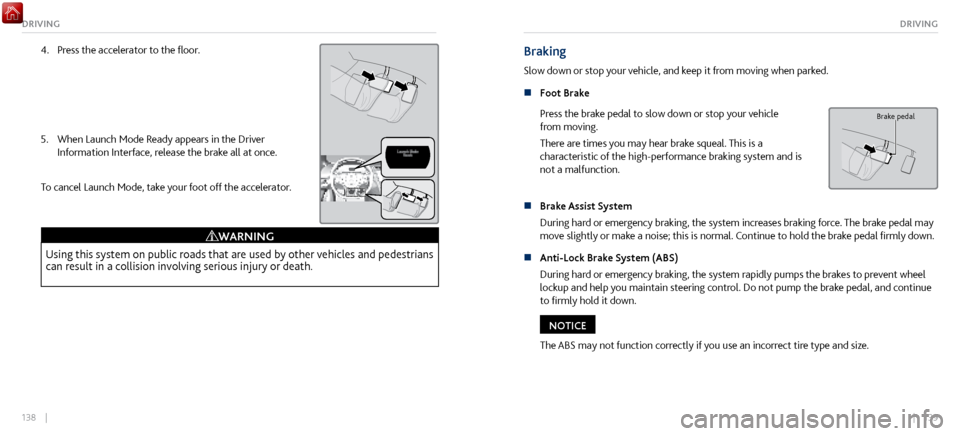
4. Press the accelerator to the floor.
5.
When Launch Mode Ready appears in the Driver
Information Interface, r
elease the brake all at once.
To cancel Launch Mode, take your foot off the accelerator.
Using this system on public roads that are used by other vehicles and pedestrians
can result in a collision involving serious injury or death.
WARNING
Braking
Slow down or stop your vehicle, and keep it from moving when parked.
n
Foot Brake
Press the
brake pedal to slow down or stop your vehicle
from moving.
There are times you may hear brake squeal. This is a
characteristic of the high-performance braking system and is
not a malfunction.
Brake pedal
n Brake Assist System
During hard or emer
gency braking, the system increases braking force. The brake pedal may
move slightly or make a noise; this is normal. Continue to hold the brake pedal firmly down.
n
Anti-Lock Brake System (ABS)
During har
d or emergency braking, the system rapidly pumps the brakes to prevent wheel
lockup and help you maintain steering control. Do not pump the brake pedal, and continue
to firmly hold it down.
The ABS may not function correctly if you use an incorrect tire type and size.
NOTICE
Page 73 of 116

140 || 141
DRIVINGDRIVING
n Parking Brake
Keep the
vehicle from moving when it is parked.
To apply: Pull up the switch. The parking brake indicator
appears in the instrument panel.
To release: Press the brake pedal and make sure your seat
belt is fastened. Press the switch down to release.
You can also lightly press the accelerator pedal if your seat
belt is fastened, the vehicle is on, and not in Park or Neutral.
Electric Parking Brake Switch
Electric Parking Brake Switch
Accelerator Pedal
Automatic Brake Hold
Maintains rear brake hold even after the brake pedal is released. Make sure the vehicle is on and
your seat belt is fastened when operating this feature.
1.
Press the BRAKE HOLD button. The BRAKE HOLD indicator
appears in
the instrument panel.
2.
With the transmission in D, M, or N, pr
ess the brake pedal and
come to a complete stop. The HOLD indicator appears, and
brake hold is applied. Release the brake pedal.
Press the accelerator pedal to cancel brake hold and start
moving.
Accelerator Peda lBrake PedalAutomatic Brake
Hold Button
Off
On OnGoes
On
On
On
U.S.
Canada
Accelerator Peda
lBrake PedalAutomatic Brake
Hold Button
Off
On OnGoes
On
On
On
U.S.
Canada
To turn off brake hold: Press the brake pedal and press the BRAKE
HOLD button again.
Automatic brake hold cancels when:
•
Braking is applied for more than 10 minutes.
•
The driver’
s seat belt is unfastened.
•
The power system is turned off.
Accelerator Peda lBrake PedalAutomatic Brake
Hold Button
Off
On OnGoes
On
On
On
U.S.
Canada
Page 74 of 116

142 || 143
DRIVINGDRIVING
Using the automatic brake hold system on steep hills or slippery roads may still
allow the vehicle to move if you remove your foot from the brake pedal.
If a vehicle unexpectedly moves, it may cause a crash resulting in serious injury or
death.
Never use the automatic brake hold system or rely on it to keep a vehicle from
moving when stopped on a steep hill or slippery roads.
WARNING
Using the automatic brake hold system to park the vehicle may result in the vehicle
unexpectedly moving.
If a vehicle moves unexpectedly, it may cause a crash, resulting in serious injury or
death.
Never leave the vehicle when braking is temporarily kept by automatic brake hold
and always park the vehicle by putting the transmission in Park (P) and applying the
parking brake.
WARNING
Cruise Control
Maintain a constant vehicle speed without having to keep your foot on the accelerator pedal.
Use cruise control on freeways or open roads where you can travel at a constant speed with
little acceleration or deceleration.
CRUISE MAIN is on in
the instrument panel .
Cruise control is ready to
use.
Press the CRUISE button on
the steering wheel.
Improper use of cruise control can lead to a crash.
Use cruise control only when traveling on open highways in good weather.
WARNING
Page 75 of 116

144 || 145
DRIVINGDRIVING
n Activating and Setting the Vehicle Speed
Press the CRUISE
button.
Accelerate to the desired speed (above 25 mph). Press the
SET/– part of the switch and take your foot off the pedal.
RES/+ /SET/ Switch
Press down and release
n Adjusting the Vehicle Speed
Press the RES/+
section of the switch to increase speed or the
SET/– section to decrease speed.
Each time you press the switch, the vehicle speed changes by
about 1 mph (1.6 km/h). If you keep the switch pressed, the
vehicle speed increases or decreases until you release it.
To increase speed
To decrease speed
n Canceling Cruise Control
Press either the CANCEL or CRUISE buttons, or press the
brake pedal.
After cruise control has been canceled, you can still resume
the prior set speed by pressing the RES/+ part of the switch
while driving at a speed of at least 25 mph (40 km/h).
Press the CRUISE button to turn the system off.
ButtonCANCEL
CRUISE
Button
Vehicle Stability Assist® (VSA®)
Also known as Electronic Stability Control (ESC), VSA helps stabilize the vehicle during cornering
if the vehicle turns more or less than what was intended. It assists in maintaining traction on
slippery surfaces by regulating engine output and selectively applying the brakes.
n
Turning VSA On or Off
VSA is turned on
every time you turn on the vehicle, even if you previously turned it off. If
you turn VSA off, your vehicle has normal braking and cornering ability, but not VSA traction
and stability enhancement.
To turn VSA on or off, press and hold the VSA OFF button
until you hear a beep. The VSA OFF indicator appears when
the system is off.
Turning VSA off also turns off traction control. That may make
it easier to free your vehicle if it is stuck in mud or snow.
VSA® OFF Indicator
Page 78 of 116

150 || 151
DRIVINGDRIVING
High-Performance Driving
Your Acura NSX is designed, built and equipped with systems and features to provide you with
exceptional driving performance, including the ability to engage in high-performance driving.
However, due to the risks to both you and other road users, including the risk of injury or death
from a high-speed loss of control or crash, if you engage in high-performance driving, Acura
recommends you only do so where conditions are controlled, such as at a track or other closed-
course venue. When driving on public roads you should always obey the posted speed limits
and other traffic laws, reduce speed as needed for traffic and environmental conditions, and
not engage in driving behaviors (including, for instance, use of Launch Control) that may create
heightened risks for yourself and any other road users who may be present (even if you are
unaware of them).
The NSX warranty does not cover any damage or failure resulting from high-performance
driving, competitive driving of any sort whatsoever, or use on a track or similar-type venue. See
warranty book for details.
NOTICE
NSX Track Mode (see page 136), Launch Control (see page 137) and other systems are
designed for increased performance, both in terms of acceleration and handling, up to near-
performance-limit conditions. They are most appropriately used on closed courses and they
should not be used on public roads. Use of these systems may delay the intervention of vehicle
safety systems designed to minimize the risk of a loss of traction or steering control, and can
cause the NSX to handle differently than you might expect or would experience under normal
driving conditions. Use of these systems will not make up for a lack of appropriate driver experience and skill, and
will not allow the driver to overcome risks created by:
•
A lack of proper v
ehicle maintenance
•
Less than ideal road conditions and/or unfamiliarity with
the driving environment
•
Other traffic or road users
High-performance
driving requires special skills, knowledge and experience, as the safety
risks are greatly increased when the NSX is operated at its upper performance abilities. As
a responsible NSX driver, you should not drive above your skill limits or training, even if the
NSX’s performance levels would otherwise allow you to do so. If you intend to engage in high-
performance driving, Acura strongly recommends that:
•
You first obtain appr
opriate, professional training
•
Wear the appropriate
driving clothing and gear (e.g., helmet, gloves and driving shoes)
•
Be fully rested and alert (fr
ee of drugs or alcohol)
•
Turn off any devices or systems that
may distract you from the driving task
High-performance driving in general, and the use of Track Mode and Launch Control in
particular, puts very high loads on the NSX and its components, and results in greater wear and
tear on the vehicle. Because of these high loads, if your NSX is not in top condition or if certain
components, such as the brakes or tires, have undue wear, those components could experience
a loss of performance, or fail, when subjected to the additional loads. Therefore, Acura highly
recommends that you undertake more proactive and frequent maintenance than that required
under normal use and have your vehicle inspected at an authorized Acura NSX dealer (and all
necessary repairs or adjustments made) before you engage in any high-performance driving.
In addition to any required maintenance, there are certain NSX specific items and protocols that
you should pay special attention to before, during and after engaging in any high-performance
Page 79 of 116

152 || 153
DRIVINGDRIVING
driving. Ultimately, the decision whether to engage in high-performance driving is yours, and
depending on your NSX’s condition and prior usage, the items and protocols listed below may
or may not be sufficient to ensure a safe driving experience.
n
BEFORE DRIVING
•
With the vehicle park
ed on level ground, properly bleed brake system after replacing with
new Honda DOT 4 brake fluid or equivalent.
•
Inspect brake pad thickness and replace if 6.0mm
or less.
•
Burnish the brake pads so that
they have the performance characteristics necessary
to repeatedly and quickly slow the NSX when it is being operated at significantly high
speeds. (While the NSX’s brake pads are properly burnished for the demands expected in
ordinary day-to-day driving, high performance driving puts unique demands on the brake
system which require further burnishing.) A high performance burnish at the driving venue
prior to the first session of the day is highly recommended.
•
Inspect ALL cooling openings to confirm
they are open and free of debris such as leaves,
etc. Cooling openings include engine undercover ducts, heat resistance ducts, brake ducts,
radiators, and intercoolers.
•
Remove
Tire Repair Kit from the trunk, along with any other cargo area contents.
•
Check tire wear and
tire pressure, and make certain wheel lug bolts are properly torqued,
as driving at high speed puts additional strain on tires and wheels. Never use slick tires,
and do not use Summer Only tires and Ultra High Performance tires if temperatures will
be lower than 45°F (7°C).
•
If you anticipate sustained driving at speeds gr
eater than 168 mph/270 km/h, adjust the
cold tire pressure as shown on the driver door jamb warning label. This will help avoid heat
build-up and sudden tire failure.
If driving at high speeds (over 168mph/270km/h),
adjust cold tire pressure as show n below to avoid
ex cess heat buildup and sudden tire failur e.
DRIVING SPEED TIRE COLD TIRE PRESSUREOVER
168 mph/ 270 km/h FRONT
REAR 260
KPA, 38 PSI
260 KPA, 38 PSI
WARNINGIf driving at high\6 speeds (o ver 16\fmph/2\b0km/h),
adjust cold tire pr\6essure as shown be\6low to avoid
ex cess heat buildup a\6nd sudden tire fai\6lure. Pour conduire à gra\6nde vitesse (plus d\6e 16\f mph /
2\b0 km/h) ajuster la \6pression des pneus\6 à froid, comme
indiqué ci-dessous\6, afn d’éviter l’ac\6cumulation e xcessive
de chaleur et une d\6éfaillance soudaine \6du pneu.
DRIVING SPEED VITESSE DE CONDUITE COLD TIRE PRESSURE PRESSION DES PNEUS À FROIDTIRE/ PNEU
FRONT/AVANT
REAR/ARRIÈRE260 KPA, 38 PSI
260 KPA, 38 PSI
OVER/ PLUS DE
168 mph/ 270 km/h
WARNINGATTENTION
U.S. models Canadian models
Doorjamb
2DAAAA
Use of slick tires/racing slicks may subject the chassis and body components to
higher dynamic loads than they were designed for.
Higher than intended dynamic loads could result in component failure, loss of
control, and serious injury or death to you or others.
Do not install slick tires on the NSX.
WARNING
• Inspect all exhaust mounts for cracks or signs of
wear.
•
Inspect tailpipe active exhaust val
ves to ensure they are functioning correctly. You can
do this by cycling the IDS switch between SPORT and TRACK modes, while the engine is
idling.
Page 80 of 116

154 || 155
DRIVINGDRIVING
n While Driving
•
You may see a brake warning message in
the Driver
Information Interface (and warning message chime) and/
or experience increased brake pedal stroke. If either occurs,
immediately slow down and allow for increased stopping
distances. The message will disappear once the brakes have
cooled and the system has returned to normal operating
condition.
• After high-performance driving, it is critical to allow your vehicle to properly cool down.
Do not immediately stop your vehicle. Instead, continue driving at reduced speeds,
allowing for increased braking distances until your vehicle returns to normal operating
temperatures. Once you stop and safely park the NSX, open the hatch to aid cooling. If
the engine oil temperature reaches the H mark during high-performance driving, have
your NSX inspected by an authorized Acura NSX dealer.
n
AFTER DRIVING
Check your NSX, and each of its r
elevant components, to make sure that it still is in a safe
operating condition (example: wheel lug bolt torque, tire pressure, etc.). We recommend
you repeat the Before Driving protocol. If any item shows excessive wear or appears to be
in an unusual condition, have it replaced, or exercise appropriate caution when driving and
see your authorized Acura NSX dealer
For more information, please contact your authorized Acura NSX dealer, and/or Acura Client
Relations (see page 213).
Cold or Rainy Weather Driving
Summer-only and Ultra High Performance (UHP) tires are very sensitive to ambient
temperatures and are designed to be used at temperatures above 45°F (7°C). Below that
temperature, Summer-only and UHP tires provide decreasing amounts of grip and other
performance attributes. At temperatures below -4°F (-20°C), the tire treads may become
brittle, resulting in permanent damage to the tread. A damaged tire may fail during use.
Therefore, if you will operate the vehicle when temperatures are below 45°F (7°C), we
recommend you install other tires (e.g., mud+snow, winter) designed to perform under the
expected conditions.
Use of Summer-only or Ultra High Performance tires at temperatures below 45°F
(7°C) may lead to a loss of performance and control, which could result in a crash,
serious injury or death.
WARNING
Your NSX is equipped with ultra-high-performance summer-only tires that, due to their
decreased tread depth, are at greater risk of hydroplaning on wet roads compared to regular
tires. Exercise caution when driving on wet surfaces.
Page 81 of 116
156 || 157
HANDLING THE UNEXPECTEDHANDLING THE UNEXPECTED
HANDLING THE UNEXPECTED
Learn about what to do in critical or emergency situations.
Keyless Access Remote Battery Strength
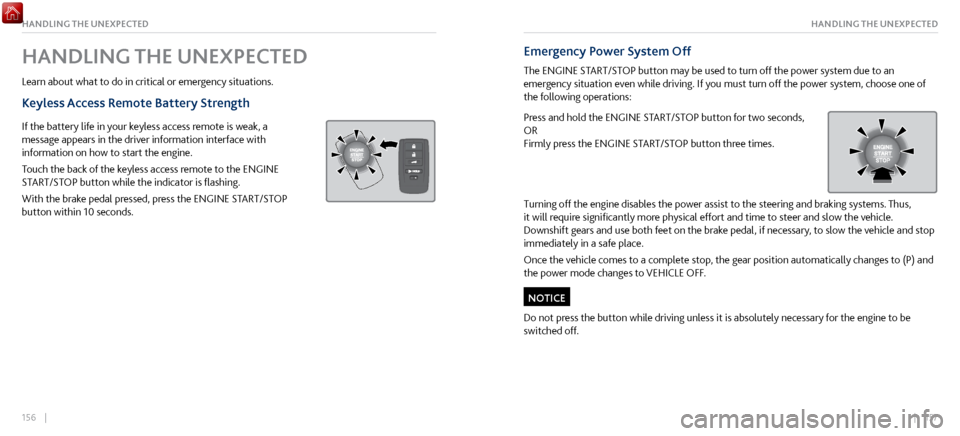
If the battery life in your keyless access remote is weak, a
message appears in the driver information interface with
information on how to start the engine.
Touch the back of the keyless access remote to the ENGINE
START/STOP button while the indicator is flashing.
With the brake pedal pressed, press the ENGINE START/STOP
button within 10 seconds.
Emergency Power System Off
The ENGINE START/STOP button may be used to turn off the power system due to an
emergency situation even while driving. If you must turn off the power system, choose one of
the following operations:
Press and hold the ENGINE START/STOP button for two seconds,
OR
Firmly press the ENGINE START/STOP button three times.
Turning off the engine disables the power assist to the steering and braking systems. Thus,
it will require significantly more physical effort and time to steer and slow the vehicle.
Downshift gears and use both feet on the brake pedal, if necessary, to slow the vehicle and stop
immediately in a safe place.
Once the vehicle comes to a complete stop, the gear position automatically changes to (P) and
the power mode changes to VEHICLE OFF.
Do not press the button while driving unless it is absolutely necessary for the engine to be
switched off.
NOTICE
Page 86 of 116

166 || 167
HANDLING THE UNEXPECTEDHANDLING THE UNEXPECTED
Tire Repair Kit
If a tire has a small puncture, you can use the tire repair kit to temporarily repair it. The puncture
must be smaller than 3/16-inch (4 mm) and not in the tire sidewall. Go to a authorized Acura
NSX dealer to have the full-size tire permanently repaired or replaced.
n
Before Repairing
the Tire
•
Park the v
ehicle on a firm, level, and non-slippery surface.
•
Make sure the
vehicle is in Park (P), and apply the parking brake.
•
Turn on the hazard warning
lights, and turn the power system off. n
Getting Ready to R
epair the Tire
1. Open the hatch.
2.
Loosen the tool box tie-downs and
remove the tool box
lid.
3.
Take the kit out of the tool
box.
4.
Place the kit face up on
flat ground near the punctured
tire and away from traffic. Do not place the kit on its side.
Follow the instructions in the kit to repair the tire.Lid Tie Down
Tire Repair Kit
Do not use an unapproved puncture-repairing agent other than the one provided in the kit
that came with your vehicle. If a different agent is used, you may permanently damage the
tire pressure sensor.
NOTICE
Page 87 of 116
168 || 169
HANDLING THE UNEXPECTEDHANDLING THE UNEXPECTED
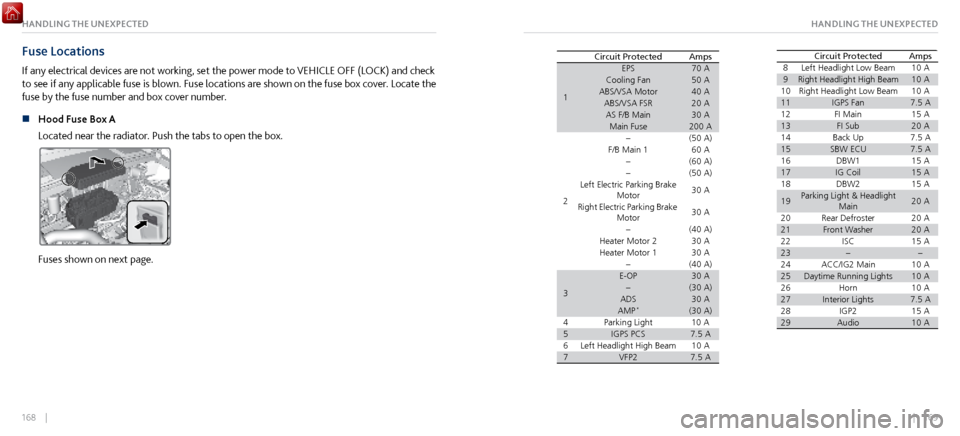
Fuse Locations
If any electrical devices are not working, set the power mode to VEHICLE OFF (LOCK) and check
to see if any applicable fuse is blown. Fuse locations are shown on the fuse box cover. Locate the
fuse by the fuse number and box cover number.
n
Hood Fuse Box A
Located near the
radiator. Push the tabs to open the box.
Fuses shown on next page.
Circuit Protected Amps
1
70A50A40A20A30A200A
2(50 A) 60 A
(6 0A )
(5 0A )
30 A
30 A
(4 0A )
30 A
30 A
3
(40A )30A(30 A)30A
4 (30 A)10
A
57.5A
610 A
77.5ALeft Headlight High Beam VFP2EPS
Cooling Fan
ABS/VSA Motor ABS/VSA FS R
AS F/B Main Main Fuse
F/B Main 1
Left Electric Parking Brake Motor
Right Electric Parking Brake Motor
Heater Motor 2
Heater Motor 1
E-OP
ADS
AMP
*
Parking Light IGPS PCS 8
Left Headlight Low Beam 10 A
9Right Headlight High Beam
10 10
A
Right Headlight Low Beam10 A
11IGPS Fan 7.5 A
12 FI Main15A
13FI Sub14 20
A
Back Up7.5A
15SBW ECU16 7.5 A
DBW 115A
17IG Coil15 A
18 DBW215A
19Parking Light & Headlight Main 20
A
20 Rear Defroste r
20A
21Front Washer 20A
22 ISC15A
23
24 ACC/IG2 Main 10 A
2510 A
26 Daytime Running Lights
Horn10A
27Interior Lights 7.5 A
28 IGP215A
29Audio10 A
AmpsCircuit Protecte dCircuit Protected Amps
1
70A50A40A20A30A200A
2(50 A) 60 A
(6 0A )
(5 0A )
30 A
30 A
(4 0A )
30 A
30 A
3
(40A )30A(30 A)30A
4 (30 A)10
A
57.5A
610 A
77.5ALeft Headlight High Beam VFP2EPS
Cooling Fan
ABS/VSA Motor ABS/VSA FS R
AS F/B Main Main Fuse
F/B Main 1
Left Electric Parking Brake Motor
Right Electric Parking Brake Motor
Heater Motor 2
Heater Motor 1
E-OP
ADS
AMP
*
Parking Light IGPS PCS 8
Left Headlight Low Beam 10 A
9Right Headlight High Beam
10 10
A
Right Headlight Low Beam10 A
11IGPS Fan 7.5 A
12 FI Main15A
13FI Sub14 20
A
Back Up7.5A
15SBW ECU16 7.5 A
DBW 115A
17IG Coil15 A
18 DBW215A
19Parking Light & Headlight Main 20
A
20 Rear Defroste r
20A
21Front Washer 20A
22 ISC15A
23
24 ACC/IG2 Main 10 A
2510 A
26 Daytime Running Lights
Horn10A
27Interior Lights 7.5 A
28 IGP215A
29Audio10 A
AmpsCircuit Protecte d