maintenance Acura NSX 2017 Owner's Manual
[x] Cancel search | Manufacturer: ACURA, Model Year: 2017, Model line: NSX, Model: Acura NSX 2017Pages: 116, PDF Size: 7.19 MB
Page 100 of 116

194 || 195
MAINTENANCEMAINTENANCE
The battery gives off explosive hydrogen gas during normal operation.
A spark or flame can cause the battery to explode with enough force to kill or
seriously hurt you.
When conducting any battery maintenance, wear protective clothing and a face
shield, or have a skilled technician do it.
WARNING
WARNING: Battery posts, terminals, and related accessories contain lead and lead compounds.
Wash your hands after handling.
Changing Wiper Blades
If the wiper blades leave streaks across the windshield, try cleaning them first with a paper towel
or soft cloth and wiper fluid. If the wiper blade rubber has deteriorated, you should change the
wiper blades.
1.
Hold the wiper switch in MIST as y
ou change the power
mode to VEHICLE OFF (LOCK). The wiper arms will move into
the service position.
2. Lift both wiper arms.
3. For each wiper, press and hold the tab, then slide the wiper
blade holder out fr om the wiper arm.
Tab
Page 101 of 116

196 || 197
MAINTENANCEMAINTENANCE
4. Push to compress the wiper blade until it clears the end cap,
then pull to slide it up and out
of the holder.
Holder
5. Slide the new wiper blade into the holder and secure the end
into the cap. Slide the blade holder onto the wiper arm until
it clicks, then lower the arm.
6.
Set the power mode to ON. Hold
the wiper switch in MIST
until the wiper arms return to their normal position..Wiper Blade
the bottomEnd Cap at
Avoid dropping the wiper arm, as it may damage the windshield.
NOTICE
Tire Information
To safely operate your vehicle, your tires must be of the proper type and size, in good condition
with adequate tread, and properly inflated.
n
Inflation Guidelines
Properly inflated tir
es provide the best combination of handling, tread life, and comfort.
Refer to the driver’s doorjamb label or the specifications (see page 127) for the specified
pressure.
Underinflated tires wear unevenly, adversely affect handling and fuel economy, and are
more likely to fail from overheating.
Overinflated tires make your vehicle ride harshly, are more prone to road hazards, and wear
unevenly.
Every day before you drive, look at each of the tires. If one looks lower than the others,
check the pressure with a tire gauge.
Measure the air pressure when tires are cold. This means the vehicle has been parked for at
least 3 hours, or driven less than 1 mile (1.6 km). If necessary, add or release air until the
specified pressure is reached. If checked when hot, tire pressure can be as much as 4-6 psi
(30-40 kPa, 0.3-0.5 kgf/cm
2) higher than checked when cold.
At least once a month or before long trips, use a gauge to measure the pressure in all tires,
including the spare. Even tires in good condition can lose 1-2 psi
(10-20 kPa, 0.1-0.2 kgf/cm
2) per month.
Page 102 of 116
198 || 199
MAINTENANCEMAINTENANCE
n Inspection Guidelines
Every time you inflate the tir
es, check for the following:
•
Any damage to
tires, including bumps, bulges, cuts, splits, or cracks in the side or tread.
Remove any foreign objects and inspect for air leaks. Replace tires if you see fabric or cord.
•
Uneven or excessiv
e tread wear. Have an authorized Acura NSX dealer check the wheel
alignment.
•
Cracks or other damage around the val
ve stems.
n
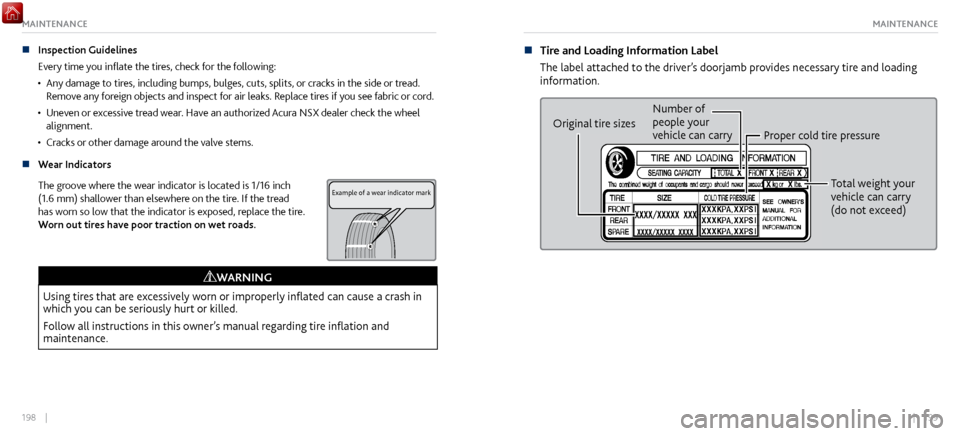
Wear Indicators
The groov
e where the wear indicator is located is 1/16 inch
(1.6 mm) shallower than elsewhere on the tire. If the tread
has worn so low that the indicator is exposed, replace the tire.
Worn out tires have poor traction on wet roads.
Example of a wear indicator mark
Using tires that are excessively worn or improperly inflated can cause a crash in
which you can be seriously hurt or killed.
Follow all instructions in this owner’s manual regarding tire inflation and
maintenance.
WARNING n
Tire and Loading Information Label
The label attached to the
driver’s doorjamb provides necessary tire and loading
information.
Original tire sizes Number of
people your
vehicle can carry
Proper cold tire pressure
Total weight your
vehicle can carry
(do not exceed)
Page 103 of 116

200 || 201
MAINTENANCEMAINTENANCE
n Tire and Wheel Replacement
Replace y
our tires with radials of the same size, load range, speed rating, and maximum
cold tire pressure rating (as shown on the tire’s sidewall). Using tires of a different size or
construction can cause certain vehicle systems to work incorrectly. It is best to replace all
four tires at the same time. If that isn’t possible, replace the front or rear tires in pairs.
If you change or replace a wheel, make sure that the wheel’s specifications match those of
the original wheels. Only use TPMS-specified wheels approved for your vehicle.
Installing improper tires on your vehicle can affect handling and stability.
This can cause a crash in which you can be seriously hurt or killed.
Always use the size and type of tires recommended in the owner’s manual.
WARNING
n Tire Service Life
The life of y
our tires is dependent on many factors, including driving habits, road conditions,
vehicle loading, inflation pressure, maintenance history, speed, and environmental
conditions (even when the tires are not in use).
In addition to regular inspections and inflation pressure maintenance, it is recommended
that you have annual inspections performed once the tires reach five years old. All tires,
including the spare, should be removed from service after 10 years from the date of
manufacture, regardless of their condition or state of wear. n
Winter Tires
If driving on snowy
or frozen roads, mount all season tires marked “M+S”, snow tires, or
tire chains; reduce speed; and maintain sufficient distance between vehicles when driving.
For winter tires, select the size and load ranges that are the same as the original tires, and
mount them to all four wheels.
n
Tire Chains
Tire chains can be used onl
y in conjunction with winter tires. Install tire chains on the rear
tires only.
For 295/30R20 (97V) winter tires: Auto-trac 232405
For 305/30R20 (103W) XL winter tires: K-Summit K-44
Mount chains as tightly as you can, and make sure that they do not touch the brake lines or
suspension.
Using the wrong chains, or not properly installing chains, can damage the brake
lines and cause a crash in which you can be seriously injured or killed.
Follow all instructions in this guide regarding the selection and use of tire chains.
WARNING
Traction devices that are the wrong size or improperly installed can damage your vehicle’s
brake lines, suspension, body, and wheels. Stop driving if they are hitting any part of the
vehicle.
NOTICE
Page 104 of 116

202 || 203
MAINTENANCEMAINTENANCE
Tire Labeling
The tires that came on your vehicle have a number of markings. Those you should be
aware of are described below.
Here is an example of what each marking means:
• P235/60R18 102V
•
P: vehicle type (passenger)
•
235: tire width in millimeters
•
60: aspect ratio (tire section height as a percentage
of its width)
•
R: tire construction code (radial)
•
18: rim diameter in inches
•
102: load index (code indicating maximum load tire can
carry)
•
V: speed symbol (code indicating maximum speed
rating)
Example Tire size
Tire
Identication
Number (TIN)
Ma ximum
ti re load
Maximum
tire pressure
Tire siz e
n Tire Identification Number (TIN)
The tire identification number (TIN) is a gr
oup of
numbers and letters that look like the example shown.
TIN is located on the sidewall of the tire.
DOT B97R FW6X 2209
DOT: This indicates that the tire meets all
requirements of the U.S. Department of
Transportation.
B97R: Manufacturer’s identication mark.
FW 6X: Tire type code.
22 09: Date of manufacture.
Year
Week
n Glossary of Tire Terminology
Cold Tire Pressure – The tire air pressure when the vehicle has been parked for at
least three hours or driven less than 1 mile (1.6 km).
Load Rating – The maximum load that a tire is rated to carry for a given inflation
pressure.
Maximum Inflation Pressure – The maximum tire air pressure that the tire can
hold.
Maximum Load Rating – The load rating for a tire at the maximum permissible
inflation pressure for that tire.
Recommended Inflation Pressure – The cold tire inflation pressure recommended
by the manufacturer.
Treadwear Indicators (TWI) – The projections within the principal grooves
designed to give a visual indication of the degrees of wear of the tread.
Page 105 of 116

204 || 205
MAINTENANCEMAINTENANCE
DOT Tire Quality Grading
The tires on your vehicle meet all U.S. Federal Safety Requirements. All tires are also graded for
treadwear, traction, and temperature performance according to Department of Transportation
(DOT) standards. The following explains these gradings.
n
Uniform Tire Quality Grading
Quality grades can be found
where applicable on the tire sidewall between tread shoulder
and maximum section width.
For example:
Treadwear 200
Traction AA
Temperature A
All passenger car tires must conform to Federal Safety Requirements in addition to these
grades.
n
Treadwear
The tr
eadwear grade is a comparative rating based on the wear rate of the tire when tested
under controlled conditions on a specified government test course. For example, a tire
graded 150 would wear one and one-half (1 1/2) times as well on the government course as
a tire graded 100. The relative performance of tires depends upon the actual conditions of
their use, however, and may depart significantly from the norm due to variations in driving
habits, service practices, and differences in road characteristics and climate. n
Traction
The traction grades,
from highest to lowest, are AA, A, B, and C. Those grades represent the
tire’s ability to stop on wet pavement as measured under controlled conditions on specified
government test surfaces of asphalt and concrete. A tire marked C may have poor traction
performance.
WARNING: The traction grade assigned to this tire is based on straight-ahead braking
traction tests, and does not include acceleration, cornering, hydroplaning, or peak traction
characteristics.
n
Temperature
The
temperature grades are A (the highest), B, and C, representing the tire’s resistance to the
generation of heat and its ability to dissipate heat when tested under controlled conditions
on a specified indoor laboratory test wheel. Sustained high temperature can cause the
material of the tire to degenerate and reduce tire life, and excessive temperature can lead to
sudden tire failure. The grade C corresponds to a level of performance which all passenger
car tires must meet under the Federal Motor Vehicle Safety Standard No. 109. Grades B and
A represent higher levels of performance on the laboratory test wheel than the minimum
required by law.
WARNING: The temperature grade for this tire is established for a tire that is properly
inflated and not overloaded. Excessive speed, underinflation, or excessive loading, either
separately or in combination, can cause heat buildup and possible tire failure.
Page 106 of 116

206 || 207
MAINTENANCEMAINTENANCE
Testing of Readiness Codes
Your vehicle has readiness codes as part of the onboard self-diagnostic system. Some states use these
codes for testing to verify your vehicle’s emissions components are working properly. The codes may
not be read if you go through the testing just after the battery has gone dead or been disconnected.
To check if they are set, turn the vehicle on without starting the engine. The malfunction indicator
lamp will come on for several seconds. If it goes off, the readiness codes are set. If it blinks five times,
the readiness codes are not set.
If you are required to have your vehicle tested before the readiness codes are set, prepare the vehicle
for retesting by doing the following:
1.
Fill the gas tank to appro
ximately 3/4 full.
2.
Park the v
ehicle and leave the power system off for 6 hours or more.
3.
Make sure the ambient
temperature is between 40°F and 95°F (4°C and 35°C).
4.
Turn the power system on without
touching the accerator pedal, and let it idle for 20 seconds.
5.
Still in Park (P), increase the engine speed
to 2.000 rpm and hold it for about three minutes.
6.
Let the engine idle for 20 seconds without
touching the accelerator.
7.
Select a nearby, lightly
traveled major highway where you can maintain a speed of 50 mph (80
km/h) for at least 20 minutes. Drive on the highway with the vehicle in D and in SPORT mode. Do
not use cruise control.
8.
Drive in city or suburban traffic
for at least 10 minutes. When traffic conditions allow, let the
vehicle coast for several seconds without using the accelerator pedal or the brake pedal.
9.
Park the v
ehicle and leave the power system off for 40 minutes.
The readiness codes are erased when the battery is disconnected, and set again only after several
days of driving under a variety of conditions.
If a testing facility determines that the readiness codes are not set, you may be requested to return at
a later date to complete the test, or see your authorized Acura NSX dealer.
Long-Term Storage
If you need to park your vehicle for an extended period (more than one month), there are
several things you should do to prepare it for storage. This helps reduce possible deterioration of
vehicle components and overall condition, which allows you to get the vehicle back on the road
with minimal delay. These are:
•
If possible, store your NSX in a garage
or enclosed area.
•
Fill the fuel tank completely
.
•
Change the engine oil and filter
.
•
Wash and dry the exterior completel
y.
•
Clean the interior. Make sur
e the carpeting, floor mats, etc., are completely dry.
•
Put the transmission in (P). Release
the parking brake.
•
Leave one window
open slightly (if the vehicle is being stored indoors).
•
Connect the 12-volt battery
to an accessory battery charger. For more information on how
to maintain your 12-volt battery, consult an authorized Acura NSX dealer.
•
If the vehicle is
to be stored for a longer period of time, it should be supported on jack
stands to raise the tires off the ground to prevent tire flat spotting. Consult an authorized
Acura NSX dealer for information about the correct jack stands.
•
Support the front wiper
blade arms with a folded towel or rag so they do not touch the
windshield.
•
Cover
the vehicle with a breathable cover, one made from a porous material such as cotton.
Nonporous materials (such as plastic sheeting) may trap moisture, which can damage the
paint.
Page 107 of 116
208 || 209
SPECIFICATIONSMAINTENANCE
• If possible, remove the vehicle from the garage or enclosed area, remove covering, and
periodically run the engine until it reaches full operating temperature (the cooling fan cycles
on and off twice). Preferably, do this once a month.
•
To maintain the High V
oltage battery, drive your vehicle for more than 30 minutes at least
once every three months.
If road conditions are not suitable or desirable for driving, the following alternate procedure can
be used to maintain the vehicle’s High Voltage battery if local laws permit idling:
1.
Remove
the vehicle from the garage or enclosed area to prevent carbon monoxide
accumulation.
2.
Depress the brake pedal and pr
ess the ENGINE START/STOP button as you normally would
to start the vehicle.
3.
Allow the vehicle
to run for 30 minutes. Time spent at idle stop still counts as part of this
30-minute run.
Paint Care
Your vehicle’s paint requires up to 60 days from the production date to fully cure. During this
time, avoid applying any wax or paint sealant-type products, as they could hinder the curing
process and affect the paint’s durability.
You may polish the paint during these 60 days if the polishes do not contain any wax or paint
sealant ingredients. Use only clean, high-quality microfiber towels or pads, as they are softer
material and have less chance of scratching the finish. It is absolutely necessary to keep the
microfiber towels or pads properly cleaned and maintained before using on your vehicle.
For more information, contact an authorized Acura NSX dealer. n
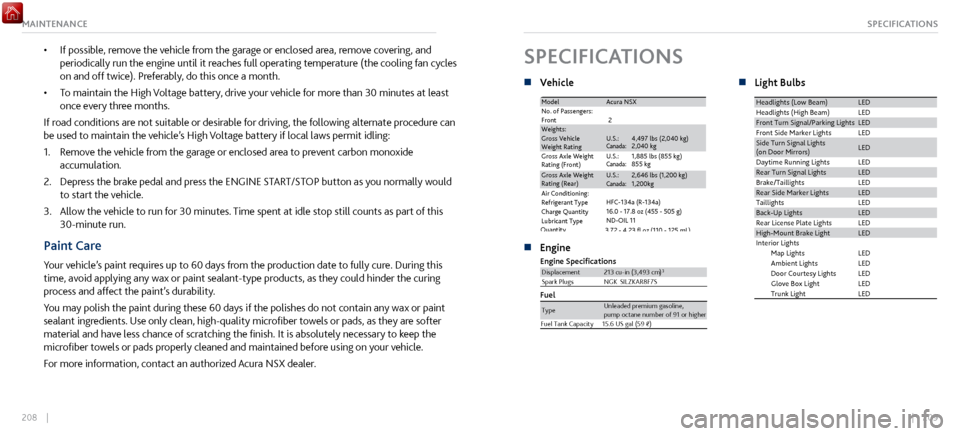
Vehicle
ModelAcura NSX
No. of Passengers :
Front 2
Weights:Gross Vehicle
Weight RatingU.S. :4,497 lbs (2,040 kg)Canada :2,040 kgGross Axle Weight
Rating (Front)U.S.:1 ,885 lbs (855 kg)Canada :855 kgGross Axle Weight
Rating (Rear)U.S.:2,646 lbs (1,200 kg)Canada :1,200kg
Air Conditioning:
Refrigerant Type
Charge Quantit y
Lubricant Type
HFC-134a (R-134a) 16.0 - 17.8 oz (455 - 505 g)
ND-OIL 11
Quantity3.72 - 4.23 oz (110 - 125 mL)
n Engine
Fuel
Engine Specification sDisplacement 213 cu-in (3,493 cm3)
NG K
Spark PlugsSILZKAR8F7S
Unleaded premium gasoline,
Type
pump octane number of 91 or higher
Fuel Tank Capacity 15.6 US gal (59 ℓ)
n Light Bulbs
LE DLEDLEDLED
LED
LEDLEDLEDLEDLEDLEDLEDLED
LEDLEDLEDLEDLED
Map Lights
Ambient Lights
Door Courtesy Lights
Glove Box Ligh t
Trunk Light
Headlights (Low Beam )Headlights (High Beam )
Front Turn Signal/Parking Lights
Front Side Marker Lights
Side Turn Signal Lights
(on Door Mirrors)
Daytime Running Lights
Rear Turn Signal Lights
Brake/Taillights
Rear Side Marker Lights
Taillights
Back-Up Lights
Rear License Plate Lights
High-M ount Brake Ligh t
In terior Lights
SPECIFICATIONS
Page 115 of 116

224 || 225
VOICE COMMAND INDEXVOICE COMMAND INDEX
Cruise control ................................................................. 143
Adjusting the Vehicle Speed ................................... 144
Canceling Cruise Control ......................................... 144
Setting the Vehicle Speed ....................................... 144
Customized features ....................................................... 78
Devices That Emit Radio W
aves
................................. 216
Display Audio .................................................................. 84
Apps or Widgets .......................................................... 85
Changing Icon Order .................................................. 85
Wi-Fi Connection ........................................................ 87
Doors Auto Pop-Out Main S
witch
...................................... 55
Door Operation ........................................................... 57
Inner Handle ................................................................ 58
Lock tab ........................................................................\
. 57
Master door-lock switch ............................................ 57
Unlocking/Locking the Doors ................................... 55
Unlocking the Hatch .................................................. 56
Driver Information Interface ......................................... 51
Driving Changing the Power Mode
...................................... 131
Cold Weather
Driving
............................................... 155
Electronic Gear Selector .......................................... 132
Emergency Shutdown ................................................ 18
Exterior Checks .......................................................... 125
High-Performance Driving ...................................... 150
Integrated Dynamics System (IDS) ....................... 136
Interior Checks ........................................................... 126
Launch Control .......................................................... 137
Rear camera ............................................................... 147
Refueling ..................................................................... 148
Sequential Shift Mode ............................................. 133Emergency engine stop
................................................
157
Exterior lights .................................................................. 60
Floor mats ........................................................................\
. 69
FM Radio Commands ................................................... 221
Frequentl
y-asked questions
........................................ 211
Fuses Changing
..................................................................... 1 74
Location ...................................................................... 168
HandsFr
eeLink
................................................................ 101
Call history ................................................................. 107
Dialing ........................................................................\
104
E-mail ........................................................................\
. 108
Pairing a phone ..................................................... 8, 103
Phonebook ................................................................. 105
Siri Eyes-Fr
ee
.............................................................. 109
SMS text messaging ................................................ 108
Speed dial .......................................................... 106, 107
TALK button ............................................................... 102
Voice recognition ......................................................... 11
HandsFreeLink contr
ols
................................................ 101
Hatch Main Switch
.................................................................. 58
Opening the Hatch ..................................................... 58
Unlocking the Hatch .................................................. 56
High-Performance Driving...........................................
150
High-Voltage System Precautions
............................... 18
HomeLink ........................................................................\
.. 74
In Case of a C
ollision
....................................................... 18
Instrument Panel ............................................................. 45
Brightness Control ...................................................... 61
Driver Information Interface..................................... 51Instrument panel indicators
..................................
45, 48
Anti-Lock Brake S ystem ............................................ 46
Automatic brake hold ................................................ 50
Brake system ......................................................... 46, 47
Brake Wear .................................................................. 49
Charging system ........................................................ 46
check engine light ...................................................... 46
CRUISE ........................................................................\
.. 50
Electric Power Steering .............................................. 47
Exterior lights ............................................................... 50
High beams .................................................................. 50
Immobilizer ................................................................. 49
Immobilizer/security system ................................... 49
Keyless Access S
ystem
............................................... 47
Low fuel ........................................................................\
48
Low oil pressur
e
.......................................................... 46
Low tire pr
essure
........................................................ 48
Parking brake...............................................................
48
Power system............................................................... 47
Ready
........................................................................\
.... 49
Seat belt reminder ..................................................... 48
Supplemental Restraint S
ystem
.............................. 47
System message ......................................................... 48
Turn signals/hazards on ............................................. 50
Vehicle Stability Assist ............................................... 47
VSA ........................................................................\
........ 50
Integrated Dynamics System (IDS) ........................... 136
Interior lights .................................................................... 61
iPod® Commands .......................................................... 221
Jump starting .................................................................. 158
Keyless Access
System
................................................... 55Lights
Exterior lights
.............................................................. 60
Interior lights ............................................................... 61
Map Lights .................................................................... 62
Load Limit ....................................................................... 127
Long-Term Storage ....................................................... 207
Maintenance Battery........................................................................\
. 193
Brak
e fluid
................................................................... 192
Engine coolant ........................................................... 189
Engine oil .................................................. 185, 186, 187
High Voltage Battery ................................................ 127
Inverter Coolant ........................................................ 191
Maintenance Minder ................................................ 177
Opening the hatch .................................................... 183
Opening the hood ..................................................... 181
Removing
the Engine Compartment Cover
......... 183
Resetting the Engine
Oil Life
.................................. 188
Service codes ............................................................. 179
Window washer fluid ............................................... 191
Wiper blades .............................................................. 195
Mirrors ........................................................................\
....... 72
Automatic Dimming Rearview Mirror .................... 72
Door mirrors................................................................. 72
R
everse tilt-down mirrors
......................................... 73
Music search .................................................................. 222