tires Acura NSX 2017 Owner's Guide
[x] Cancel search | Manufacturer: ACURA, Model Year: 2017, Model line: NSX, Model: Acura NSX 2017Pages: 116, PDF Size: 7.19 MB
Page 65 of 116
124 || 125
DRIVINGNAVIGATION
n Traffic
View traffic flow and incidents in select metr
o areas. Traffic alerts are accompanied by an
audible beep. Pop-up messages and traffic information can be viewed when you are on the
map screen. You can also select traffic to avoid. Traffic coverage is limited in Canada.
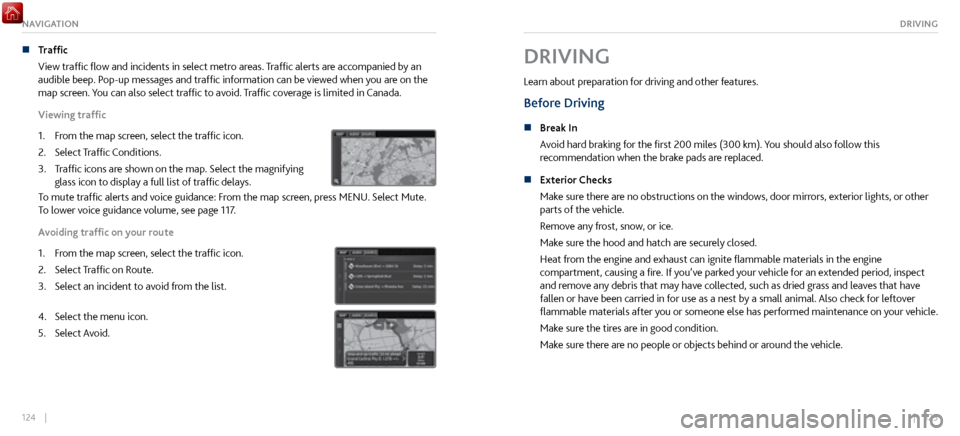
Viewing traffic
1.
From the map scr
een, select the traffic icon.
2.
Select Traffic Conditions.
3.
Traffic icons are shown on
the map. Select the magnifying
glass icon to display a full list of traffic delays.
To mute traffic alerts and voice guidance: From the map screen, press MENU. Select Mute.
To lower voice guidance volume, see page 117.
Avoiding traffic on your route
1.
From the map scr
een, select the traffic icon.
2.
Select Traffic on R
oute.
3.
Select an incident to avoid fr
om the list.
4. Select the menu icon.
5.
Select Avoid.
DRIVING
Learn about preparation for driving and other features.
Before Driving
n Break In
Avoid har d braking for the first 200 miles (300 km). You should also follow this
recommendation when the brake pads are replaced.
n
Exterior Checks
Make sure ther
e are no obstructions on the windows, door mirrors, exterior lights, or other
parts of the vehicle.
Remove any frost, snow, or ice.
Make sure the hood and hatch are securely closed.
Heat from the engine and exhaust can ignite flammable materials in the engine
compartment, causing a fire. If you’ve parked your vehicle for an extended period, inspect
and remove any debris that may have collected, such as dried grass and leaves that have
fallen or have been carried in for use as a nest by a small animal. Also check for leftover
flammable materials after you or someone else has performed maintenance on your vehicle.
Make sure the tires are in good condition.
Make sure there are no people or objects behind or around the vehicle.
Page 66 of 116

126 || 127
DRIVINGDRIVING
If the doors are frozen shut, use warm water around the door edges to melt any ice. Do not
try to force them open, as this can damage the rubber trim around the doors. When done,
wipe dry to avoid further freezing.
NOTICE
n
Interior Checks
Store or secure all items
on board properly.
Do not pile items higher than the seat height.
Do not place anything in the footwells. Make sure to secure the floor mats.
If you have any animals on board, do not let them move freely in the vehicle.
Securely close and lock both doors.
Adjust your seating position, mirrors, and steering wheel properly.
Everyone in the vehicle must fasten their seat belt.
Make sure that the indicators in the instrument panel come on when you start the vehicle,
and go off soon after.
Improper accessories or modifications can affect your vehicle’s handling,
stability, and performance, and cause a crash in which you can be seriously hurt
or killed.
Follow all instructions in the vehicle owner’s manual regarding accessories and
modifications.
WARNING
Maximum Load Limit
Carrying too much cargo or improperly storing it can affect your vehicle’s handling, stability,
stopping distance, and tires, and make it unsafe.
The maximum load for your vehicle is 507 lbs (230 kg). See the Tire and Loading Information
label on the driver’s doorjamb. The maximum load in the trunk is 100 lbs (45 kg).
The vehicle maximum load includes the total weight of all occupants, cargo,
accessories, and the tongue load if you are towing a trailer. Below are the steps for
determining the correct load limit:
1. Locate the statement “The combined weight of occupants and cargo should never exceed
XXX kg or XXX lbs.” on your vehicle’s placard.
2.
Determine the combined weight of the driver
and passengers that will be riding in your
vehicle.
3.
Subtract the combined weight of the driver
and passengers from XXX kg or XXX lbs.
4.
The resulting figure equals
the available amount of cargo and luggage load capacity. For
example, if the “XXX” amount equals 1,400 lbs. and there will be five 150 lb. passengers in
your vehicle, the amount of available cargo and luggage load capacity is 650 lbs. (1,400 -
750 (5 x 150) = 650 lbs.)
High Voltage Battery Maintenance
All batteries discharge if not used. For best battery life and capacity, drive your vehicle for at
least 30 minutes, at least once every three months. Try to avoid parking under direct summer
sun. For battery maintenance while storing the vehicle, see page 207.
Page 78 of 116

150 || 151
DRIVINGDRIVING
High-Performance Driving
Your Acura NSX is designed, built and equipped with systems and features to provide you with
exceptional driving performance, including the ability to engage in high-performance driving.
However, due to the risks to both you and other road users, including the risk of injury or death
from a high-speed loss of control or crash, if you engage in high-performance driving, Acura
recommends you only do so where conditions are controlled, such as at a track or other closed-
course venue. When driving on public roads you should always obey the posted speed limits
and other traffic laws, reduce speed as needed for traffic and environmental conditions, and
not engage in driving behaviors (including, for instance, use of Launch Control) that may create
heightened risks for yourself and any other road users who may be present (even if you are
unaware of them).
The NSX warranty does not cover any damage or failure resulting from high-performance
driving, competitive driving of any sort whatsoever, or use on a track or similar-type venue. See
warranty book for details.
NOTICE
NSX Track Mode (see page 136), Launch Control (see page 137) and other systems are
designed for increased performance, both in terms of acceleration and handling, up to near-
performance-limit conditions. They are most appropriately used on closed courses and they
should not be used on public roads. Use of these systems may delay the intervention of vehicle
safety systems designed to minimize the risk of a loss of traction or steering control, and can
cause the NSX to handle differently than you might expect or would experience under normal
driving conditions. Use of these systems will not make up for a lack of appropriate driver experience and skill, and
will not allow the driver to overcome risks created by:
•
A lack of proper v
ehicle maintenance
•
Less than ideal road conditions and/or unfamiliarity with
the driving environment
•
Other traffic or road users
High-performance
driving requires special skills, knowledge and experience, as the safety
risks are greatly increased when the NSX is operated at its upper performance abilities. As
a responsible NSX driver, you should not drive above your skill limits or training, even if the
NSX’s performance levels would otherwise allow you to do so. If you intend to engage in high-
performance driving, Acura strongly recommends that:
•
You first obtain appr
opriate, professional training
•
Wear the appropriate
driving clothing and gear (e.g., helmet, gloves and driving shoes)
•
Be fully rested and alert (fr
ee of drugs or alcohol)
•
Turn off any devices or systems that
may distract you from the driving task
High-performance driving in general, and the use of Track Mode and Launch Control in
particular, puts very high loads on the NSX and its components, and results in greater wear and
tear on the vehicle. Because of these high loads, if your NSX is not in top condition or if certain
components, such as the brakes or tires, have undue wear, those components could experience
a loss of performance, or fail, when subjected to the additional loads. Therefore, Acura highly
recommends that you undertake more proactive and frequent maintenance than that required
under normal use and have your vehicle inspected at an authorized Acura NSX dealer (and all
necessary repairs or adjustments made) before you engage in any high-performance driving.
In addition to any required maintenance, there are certain NSX specific items and protocols that
you should pay special attention to before, during and after engaging in any high-performance
Page 79 of 116

152 || 153
DRIVINGDRIVING
driving. Ultimately, the decision whether to engage in high-performance driving is yours, and
depending on your NSX’s condition and prior usage, the items and protocols listed below may
or may not be sufficient to ensure a safe driving experience.
n
BEFORE DRIVING
•
With the vehicle park
ed on level ground, properly bleed brake system after replacing with
new Honda DOT 4 brake fluid or equivalent.
•
Inspect brake pad thickness and replace if 6.0mm
or less.
•
Burnish the brake pads so that
they have the performance characteristics necessary
to repeatedly and quickly slow the NSX when it is being operated at significantly high
speeds. (While the NSX’s brake pads are properly burnished for the demands expected in
ordinary day-to-day driving, high performance driving puts unique demands on the brake
system which require further burnishing.) A high performance burnish at the driving venue
prior to the first session of the day is highly recommended.
•
Inspect ALL cooling openings to confirm
they are open and free of debris such as leaves,
etc. Cooling openings include engine undercover ducts, heat resistance ducts, brake ducts,
radiators, and intercoolers.
•
Remove
Tire Repair Kit from the trunk, along with any other cargo area contents.
•
Check tire wear and
tire pressure, and make certain wheel lug bolts are properly torqued,
as driving at high speed puts additional strain on tires and wheels. Never use slick tires,
and do not use Summer Only tires and Ultra High Performance tires if temperatures will
be lower than 45°F (7°C).
•
If you anticipate sustained driving at speeds gr
eater than 168 mph/270 km/h, adjust the
cold tire pressure as shown on the driver door jamb warning label. This will help avoid heat
build-up and sudden tire failure.
If driving at high speeds (over 168mph/270km/h),
adjust cold tire pressure as show n below to avoid
ex cess heat buildup and sudden tire failur e.
DRIVING SPEED TIRE COLD TIRE PRESSUREOVER
168 mph/ 270 km/h FRONT
REAR 260
KPA, 38 PSI
260 KPA, 38 PSI
WARNINGIf driving at high\6 speeds (o ver 16\fmph/2\b0km/h),
adjust cold tire pr\6essure as shown be\6low to avoid
ex cess heat buildup a\6nd sudden tire fai\6lure. Pour conduire à gra\6nde vitesse (plus d\6e 16\f mph /
2\b0 km/h) ajuster la \6pression des pneus\6 à froid, comme
indiqué ci-dessous\6, afn d’éviter l’ac\6cumulation e xcessive
de chaleur et une d\6éfaillance soudaine \6du pneu.
DRIVING SPEED VITESSE DE CONDUITE COLD TIRE PRESSURE PRESSION DES PNEUS À FROIDTIRE/ PNEU
FRONT/AVANT
REAR/ARRIÈRE260 KPA, 38 PSI
260 KPA, 38 PSI
OVER/ PLUS DE
168 mph/ 270 km/h
WARNINGATTENTION
U.S. models Canadian models
Doorjamb
2DAAAA
Use of slick tires/racing slicks may subject the chassis and body components to
higher dynamic loads than they were designed for.
Higher than intended dynamic loads could result in component failure, loss of
control, and serious injury or death to you or others.
Do not install slick tires on the NSX.
WARNING
• Inspect all exhaust mounts for cracks or signs of
wear.
•
Inspect tailpipe active exhaust val
ves to ensure they are functioning correctly. You can
do this by cycling the IDS switch between SPORT and TRACK modes, while the engine is
idling.
Page 80 of 116

154 || 155
DRIVINGDRIVING
n While Driving
•
You may see a brake warning message in
the Driver
Information Interface (and warning message chime) and/
or experience increased brake pedal stroke. If either occurs,
immediately slow down and allow for increased stopping
distances. The message will disappear once the brakes have
cooled and the system has returned to normal operating
condition.
• After high-performance driving, it is critical to allow your vehicle to properly cool down.
Do not immediately stop your vehicle. Instead, continue driving at reduced speeds,
allowing for increased braking distances until your vehicle returns to normal operating
temperatures. Once you stop and safely park the NSX, open the hatch to aid cooling. If
the engine oil temperature reaches the H mark during high-performance driving, have
your NSX inspected by an authorized Acura NSX dealer.
n
AFTER DRIVING
Check your NSX, and each of its r
elevant components, to make sure that it still is in a safe
operating condition (example: wheel lug bolt torque, tire pressure, etc.). We recommend
you repeat the Before Driving protocol. If any item shows excessive wear or appears to be
in an unusual condition, have it replaced, or exercise appropriate caution when driving and
see your authorized Acura NSX dealer
For more information, please contact your authorized Acura NSX dealer, and/or Acura Client
Relations (see page 213).
Cold or Rainy Weather Driving
Summer-only and Ultra High Performance (UHP) tires are very sensitive to ambient
temperatures and are designed to be used at temperatures above 45°F (7°C). Below that
temperature, Summer-only and UHP tires provide decreasing amounts of grip and other
performance attributes. At temperatures below -4°F (-20°C), the tire treads may become
brittle, resulting in permanent damage to the tread. A damaged tire may fail during use.
Therefore, if you will operate the vehicle when temperatures are below 45°F (7°C), we
recommend you install other tires (e.g., mud+snow, winter) designed to perform under the
expected conditions.
Use of Summer-only or Ultra High Performance tires at temperatures below 45°F
(7°C) may lead to a loss of performance and control, which could result in a crash,
serious injury or death.
WARNING
Your NSX is equipped with ultra-high-performance summer-only tires that, due to their
decreased tread depth, are at greater risk of hydroplaning on wet roads compared to regular
tires. Exercise caution when driving on wet surfaces.
Page 84 of 116

162 || 163
HANDLING THE UNEXPECTEDHANDLING THE UNEXPECTED
Emergency Towing
This vehicle requires flat bed towing. Call a professional towing service if you need to tow
your vehicle. The operator loads your vehicle on the back of a truck.
Trying to lift or tow your vehicle by the bumpers will cause serious damage. The bumpers are
not designed to support the vehicle’s weight.
Improper towing such as towing behind a motorhome or other motor vehicle can damage the
transmission.
NOTICE
Tire Pressure Monitoring System (TPMS)
Monitors the tire pressure while you are driving.
If your vehicle’s tire pressure becomes significantly low, the low
tire pressure indicator comes on and a message appears on the
multi-information display. Roll the right selector wheel on the
steering wheel to view the tire pressure monitor.
n What to Do
Stop your
vehicle in a safe place. Check the tire pressure and adjust the pressure to the
specified level. The specified tire pressure is on a label on the driver’s doorjamb.
Driving on an extremely underinflated tire can cause it to overheat. An overheated tire can
fail. Always inflate your tires to the specified pressure.
NOTICE
Page 85 of 116

164 || 165
HANDLING THE UNEXPECTEDHANDLING THE UNEXPECTED
n Tire Pressure Monitoring System (TPMS) - Required Federal Explanation
Each tire, including
the spare (if provided), should be checked monthly when cold
and inflated to the inflation pressure recommended by the vehicle manufacturer
on the vehicle placard or tire inflation pressure label.
(If your vehicle has tires of a different size than the size indicated on the vehicle
placard or tire inflation pressure label, you should determine the proper tire
inflation pressure for those tires.)
As an added safety feature, your vehicle has been equipped with a tire
pressure monitoring system (TPMS) that illuminates a low tire pressure
telltale when one or more of your tires is significantly under-inflated.
Accordingly, when the low tire pressure telltale illuminates, you should stop and
check your tires as soon as possible, and inflate them to the proper pressure.
Driving on a significantly under-inflated tire causes the tire to overheat and can
lead to tire failure. Under-inflation also reduces fuel efficiency and tire tread life,
and may affect the vehicle’s handling and stopping ability.
Please note that the TPMS is not a substitute for proper tire maintenance, and it is
the driver’s responsibility to maintain correct tire pressure, even if under-inflation
has not reached the level to trigger illumination of the TPMS low tire pressure
telltale. Your vehicle has also been equipped with a TPMS malfunction indicator to indicate
when the system is not operating properly. The TPMS malfunction indicator
is combined with the low tire pressure telltale. When the system detects a
malfunction, the telltale will flash for approximately one minute and then remain
continuously illuminated. This sequence will continue upon subsequent vehicle
start-ups as long as the malfunction exists.
When the malfunction indicator is illuminated, the system may not be able to
detect or signal low tire pressure as intended.
TPMS malfunctions may occur for a variety of reasons, including the installation of
replacement or alternate tires or wheels on the vehicle that prevent the TPMS from
functioning properly.
Always check the TPMS malfunction telltale after replacing one or more tires
or wheels on your vehicle to ensure that the replacement or alternate tires and
wheels allow the TPMS to continue to function properly.
Page 101 of 116

196 || 197
MAINTENANCEMAINTENANCE
4. Push to compress the wiper blade until it clears the end cap,
then pull to slide it up and out
of the holder.
Holder
5. Slide the new wiper blade into the holder and secure the end
into the cap. Slide the blade holder onto the wiper arm until
it clicks, then lower the arm.
6.
Set the power mode to ON. Hold
the wiper switch in MIST
until the wiper arms return to their normal position..Wiper Blade
the bottomEnd Cap at
Avoid dropping the wiper arm, as it may damage the windshield.
NOTICE
Tire Information
To safely operate your vehicle, your tires must be of the proper type and size, in good condition
with adequate tread, and properly inflated.
n
Inflation Guidelines
Properly inflated tir
es provide the best combination of handling, tread life, and comfort.
Refer to the driver’s doorjamb label or the specifications (see page 127) for the specified
pressure.
Underinflated tires wear unevenly, adversely affect handling and fuel economy, and are
more likely to fail from overheating.
Overinflated tires make your vehicle ride harshly, are more prone to road hazards, and wear
unevenly.
Every day before you drive, look at each of the tires. If one looks lower than the others,
check the pressure with a tire gauge.
Measure the air pressure when tires are cold. This means the vehicle has been parked for at
least 3 hours, or driven less than 1 mile (1.6 km). If necessary, add or release air until the
specified pressure is reached. If checked when hot, tire pressure can be as much as 4-6 psi
(30-40 kPa, 0.3-0.5 kgf/cm
2) higher than checked when cold.
At least once a month or before long trips, use a gauge to measure the pressure in all tires,
including the spare. Even tires in good condition can lose 1-2 psi
(10-20 kPa, 0.1-0.2 kgf/cm
2) per month.
Page 102 of 116
198 || 199
MAINTENANCEMAINTENANCE
n Inspection Guidelines
Every time you inflate the tir
es, check for the following:
•
Any damage to
tires, including bumps, bulges, cuts, splits, or cracks in the side or tread.
Remove any foreign objects and inspect for air leaks. Replace tires if you see fabric or cord.
•
Uneven or excessiv
e tread wear. Have an authorized Acura NSX dealer check the wheel
alignment.
•
Cracks or other damage around the val
ve stems.
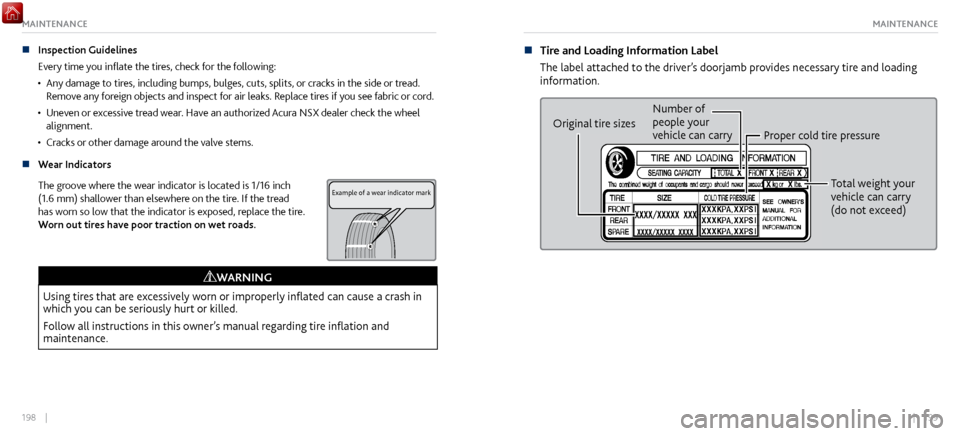
n
Wear Indicators
The groov
e where the wear indicator is located is 1/16 inch
(1.6 mm) shallower than elsewhere on the tire. If the tread
has worn so low that the indicator is exposed, replace the tire.
Worn out tires have poor traction on wet roads.
Example of a wear indicator mark
Using tires that are excessively worn or improperly inflated can cause a crash in
which you can be seriously hurt or killed.
Follow all instructions in this owner’s manual regarding tire inflation and
maintenance.
WARNING n
Tire and Loading Information Label
The label attached to the
driver’s doorjamb provides necessary tire and loading
information.
Original tire sizes Number of
people your
vehicle can carry
Proper cold tire pressure
Total weight your
vehicle can carry
(do not exceed)
Page 103 of 116

200 || 201
MAINTENANCEMAINTENANCE
n Tire and Wheel Replacement
Replace y
our tires with radials of the same size, load range, speed rating, and maximum
cold tire pressure rating (as shown on the tire’s sidewall). Using tires of a different size or
construction can cause certain vehicle systems to work incorrectly. It is best to replace all
four tires at the same time. If that isn’t possible, replace the front or rear tires in pairs.
If you change or replace a wheel, make sure that the wheel’s specifications match those of
the original wheels. Only use TPMS-specified wheels approved for your vehicle.
Installing improper tires on your vehicle can affect handling and stability.
This can cause a crash in which you can be seriously hurt or killed.
Always use the size and type of tires recommended in the owner’s manual.
WARNING
n Tire Service Life
The life of y
our tires is dependent on many factors, including driving habits, road conditions,
vehicle loading, inflation pressure, maintenance history, speed, and environmental
conditions (even when the tires are not in use).
In addition to regular inspections and inflation pressure maintenance, it is recommended
that you have annual inspections performed once the tires reach five years old. All tires,
including the spare, should be removed from service after 10 years from the date of
manufacture, regardless of their condition or state of wear. n
Winter Tires
If driving on snowy
or frozen roads, mount all season tires marked “M+S”, snow tires, or
tire chains; reduce speed; and maintain sufficient distance between vehicles when driving.
For winter tires, select the size and load ranges that are the same as the original tires, and
mount them to all four wheels.
n
Tire Chains
Tire chains can be used onl
y in conjunction with winter tires. Install tire chains on the rear
tires only.
For 295/30R20 (97V) winter tires: Auto-trac 232405
For 305/30R20 (103W) XL winter tires: K-Summit K-44
Mount chains as tightly as you can, and make sure that they do not touch the brake lines or
suspension.
Using the wrong chains, or not properly installing chains, can damage the brake
lines and cause a crash in which you can be seriously injured or killed.
Follow all instructions in this guide regarding the selection and use of tire chains.
WARNING
Traction devices that are the wrong size or improperly installed can damage your vehicle’s
brake lines, suspension, body, and wheels. Stop driving if they are hitting any part of the
vehicle.
NOTICE