warning Acura NSX 2017 Service Manual
[x] Cancel search | Manufacturer: ACURA, Model Year: 2017, Model line: NSX, Model: Acura NSX 2017Pages: 473, PDF Size: 16.01 MB
Page 359 of 473
358
uuRefueling uHow to Refuel
Driving
How to Refuel
Your fuel tank is not equipped with a fuel fill cap. You can insert the filler nozzle
directly into the filler neck. The tank seal s itself again when you pull out the filler
nozzle.
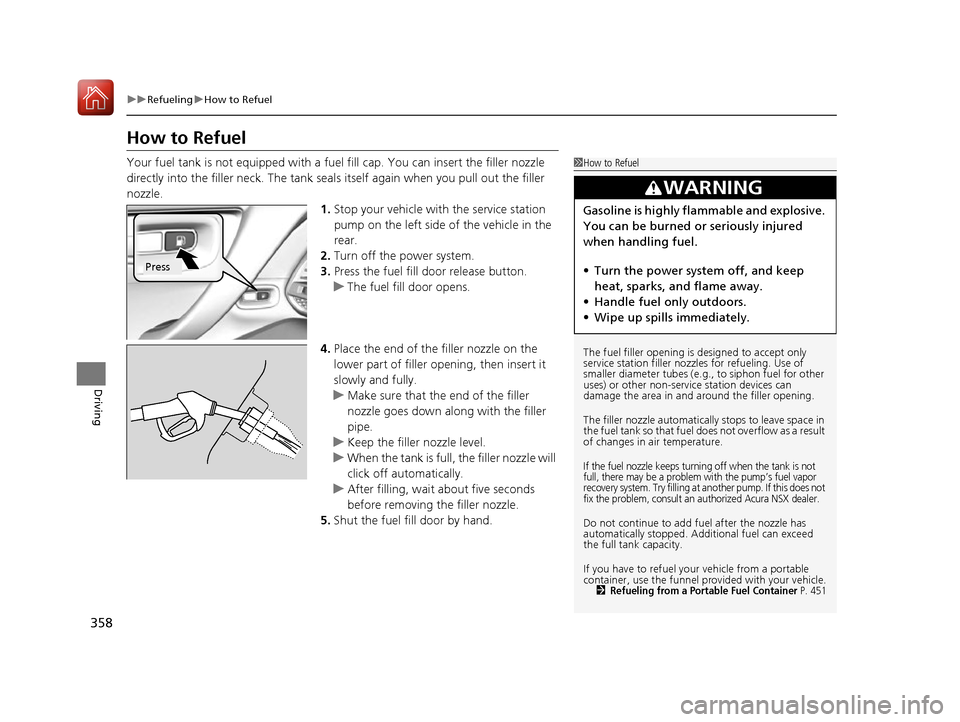
1.Stop your vehicle with the service station
pump on the left side of the vehicle in the
rear.
2. Turn off the power system.
3. Press the fuel fill door release button.
u The fuel fill door opens.
4. Place the end of the filler nozzle on the
lower part of filler opening, then insert it
slowly and fully.
u Make sure that the end of the filler
nozzle goes down along with the filler
pipe.
u Keep the filler nozzle level.
u When the tank is full, the filler nozzle will
click off automatically.
u After filling, wait about five seconds
before removing th e filler nozzle.
5. Shut the fuel fill door by hand.1How to Refuel
The fuel filler opening is designed to accept only
service station filler nozzles for refueling. Use of
smaller diameter tubes (e.g ., to siphon fuel for other
uses) or other non-service station devices can
damage the area in and around the filler opening.
The filler nozzle automatically stops to leave space in
the fuel tank so that fuel does not overflow as a result
of changes in air temperature.
If the fuel nozzle keeps turning off when the tank is not
full, there may be a problem with the pump’s fuel vapor
recovery system. Try filling at another pump. If this does not
fix the problem, consult an authorized Acura NSX dealer.
Do not continue to add fuel after the nozzle has
automatically stopped. Addi tional fuel can exceed
the full tank capacity.
If you have to refuel y our vehicle from a portable
container, use the funnel pr ovided with your vehicle.
2Refueling from a Portable Fuel Container P. 451
3WARNING
Gasoline is highly flammable and explosive.
You can be burned or seriously injured
when handling fuel.
•Turn the power sy stem off, and keep
heat, sparks, and flame away.
• Handle fuel only outdoors.
• Wipe up spills immediately.
Press
17 NSX-31T6N6000.book 358 ページ 2016年4月22日 金曜日 午後3時44分
Page 364 of 473
363
uuBefore Performing Maintenance uSafety When Performing Maintenance
Maintenance
Safety When Performing Maintenance
Some of the most important safe ty precautions are given here.
However, we cannot warn you of every conceivable hazard that can arise in
performing maintenance. Only you can decide whether or not you should perform
a given task.
• To reduce the possibility of fire or explos ion, keep cigarettes, sparks, and flames
away from the 12-volt battery, all fuel re lated parts, and all High Voltage system
related parts.
• Never leave rags, towels, or other flammable objects under the hood and hatch.
u Heat from the engine and exhaust can ignite them causing a fire.
• To clean parts, use a co mmercially available degreas er or parts cleaner, not
gasoline.
• Wear eye protection and protective clothing when working with the 12-volt
battery or compressed air.
• Engine exhaust contains carbon monoxide, which is poisonous and can kill you.
u Operate the engine only when there is sufficient ventilation.
• The vehicle must be in a stationary condition.
u Make sure your vehicle is parked on le vel ground, the parking brake is set, and
the power system is turned off.
• Be aware that hot parts can burn you.
u Make sure to let the power system, including the engine and exhaust system,
cool thoroughly before touching vehicle parts.
• Be aware that moving parts can injure you.
u Do not activate the power system unle ss instructed, and keep your hands and
limbs away from moving parts.
■Maintenance Safety
■Vehicle Safety
1 Safety When Performing Maintenance
3WARNING
Improperly maintaining this vehicle or
failing to correct a pr oblem before driving
can cause a crash in which you can be
seriously hurt or killed.
Always follow the inspection and
maintenance recommendations according
to the schedules in this owner’s manual.
3WARNING
Failure to properly follow maintenance
instructions and precautions can cause you
to be seriously hurt or killed.
Always follow the procedures and
precautions in this owner’s manual.
17 NSX-31T6N6000.book 363 ページ 2016年4月22日 金曜日 午後3時44分
Page 378 of 473
377
uuMaintenance Under the Hood and Hatch uOil Check
Continued
Maintenance
Oil Check
We recommend that you check the engine oil level every time you refuel.
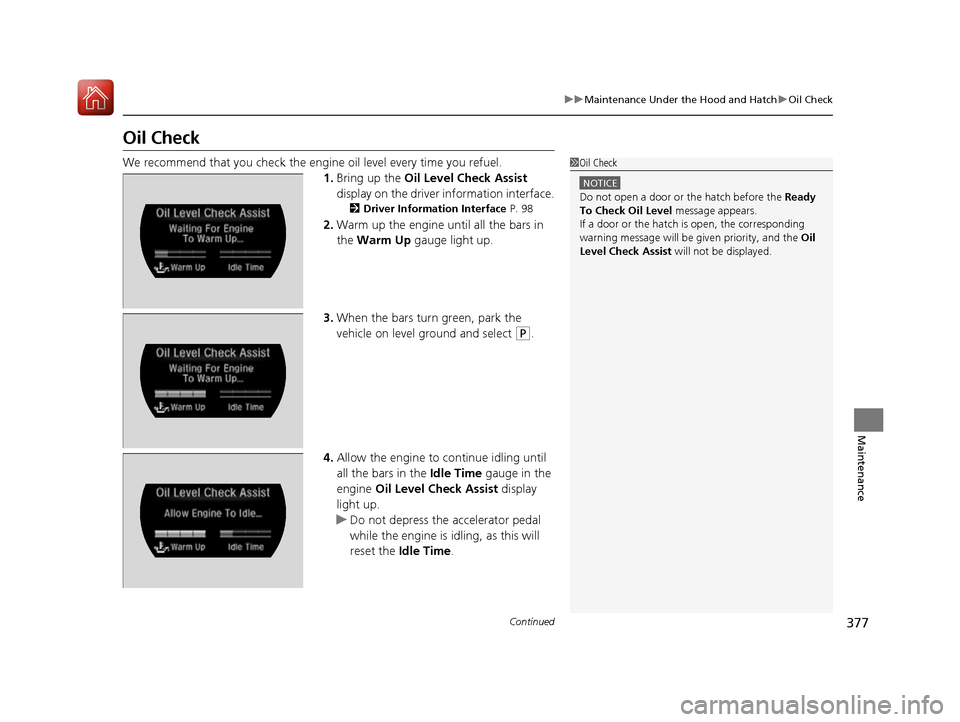
1. Bring up the Oil Level Check Assist
display on the driver information interface.
2 Driver Information Interface P. 98
2.Warm up the engine until all the bars in
the Warm Up gauge light up.
3. When the bars turn green, park the
vehicle on level ground and select
(P.
4. Allow the engine to continue idling until
all the bars in the Idle Time gauge in the
engine Oil Level Check Assist display
light up.
u Do not depress the accelerator pedal
while the engine is idling, as this will
reset the Idle Time .
1Oil Check
NOTICE
Do not open a door or the hatch before the Ready
To Check Oil Level message appears.
If a door or the hatch is open, the corresponding
warning message will be given priority, and the Oil
Level Check Assist will not be displayed.
17 NSX-31T6N6000.book 377 ページ 2016年4月22日 金曜日 午後3時44分
Page 384 of 473
383
uuMaintenance Under the Hood and Hatch uCooling System
Maintenance
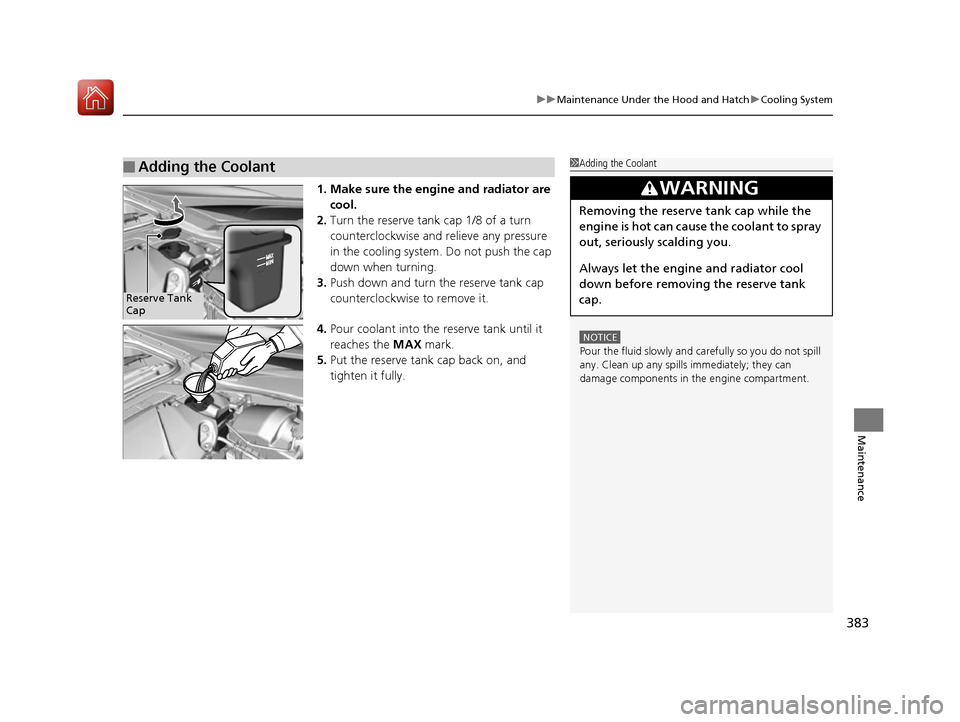
1. Make sure the engine and radiator are
cool.
2. Turn the reserve tank cap 1/8 of a turn
counterclockwise and re lieve any pressure
in the cooling system. Do not push the cap
down when turning.
3. Push down and turn the reserve tank cap
counterclockwise to remove it.
4. Pour coolant into the reserve tank until it
reaches the MAX mark.
5. Put the reserve tank cap back on, and
tighten it fully.
■Adding the Coolant1Adding the Coolant
NOTICE
Pour the fluid slowly and carefully so you do not spill
any. Clean up any spills immediately; they can
damage components in the engine compartment.
3WARNING
Removing the reserve tank cap while the
engine is hot can cause the coolant to spray
out, seriously scalding you.
Always let the engine and radiator cool
down before removing the reserve tank
cap.
Reserve Tank
Cap
17 NSX-31T6N6000.book 383 ページ 2016年4月22日 金曜日 午後3時44分
Page 394 of 473
393
Maintenance
Checking and Maintaining Tires
Checking Tires
To safely operate your vehicle, your tires must be of the proper type and size, in
good condition with adequate tread, and properly inflated.
■Inflation guidelines
Properly inflated tires provide the best combination of handling, tread life, and
comfort. Refer to the driver’s doorjamb labe l or specifications page for the specified
pressure.
Underinflated tires wear unev enly, adversely affect handling and fuel economy, and
are more likely to fail from overheating.
Overinflated tires make your vehicle ride ha rshly, are more prone to road hazards,
and wear unevenly.
Every day before you drive, look at each of the tires. If one looks lower than the
others, check the pressure with a tire gauge.
At least once a month or before long trips , use a gauge to measure the pressure in
all tires. Even tires in good condition can lose 1 to 2 psi (10 to 20 kPa, 0.1 to 0.2
kgf/cm
2) per month.
■Inspection guidelines
Every time you check inflation, also examine the tires and valve stems.
Look for:
• Bumps or bulges on the side or in the tread. Replace the tire if you find any cuts,
splits, or cracks in the side of the tire . Replace it if you see fabric or cord.
• Remove any foreign objects and inspect for air leaks.
• Uneven tread wear. Have an authorized Acura NSX dealer check the wheel
alignment.
• Excessive tread wear.
2 Wear Indicators P. 398
•Cracks or other damage around valve stem.
1Checking Tires
Measure the air pressure when tires are cold. This
means the vehicle has been parked for at least three
hours, or driven less than 1 mile (1.6 km). If
necessary, add or releas e air until the specified
pressure is reached.
If checked when hot, tire pressure can be as much as
4 – 6 psi (30 – 40 kPa, 0.3 – 0.4 kgf/cm
2) higher than
if checked when cold.
Have an authorized Acura NSX dealer check the tires
if you feel a consistent vi bration while driving. New
tires and any that have be en removed and reinstalled
should be properly balanced.
3WARNING
Using tires that are excessively worn or
improperly inflated can cause a crash in
which you can be seriously hurt or killed.
Follow all instruction s in this owner’s
manual regarding ti re inflation and
maintenance.
17 NSX-31T6N6000.book 393 ページ 2016年4月22日 金曜日 午後3時44分
Page 398 of 473

397
uuChecking and Maintaining Tires uDOT Tire Quality Grading (U.S. Vehicles)
Maintenance
The traction grades, from highest to lowest, are AA, A, B, and C.
Those grades represent the tire’s ability to stop on wet pavement
as measured under controlled conditions on specified
government test surfaces of asph alt and concrete. A tire marked
C may have poor traction performance.
The temperature grades are A (the highest), B, and C,
representing the tire’s resistance to the generation of heat and its
ability to dissipate heat when te sted under controlled conditions
on a specified indoor laboratory test wheel. Sustained high
temperature can cause the material of the tire to degenerate and
reduce tire life, and ex cessive temperature can lead to sudden tire
failure. The grade C corresponds to a level of performance which
all passenger car tires must meet under the Federal Motor Vehicle
Safety Standard No. 109. Grades B and A represent higher levels
of performance on the laboratory test wheel than the minimum
required by law.
■Traction
■Temperature
1 Traction
Warning: The traction grade
assigned to this tire is based on
straight-ahead braking traction tests,
and does not include acceleration,
cornering, hydroplaning, or peak
traction characteristics.
1Temperature
Warning: The temperature grade for
this tire is establishe d for a tire that is
properly inflated and not
overloaded. Excessive speed,
underinflation, or excessive loading,
either separately or in combination,
can cause heat buildup and possible
tire failure.
17 NSX-31T6N6000.book 397 ページ 2016年4月22日 金曜日 午後3時44分
Page 400 of 473
399
uuChecking and Maintaining Tires uTire and Wheel Replacement
Maintenance
Tire and Wheel Replacement
Replace your tires with radials of the same size, load range, speed rating, and
maximum cold tire pressure rating (as shown on the tire’s sidewall). Using tires of a
different size or construction can cause the ABS and vehicle stability assist (VSA ®)
and SH-AWD ® systems to work incorrectly.
It is best to replace all four tires at the same time.
If you replace a wheel, only use TPMS spec ified wheels approved for your vehicle.
Make sure that the wheel’s specifications match those of the original wheels.1 Tire and Wheel Replacement
3WARNING
Installing improper tires on your vehicle can
affect handling and stability. This can cause
a crash in which you can be seriously hurt or
killed.
Always use the size and type of tires
recommended in this owner’s manual.
17 NSX-31T6N6000.book 399 ページ 2016年4月22日 金曜日 午後3時44分
Page 402 of 473

401
uuChecking and Maintaining Tires uWinter Tires
Maintenance
Winter Tires
If driving on snowy or frozen roads, mount all-season marked M+S tires, snow tires,
or tire chains; reduce speed; and maintain sufficient distance between vehicles when
driving.
Be particularly careful when operating the steering wheel or brakes to prevent skidding.
Use tire chains, snow tires, or all-season tires when necessary or according to the law.
When mounting, refer to the following points.
For winter tires:
• Mount the tires to all four wheels.
For tire chains:
• Install them on the rear tires only.
• Because your vehicle has limited tire clea rance, we strongly recommend using the
chains listed below:
*1:Tire chains to be used only on optional 295/30R20 (97V) winter tires.
*2:Tire chains to be used only on optional 305/30R20 (103W) XL winter tires.
• Follow the chain manufactur er’s instruction when installing. Mount them as
tightly as you can.
• Check that the chains do not touc h the brake lines or suspension.
• Drive slowly.
Recommended Winter Tires:
●Michelin Alpin PA4
Front: 245/35R19 (93W) XL
Rear: 295/30R20 (97V)
●Pirelli SottoZero 3
Front: 245/35R19 (93W) XL
Rear: 305/30R20 (103W) XL
●Auto-trac 232405*1
●K-Summit K-44*2
1 Winter Tires
NOTICE
Traction devices that are th e wrong size or improperly
installed can damage your vehicle’s brake lines,
suspension, body, and wheels. Stop driving if they are
hitting any part of the vehicle.
When tire chains are mounted, follow the chain
manufacturer’s instructi ons regarding vehicle
operational limits.
If your vehicle is equipped with summer tires, be
aware that these tires are not designed for winter
driving conditions. For more information, contact an
authorized Acura NSX dealer.
3WARNING
Using the wrong chains, or not properly
installing chains, can damage the brake
lines and cause a crash in which you can be
seriously injured or killed.
Follow all instruction s in this owner’s
manual regarding the selection and use of
tire chains.
17 NSX-31T6N6000.book 401 ページ 2016年4月22日 金曜日 午後3時44分
Page 403 of 473
402
uuChecking and Maintaining Tires uCold Weather Driving
Maintenance
Cold Weather Driving
Summer Only tires and Ultra High Performan ce (UHP) tires are very sensitive to
ambient temperatures and are designed to be used at temperatures above 45°F
(7°C). If the vehicle is operated with Summer Only tires or UHP tires at temperatures
below 45°F (7°C), the tires will provide decreasing amounts of grip and other
performance attributes. If the vehicle is operated with Summer Only tires or UHP
tires at temperatures below -4°F (-20°C), th e tire tread may lose their elasticity and
become brittle, resulting in permanent damage to the tread. A damaged tire may
fail during use. Therefore, if you operate the vehicle when ambient temperatures are
below 45°F (7°C), we recommend that you install other tires (e.g., mud+snow,
winter) that are designed to provide appropriate performance attributes under the
anticipated conditions.1 Cold Weather Driving
3WARNING
Use of Summer Only tires or Ultra High
Performance tires at temperatures below
45°F (7°C) may lead to a loss of
performance and control, which could
result in a crash, se rious injury or death.
17 NSX-31T6N6000.book 402 ページ 2016年4月22日 金曜日 午後3時44分
Page 404 of 473
403
Maintenance
12-Volt Battery
Checking the 12-Volt Battery
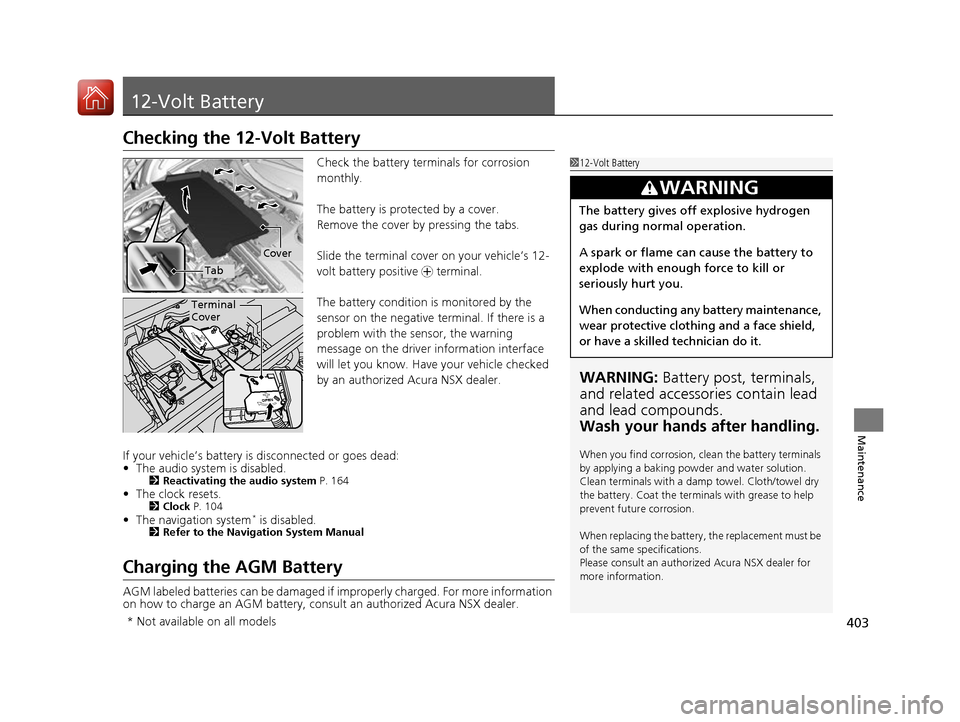
Check the battery terminals for corrosion
monthly.
The battery is protected by a cover.
Remove the cover by pressing the tabs.
Slide the terminal cover on your vehicle’s 12-
volt battery positive + terminal.
The battery condition is monitored by the
sensor on the negative terminal. If there is a
problem with the sensor, the warning
message on the driver information interface
will let you know. Have your vehicle checked
by an authorized Acura NSX dealer.
If your vehicle’s battery is disconnected or goes dead:
• The audio system is disabled.
2 Reactivating the audio system P. 164
•The clock resets.2 Clock P. 104
•The navigation system* is disabled.2 Refer to the Navigation System Manual
Charging the AGM Battery
AGM labeled batteries can be damaged if improperly charged. For more information
on how to charge an AGM battery, consult an authorized Acura NSX dealer.
1 12-Volt Battery
WARNING: Battery post, terminals,
and related accessories contain lead
and lead compounds.
Wash your hands after handling.
When you find corrosion, cl ean the battery terminals
by applying a baking powder and water solution.
Clean terminals with a damp towel. Cloth/towel dry
the battery. Coat the terminals with grease to help
prevent future corrosion.
When replacing the battery, the replacement must be
of the same specifications.
Please consult an authorized Acura NSX dealer for
more information.
3WARNING
The battery gives off explosive hydrogen
gas during normal operation.
A spark or flame can cause the battery to
explode with enough force to kill or
seriously hurt you.
When conducting any battery maintenance,
wear protective clothing and a face shield,
or have a skilled technician do it.
Tab
Cover
Terminal
Cover
* Not available on all models
17 NSX-31T6N6000.book 403 ページ 2016年4月22日 金曜日 午後3時44分