fuel type Acura NSX 2018 Owner's Manual
[x] Cancel search | Manufacturer: ACURA, Model Year: 2018, Model line: NSX, Model: Acura NSX 2018Pages: 489, PDF Size: 27.64 MB
Page 13 of 489
12
Quick Reference Guide
Energy Efficiency
As with a gasoline-powered vehicle, hybrid vehicle fuel efficiency and driving range is most impacted by your driving style. Aggressive
acceleration and high-speed driving can easily trigger the system to switch the propulsion source to the gasoline-powered engin e.
In addition, heavy climate control system us e negatively affects vehicle range and efficiency. Either of these use patterns wil l more quickly
reduce the High Voltage battery's state of charge.
Battery Types
There are two types of batteries used in this vehicle; a standa rd 12-volt battery that powers the airbags, the interior and exterior lights, and
other standard 12-volt systems; and a High Voltage battery that is used to power the propulsion motors and recharge the 12-volt battery.
Regenerative Energy and Regenerative Braking
When decelerating without the accelerator being depressed or the brake pedal being applied, or while driving downhill, the elec tric motors
act as generators that a portion of the elec trical energy that was used to accelerate the vehicle. This regenerative braking slows the vehicle
in a manner similar to engine braking in a gasoline-powered vehicle.
18 NSX-31T6N6100.book 12 ページ 2017年10月27日 金曜日 午後1時39分
Page 235 of 489
234
uuGeneral Information on the Audio System uHonda App License Agreement
Features
E. Information Collection and Storage
1. Information Collection , Use, Transmission and Storage of Data. Consent to Use of Data:
You agree that HONDA and PROVIDERS may
collect and use your information gathered in any manner as part of product support services related to the SOFTWARE or related services.
HONDA may share such information with third parties, including, without limitation, PROV IDERS, third party software and service s
suppliers, their affiliates and/or their design ated agents, solely to improve their products or to provide services or technologies to you.
HONDA, third party software and systems supp liers, their affiliates and/or their designated agent may disclose this information to others,
but not in a form that pe rsonally identifies you.
2. Information Storage.
Depending on the type of multimedia system you have in your VEHICLE, certain information may be stored for ease
of use of the SOFTWARE including, without limitation, search hi story, location history in certain applications, previous and saved
destinations, map locations within certain applications, and device numbers and contact information.
(a) Vehicle Health Information.
Your VEHICLE may remotely trans mit information regarding the status and health of your VEHICLE
(“VEHICLE INFORMATION”) to HONDA without notification to you. VEHICLE INFORMATION may contain VEHICLE maintenance and
malfunction status that is derived from VEHICLE diagnostic data and includes, but is not limited to, status of powered doors and windows,
battery life data, battery charging data, VEHICLE speed, coolant temperat ure, air compressor revolution, output power, warning codes,
diagnostic trouble codes, fuel injection volume, and engine rotati ons per minute. VEHICLE HEALTH INFORMATION may be used by HONDA
for research and development, to deliver HO NDA SERVICES and information to you, and to contact you, and is retained only for a period
of time necessary to fulfill these goals.
(b) VEHICLE Geolocation Data (non-navigation/map based).
If you opt-in to geolocation-based SERVICES, your vehicle’s geolocation data
(latitude and longitude) will be automatically sent from your VEHICLE to HONDA and PROVIDERS.
(c) You understand that the inputting or uploading of information to your VEHICLE’s multimedia system or the SOFTWARE or SERVICES is
at your own risk and that HONDA is not resp onsible for unauthorized access to or use of any personal or other information. All information
uploaded to the SOFTWARE and SERVICES may be stored on your VEHI CLES’s multimedia system and you understand that the security and
safety of your VEHICLE’s multimedia system is your sole responsibility.
18 NSX-31T6N6100.book 234 ページ 2017年10月27日 金曜日 午後1時39分
Page 377 of 489
376
Maintenance
Before Performing Maintenance
Inspection and Maintenance
For your safety, perform all listed inspections and maintenance to keep your vehicle
in good condition. If you become aware of any abnormality (noise, smell, insufficient
brake fluid, oil residue on the ground, etc .), have your vehicle inspected by an
authorized Acura NSX dealer. (Note, however, that service at an authorized Acura
NSX dealer is not mandatory to keep your warranties in effect.)
■Daily inspections
Perform inspections before long distance trips, when washing the vehicle, or when
refueling.
■Periodic inspections
• Check the brake fluid level monthly.
2 Brake Fluid P. 400
•Check the tire pressure monthly. Examin e the tread for wear and foreign objects.
2Checking and Maintaining Tires P. 407
•Check the operation of the exterior lights monthly.
2 Replacing Light Bulbs P. 401
•Check the condition of the wiper bl ades at least every six months.
2Checking and Maintaining Wiper Blades P. 404
■Types of Inspection and Maintenance
1Inspection and Maintenance
Maintenance, replacement, or repair of
emissions control devices and systems may be
done by any automotive repair establishment or
individuals using parts that are “certified” to
EPA standards.
According to state and fede ral regulations, failure to
perform maintenance on the maintenance main
items marked with # will not void your emissions
warranties. However, all maintenance services should
be performed in accordan ce with the intervals
indicated by the driver information interface.
2 Maintenance Service Items P. 382
If you want to perform complex maintenance tasks
that require more skills a nd tools, you can purchase a
subscription to the Service Express website at
www.techinfo.honda.com .
2 Authorized Manuals P. 477
If you want to perform ma intenance yourself, make
sure that you have the necessary tools and skills first.
After performing ma intenance, update the records in
the separate maintenance booklet.
U.S. models
18 NSX-31T6N6100.book 376 ページ 2017年10月27日 金曜日 午後1時39分
Page 397 of 489
396
uuMaintenance Under the Hood and Hatch uCooling System
Maintenance
Cooling System
This coolant is premixed with 50% antifreeze and 50% water. Do not add any
straight antifreeze or water.
We recommend you check the engine coolant level every time you refuel. Check the
reserve tank. Add the engine coolant accordingly.
1. Make sure the engine and radiator are cool.
2. Open the hatch.
2 Opening the Hatch P. 387
3.Remove the left engine compartment
cover.
2 Engine Compartment Cover P. 389
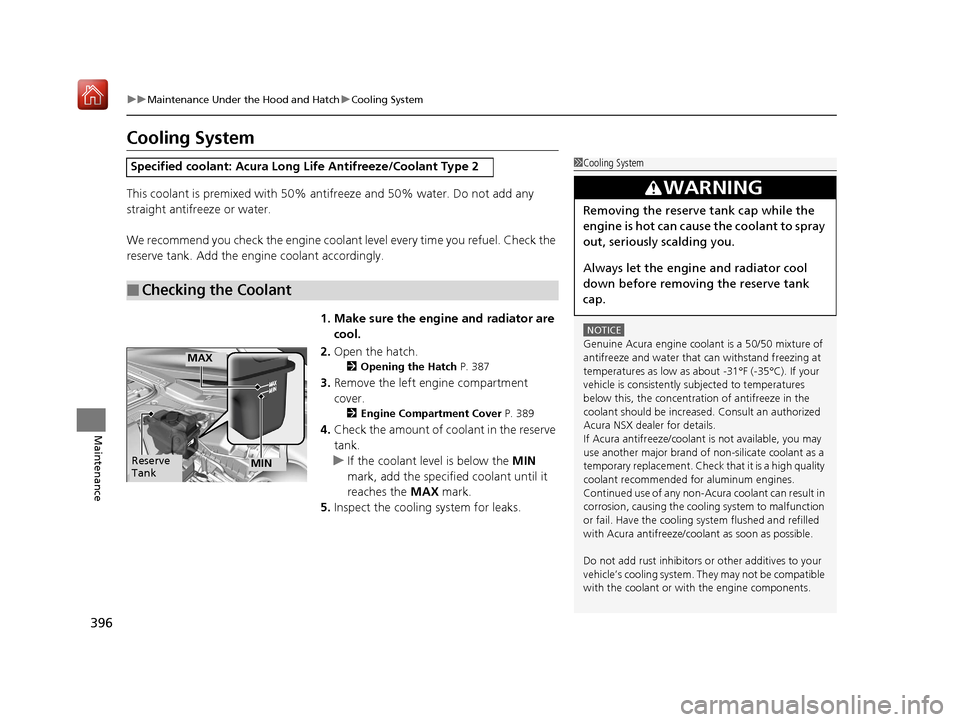
4.Check the amount of coolant in the reserve
tank.
u If the coolant level is below the MIN
mark, add the specified coolant until it
reaches the MAX mark.
5. Inspect the cooling system for leaks.
Specified coolant: Acura Long Life Antifreeze/Coolant Type 2
■Checking the Coolant
1Cooling System
NOTICE
Genuine Acura engine cool ant is a 50/50 mixture of
antifreeze and water that can withstand freezing at
temperatures as low as a bout -31°F (-35°C). If your
vehicle is consistently subjected to temperatures
below this, the concentration of antifreeze in the
coolant should be increased. Consult an authorized
Acura NSX dealer for details.
If Acura antifreeze/coolant is not available, you may
use another major brand of non-silicate coolant as a
temporary replacement. Check that it is a high quality
coolant recommended for aluminum engines.
Continued use of any non-Acur a coolant can result in
corrosion, causing the cooling system to malfunction
or fail. Have the cooling system flushed and refilled
with Acura antifreeze/cool ant as soon as possible.
Do not add rust inhibitors or other additives to your
vehicle’s cooling system. They may not be compatible
with the coolant or with the engine components.
3WARNING
Removing the reserve tank cap while the
engine is hot can cause the coolant to spray
out, seriously scalding you.
Always let the engine and radiator cool
down before removing the reserve tank
cap.
Reserve
Tank
MAX
MIN
18 NSX-31T6N6100.book 396 ページ 2017年10月27日 金曜日 午後1時39分
Page 399 of 489
398
uuMaintenance Under the Hood and Hatch uInverter Coolant
Maintenance
Inverter Coolant
This coolant is premixed with 50% antifreeze and 50% water. Do not add any
straight antifreeze or water.
We recommend you check the inverter co olant level every time you refuel.
Have an authorized Acura NSX deal er replace the inverter coolant.
1. Open the hood.
2 Opening the Hood P. 388
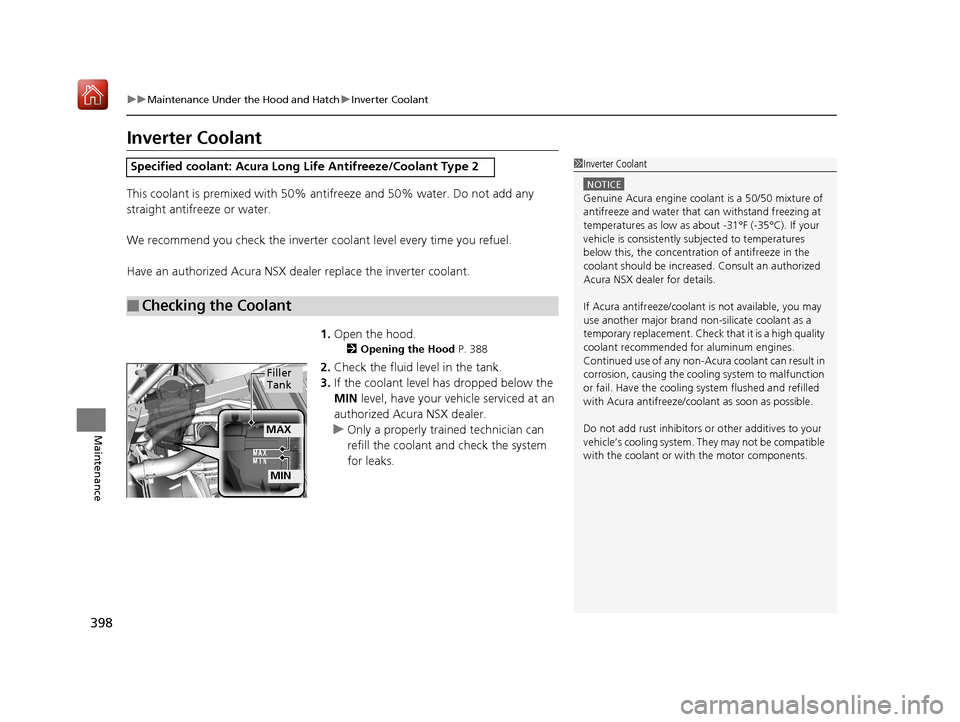
2.Check the fluid level in the tank.
3. If the coolant level has dropped below the
MIN level, have your vehicle serviced at an
authorized Acura NSX dealer.
u Only a properly trained technician can
refill the coolant an d check the system
for leaks.
Specified coolant: Acura Long Life Antifreeze/Coolant Type 2
■Checking the Coolant
1Inverter Coolant
NOTICE
Genuine Acura engine cool ant is a 50/50 mixture of
antifreeze and water that can withstand freezing at
temperatures as low as a bout -31°F (-35°C). If your
vehicle is consistently subjected to temperatures
below this, the concentration of antifreeze in the
coolant should be increased. Consult an authorized
Acura NSX dealer for details.
If Acura antifreeze/coolant is not available, you may
use another major brand non- silicate coolant as a
temporary replacement. Check that it is a high quality
coolant recommended fo r aluminum engines.
Continued use of any non-Acur a coolant can result in
corrosion, causing the cooling system to malfunction
or fail. Have the cooling system flushed and refilled
with Acura antifreeze/cool ant as soon as possible.
Do not add rust inhibitors or other additives to your
vehicle’s cooling system. They may not be compatible
with the coolant or with the motor components.
MAX
MIN
Filler
Tank
18 NSX-31T6N6100.book 398 ページ 2017年10月27日 金曜日 午後1時39分
Page 408 of 489
407
Maintenance
Checking and Maintaining Tires
Checking Tires
To safely operate your vehicle, your tires must be of the proper type and size, in
good condition with adequate tread, and properly inflated.
■Inflation guidelines
Properly inflated tires provide the best combination of handling, tread life, and
comfort. Refer to the driver’s doorjamb labe l or specifications page for the specified
pressure.
Underinflated tires wear unev enly, adversely affect handling and fuel economy, and
are more likely to fail from overheating.
Overinflated tires make your vehicle ride ha rshly, are more prone to road hazards,
and wear unevenly.
Every day before you drive, look at each of the tires. If one looks lower than the
others, check the pressure with a tire gauge.
At least once a month or before long trips, use a gauge to measure the pressure in all
tires. Even tires in good condition can lose 1
– 2 psi (10 – 20 kPa, 0.1 – 0.2 kgf/cm2) per
month.
■Inspection guidelines
Every time you check inflation, also examine the tires and valve stems. Look for:
• Bumps or bulges on the side or in the tr ead. Replace the tire if you find any cuts,
splits, or cracks in the side of the tire . Replace it if you see fabric or cord.
• Remove any foreign objects and inspect for air leaks.
• Uneven tread wear. Have an authorized Acura NSX dealer check the wheel
alignment.
• Excessive tread wear.
2 Wear Indicators P. 412
•Cracks or other damage around valve stem.
1Checking Tires
Measure the air pressure when tires are cold. This
means the vehicle has been parked for at least three
hours, or driven less than 1 mile (1.6 km). If
necessary, add or releas e air until the specified
pressure is reached.
If checked when hot, tire pressure can be as much as
4 – 6 psi (30 – 40 kPa, 0.3 – 0.4 kgf/cm
2) higher than
if checked when cold.
Have an authorized Acura NSX dealer check the tires
if you feel a consistent vi bration while driving. New
tires and any that have be en removed and reinstalled
should be properly balanced.
3WARNING
Using tires that are excessively worn or
improperly inflated can cause a crash in
which you can be seriously hurt or killed.
Follow all instruction s in this owner’s
manual regarding tire inflation and
maintenance.
18 NSX-31T6N6100.book 407 ページ 2017年10月27日 金曜日 午後1時39分
Page 432 of 489
431
Handling the Unexpected
This chapter explains how to handle unexpected troubles.
ToolsTypes of Tools .................................. 432
If a Tire Goes Flat Temporarily Repairi ng a Flat Tire....... 433
Handling of the Jack ........................ 444
Power System Won’t Start Checking the Procedure ................... 445
If the Keyless Access Remote Battery is Weak ............................................. 446
Emergency Power System Off........... 447
Jump Starting .................................... 448
Overheating How to Handle Overheating ............. 450 Indicator, Coming On/Blinking
If the 12-Volt Battery Charging System Indicator Comes On ....................... 452
If the Malfunction Indicator Lamp Comes On or Blinks ................................... 452
If the Brake System Indicator (Red) Comes On ................................................. 453
If the Electric Power Steering (EPS) System Indicator Comes On ....................... 453
If the Electric Parking Brake System Indicator Comes On ....................... 454 If the Low Tire Pressure/TPMS Indicator
Comes On or Blinks ....................... 455
If the Transmission System Indicator Blinks along with the Warning Message... 456
If the Low Oil Level Symbol Appears.....456Fuses Fuse Locations ................................. 457
Inspecting and Changing Fuses ........ 461
Emergency Towing ........................... 462
When You Cannot Unlock the Fuel Fill Door ................................................. 463
When You Cannot Open the Hatch.....464RefuelingRefueling from a Portable Fuel Container .... 465
18 NSX-31T6N6100.book 431 ページ 2017年10月27日 金曜日 午後1時39分
Page 466 of 489
465
Handling the Unexpected
Refueling
Refueling from a Portable Fuel Container
If you have run out of fuel and need to refuel your vehicle from a portable fuel
container, use the funnel provided with your vehicle.
1.Turn off the power system.
2. Press the fuel fill door release button.
u The fuel fill door opens.
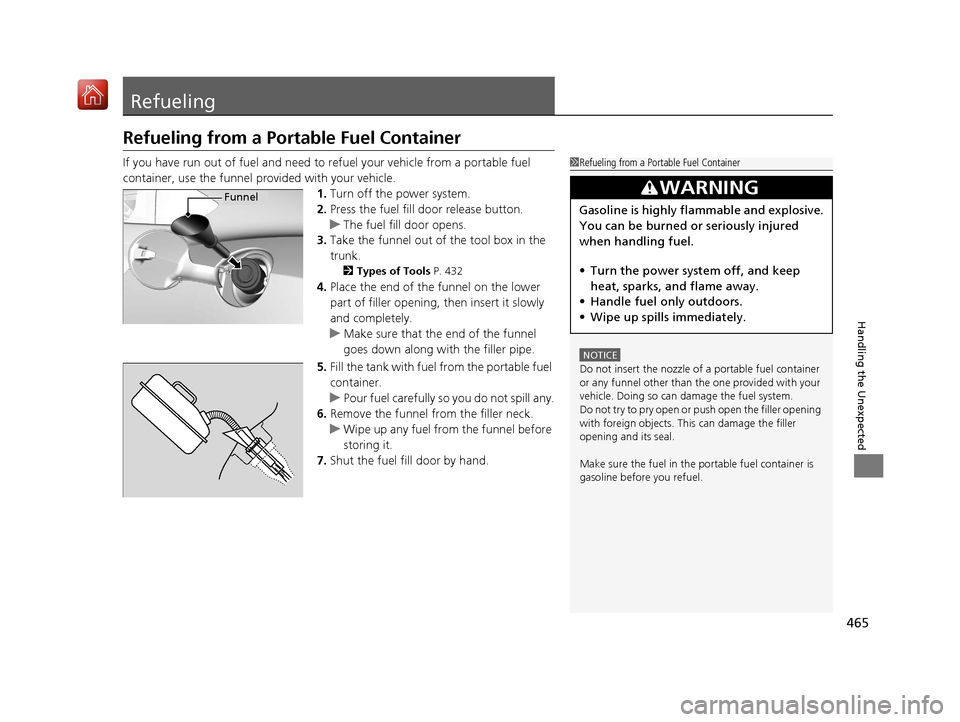
3. Take the funnel out of the tool box in the
trunk.
2 Types of Tools P. 432
4.Place the end of the funnel on the lower
part of filler opening, then insert it slowly
and completely.
u Make sure that the end of the funnel
goes down along with the filler pipe.
5. Fill the tank with fuel from the portable fuel
container.
u Pour fuel carefully so you do not spill any.
6. Remove the funnel from the filler neck.
u Wipe up any fuel from the funnel before
storing it.
7. Shut the fuel fill door by hand.
1Refueling from a Portable Fuel Container
NOTICE
Do not insert the nozzle of a portable fuel container
or any funnel other than the one provided with your
vehicle. Doing so can damage the fuel system.
Do not try to pry open or push open the filler opening
with foreign objects. This can damage the filler
opening and its seal.
Make sure the fuel in the portable fuel container is
gasoline before you refuel.
3WARNING
Gasoline is highly flammable and explosive.
You can be burned or seriously injured
when handling fuel.
• Turn the power sy stem off, and keep
heat, sparks, and flame away.
• Handle fuel only outdoors.
• Wipe up spills immediately.
Funnel
18 NSX-31T6N6100.book 465 ページ 2017年10月27日 金曜日 午後1時39分
Page 469 of 489
468
Information
Specifications
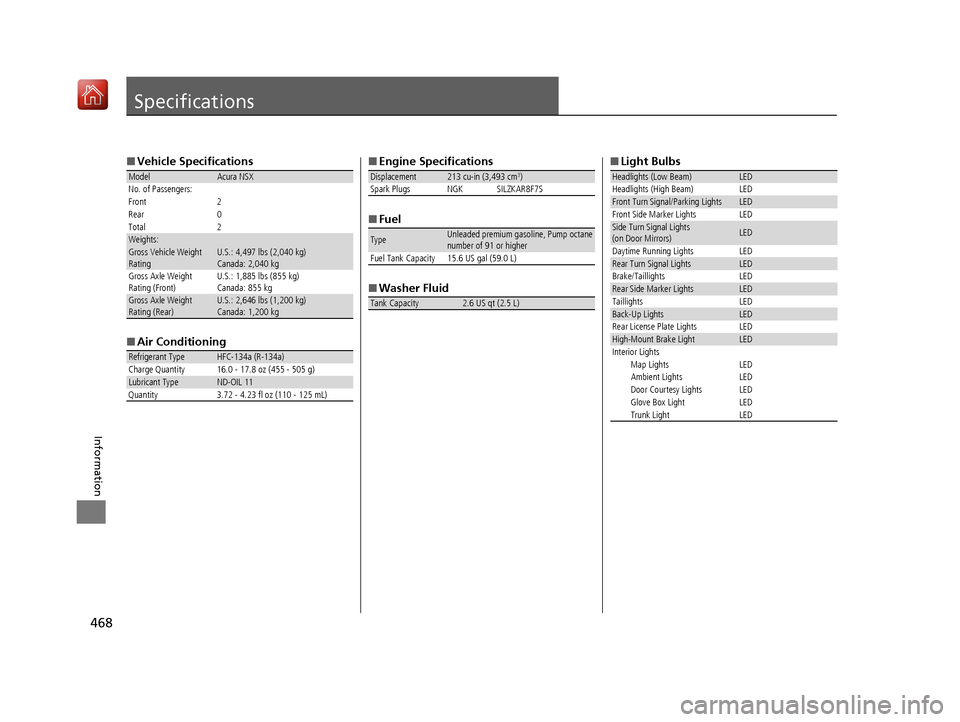
■Vehicle Specifications
■ Air Conditioning
ModelAcura NSX
No. of Passengers:
Front 2
Rear 0
Total 2
Weights:Gross Vehicle Weight
Rating U.S.: 4,497 lbs (2,040 kg)
Canada: 2,040 kg
Gross Axle Weight
Rating (Front)U.S.: 1,885 lbs (855 kg)
Canada: 855 kg
Gross Axle Weight
Rating (Rear)U.S.: 2,646 lbs (1,200 kg)
Canada: 1,200 kg
Refrigerant Type HFC-134a (R-134a)
Charge Quantity 16.0 - 17.8 oz (455 - 505 g)
Lubricant TypeND-OIL 11
Quantity 3.72 - 4.23 fl oz (110 - 125 mL)
■ Engine Specifications
■ Fuel
■ Washer Fluid
Displacement213 cu-in (3,493 cm3)
Spark Plugs NGK SILZKAR8F7S
TypeUnleaded premium gasoline, Pump octane
number of 91 or higher
Fuel Tank Capacity 15.6 US gal (59.0 L)
Tank Capacity2.6 US qt (2.5 L)
■ Light Bulbs
Headlights (Low Beam)LED
Headlights (High Beam) LED
Front Turn Signal/Parking LightsLED
Front Side Marker Lights LED
Side Turn Signal Lights
(on Door Mirrors)LED
Daytime Running Lights LED
Rear Turn Signal LightsLED
Brake/Taillights LED
Rear Side Marker LightsLED
Taillights LED
Back-Up LightsLED
Rear License Plate Lights LED
High-Mount Brake LightLEDInterior LightsMap LightsLEDAmbient LightsLEDDoor Courtesy LightsLEDGlove Box LightLEDTrunk LightLED
18 NSX-31T6N6100.book 468 ページ 2017年10月27日 金曜日 午後1時39分
Page 484 of 489
483
Index
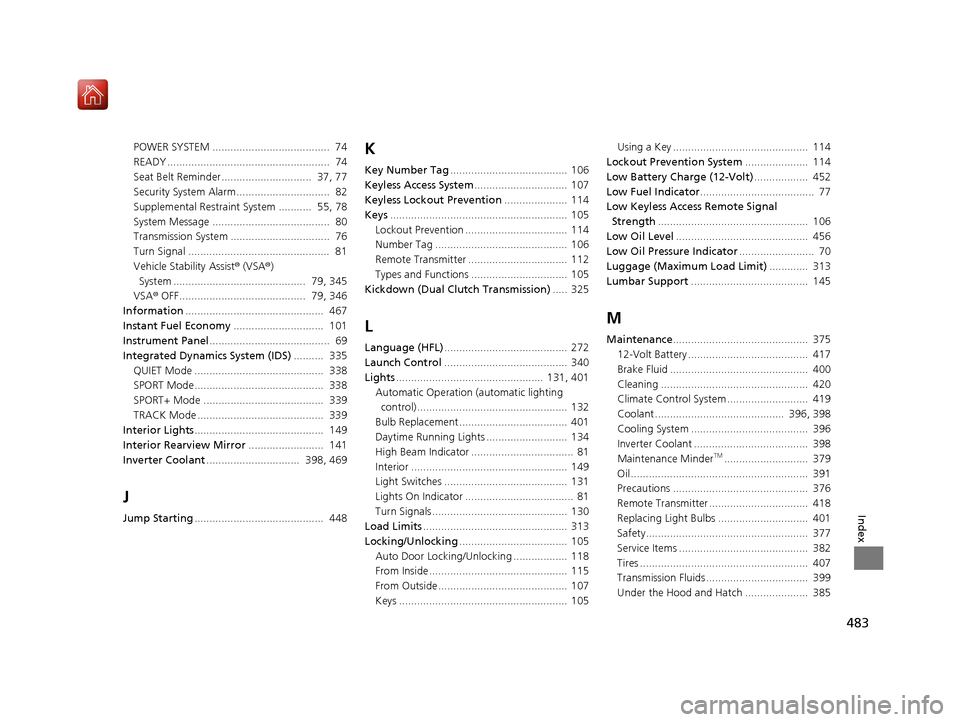
POWER SYSTEM ....................................... 74
READY ...................................................... 74
Seat Belt Reminder.............................. 37, 77
Security System Alarm............................... 82
Supplemental Restraint System ........... 55, 78
System Message ....................................... 80
Transmission System ................................. 76
Turn Signal ............................................... 81
Vehicle Stability Assist® (VSA ®)
System ............................................ 79, 345
VSA ® OFF.......................................... 79, 346
Information .............................................. 467
Instant Fuel Economy .............................. 101
Instrument Panel ........................................ 69
Integrated Dynamics System (IDS) .......... 335
QUIET Mode ........................................... 338
SPORT Mode........................................... 338
SPORT+ Mode ........................................ 339
TRACK Mode .......................................... 339
Interior Lights ........................................... 149
Interior Rearview Mirror ......................... 141
Inverter Coolant ............................... 398, 469
J
Jump Starting........................................... 448
K
Key Number Tag ....................................... 106
Keyless Access System ............................... 107
Keyless Lockout Prevention ..................... 114
Keys ........................................................... 105
Lockout Prevention .................................. 114
Number Tag ............................................ 106
Remote Transmitter ................................. 112
Types and Functions ................................ 105
Kickdown (Dual Clutch Transmission) ..... 325
L
Language (HFL)......................................... 272
Launch Control ......................................... 340
Lights ................................................. 131, 401
Automatic Operation (automatic lighting control).................................................. 132
Bulb Replacement .................................... 401
Daytime Running Lights ........................... 134
High Beam Indicator .................................. 81
Interior .................................................... 149
Light Switches ......................................... 131
Lights On Indicator .................................... 81
Turn Signals ............................................. 130
Load Limits ................................................ 313
Locking/Unlocking .................................... 105
Auto Door Locking/Unlocking .................. 118
From Inside .............................................. 115
From Outside ........................................... 107
Keys ........................................................ 105 Using a Key ............................................. 114
Lockout Prevention System ..................... 114
Low Battery Charge (12-Volt) .................. 452
Low Fuel Indicator ...................................... 77
Low Keyless Access Remote Signal
Strength .................................................. 106
Low Oil Level ............................................ 456
Low Oil Pressure Indicator ......................... 70
Luggage (Maximum Load Limit) ............. 313
Lumbar Support ....................................... 145
M
Maintenance............................................. 375
12-Volt Battery ........................................ 417
Brake Fluid .............................................. 400
Cleaning ................................................. 420
Climate Control System ........................... 419
Coolant ........................................... 396, 398
Cooling System ....................................... 396
Inverter Coolant ...................................... 398
Maintenance Minder
TM............................ 379
Oil ........................................................... 391
Precautions ............................................. 376
Remote Transmitter ................................. 418
Replacing Light Bulbs .............................. 401
Safety...................................................... 377
Service Items ........................................... 382
Tires ........................................................ 407
Transmission Fluids .................................. 399
Under the Hood and Hatch ..................... 385
18 NSX-31T6N6100.book 483 ページ 2017年10月27日 金曜日 午後1時39分