brakes ACURA NSX 2020 User Guide
[x] Cancel search | Manufacturer: ACURA, Model Year: 2020, Model line: NSX, Model: ACURA NSX 2020Pages: 491, PDF Size: 20.24 MB
Page 384 of 491
382
uuMaintenance MinderTMuTo Use Maintenance Minder TM
Maintenance
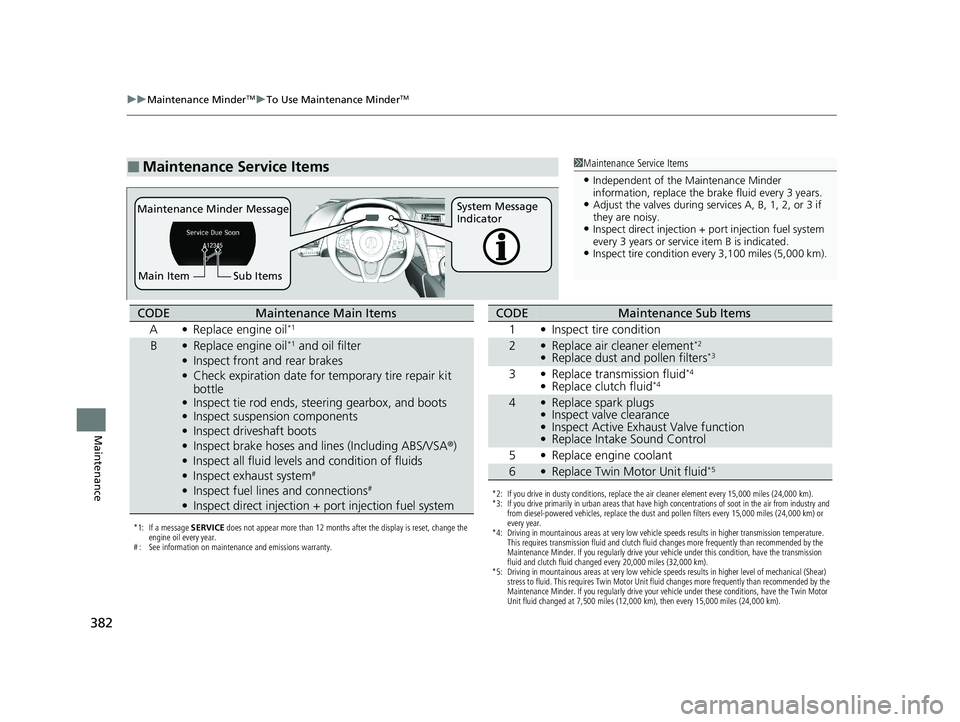
■Maintenance Service Items1Maintenance Service Items
• Independent of the Maintenance Minder
information, replace the brake fluid every 3 years.
• Adjust the valves during services A, B, 1, 2, or 3 if
they are noisy.
• Inspect direct injection + port injection fuel system
every 3 years or service item B is indicated.
• Inspect tire condition ev ery 3,100 miles (5,000 km).
Maintenance Minder Message System Message
Indicator
Main Item Sub Items
*1: If a message SERVICE does not appear more than 12 months after the display is reset, change the
engine oil every year.
# : See information on maintenance and emissions warranty.
CODEMaintenance Main Items
A •Replace engine oil *1
B•
Replace engine oil *1
and oil filter
• Inspect front and rear brakes
• Check expiration date for temporary tire repair kit bottle
• Inspect tie rod ends, steering gearbox, and boots
• Inspect suspension components
• Inspect driveshaft boots
• Inspect brake hoses and li nes (Including ABS/VSA®)
• Inspect all fluid levels and condition of fluids
• Inspect exhaust system #
• Inspect fuel lines and connections #
• Inspect direct injection + port injection fuel system
*2: If you drive in dusty conditions, replace the air cleaner element every 15,000 miles (24,000 km).
*3: If you drive primarily in urban areas that have high concentrations of soot in the air from industry and
from diesel-powered vehicles, replace the dust and pollen filters every 15,000 miles (24,000 km) or every year.
*4: Driving in mountainous areas at very low vehicle speeds results in higher transmission temperature. This requires transmission fluid and clutch fluid changes more frequently than recommended by the
Maintenance Minder. If you regularly drive your vehicle under this condition, have the transmission
fluid and clutch fluid changed every 20,000 miles (32,000 km).
*5: Driving in mountainous areas at very low vehicle speeds results in higher level of mechanical (Shear) stress to fluid. This requires Twin Motor Unit fluid changes more frequently than recommended by the
Maintenance Minder. If you regularly drive your vehicle under these conditions, have the Twin Motor
Unit fluid changed at 7,500 miles (12,000 km), then every 15,000 miles (24,000 km).
CODEMaintenance Sub Items
1 •Inspect tire condition
2•Replace air cleaner element *2
• Replace dust and pollen filters *3
3 •Replace transmission fluid *4
• Replace clutch fluid *4
4•
Replace spark plugs
• Inspect valve clearance
• Inspect Active Exhaust Valve function
• Replace Intake Sound Control
5 •Replace engine coolant
6• Replace Twin Motor Unit fluid *5
20 ACURA NSX PMC-31T6N6300.book 382 ページ 2019年9月11日 水曜日 午後4時51分
Page 417 of 491

415
uuChecking and Maintaining TiresuWinter Tires
Maintenance
Winter Tires
If driving on snowy or frozen roads, mount all-season marked M+S tires, snow tires,
or tire chains; reduce speed; and maintain sufficient distance between vehicles when
driving.
Be particularly careful wh en operating the steering wheel or brakes to prevent
skidding.
Use tire chains, snow tires, or all-season tires when necessary or according to the law.
When mounting, refer to the following points.
For winter tires: • Mount the tires to all four wheels.
For tire chains:• Install them on the rear tires only.
• Because your vehicle has limited tire clea rance, we strongly recommend using the
chains listed below:
*1:Tire chains to be used only on optional 295/30R20 winter tires.
*2:Tire chains to be used only on optional 305/30R20 winter tires.• Follow the chain manufactur er’s instruction when installing. Mount them as
tightly as you can.
• Check that the chains do not touc h the brake lines or suspension.
• Drive slowly.
Recommended Winter Tires: •Michelin Alpin PA4
Front: 245/35R19 (93W)
Rear: 295/30R20 (97V)• Pirelli SottoZero 3
Front: 245/35R19 (93W)
Rear: 305/30R20 (103W)
• Auto-trac 232405 *1
• K-Summit K-44 *2
1Winter Tires
NOTICE
Traction devices that are the wrong size or improperly
installed can damage your
vehicle’s brake lines,
suspension, body, and wheels. Stop driving if they are hitting any part of the vehicle.
When tire chains are mounted, follow the chain
manufacturer’s instructi ons regarding vehicle
operational limits.
If your vehicle is equipp ed with summer tires, be
aware that these tires are not designed for winter
driving conditions. For more information, contact an
authorized Acura NSX dealer.
3WARNING
Using the wrong chains, or not properly
installing chains, can damage the brake
lines and cause a crash in which you can be
seriously injured or killed.
Follow all instruction s in this owner’s
manual regarding the selection and use of
tire chains.
20 ACURA NSX PMC-31T6N6300.book 415 ページ 2019年9月11日 水曜日 午後4時51分
Page 426 of 491
uuCleaninguExterior Care
424
Maintenance
The inside lenses of exterior lights (headli ghts, brake lights, etc.) may fog temporarily
if you have driven in the rain. Dew condensation also may build up inside the lenses
when there is a significant enough differe nce between the ambient and inside lens
temperatures (similar to vehicle windows fogging up in rainy conditions). These
conditions are natural processes, not stru ctural design problems in the exterior
lights.
Lens design characteristics may result in mo isture developing on the light lens frame
surfaces. This also is not a malfunction.
However, if you see large amounts of wa ter accumulation, or large water drops
building up inside the lenses, have your vehicle inspected by an authorized Acura NSX dealer.
Keep brake pads and rotors free of substances that are either abrasive or oil based,
as these substances can re duce brake system performance.
NSX brake pads and disks have a high meta llic content. Under certain conditions
these pad and disks may rust to varying degrees, which may cause a clunk noise or
rubbing sound if parked when brakes become wet. This is normal for brakes with
high friction pads and it does not affect operation of the brakes.
To prevent the iron contained in the brake pa ds and rotors from rusting and sticking,
brakes should be dried before parking the ve hicle after driving on wet roads or after
washing the vehicle (especially before long -term storage). To dry the brake pads and
rotors, drive the vehicle at a low sp eed and apply the brakes several times.
By regularly applying strong pressure to the brakes, you can reduce corrosion
buildup on the brake pads and rotors.
■Fogged Exterior Light Lenses
■Cast Iron Brakes *
1Brake Maintenance
Brake maintenance require
s specialized knowledge.
We recommend maintenance to be carried out by an
authorized Acura NSX dealer.
1Maintenance of Brake Surfaces Brakes can be dried by driv ing on a dry road for few
miles/kilometers, and a pplying the brake pedal
normally, based on traffic and road conditions. These
steps help maintain br ake system performance.
* Not available on all models
20 ACURA NSX PMC-31T6N6300.book 424 ページ 2019年9月11日 水曜日 午後4時51分
Page 427 of 491
425
uuCleaninguExterior Care
Maintenance
Keep the brake pads and rotors free of substances that are either abrasive or oil
based, as these substances can reduce br aking power. After driving in the presence
of salt and/or sand, briefly wash the ro tor/pad surfaces with low-pressure water,
then allow the brake system to dry. To dry the brake pads and rotors, drive the
vehicle at a low speed and apply the brakes several times.
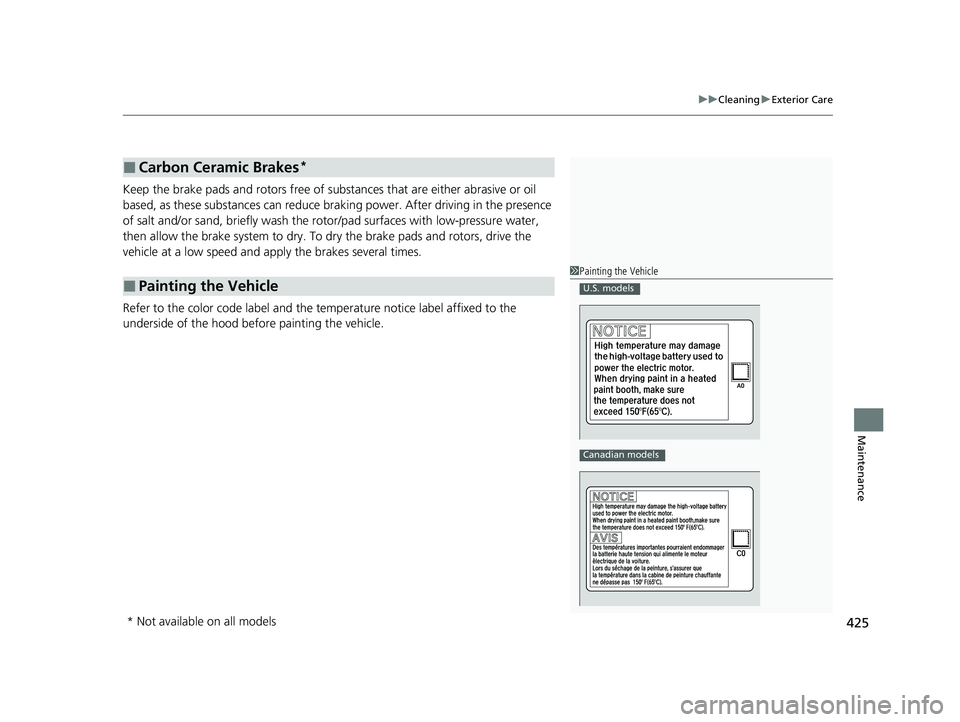
Refer to the color code label and the te mperature notice label affixed to the
underside of the hood before painting the vehicle.
■Carbon Ceramic Brakes *
■Painting the Vehicle
1Painting the Vehicle
U.S. models
Canadian models
* Not available on all models
20 ACURA NSX PMC-31T6N6300.book 425 ページ 2019年9月11日 水曜日 午後4時51分