flat tire ACURA NSX 2020 User Guide
[x] Cancel search | Manufacturer: ACURA, Model Year: 2020, Model line: NSX, Model: ACURA NSX 2020Pages: 491, PDF Size: 20.24 MB
Page 413 of 491

411
uuChecking and Maintaining TiresuDOT Tire Quality Grading (U.S. Vehicles)
Maintenance
The traction grades, from highest to lowest, are AA, A, B, and C.
Those grades represent the tire’s ability to stop on wet pavement
as measured under controlled conditions on specified government test surfaces of asph alt and concrete. A tire marked
C may have poor traction performance.
The temperature grades are A (the highest), B, and C,
representing the tire’s resistance to the generation of heat and its
ability to dissipate heat when te sted under controlled conditions
on a specified indoor laboratory test wheel. Sustained high
temperature can cause the material of the tire to degenerate and
reduce tire life, and ex cessive temperature can lead to sudden tire
failure. The grade C corresponds to a level of performance which
all passenger car tires must meet under the Federal Motor Vehicle
Safety Standard No. 109. Grades B and A represent higher levels
of performance on the laboratory test wheel than the minimum
required by law.
■Traction
■Temperature
1Traction
Warning: The traction grade
assigned to this tire is based on straight-ahead braking traction tests,
and does not include acceleration,
cornering, hydroplaning, or peak
traction characteristics.
1TemperatureWarning: The temperature grade for
this tire is establishe d for a tire that is
properly inflated and not
overloaded. Excessive speed,
underinflation, or excessive loading, either separately or in combination,
can cause heat buildup and possible tire failure.
20 ACURA NSX PMC-31T6N6300.book 411 ページ 2019年9月11日 水曜日 午後4時51分
Page 414 of 491

412
uuChecking and Maintaining TiresuWear Indicators
Maintenance
Wear IndicatorsThe groove where the wear indicator is
located is 1/16 inch (1.6 mm) shallower than
elsewhere on the tire. If the tread has worn so
that the indicator is exposed, replace the tire.
Worn out tires have poor traction on wet roads.
Tire Service Life
The life of your tires is dependent on many factors, including driving habits, road
conditions, vehicle loading, inflation pre ssure, maintenance history, speed, and
environmental conditions (even when the tires are not in use).
In addition to regular inspections and inflation pressure maintenance, it is
recommended that you have annual inspections performed once the tires reach five
years old. All tires should be removed fro m service after 10 years from the date of
manufacture, regardless of their condition or state of wear.
1Checking Tires
High speed driving
We recommend that you do not drive on public roads faster than the posted sp eed limits and conditions
allow. If you intend to driv e at sustained high speeds
(over 168 mph or 270 km/h), such as at a track or
other closed course venue , adjust the cold tire
pressures as shown below to avoid excessive heat
build up and sudden tire failure.
Tire SizeFront:
245/35ZR19 (93Y)Rear:
305/30ZR20 (103Y)
Pressure Front: 38 psi (260 kPa, 2.6 kgf/cm 2
)
Rear:
38 psi (260 kPa, 2.6 kgf/cm 2
)
Example of a Wear
Indicator mark
20 ACURA NSX PMC-31T6N6300.book 412 ページ 2019年9月11日 水曜日 午後4時51分
Page 430 of 491

428
Maintenance
Storage
Vehicle Storage
If you need to park your vehicle for an extended period (more than one month),
there are several things you should do to prepare it for storage. This helps reduce
possible deterioration of vehicle components and overall condition, which allows
you to get the vehicle back on the road with minimal delay. These are:
• If possible, store your NSX in a garage or enclosed area.
• Fill the fuel tank completely.
• Change the engine oil and filter.
• Wash and dry the exterior completely.
• Clean the interior. Make sure the carpeti ng, floor mats, etc., are completely dry.
• Put the transmission in
(P .
Release the parking brake.
• Leave one window open slightly (if th e vehicle is being stored indoors).
• To maintain the low-voltage 12-volt batte ry, connect it to an accessory battery
charger. For more information on how to maintain your 12-volt battery, consult
an authorized Acura NSX dealer. 2 Checking the 12-Volt Battery P. 417
• If the vehicle is to be stored for a longer period of time, it should be supported on
jack stands to raise the tires off th e ground to prevent tire flat spotting.
2 Handling of the Jack P. 444
• Support the front wiper blade arms with a folded towel or rag so they do not
touch the windshield.
• Cover the vehicle with a “breathable” co ver, one made from a porous material
such as cotton. Nonporous materials (suc h as plastic sheeting) may trap moisture,
which can damage the paint.
• If possible, remove the vehicle from th e garage or enclosed area, remove
covering, and periodically run the engi ne until it reaches full operating
temperature (the cooling fa n cycles on and off twice).
Preferably, do this once a month.
20 ACURA NSX PMC-31T6N6300.book 428 ページ 2019年9月11日 水曜日 午後4時51分
Page 433 of 491

431
Handling the UnexpectedThis chapter explains how to handle unexpected troubles.
ToolsTypes of Tools .................................. 432
If a Tire Goes Flat
Temporarily Repairi ng a Flat Tire....... 433
Handling of the Jack ........................ 444
Power System Won
Page 435 of 491
433
Continued
Handling the Unexpected
If a Tire Goes Flat
Temporarily Repairing a Flat Tire
If the tire has a large cut or is otherwise
severely damaged, you will need to have the
vehicle towed. If the tire only has a sma ll puncture, from a small nail for instance,
you can use the temporary tire repair kit so that you can drive to the nearest service
station for a more permanent repair.
If a tire goes flat while driving, grasp the steering wheel firmly, and brake gradually
to reduce speed. Then stop in a safe place.1. Park the vehicle on a firm, level, and non-slippery surface. Apply the parking
brake.
2. Put the transmission into
(P .
3. Turn on the hazard warning lights an d set the power mode to VEHICLE OFF.
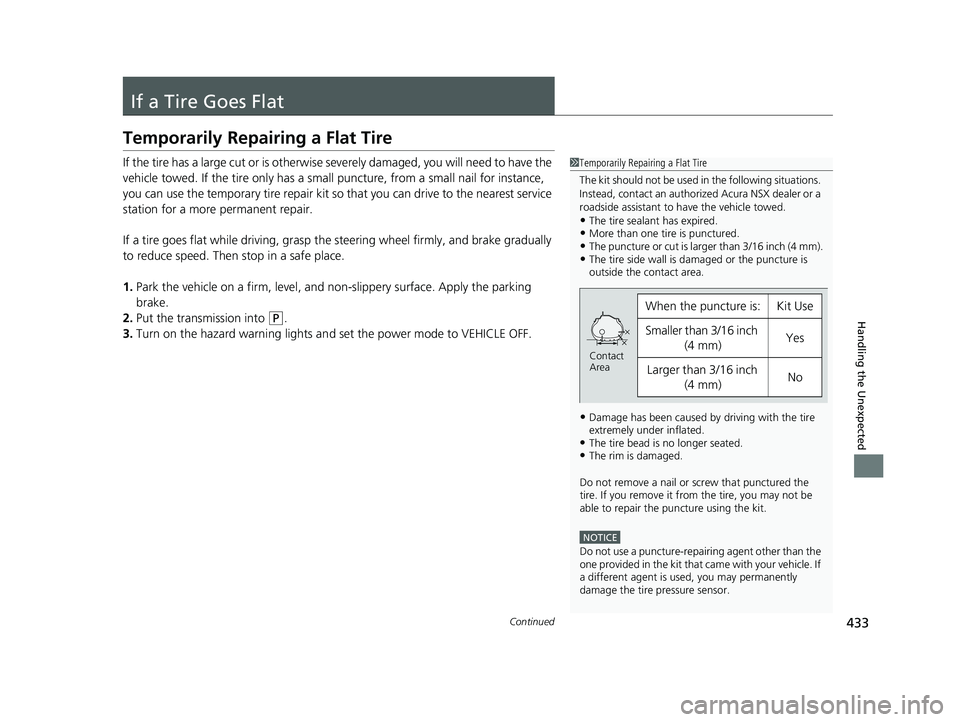
1Temporarily Repairing a Flat Tire
The kit should not be used in the following situations.
Instead, contact an authorized Acura NSX dealer or a
roadside assistant to have the vehicle towed.
• The tire sealant has expired.
• More than one tire is punctured.
• The puncture or cut is larger than 3/16 inch (4 mm).
• The tire side wall is da maged or the puncture is
outside the contact area.
• Damage has been caused by driving with the tire
extremely under inflated.
• The tire bead is no longer seated.
• The rim is damaged.
Do not remove a nail or screw that punctured the
tire. If you remove it from the tire, you may not be
able to repair the puncture using the kit.
NOTICE
Do not use a puncture-repairing agent other than the
one provided in the kit that came with your vehicle. If
a different agent is used, you may permanently
damage the tire pressure sensor.
When the puncture is:Kit Use
Smaller than 3/16 inch
(4 mm)Yes
Larger than 3/16 inch (4 mm)No
Contact
Area
20 ACURA NSX PMC-31T6N6300.book 433 ページ 2019年9月11日 水曜日 午後4時51分
Page 436 of 491

uuIf a Tire Goes FlatuTemporarily Repairing a Flat Tire
434
Handling the Unexpected
1. Open the hatch.
2. Loosen tool box tie downs.
3. Remove tool box lid.
4. Take the kit out of the tool box.
5. Place the kit face up, on flat ground near
the flat tire, and away from traffic. Do not
place the kit on its side.
■Getting Ready to Temporarily Repair the Flat Tire1Getting Ready to Temporarily Repair the Flat Tire
When making a temporary repair, carefully read the
instruction manual provided with the kit.
Air Compressor Instruction
Manual
Sealant Bottle Speed Restriction
Label
Expiration Date
Deflation Button
Air Compressor
Switch
Repair Notification
Label
U.S. Canada
U.S. Canada
Tie Down
Lid
Tire Repair Kit
20 ACURA NSX PMC-31T6N6300.book 434 ページ 2019年9月11日 水曜日 午後4時51分
Page 437 of 491

Continued435
uuIf a Tire Goes FlatuTemporarily Repairing a Flat Tire
Handling the Unexpected
1.Remove the valve cap from the tire valve
stem.
2. Shake the sealant bottle.
3. Attach the sealant/air hose onto the tire
valve stem. Screw the sealant/air hose
until it is tightly connected to the valve
stem.
uMake sure the bottle remains upright to
ensure all the sealant flows into the tire.
4. Remove the bottle cap from the bottle
adapter.
5. Attach the air compre ssor hose onto the
bottle adapter. Screw the air compressor
hose until it is tightly connected to the
bottle adapter.
■Injecting Sealant and Air1Injecting Sealant and Air
Keep the sealant bottle out of the reach of children.
Do not shake the bottle after the bottle cap removed.
If you shake the bottle after the cap is removed, it
may spill sealant.
In cold temperatures, the sealant may not flow easily.
In this situation, warm it up for five minutes before
using.
The sealant is latex based and can permanently stain
clothing and other materi als. Be careful during
handling and wipe up an y spills immediately.
3WARNING
Tire sealant contains substances that are
harmful and can be fatal if swallowed.
If accidentally swallowed, do not induce
vomiting. Drink plenty of water and get
medical attention immediately.
For skin or eye contact, flush with cool
water and get medical attention if
necessary.
Tire Valve Stem
Valve Cap
Sealant/Air Hose Tire Valve Stem
Bottle Adapter
Air Compressor Hose
Bottle
Cap
20 ACURA NSX PMC-31T6N6300.book 435 ページ 2019年9月11日 水曜日 午後4時51分
Page 438 of 491

uuIf a Tire Goes FlatuTemporarily Repairing a Flat Tire
436
Handling the Unexpected
6. Plug in the compressor to the accessory
power socket.
uBe careful not to pinch the cord in a
door or window.
2 Accessory Power Socket P. 153
7. Turn the power system on.
uKeep the power system on while
injecting sealant and air.
2 Carbon Monoxide Gas P. 67
8. Turn the air compressor on to inflate the
tire.
uThe compressor starts injecting sealant and air into the tire.
9. After the air pressure reaches 32 psi (220
kPa), turn off the compressor.
1Injecting Sealant and Air
NOTICE
Do not operate the temporary tire repair kit compressor
for more than 15 minutes. The compressor can overheat
and become permanently damaged.
Until the sealant injection is complete, the pressure
shown on the pressure gauge will appear higher than
actual. After the sealant injection is complete the
pressure will drop and then begi n to rise again as the tire
is inflated with air. This is normal. To accurately measure
the air pressure using the gauge, turn the air compressor
off only after the sealan t injection is complete.
If the required air pressure is not reached within 15
minutes, the tire may be too severely damaged for
the kit to provide the necessa ry seal and your vehicle
will need to be towed.
See an authorized Acura NSX dealer for a replacement
sealant bottle and proper disposal of an empty bottle.
3WARNING
Running the engine with the vehicle in an
enclosed or even partly enclosed area can
cause a rapid build-up of toxic carbon
monoxide.
Breathing this colorless, odorless gas can
cause unconsciousness and even death.
Only run the engine to power the air
compressor with th e vehicle outdoors.
Air Compressor Switch
OFF
ON
20 ACURA NSX PMC-31T6N6300.book 436 ページ 2019年9月11日 水曜日 午後4時51分
Page 439 of 491

437
uuIf a Tire Goes FlatuTemporarily Repairing a Flat Tire
Continued
Handling the Unexpected
10.Unplug the kit from the accessory power socket.
11. Unscrew the sealant/ai r hose from the tire
valve stem. Reinstall the valve cap.
12. Push the deflation button until the gauge
returns 0 psi (0 kPa).
13. Apply the repair notification label to the
flat surface of the wheel.
uThe wheel surface must be clean to
ensure the label adheres properly.
Deflation Button Air Pressure Gauge
Repair Notification Label
U.S.
Canada
20 ACURA NSX PMC-31T6N6300.book 437 ページ 2019年9月11日 水曜日 午後4時51分
Page 440 of 491

438
uuIf a Tire Goes FlatuTemporarily Repairing a Flat Tire
Handling the Unexpected
1.Apply the speed restriction label to the
location as shown.
2. Drive the vehicle for about five minutes.
uDo not exceed 50 mph (80 km/h).
3. Stop the vehicle in a safe place.
■Distributing the Sealant in the Tire
Speed Restriction Label
U.S.
Canada
20 ACURA NSX PMC-31T6N6300.book 438 ページ 2019年9月11日 水曜日 午後4時51分