ABS ACURA NSX 2020 Owners Manual
[x] Cancel search | Manufacturer: ACURA, Model Year: 2020, Model line: NSX, Model: ACURA NSX 2020Pages: 491, PDF Size: 20.24 MB
Page 18 of 491
16
Quick Reference Guide
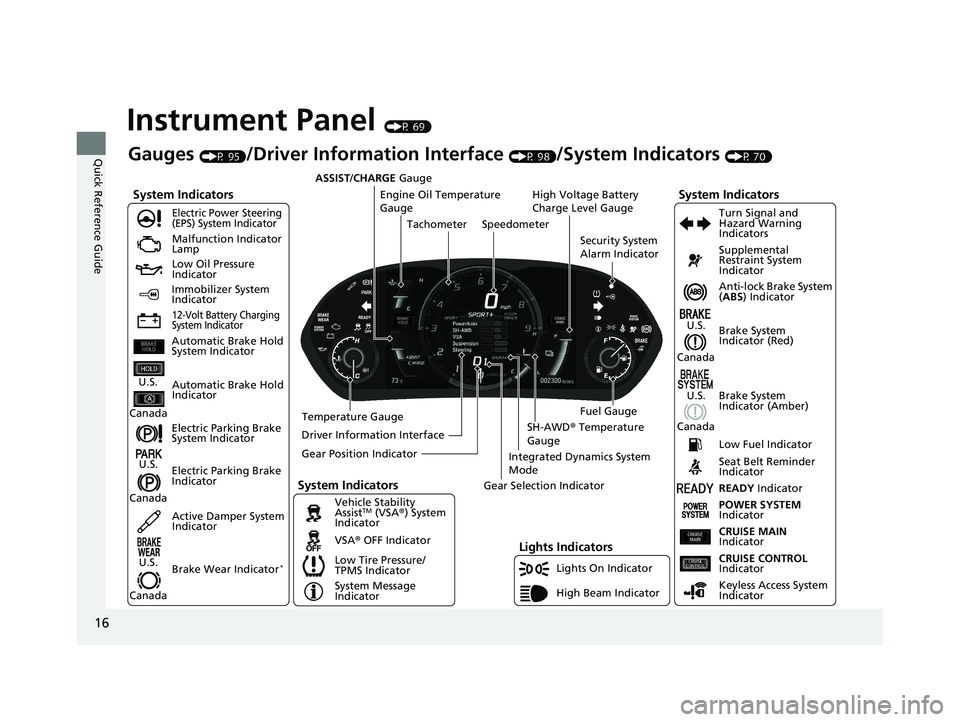
Instrument Panel (P 69)
System Indicators
Malfunction Indicator
Lamp
Low Oil Pressure
Indicator
12-Volt Battery Charging
System Indicator
Anti-lock Brake System (ABS ) Indicator
Vehicle Stability
Assist TM
(VSA ®) System
Indicator
VSA ® OFF Indicator
Electric Power Steering
(EPS) System Indicator
Lights Indicators
Lights On Indicator
High Beam Indicator
Immobilizer System
Indicator
Seat Belt Reminder
Indicator
System Indicators
System Message
Indicator Brake System
Indicator (Red)
Supplemental
Restraint System
Indicator
Low Fuel Indicator
Gauges
(P 95)/Driver Information Interface (P 98)/System Indicators (P 70)
Low Tire Pressure/
TPMS Indicator Turn Signal and
Hazard Warning
Indicators
Keyless Access System
Indicator
High Voltage Battery
Charge Level Gauge
Security System
Alarm Indicator
Fuel Gauge
Tachometer
Driver Information Interface Speedometer
Gear Position Indicator Gear Selection Indicator
Electric Parking Brake
System Indicator
Electric Parking Brake
Indicator
Automatic Brake Hold
System Indicator
Brake System
Indicator (Amber)
System Indicators
Automatic Brake Hold
IndicatorU.S.
Canada
U.S.
Canada
U.S.
Canada
U.S.
Canada
READY Indicator
POWER SYSTEM
Indicator
Temperature Gauge ASSIST
/CHARGE Gauge
U.S.
Canada Active Damper System
Indicator
Brake Wear Indicator
* CRUISE MAIN
Indicator
CRUISE CONTROL
Indicator
Engine Oil Temperature
Gauge
Integrated Dynamics System
Mode
SH-AWD ® Temperature
Gauge
20 ACURA NSX PMC-31T6N6300.book 16 ページ 2019年9月11日 水曜日 午後4時51分
Page 50 of 491

48
uuAirbagsuFront Airbags (SRS)
Safe Driving
■When front airbags should not deploy
Minor frontal crashes: Front airbags were designed to supplement seat belts and
help save lives, not to prevent minor scrape s, or even broken bones that might occur
during a less than moderate-to-severe frontal crash.
Side impacts: Front airbags can provide protection when a sudden deceleration
causes a driver or passenger to move towa rd the front of the vehicle. Side airbags
and side curtain airbags have been specifically designed to help reduce the severity
of injuries that can occur during a moderate-to-severe side impact which can cause
the driver or passenger to move toward the side of the vehicle.
Rear impacts: Head restraints and seat belts are your best protection during a rear
impact. Front airbags cannot provide any si gnificant protection and are not designed
to deploy in such collisions.
Rollovers: In a rollover, your best form of protection is a seat belt or, if your vehicle
is equipped with a rollover sensor, both a se at belt and a side curtain airbag. Front
airbags, however, are not designed to deploy in a rollover as they would provide
little if any protection.
■ When front airbags deploy with little or no visible damage
Because the airbag system senses sudden deceleration, a strong impact to the
vehicle framework or suspension might caus e one or more of the airbags to deploy.
Examples include running into a curb, the edge of a hole, or other low fixed object
that causes a sudden deceleration in th e vehicle chassis. Since the impact is
underneath the vehicle, damage may not be readily apparent. ■ When front airbags may not deploy, even though exterior damage
appears severe
Since crushable body parts absorb crash energy during an impact, the amount of
visible damage does not always indicate proper airbag operation. In fact, some
collisions can result in severe damage but no airbag deployment because the airbags
would not have been needed or would not have provided protection even if they
had deployed.
20 ACURA NSX PMC-31T6N6300.book 48 ページ 2019年9月11日 水曜日 午後4時51分
Page 55 of 491

53
uuAirbagsuSide Airbags
Safe Driving
■When a side airbag deploys with little or no visible damage
Because the airbag system senses sudden acceleration, a strong impact to the side
of the vehicle’s framework can cause a side airbag to deploy. In such cases, there
may be little or no damage, but the side impact sensors detected a severe enough
impact to deploy the airbag. ■ When a side airbag may not deploy, even though visible damage appears
severe
It is possible for a side airbag not to deploy during an impact that results in
apparently severe damage. This can occur when the point of impact was toward the
far front or rear of the vehicle, or when the vehicle’s crushable body parts absorbed
most of the crash energy. In either case , the side airbag would not have been
needed nor provided protection even if it had deployed.
20 ACURA NSX PMC-31T6N6300.book 53 ページ 2019年9月11日 水曜日 午後4時51分
Page 72 of 491

70
Instrument Panel
Indicators
IndicatorNameOn/BlinkingExplanationMessage
Brake System
Indicator (Red)
•Comes on for a few seconds when
you set the power mode to ON, then goes off.
• Comes on when the brake fluid
level is low.
• Comes on if there is a problem with
the brake system.• Comes on while driving - Check the
brake fluid level. 2What to do when the indicator comes
on while driving P. 453
• Comes on along with the brake
system indicator (amber) - Immediately
stop in a safe place. Contact an authorized
Acura NSX dealer for repair. The brake
pedal becomes harder to operate. Depress
the pedal further than you normally do.
• Comes on along with the ABS indicator - Have your vehicle checked by
an authorized Acura NSX dealer. 2If the Brake System Indicator (Red)
Comes On P. 453
Low Oil Pressure
Indicator
•Comes on when you set the power
mode to ON, and goes off when
the power system starts.
• Comes on when the engine oil
pressure is low.
• Comes on if there is a problem with
the engine oil pressure system.• Comes on while driving - Immediately
stop in a safe place and set the power
mode to VEHICLE OFF, then contact an
authorized Acura NSX dealer.
U.S.
Canada
(Red)
20 ACURA NSX PMC-31T6N6300.book 70 ページ 2019年9月11日 水曜日 午後4時51分
Page 80 of 491

78
uuIndicatorsu
Instrument Panel
IndicatorNameOn/BlinkingExplanationMessage
Anti-lock Brake
System (ABS)
Indicator
• Comes on for a few seconds when
you set the power mode to ON,
then goes off.
• If it comes on at any other time,
there is a problem with the ABS.•Stays on constantly - Have your vehicle
checked by an authorized Acura NSX
dealer. With this indi cator on, your vehicle
still has normal braking ability but no
anti-lock function. 2Anti-lock Brake System (ABS) P. 362
Supplemental
Restraint System
Indicator
•Comes on for a few seconds when
you set the power mode to ON,
then goes off.
• Comes on if a problem with any of the following is detected:
- Supplemental restraint system
- Side airbag system
- Side curtain airbag system
- Knee airbag system
- Seat belt tensioner• Stays on constantly or does not come
on at all - Have your vehicle checked by
an authorized Acura NSX dealer.
Electric Power
Steering (EPS)
System Indicator
• Comes on when you set the power
mode to ON, and goes off when the
power system is on.
• Comes on if there is a problem with
the EPS system.•Stays on constantly or does not come
on at all - Have your vehicle checked by
an authorized Acura NSX dealer. 2If the Electric Power Steering (EPS)
System Indicator Comes On P. 453
20 ACURA NSX PMC-31T6N6300.book 78 ページ 2019年9月11日 水曜日 午後4時51分
Page 311 of 491
309
Driving
This chapter discusses driving and refueling.
Before Driving Driving Preparation .......................... 310
Maximum Load Limit........................ 313
High-Performance Driving ................ 315
Towing a Trailer Towing Your Vehicle ........................ 320
When Driving Turning on the Power ...................... 321
Precautions While Driving................. 324
Dual Clutch Transmission ................. 325
Shifting ............................................ 326Acoustic Vehicle Al erting System ...... 335 Integrated Dynamics System ............ 336
Launch Control ................................ 341
Cruise Control ................................. 343
Vehicle Stability AssistTM (VSA®), aka Electronic
Stability Control (ESC), System .............. 346
Agile Handling Assist ....................... 350
SPORT HYBRID Super Handling All-Wheel- DriveTM (SPORT HYBRID SH-AWD®) .... 351
Tire Pressure Monitoring System (TPMS) ...... 352
Tire Pressure Monitoring System (TPMS) - Required Federal Explanation ......... 354
High Voltage Battery ........................ 356 Braking
Brake System ................................... 357
Anti-lock Brake System (ABS) ........... 362
Brake Assist System ......................... 363
Parking Your Vehicle
When Stopped ................................ 364
Parking Sensor System *
................... 365
Multi-View Rear Camera .................. 369
Refueling
Fuel Information .............................. 371
How to Refuel ................................. 372
Fuel Economy and CO 2 Emissions
.... 373
Turbo Engine Vehicle ....................... 374
* Not available on all models
20 ACURA NSX PMC-31T6N6300.book 309 ページ 2019年9月11日 水曜日 午後4時51分
Page 360 of 491

uuBrakinguBrake System
358
Driving
■ To release automatically
Depressing the accelerator pedal releases the parking brake.
Use the accelerator pedal to release th e brake when you are starting the vehicle
facing uphill, or in a traffic jam.
Gently depress the accelerator pedal.
When on a hill, it may require more
accelerator input to release.
uThe electric parking brake indicator goes off.
You can release the parki ng brake automatically when:
• You are wearing the driver’s seat belt.
• The power system is on.
• The transmission is not in
(P or (N.
1Parking Brake
In the following situations, the parking brake
automatically operates.
• When the vehicle stops with the automatic brake
hold system activated for more than 10 minutes.
• When the driver’s seat belt is unfastened while
your vehicle is stopped and brake hold is applied.
• When the power system is turned off while brake hold is applied.
• When there is a problem with the Brake Hold
System.
If the parking brake cannot be released
automatically, release it manually.
The parking brake cannot be released automatically
while the following indicators are on:
• Malfunction indicator lamp
• Transmission system indicator
The parking brake may not be released automatically
while the following indicators are on:
• Electric parking brak e system indicator
• VSA ® system indicator
• ABS indicator
• Supplemental restraint system indicator
Accelerator Pedal
20 ACURA NSX PMC-31T6N6300.book 358 ページ 2019年9月11日 水曜日 午後4時51分
Page 361 of 491
Continued359
uuBrakinguBrake System
Driving
Your vehicle is equipped with disc brakes at all four wheels. The brake assist system
increases the stopping force when you depress the brake pedal hard in an
emergency situation. The an ti-lock brake system (ABS) helps you retain steering
control when brak ing very hard.
2 Brake Assist System P. 363
2 Anti-lock Brake System (ABS) P. 362
■ Brake squeal
To satisfy the performance under a wide range of driving conditions, a high-
performance braking system is equipped on your vehicle. You may hear the brake
squeal under certain conditions, such as vehicle speed, deceleration, humidity, and
so on. This is not a malfunction.
■Foot Brake1Foot Brake
Check the brakes after driving through deep water,
or if there is a buildup of road surface water. If
necessary, dry the brakes by lightly depressing the
pedal several times. If you hear a continuous me tallic friction sound when
applying the brakes, this is caused by the brake wear
indicator rubbing on the brake rotor and indicates
that the brake pads need to replaced. Have your
vehicle checked by an authorized Acura NSX dealer.
If you hear only an occasion al squeak or squeal when
you initially apply the brake pedal, this may be normal
and caused by high frequen cy vibration of the brake
pads against the rotating brake disc.
Constantly using the brake pedal while going down a
long hill builds up heat, which reduces the brake
effectiveness. Apply regene rative braking by taking
your foot off the accelera tor pedal and downshifting
to a lower gear.
Do not rest your foot on the brake pedal while
driving, as it will lightly apply the brakes and cause
them to lose effectiveness over time and reduce pad
life. It will also conf use drivers behind you.
Models with iron brake discs
Models with iron brake discs
20 ACURA NSX PMC-31T6N6300.book 359 ページ 2019年9月11日 水曜日 午後4時51分
Page 364 of 491

362
uuBrakinguAnti-lock Brake System (ABS)
Driving
Anti-lock Brake System (ABS)
Helps prevent the wheels from locking up, and helps you retain steering control by
pumping the brakes rapidly, much faster than you.
The electronic brake distributi on (EBD) system, which is part of the ABS, also
balances the front-to-rear braking distri bution according to vehicle loading.
You should never pump the brake pedal. Let the ABS work for you by always
keeping firm, steady pressure on the brake pe dal. This is sometimes referred to as
“stomp and steer.” ■ ABS operation
You may hear an operating noise when the ABS is working. Depress the brake pedal
and keep holding the pedal firmly down. On dry pavement, you will need to press
on the brake pedal very hard before the AB S activates. However, you may feel the
ABS activate immediately if you are trying to stop on snow or ice.
ABS may activate when you depress the brake pedal when driving on:
• Wet or snow covered roads.
• Roads paved with stone.
• Roads with uneven surfaces, such as potholes, cracks, manholes, etc.
When the vehicle speed goes unde r 6 mph (10 km/h), the ABS stops.
■ABS1Anti-lock Brake System (ABS)
NOTICE
The ABS may not function correctly if you use an
incorrect tire type and size.
When the ABS indicator comes on while driving,
there may be a problem with the system.
While normal braking is not affected, there is a
possibility of the ABS not operating. Have your
vehicle checked by an authorized Acura NSX dealer
immediately.
The ABS does not reduce the ti me or distance it takes
to stop the vehicle. It only helps with steering control
during hard braking.
In the following cases, yo ur vehicle may need more
stopping distance than a vehicle without the ABS:
• When driving on rough road surfaces, including
when driving on uneven surf aces, such as gravel or
snow.
• When tire chains are installed.
The following may be observed with the ABS system:
• Motor sounds coming from the engine
compartment when the brakes are applied, or
when system checks are being performed after the engine has been started and while vehicle is
accelerates.
These sounds are normal to ABS systems and are
no cause for concern.
20 ACURA NSX PMC-31T6N6300.book 362 ページ 2019年9月11日 水曜日 午後4時51分
Page 367 of 491

365
uuParking Your VehicleuParking Sensor System*
Continued
Driving
Parking Sensor System *
The corner and center sensors monitor obstacles around your vehicle, and the
beeper and audio/information screen le t you know the approximate distance
between your vehicle and the obstacle. ■ The sensor location and range
1Parking Sensor System *
Even when the system is on, always confirm if there is
no obstacle near your ve hicle before parking.
The system may not work properly when:
• The sensors are covered with snow, ice, mud or
dirt.
• The vehicle is on uneven su rface, such as grass,
bumps, or a hill.
• The vehicle has been out in hot or cold weather.
• The system is affected by devices that emit ultrasonic waves.
• Driving in bad weather.
The system may not sense:
• Thin or low objects.
• Sonic-absorptive materials, such as snow, cotton,
or sponge.
• Objects directly under the bumper.
Do not put any accessories on or around the sensors.
Within about 24 in (60 cm) or less
Front Corner Sensors
Rear Corner Sensors R
ear Center Sensors
Within about 43 in (110 cm) or less
Within about 39 in (100 cm) or less
Front Center Sensors
* Not available on all models
20 ACURA NSX PMC-31T6N6300.book 365 ページ 2019年9月11日 水曜日 午後4時51分