weight Acura RDX 2012 User Guide
[x] Cancel search | Manufacturer: ACURA, Model Year: 2012, Model line: RDX, Model: Acura RDX 2012Pages: 518, PDF Size: 26.43 MB
Page 59 of 518
When a child reaches the
recommended weight or height limit
for a forward-facing child seat, the
child should sit in a back seat on a
booster seat and wear a lap/shoulder
belt.
The following pages give instructions
on how to check proper seat belt fit,
what kind of booster seat to use if
one is needed, and important
precautions for a child who must sit
in front.
Allowing a child age 12 or under
to sit in front can result in injury
or death if the passenger's front
airbag inflates.
If a child must ride in front,
move the vehicle seat as far
back as possible, use a booster
seat if needed, have the child
sit up properly and wear the
seat belt properly.Checking Seat Belt Fit
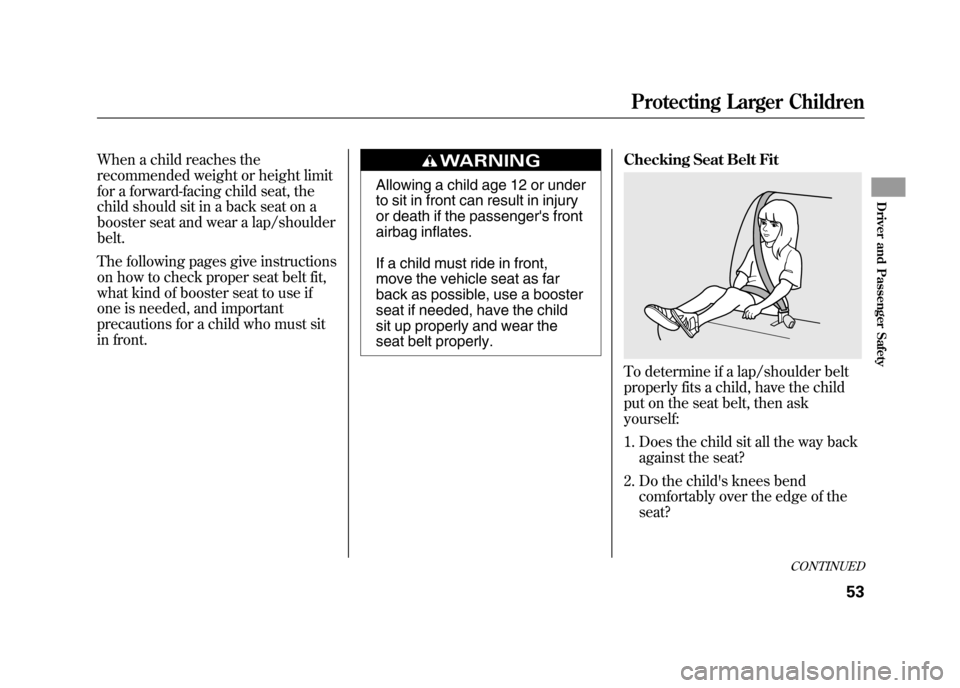
To determine if a lap/shoulder belt
properly fits a child, have the child
put on the seat belt, then ask
yourself:
1. Does the child sit all the way back
against the seat?
2. Do the child's knees bend comfortably over the edge of the
seat?
CONTINUED
Protecting Larger Children
53
Driver and Passenger Safety
11/06/16 17:42:51 12 ACURA RDX MMC North America Owner's M 50 31STK650 enu
Page 60 of 518
3. Does the shoulder belt crossbetween the child's neck and arm?
4. Is the lap part of the belt as low as possible, touching the child's
thighs?
5. Will the child be able to stay seated like this for the whole trip?
If you answer yes to all these
questions, the child is ready to wear
the lap/shoulder belt correctly. If
you answer no to any question, the
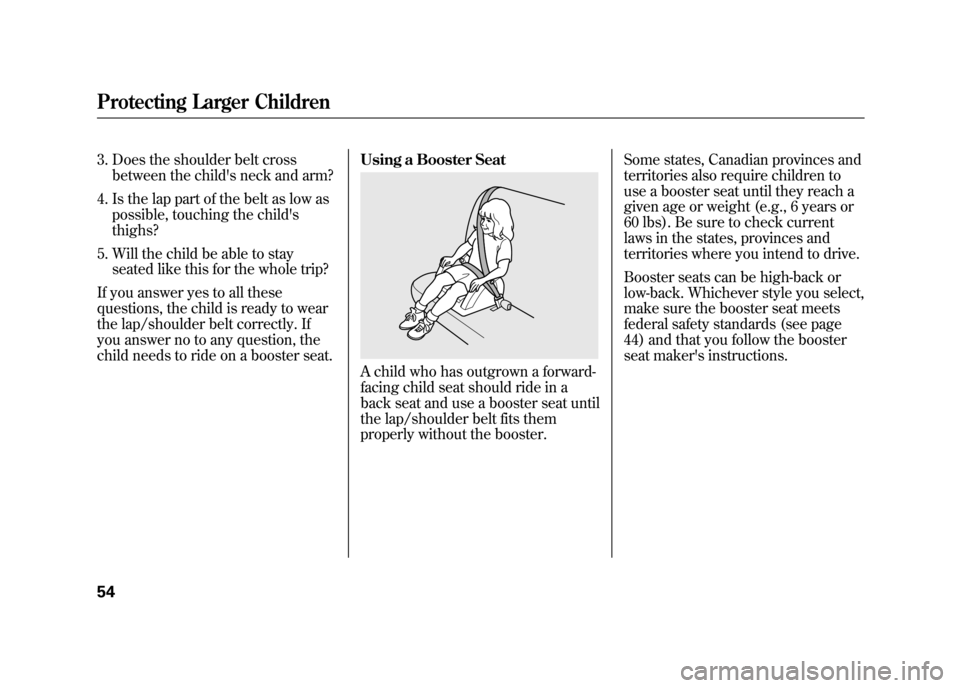
child needs to ride on a booster seat. Using a Booster Seat
A child who has outgrown a forward-
facing child seat should ride in a
back seat and use a booster seat until
the lap/shoulder belt fits them
properly without the booster.Some states, Canadian provinces and
territories also require children to
use a booster seat until they reach a
given age or weight (e.g., 6 years or
60 lbs). Be sure to check current
laws in the states, provinces and
territories where you intend to drive.
Booster seats can be high-back or
low-back. Whichever style you select,
make sure the booster seat meets
federal safety standards (see page
44) and that you follow the booster
seat maker's instructions.
Protecting Larger Children5411/06/16 17:42:51 12 ACURA RDX MMC North America Owner's M 50 31STK650 enu
Page 146 of 518

Do not put any heavy items on the
seat-back when it is folded down.
Make sure all items in the cargo area
are secured. Loose items can fly
forward and cause injury if you have
to brake hard (SeeCarrying Cargo
on page 365).
Make sure that the folded down rear
seat does not interfere with the front
passenger's seat-back. This will
cause the front passenger's weight
sensors and the front passenger's
seat belt reminder indicator to work
improperly (see pages 21 and 33).
Also check the passenger airbag off
indicator to assure proper operation
of the passenger's front airbag.
After returning the seat-back to the
upright position, tug on the seat-back
to make sure it is latched. If the seat-
back is not latched fully, the seat belt
will not work properly and you will
see the red indicator behind the
release lever as shown. To return the seat cushion to its
original position, lift up the seat
cushion, then place the rear of the
seat cushion at the base of the seat-
back. Use the seat buckles as guides.
Lower the front of the seat cushion
until it locks into place.
Make sure the seat-back and seat
cushion are locked securely and all
rear shoulder belts are positioned in
front of the rear seat-backs.
RELEASE
LEVER
INDICATOR
Seats14011/06/16 17:42:51 12 ACURA RDX MMC North America Owner's M 50 31STK650 enu
Page 161 of 518

Glove BoxOpen the glove box by pulling the
handle to the left. Close it with a firm
push. Lock or unlock the glove box
with the master key.
An open glove box can cause
serious injury to your passenger
in a crash, even if the
passenger is wearing the seat
belt.
Always keep the glove box
closed while driving.
The glove box light comes on when
the parking lights are on. Front Door Pockets
The interior of each front door has an
extendable pocket for maps and
other small, lightweight items. For
safety, be sure both front door
pockets are closed while driving.
Lock
FRONT DOOR POCKET
Interior Convenience Items
155
Instruments and Controls
11/06/16 17:42:51 12 ACURA RDX MMC North America Owner's M 50 31STK650 enu
Page 366 of 518

Improving Fuel EconomyVehicle MaintenanceA properly maintained vehicle
maximizes fuel economy. Poor
maintenance can significantly reduce
fuel economy. Always maintain your
vehicle according to the maintenance
messages displayed on the
information display (seeOwner's
Maintenance Checks on page 417).
For example:●Use the required engine oil (see
page 420).●Maintain proper tire inflation -
An underinflated tire increases
‘‘ rolling resistance, ’’which reduces
fuel economy.●Avoid carrying excess weight in
your vehicle -It puts a heavier
load on the engine, increasing fuel
consumption.
●Keep your vehicle clean -In
particular, a build-up of snow or
mud on your vehicle's underside
adds weight and rolling resistance.
Frequent cleaning helps your fuel
economy.
Drive Efficiently●Drive moderately -Rapid
acceleration, abrupt cornering, and
hard braking increase fuel
consumption.●Observe the speed limit -
Aerodynamic drag has a big effect
on fuel economy at speeds above
45 mph (75 km/h). Reduce your
speed and you reduce the drag.
Trailers, car top carriers, roof
racks and bike racks are also big
contributors to increased drag.
Fuel Economy36011/06/16 17:42:51 12 ACURA RDX MMC North America Owner's M 50 31STK650 enu
Page 372 of 518
Load Limits
The maximum load for your vehicle
is 870 lbs (395 kg).
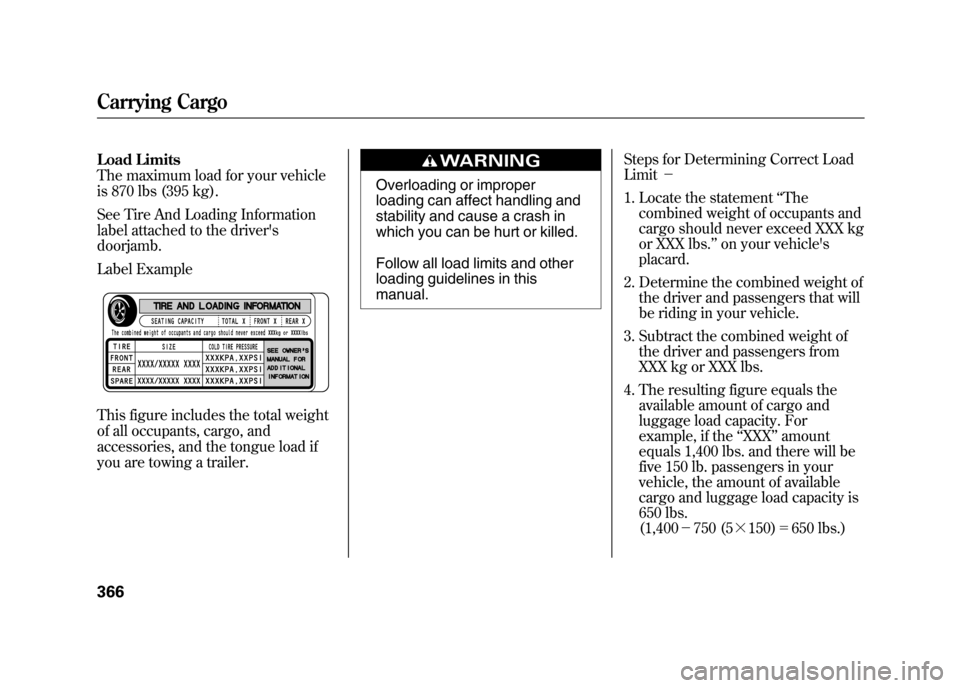
See Tire And Loading Information
label attached to the driver's
doorjamb.
Label Example
This figure includes the total weight
of all occupants, cargo, and
accessories, and the tongue load if
you are towing a trailer.
Overloading or improper
loading can affect handling and
stability and cause a crash in
which you can be hurt or killed.
Follow all load limits and other
loading guidelines in this
manual.Steps for Determining Correct Load
Limit
-
1. Locate the statement ‘‘The
combined weight of occupants and
cargo should never exceed XXX kg
or XXX lbs. ’’on your vehicle's
placard.
2. Determine the combined weight of the driver and passengers that will
be riding in your vehicle.
3. Subtract the combined weight of the driver and passengers from
XXX kg or XXX lbs.
4. The resulting figure equals the available amount of cargo and
luggage load capacity. For
example, if the ‘‘XXX ’’amount
equals 1,400 lbs. and there will be
five 150 lb. passengers in your
vehicle, the amount of available
cargo and luggage load capacity is
650 lbs.
(1,400 -750 (5 ╳150) =650 lbs.)
Carrying Cargo36611/06/16 17:42:51 12 ACURA RDX MMC North America Owner's M 50 31STK650 enu
Page 373 of 518
5. Determine the combined weight ofluggage and cargo being loaded on
the vehicle. That weight may not
safely exceed the available cargo
and luggage load capacity
calculated in Step 4.
6. If your vehicle will be towing a trailer, load from your trailer will
be transferred to your vehicle.
Consult this manual to determine
how this reduces the available
cargo and luggage load capacity of
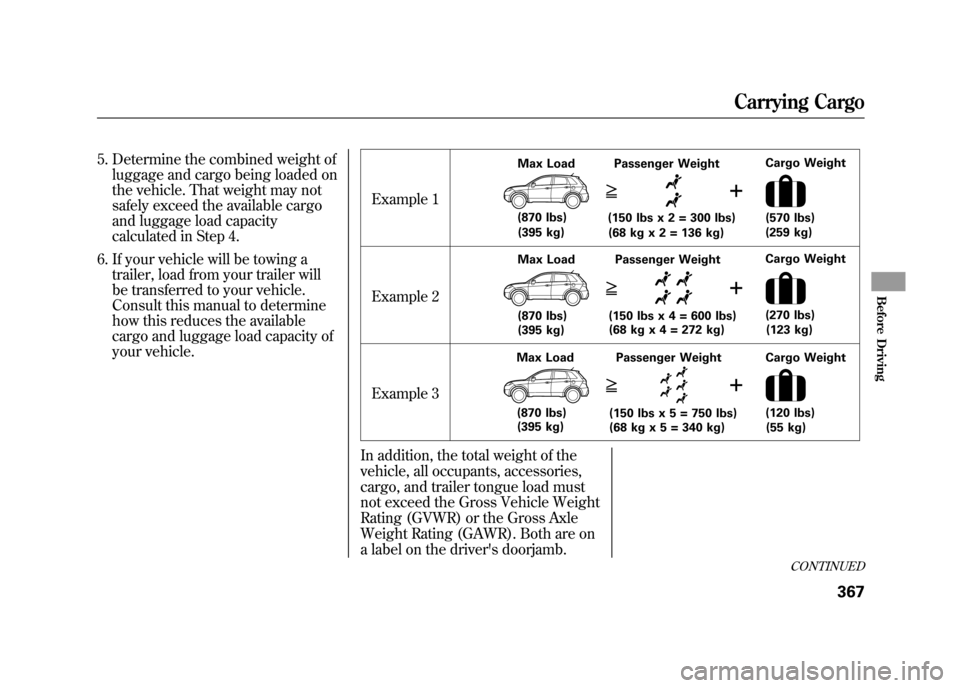
your vehicle. Example 1
Example 2
Example 3
In addition, the total weight of the
vehicle, all occupants, accessories,
cargo, and trailer tongue load must
not exceed the Gross Vehicle Weight
Rating (GVWR) or the Gross Axle
Weight Rating (GAWR). Both are on
a label on the driver's doorjamb.
Max Load Passenger Weight Cargo Weight
(870 lbs) (395 kg) (68 kg x 2 = 136 kg) (259 kg)
(150 lbs x 2 = 300 lbs) (570 lbs)(870 lbs) (150 lbs x 4 = 600 lbs)
(270 lbs)
Max Load
Passenger Weight Cargo Weight
(395 kg) (68 kg x 4 = 272 kg)
(123 kg)(870 lbs)Passenger Weight
Cargo Weight
Max Load
(150 lbs x 5 = 750 lbs) (120 lbs)
(395 kg) (68 kg x 5 = 340 kg) (55 kg)
CONTINUED
Carrying Cargo
367
Before Driving
11/06/16 17:42:51 12 ACURA RDX MMC North America Owner's M 50 31STK650 enu
Page 375 of 518
●If you carry large items that
prevent you from closing the
tailgate, exhaust gas can enter the
passenger area. To avoid the
possibility ofcarbon monoxide
poisoning, follow the instructions
on page 57.●●If you carry any items on a roof
rack, be sure the total weight of
the rack and the items does not
exceed 110 lbs (50 kg). Cargo Hooks/Hanger Bars
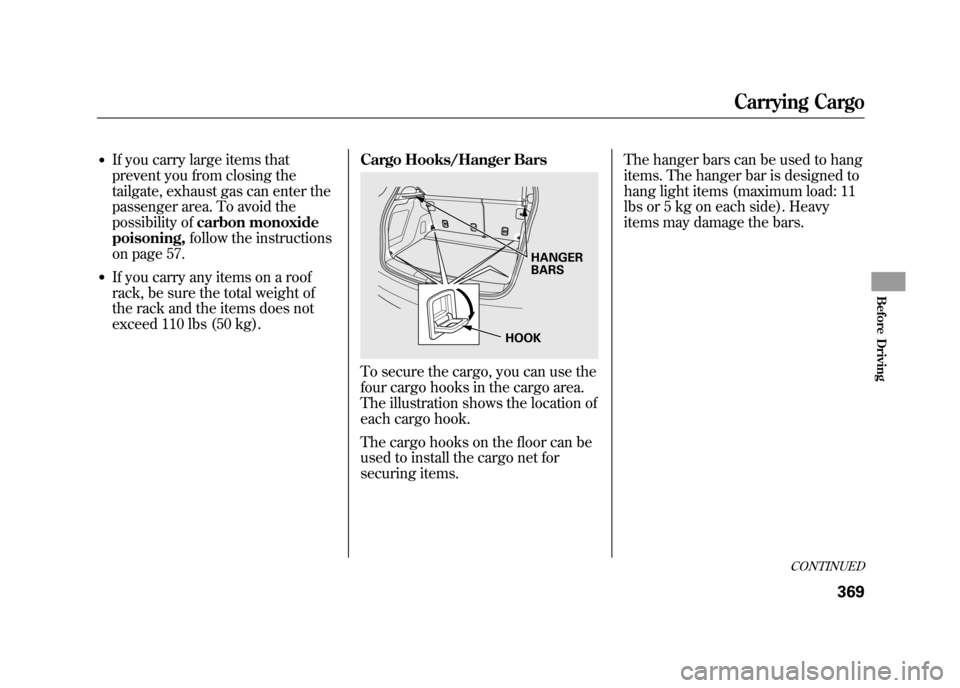
To secure the cargo, you can use the
four cargo hooks in the cargo area.
The illustration shows the location of
each cargo hook.
The cargo hooks on the floor can be
used to install the cargo net for
securing items. The hanger bars can be used to hang
items. The hanger bar is designed to
hang light items (maximum load: 11
lbs or 5 kg on each side). Heavy
items may damage the bars.
HANGER
BARS
HOOK
CONTINUED
Carrying Cargo
369
Before Driving
11/06/16 17:42:51 12 ACURA RDX MMC North America Owner's M 50 31STK650 enu
Page 403 of 518

Your vehicle has been designed
primarily to carry passengers and
their cargo. You can also use it to tow
a trailer if you carefully observe the
load limits, use the proper
equipment, and follow the guidelines
in this section.Break-In PeriodAvoid towing a trailer during your
vehicle's first 600 miles (1,000 km)
(see page 352).Be sure to read the
Off-Highway
Driving Guidelines section on page
405 if you plan to tow off paved
surfaces.
Exceeding any load limit or
improperly loading your vehicle
and trailer can cause a crash in
which you can be seriously hurt
or killed.
Check the loading of your
vehicle and trailer carefully
before starting to drive. Load Limits
Total Trailer Weight:
The maximum
allowable weight of the trailer and
everything in or on it must not
exceed 1,500 lbs (680 kg). Towing a
load that is too heavy can seriously
affect your vehicle's handling and
performance. It can also damage the
engine and drivetrain.
CONTINUED
Towing a Trailer
397
Driving
11/06/16 17:42:51 12 ACURA RDX MMC North America Owner's M 50 31STK650 enu
Page 404 of 518

Tongue Load:The weight that the
tongue of a fully-loaded trailer puts
on the hitch should be approximately
10% of the total trailer weight. Too
much tongue load reduces front-tire
traction and steering control. Too
little tongue load can make the trailer
unstable and cause it to sway. To achieve a proper tongue load,
start by loading 60% of the load
toward the front of the trailer and 40%
toward the rear, then re-adjust the
load as needed.
Gross Vehicle Weight Rating
(GVWR)
-The maximum allowable
weight of the vehicle, all occupants,
all accessories, all cargo, and the
tongue load is :
SH-AWD:4,894 lbs (2,220 kg)2WD:4,718 lbs (2,140 kg) Gross Axle Weight Ratings
(GAWR)
-The maximum allowable
weight of the vehicle axle is :
SH-AWD:2,546 lbs (1,155 kg)
on the front axle
2,381 lbs (1,080 kg)
on the rear axle2WD:2,447 lbs (1,110 kg)
on the front axle
2,271 lbs (1,030 kg)
on the rear axle
Gross Combined Weight Rating
(GCWR) -The maximum allowable
weight of the fully loaded vehicle and
trailer is :SH-AWD:6,394 lbs (2,900 kg)2WD:4,718 lbs (2,140 kg)
Towing a Trailer39811/06/16 17:42:51 12 ACURA RDX MMC North America Owner's M 50 31STK650 enu