page 61 Acura RDX 2012 Owner's Guide
[x] Cancel search | Manufacturer: ACURA, Model Year: 2012, Model line: RDX, Model: Acura RDX 2012Pages: 518, PDF Size: 26.43 MB
Page 43 of 518
All Children Should Sit in a Back
Seat
According to crash statistics,
children of all ages and sizes are
safer when they are restrained in a
back seat.
The National Highway Traffic Safety
Administration and Transport
Canada recommend that all children
aged 12 and under be properly
restrained in a back seat. Some
states have laws restricting where
children may ride.
Children who ride in back are less
likely to be injured by striking
interior vehicle parts during a
collision or hard braking. Also,
children cannot be injured by an
inflating front airbag when they ride
in the back.The Passenger's Front Airbag Can
Pose Serious Risks
Front airbags have been designed to
help protect adults in a moderate to
severe frontal collision. To do this,
the passenger's front airbag is quite
large, and it can inflate with enough
force to cause very serious injuries.
Even though your vehicle has an
advanced front airbag system that
automatically turns the passenger's
front airbag off under certain
circumstances (see page 33), please
follow these guidelines:
Infants
Never put a rear-facing child seat inthe front seat of a vehicle equipped
with a passenger's front airbag.
If the
airbag inflates, it can hit the back of
the child seat with enough force to
kill or very seriously injure an infant.
Small Children
Placing a forward-facing child seat inthe front seat of a vehicle equipped
with a passenger's front airbag can be
hazardous.
If the vehicle seat is too
far forward, or the child's head is
thrown forward during a collision, an
inflating front airbag can strike the
child with enough force to kill or
very seriously injure a small child.
Larger Children
Children who have outgrown childseats are also at risk of being injuredor killed by an inflating passenger's
front airbag.
Whenever possible,
larger children should sit in the back
seat, on a booster seat if needed, and
be properly restrained with a seat
belt (see page 53 for important
information about protecting larger
children).
CONTINUED
Protecting Children -General Guidelines
37
Driver and Passenger Safety
11/06/16 17:42:51 12 ACURA RDX MMC North America Owner's M 50 31STK650 enu
Page 45 of 518
If You Must Drive with Several
Children
Your vehicle has a back seat where
children can be properly restrained.
If you ever have to carry a group of
children, and a child must ride in
front:●Place the largest child in the front
seat, provided the child is large
enough to wear the lap/shoulder
belt properly (see page 53).●Move the vehicle seat as far to the
rear as possible (see page 134).●Have the child sit upright and well
back in the seat (see page 17).●Make sure the seat belt is properly
positioned and secured (see page
15).If a Child Requires Close
Attention
Many parents say they prefer to put
an infant or a small child in the front
passenger seat so they can watch the
child, or because the child requires
attention.
Placing a child in the front seat
exposes the child to hazards in a
frontal collision, and paying close
attention to a child distracts the
driver from the important tasks of
driving, placing both of you at risk.
If a child requires close physical
attention or frequent visual contact,
we strongly recommend that another
adult ride with the child in a back
seat. The back seat is far safer for a
child than the front.
Protecting Children
-General Guidelines
39
Driver and Passenger Safety
11/06/16 17:42:51 12 ACURA RDX MMC North America Owner's M 50 31STK650 enu
Page 46 of 518

Additional Safety Precautions●Never hold an infant or child onyour lap.
If you are not wearing a
seat belt in a crash, you could be
thrown forward and crush the
child against the dashboard or a
seat-back. If you are wearing a seat
belt, the child can be torn from
your arms and be seriously hurt or
killed.
●Never put a seat belt over yourself
or a child.
During a crash, the belt
could press deep into the child and
cause serious or fatal injuries.
●Never let two children use the
same seat belt.
If they do, they
could be very seriously injured in a
crash.
●Use the childproof door locks to prevent children from opening the
rear doors.
This can prevent
children from accidentally falling
out (see page 127).
●Make sure any unused seat belt that a child can reach is buckled,the lockable retractor is activated,
and the belt is fully retracted and
locked.
If a child wraps a loose
seat belt around their neck, they
can be seriously or fatally injured.
(See pages 50 and 51 for how to
activate and deactivate the
lockable retractor.)
●Do not leave children alone in a
vehicle.
Leaving children without
adult supervision is illegal in most
states, Canadian provinces/
territories and can be very
hazardous.
For example, infants and small
children left in a vehicle on a hot
day can die from heatstroke. A
child left alone with the key in the
ignition switch can accidentally set
the vehicle in motion, possibly
injuring themselves or others.
●Lock all doors and the tailgate when your vehicle is not in use.Children who play in vehicles can
accidentally get trapped inside.
Teach your children not to play in
or around vehicles.●Keep vehicle keys/remotetransmitters out of the reach of
children.
Even very young
children learn how to unlock
vehicle doors, turn on the ignition
switch, and open the tailgate,
which can lead to accidental injury
or death.
Protecting Children -General Guidelines4011/06/16 17:42:51 12 ACURA RDX MMC North America Owner's M 50 31STK650 enu
Page 49 of 518
Child Seat PlacementWe strongly recommend placing a
forward-facing child seat in a back
seat, not the front.Placing a forward-facing child seat inthe front seat of a vehicle equippedwith a passenger's airbag can be
hazardous.
If the vehicle seat is too
far forward, or the child's head is
thrown forward during a collision, an
inflating airbag can strike the child
with enough force to cause very
serious or fatal injuries. Even with advanced front airbags
that automatically turn the
passenger's front airbag off (see page
33), a back seat is the safest place for
a small child.
If it is necessary to put a forward-
facing child seat in the front, move
the vehicle seat as far to the rear as
possible, and be sure the child seat is
firmly secured to the vehicle and the
child is properly strapped in the seat.
Placing a forward-facing child
seat in the front seat can result
in serious injury or death if the
front airbag inflates.
If you must place a forward-
facing child seat in front, move
the vehicle seat as far back as
possible, and properly restrain
the child.
Protecting Infants and Small Children
43
Driver and Passenger Safety
11/06/16 17:42:51 12 ACURA RDX MMC North America Owner's M 50 31STK650 enu
Page 51 of 518
After selecting a proper child seat
and a good place to install the seat,
there are three main steps in
installing the seat:1.Properly secure the child seat to the vehicle.
All child seats must be
secured to the vehicle with the lap
part of a lap/shoulder belt or with
the LATCH (Lower Anchors and
Tethers for CHildren) system. A
child whose seat is not properly
secured to the vehicle can be
endangered in a crash.
2.
Make sure the child seat is firmly secured.
After installing a child
seat, push and pull the seat
forward and from side-to-side to
verify that it is secure. A child seat secured with a seat belt
should be installed as firmly as
possible. However, it does not need
to be
‘‘rock solid. ’’Some side-to-side
movement can be expected and
should not reduce the child seat's
effectiveness.
If the child seat is not secure, try
installing it in a different seating
position, or use a different style of
child seat that can be firmly secured. 3.
Secure the child in the child seat.Make sure the child is properly
strapped in the child seat
according to the child seat maker's
instructions. A child who is not
properly secured in a child seat
can be seriously injured in a crash.
The following pages provide
guidelines on how to properly install
a child seat. A forward-facing child
seat is used in all examples, but the
instructions are the same for rear-
facing child seats.
Installing a Child Seat
45
Driver and Passenger Safety
11/06/16 17:42:51 12 ACURA RDX MMC North America Owner's M 50 31STK650 enu
Page 53 of 518
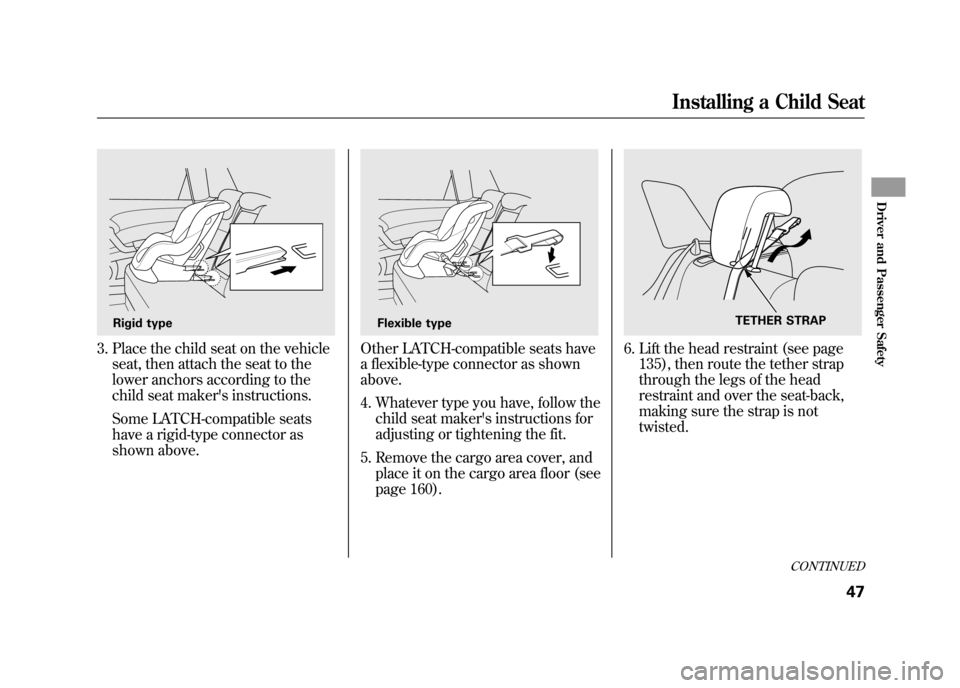
3. Place the child seat on the vehicleseat, then attach the seat to the
lower anchors according to the
child seat maker's instructions.
Some LATCH-compatible seats
have a rigid-type connector as
shown above.
Other LATCH-compatible seats have
a flexible-type connector as shown
above.
4. Whatever type you have, follow the
child seat maker's instructions for
adjusting or tightening the fit.
5. Remove the cargo area cover, and place it on the cargo area floor (see
page 160).
6. Lift the head restraint (see page135), then route the tether strap
through the legs of the head
restraint and over the seat-back,
making sure the strap is not
twisted.
Rigid type
Flexible type
TETHER STRAP
CONTINUED
Installing a Child Seat
47
Driver and Passenger Safety
11/06/16 17:42:51 12 ACURA RDX MMC North America Owner's M 50 31STK650 enu
Page 54 of 518
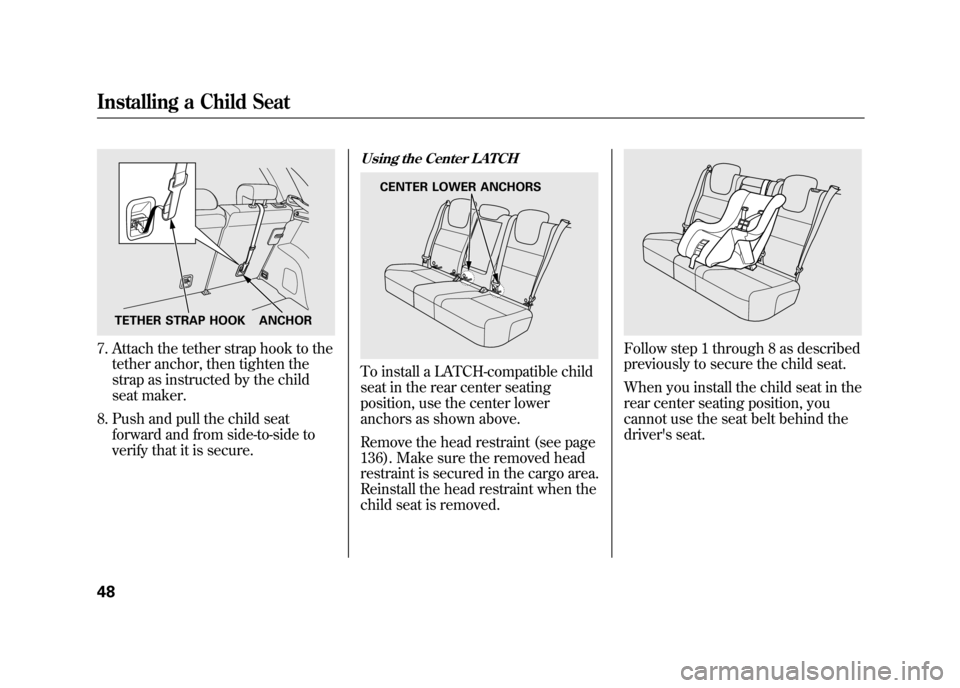
7. Attach the tether strap hook to thetether anchor, then tighten the
strap as instructed by the child
seat maker.
8. Push and pull the child seat forward and from side-to-side to
verify that it is secure.
Using the Center LATCHTo install a LATCH-compatible child
seat in the rear center seating
position, use the center lower
anchors as shown above.
Remove the head restraint (see page
136). Make sure the removed head
restraint is secured in the cargo area.
Reinstall the head restraint when the
child seat is removed.
Follow step 1 through 8 as described
previously to secure the child seat.
When you install the child seat in the
rear center seating position, you
cannot use the seat belt behind the
driver's seat.
TETHER STRAP HOOK ANCHOR
CENTER LOWER ANCHORS
Installing a Child Seat4811/06/16 17:42:51 12 ACURA RDX MMC North America Owner's M 50 31STK650 enu
Page 58 of 518
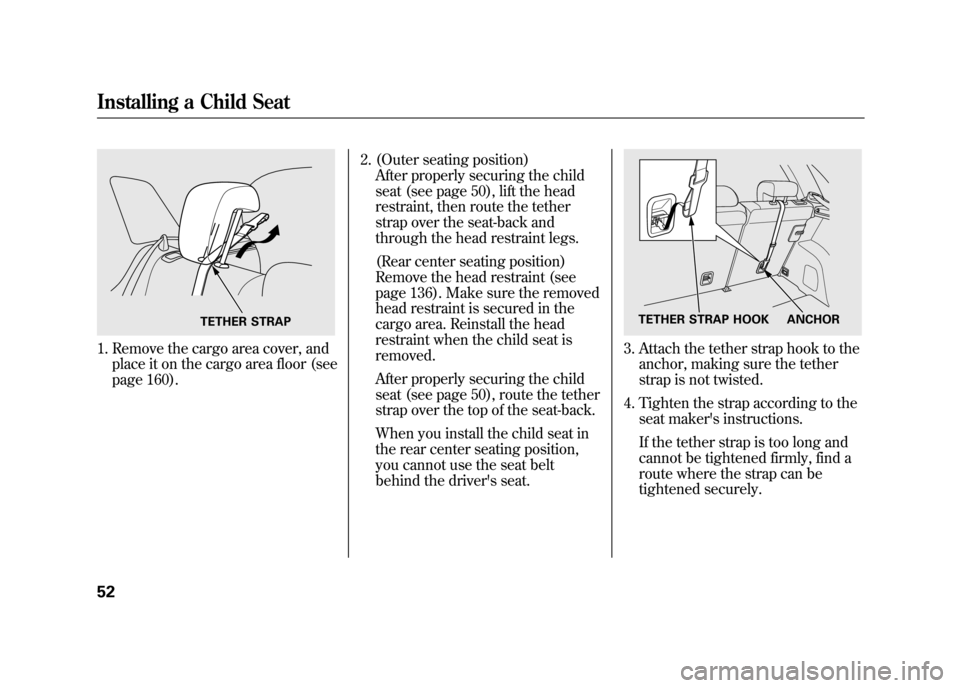
1. Remove the cargo area cover, andplace it on the cargo area floor (see
page 160). 2. (Outer seating position)
After properly securing the child
seat (see page 50), lift the head
restraint, then route the tether
strap over the seat-back and
through the head restraint legs.
(Rear center seating position)
Remove the head restraint (see
page 136). Make sure the removed
head restraint is secured in the
cargo area. Reinstall the head
restraint when the child seat is
removed.
After properly securing the child
seat (see page 50), route the tether
strap over the top of the seat-back.
When you install the child seat in
the rear center seating position,
you cannot use the seat belt
behind the driver's seat.
3. Attach the tether strap hook to theanchor, making sure the tether
strap is not twisted.
4. Tighten the strap according to the seat maker's instructions.
If the tether strap is too long and
cannot be tightened firmly, find a
route where the strap can be
tightened securely.
TETHER STRAP
TETHER STRAP HOOK ANCHOR
Installing a Child Seat5211/06/16 17:42:51 12 ACURA RDX MMC North America Owner's M 50 31STK650 enu
Page 59 of 518
When a child reaches the
recommended weight or height limit
for a forward-facing child seat, the
child should sit in a back seat on a
booster seat and wear a lap/shoulder
belt.
The following pages give instructions
on how to check proper seat belt fit,
what kind of booster seat to use if
one is needed, and important
precautions for a child who must sit
in front.
Allowing a child age 12 or under
to sit in front can result in injury
or death if the passenger's front
airbag inflates.
If a child must ride in front,
move the vehicle seat as far
back as possible, use a booster
seat if needed, have the child
sit up properly and wear the
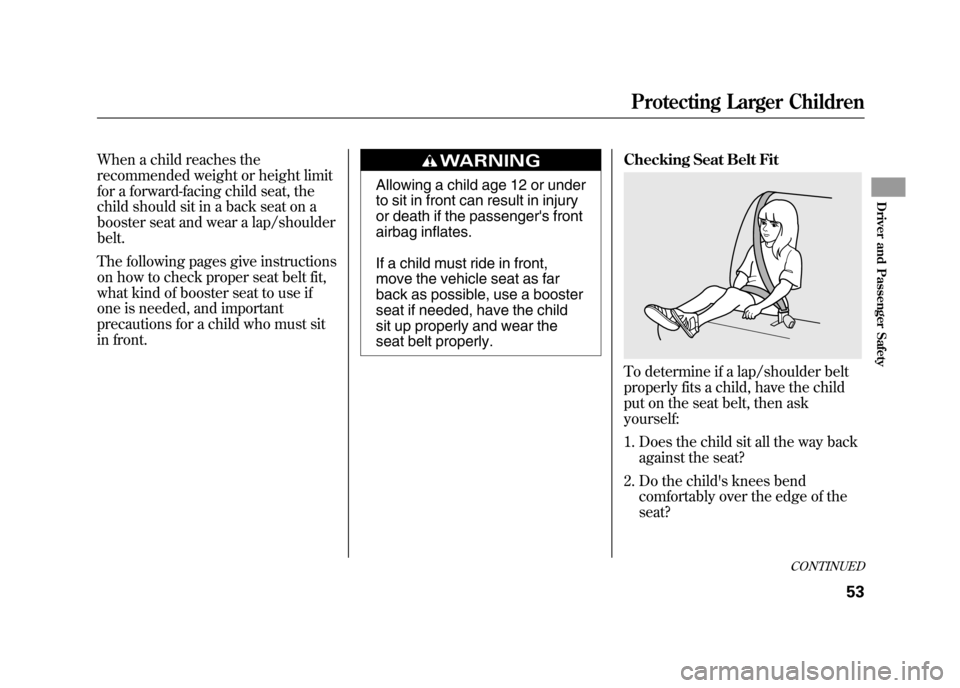
seat belt properly.Checking Seat Belt Fit
To determine if a lap/shoulder belt
properly fits a child, have the child
put on the seat belt, then ask
yourself:
1. Does the child sit all the way back
against the seat?
2. Do the child's knees bend comfortably over the edge of the
seat?
CONTINUED
Protecting Larger Children
53
Driver and Passenger Safety
11/06/16 17:42:51 12 ACURA RDX MMC North America Owner's M 50 31STK650 enu
Page 60 of 518
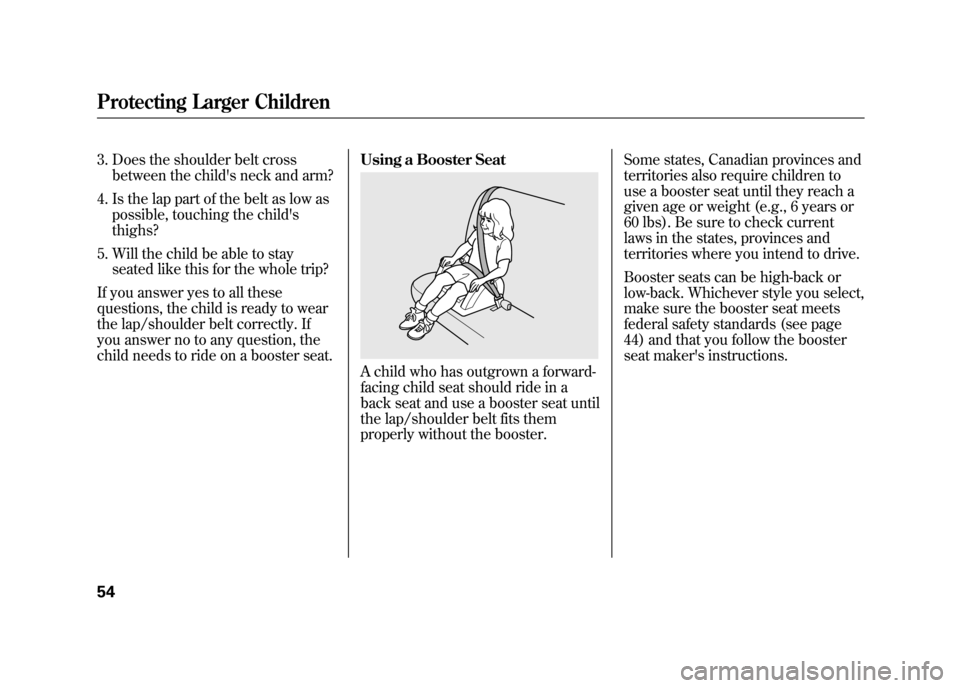
3. Does the shoulder belt crossbetween the child's neck and arm?
4. Is the lap part of the belt as low as possible, touching the child's
thighs?
5. Will the child be able to stay seated like this for the whole trip?
If you answer yes to all these
questions, the child is ready to wear
the lap/shoulder belt correctly. If
you answer no to any question, the
child needs to ride on a booster seat. Using a Booster Seat
A child who has outgrown a forward-
facing child seat should ride in a
back seat and use a booster seat until
the lap/shoulder belt fits them
properly without the booster.Some states, Canadian provinces and
territories also require children to
use a booster seat until they reach a
given age or weight (e.g., 6 years or
60 lbs). Be sure to check current
laws in the states, provinces and
territories where you intend to drive.
Booster seats can be high-back or
low-back. Whichever style you select,
make sure the booster seat meets
federal safety standards (see page
44) and that you follow the booster
seat maker's instructions.
Protecting Larger Children5411/06/16 17:42:51 12 ACURA RDX MMC North America Owner's M 50 31STK650 enu