tire pressure Acura RDX 2012 Owner's Guide
[x] Cancel search | Manufacturer: ACURA, Model Year: 2012, Model line: RDX, Model: Acura RDX 2012Pages: 518, PDF Size: 26.43 MB
Page 452 of 518

Your tires have wear indicators
molded into the tread. When the
tread wears down, you will see a 1/2
inch (12.7 mm) wide band across the
tread. This shows there is less than
1/16 inch (1.6 mm) of tread left on
the tire.
A tire this worn gives very little
traction on wet roads. You should
replace the tire if you can see three
or more tread wear indicators.Tire Service Life
The service life of your tires is
dependent on many factors,
including, but not limited to, driving
habits, road conditions, vehicle
loading, inflation pressure,
maintenance history, speed, and
environmental conditions (even
when the tires are not in use).
In addition to your regular
inspections and inflation pressure
maintenance, it is recommended that
you have annual inspections
performed once the tires reach five
years old. It is also recommended
that all tires, including the spare, be
removed from service after 10 years
from the date of manufacture,
regardless of their condition or state
of wear.
The last four digits of the TIN (tire
identification number) are found on
the sidewall of the tire and indicate
the date of manufacture (See
Tire
Labeling on page 484). Tire Maintenance
In addition to proper inflation, correct
wheel alignment helps to decrease
tire wear. If you find a tire is worn
unevenly, have your dealer check the
wheel alignment.
Have your dealer check the tires if
you feel a consistent vibration while
driving. A tire should always be
rebalanced if it is removed from the
wheel. When you have new tires
installed, make sure they are
balanced. This increases riding
comfort and tire life. For best results,
have the installer perform a dynamic
balance.
Improper wheel weights can damage
your vehicle's aluminum wheels. Use
only Acura wheel weights for
balancing.
INDICATOR LOCATION MARKS
TREAD WEAR INDICATORS
Tires44611/06/16 17:42:51 12 ACURA RDX MMC North America Owner's M 50 31STK650 enu
Page 453 of 518

Tire RotationTo help increase tire life and
distribute wear more evenly, rotate
the tires according to the
maintenance messages displayed on
the multi-information display. Move
the tires to the positions shown in
the illustration each time they are
rotated. If you purchase directional
tires, rotate only front-to-back.Replacing Tires and Wheels
Replace your tires with radial tires of
the same size, load range, speed
rating, and maximum cold tire
pressure rating (as shown on the
tire's sidewall).
Mixing radial and bias-ply tires on
your vehicle can reduce braking
ability, traction, and steering
accuracy. Using tires of a different
size or construction can cause the
ABS and vehicle stability assist
system (VSA) to work inconsistently.
The ABS and VSA system work by
comparing the speed of the wheels.
When replacing tires, use the same
size originally supplied with the
vehicle. Tire size and construction
can affect wheel speed and may
cause the ABS or VSA system to
activate.
It is best to replace all four tires at
the same time. If that is not possible
or necessary, replace the two front
tires or two rear tires as a pair.
Replacing just one tire can seriously
affect your vehicle's handling.
If you ever replace a wheel, make
sure that the wheel's specifications
match those of the original wheels.
Also be sure you use only TPMS
specific wheels. If you do not, the tire
pressure monitoring system will not
work.
Replacement wheels are available at
your dealer.
Front Front
(For Non-directional
Tires and Wheels) (For Directional
Tires and Wheels)
CONTINUED
Tires
447
Maintenance
11/06/16 17:42:51 12 ACURA RDX MMC North America Owner's M 50 31STK650 enu
Page 459 of 518

This section covers the more
common problems that motorists
experience with their vehicles. It
gives you information about how to
safely evaluate the problem and what
to do to correct it. If the problem has
stranded you on the side of the road,
you may be able to get going again. If
not, you will also find instructions on
getting your vehicle towed.Compact Spare Tire
....................
454
Changing a Flat Tire
...................
455
If the Engine Won't Start
.............
459
Jump Starting
..............................
461
If the Engine Overheats
..............
463
Low Oil Pressure Indicator
.........
465
Charging System Indicator
.........
465
Malfunction Indicator Lamp
........
466
Brake System Indicator
...............
467
Fuses
..........................................
469
Fuse Locations
............................
473
Emergency Towing
.....................
475
Taking Care of the Unexpected
453
Taking Care of the Unexpected
11/06/16 17:42:51 12 ACURA RDX MMC North America Owner's M 50 31STK650 enu
Page 460 of 518

Use the compact spare tire as a
temporary replacement only. Get
your regular tire repaired or
replaced, and put it back on your
vehicle as soon as you can.
Check the inflation pressure of the
compact spare tire every time you
check the other tires. It should be
inflated to:
60 psi (420 kPa , 4.2 kgf/cm
2)Follow these precautions:
●Never exceed 50 mph (80 km/h).●This tire gives a harsher ride and
less traction on some road
surfaces. Use greater caution while
driving.●Do not mount snow chains on the
compact spare tire.●Do not use your compact spare tire
on another vehicle unless it is the
same make and model.●After the flat tire is replaced with
the spare tire, the low tire
pressure/TPMS indicator stays on.
After several miles (kilometers)
driving with the spare, this
indicator begins to flash, then
stays on again. You will also see a
‘‘
CHECK TPMS SYSTEM ’’
message on the multi-information
display (see page 393).
Replace the tire when you can see
the tread wear indicator bars. The
replacement should be the same size
and design tire, mounted on the
same wheel. The spare tire is not
designed to be mounted on a regular
wheel, and the spare wheel is not
designed for mounting a regular tire.
INDICATOR LOCATION MARKS
TREAD WEAR INDICATOR
Compact Spare Tire45411/06/16 17:42:51 12 ACURA RDX MMC North America Owner's M 50 31STK650 enu
Page 464 of 518
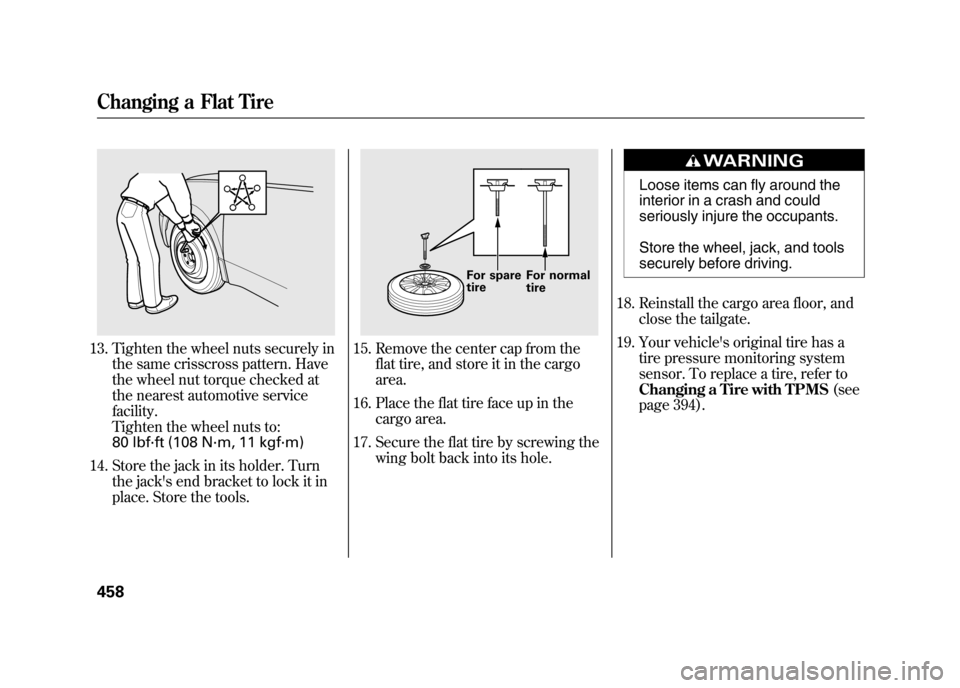
13. Tighten the wheel nuts securely inthe same crisscross pattern. Have
the wheel nut torque checked at
the nearest automotive service
facility.
Tighten the wheel nuts to:
80 lbf·ft (108 N·m, 11 kgf·m)
14. Store the jack in its holder. Turn the jack's end bracket to lock it in
place. Store the tools.
15. Remove the center cap from theflat tire, and store it in the cargo
area.
16. Place the flat tire face up in the cargo area.
17. Secure the flat tire by screwing the wing bolt back into its hole.
Loose items can fly around the
interior in a crash and could
seriously injure the occupants.
Store the wheel, jack, and tools
securely before driving.
18. Reinstall the cargo area floor, and close the tailgate.
19. Your vehicle's original tire has a tire pressure monitoring system
sensor. To replace a tire, refer to
Changing a Tire with TPMS (see
page 394).
For spare
tire For normal
tire
Changing a Flat Tire45811/06/16 17:42:51 12 ACURA RDX MMC North America Owner's M 50 31STK650 enu
Page 483 of 518

The diagrams in this section give you
the dimensions and capacities of
your vehicle and the locations of the
identification numbers. It also
includes information you should
know about your vehicle's tires and
emissions control systems.Identification Numbers
...............
478
Specifications
..............................
480
DOT Tire Quality Grading (U.S. Vehicles)
.............................
482
Uniform Tire Quality Grading
...............................
482
Treadwear
...............................
482
Traction
..................................
482
Temperature
...........................
483
Tire Labeling
..............................
484
Tire Pressure Monitoring System
(TPMS) -Required Federal
Explanation
.........................
485
Emissions Controls
.....................
487
The Clean Air Act
....................
487
Crankcase Emissions Control System
................................
487
Evaporative Emissions Control
System
................................
487
Onboard Refueling Vapor
Recovery
.............................
488
Exhaust Emissions
Controls
..............................
488
Replacement Parts
..................
488 Three Way Catalytic
Converter
................................
489
Emissions Testing
.......................
490
Technical Information
477
Technical Information
11/06/16 17:42:51 12 ACURA RDX MMC North America Owner's M 50 31STK650 enu
Page 487 of 518
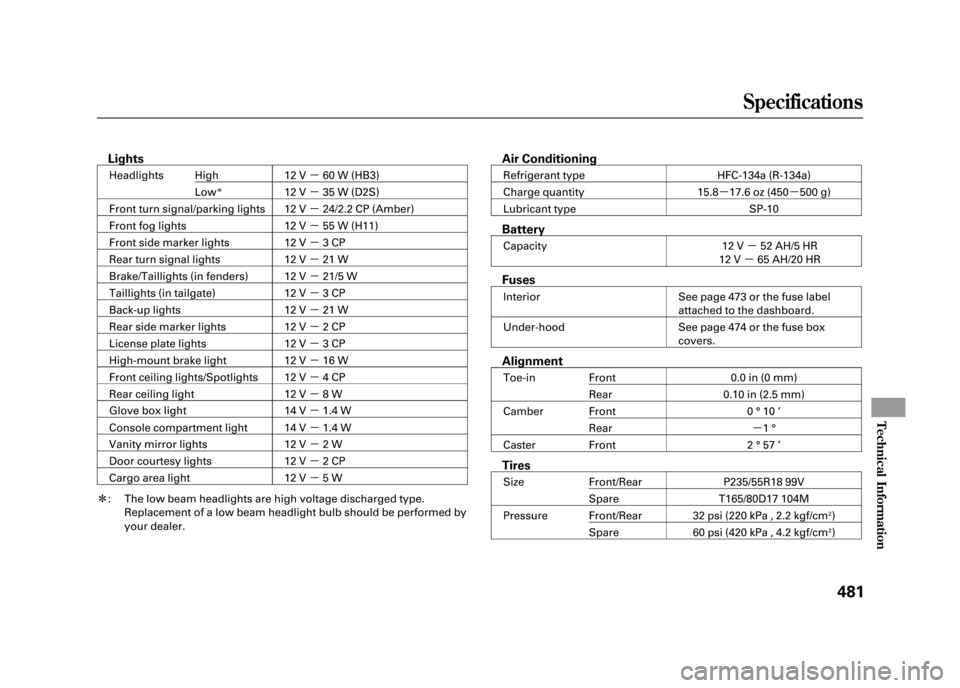
LightsHeadlights High12 V-60 W (HB3)
Low
ᤳ
12 V -35 W (D2S)
Front turn signal/parking lights 12 V -24/2.2 CP (Amber)
Front fog lights 12 V -55 W (H11)
Front side marker lights 12 V -3CP
Rear turn signal lights 12 V -21 W
Brake/Taillights (in fenders) 12 V -21/5 W
Taillights (in tailgate) 12 V -3CP
Back-up lights 12 V -21 W
Rear side marker lights 12 V -2CP
License plate lights 12 V -3CP
High-mount brake light 12 V -16 W
Front ceiling lights/Spotlights 12 V -4CP
Rear ceiling light 12 V -8W
Glove box light 14 V -1.4 W
Console compartment light 14 V -1.4 W
Vanity mirror lights 12 V -2W
Door courtesy lights 12 V -2CP
Cargo area light 12 V -5W
ᤳ : The low beam headlights are high voltage discharged type.
Replacement of a low beam headlight bulb should be performed by
your dealer.
Air ConditioningRefrigerant type HFC-134a (R-134a)
Charge quantity 15.8-17.6 oz (450 -500 g)
Lubricant type SP-10BatteryCapacity12 V-52 AH/5 HR
12 V -65 AH/20 HRFusesInterior See page 473 or the fuse label
attached to the dashboard.
Under-hood See page 474 or the fuse box
covers.AlignmentToe-in Front 0.0 in (0 mm)
Rear 0.10 in (2.5 mm)
Camber Front 0 ° 10’
Rear -1°
Caster Front 2 ° 57’TiresSize Front/Rear P235/55R18 99V
Spare T165/80D17 104M
Pressure Front/Rear 32 psi (220 kPa , 2.2 kgf/cm
2)
Spare 60 psi (420 kPa , 4.2 kgf/cm2)
Specifications
481
Technical Information
11/06/16 17:42:51 12 ACURA RDX MMC North America Owner's M 50 31STK650 enu
Page 490 of 518

The tires that came on your vehicle
have a number of markings. Those
you should be aware of are described
below.
Tire SizeWhenever tires are replaced, they
should be replaced with tires of the
same size. Below is an example of
tire size with an explanation of what
each component means.P235/55R18 99V
P -Vehicle type (P indicates
passenger vehicle).
235 -Tire width in millimeters.
55 -Aspect ratio (the tire's
section height as a
percentage of its width).
R -Tire construction code (R
indicates radial).
18 -Rim diameter in inches.
99 -Load index (a numerical
code associated with the
maximum load the tire can
carry).
V -Speed symbol (an
alphabetical code indicating
the maximum speed rating).
Tire Identification Number (TIN)The tire identification number (TIN)
is a group of numbers and letters that
look like the following example. TIN
is located on the sidewall of the tire.
DOT B97R FW6X 2202
DOT -This indicates that the tire
meets all requirements of
the U.S. Department of
Transportation.
B97R -Manufacturer's
identification mark.
FW6X -Tire type code.
TIRE LABELING EXAMPLE
(1)
(1)
(2)
(3)
(4)
(1) Tire Size
(2) Tire Identification Number (TIN)
(3) Maximum Tire Pressure
(4) Maximum Tire Load
2202 -
year
week Date of manufacture.
Tire Labeling48411/06/16 17:42:51 12 ACURA RDX MMC North America Owner's M 50 31STK650 enu
Page 491 of 518

Glossary of Tire Terminology
Cold Tire Pressure-The tire air
pressure when the vehicle has been
parked for at least three hours or
driven less than 1 mile (1.6 km).
Load Rating -Means the maximum
load that a tire is rated to carry for a
given inflation pressure.
Maximum Inflation Pressure -The
maximum tire air pressure that the
tire can hold.
Maximum Load Rating -Means the
load rating for a tire at the maximum
permissible inflation pressure for that
tire.
Recommended Inflation Pressure -
The cold tire inflation pressure
recommended by the manufacturer.
Treadwear Indicators (TWI) -
Means the projections within the
principal grooves designed to give a
visual indication of the degrees of
wear of the tread. Tire Pressure Monitoring System
(TPMS)
-Required Federal
Explanation
Each tire, including the spare (if
provided), should be checked
monthly when cold and inflated to
the inflation pressure recommended
by the vehicle manufacturer on the
vehicle placard or tire inflation
pressure label.
(If your vehicle has tires of a different
size than the size indicated on the
vehicle placard or tire inflation
pressure label, you should determine
the proper tire inflation pressure for
those tires.) As an added safety feature, your
vehicle has been equipped with a tire
pressure monitoring system (TPMS)
that illuminates a low tire pressure
telltale
when one or more of your tires is
significantly under-inflated
Accordingly, when the low tire
pressure telltale illuminates, you
should stop and check your tires as
soon as possible, and inflate them to
the proper pressure.
CONTINUED
Tire Labeling, Tire Pressure Monitoring System (TPMS)
-Required Federal Explanation
485
Technical Information
11/06/16 17:42:51 12 ACURA RDX MMC North America Owner's M 50 31STK650 enu
Page 492 of 518

Driving on a significantly under-
inflated tire causes the tire to
overheat and can lead to tire failure.
Underinflation also reduces fuel
efficiency and tire tread life, and may
affect the vehicle's handling and
stopping ability.
Please note that the TPMS is not a
substitute for proper tire
maintenance, and it is the driver's
responsibility to maintain correct tire
pressure, even if under-inflation has
not reached the level to trigger
illumination of the TPMS low tire
pressure telltale.Your vehicle has also been equipped
with a TPMS malfunction indicator to
indicate when the system is not
operating properly. The TPMS
malfunction indicator is combined
with the low tire pressure telltale.
When the system detects a
malfunction, the telltale will flash for
approximately one minute and then
remain continuously illuminated.
This sequence will continue upon
subsequent vehicle start-ups as long
as the malfunction exists.
When the malfunction indicator is
illuminated, the system may not be
able to detect or signal low tire
pressure as intended.TPMS malfunctions may occur for a
variety of reasons, including the
installation of replacement or
alternate tires or wheels on the
vehicle that prevent the TPMS from
functioning properly.
Always check the TPMS malfunction
telltale after replacing one or more
tires or wheels on your vehicle to
ensure that the replacement or
alternate tires and wheels allow the
TPMS to continue to function
properly.Tire Pressure Monitoring System (TPMS)
-Required Federal Explanation48611/06/16 17:42:51 12 ACURA RDX MMC North America Owner's M 50 31STK650 enu