Safety belt Acura RDX 2017 User Guide
[x] Cancel search | Manufacturer: ACURA, Model Year: 2017, Model line: RDX, Model: Acura RDX 2017Pages: 449, PDF Size: 10.88 MB
Page 52 of 449
51
uuChild Safety uProtecting Child Passengers
Safe Driving
• Any child who is too small to wear a seat belt correctly must be restrained in an
approved child seat that is properly secured to the vehicle using either the lap belt
portion of the lap/shoulder belt or the lower anchors of the LATCH system.
• Never hold a child on your lap because it is impossible to protect them in the
event of a collision.
• Never put a seat belt over yourself and a child. During a crash, the belt would
likely press deep into the child and cause serious or fatal injuries.
• Never let two children use the same seat belt. Both children could be very
seriously injured in a crash.
• Do not allow children to operate the doors, windows or seat adjustments.
• Do not leave children in the vehicle unatte nded, especially in hot weather when
the inside of the vehicle can get hot enough to kill them. They could also activate
vehicle controls causing it to move unexpectedly.1 Protecting Child Passengers
To deactivate a lockable retractor, release the buckle
and allow the seat belt to wind up all the way.
To remind you of the pa ssenger’s front airbag
hazards and child safety, y our vehicle warning came
with a label on the dashboard (U.S. models) and has
labels on the front visors. Pl ease read and follow the
instructions on these labels.
2 Safety Labels P. 63
3WARNING
Allowing a child to play with a seat belt or
wrap one around their neck can result in
serious injury or death.
Instruct children not to play with any seat
belt and make sure any unused seat belt a
child can reach is buckled, fully retracted,
and locked.
Page 55 of 449
uuChild Safety uSafety of Infants and Small Children
54
Safe DrivingMost child seats are LATCH-compatible (L ower Anchors and Tethers for CHildren).
Some have a rigid-type connector, while ot hers have a flexible-type connector. Both
are equally easy to use. Some existing and previously owned child seats can only be
installed using the seat belt. Whichever type you choose, follow the child seat
manufacturer’s use and care instructions as well as the instructions in this manual.
Proper installation is key to ma ximizing your child’s safety.
In seating positions and vehicles not equipped with LATCH, a LATCH compatible
child seat can be installed using the seat belt and a top tether for added security.
This is because all child seats are required to be designed so that they can be secured
with the lap part of a lap/shoulder belt. In addition, the child seat manufacturer may
advise that a seat belt be used to atta ch a LATCH-compatible seat once a child
reaches a specified weight. Please read th e child seat owner’s manual for proper
installation instructions.
■Important consideration wh en selecting a child seat
Make sure the child seat meets th e following three requirements:
• The child seat is the correct type and size for the child.
• The child seat is the correct type for the seating position.
• The child seat is compliant with Federal Motor Vehicle Safety Standard 213 or
Canadian Motor Vehicle Safety Standard 213.
■Selecting a Child Seat1Selecting a Child Seat
Installation of a LATCH-co mpatible child seat is
simple.
LATCH-compatible child s eats have been developed
to simplify the installati on process and reduce the
likelihood of injuries caused by incorrect installation.
Page 56 of 449

55
uuChild Safety uSafety of Infants and Small Children
Continued
Safe DrivingA LATCH-compatible child seat can be installe d in either of the two outer rear seats.
A child seat is attached to th e lower anchors with either th e rigid or flexible type of
connectors. 1.Locate the lower anchors under the marks.
2. Place the child seat on the vehicle seat then
attach the child seat to the lower anchors
according to the ins tructions that came
with the child seat.
u When installing the child seat, make sure
that the lower anchors are not
obstructed by the seat belt or any other
object.
■Installing a LATCH-Compatible Child Seat
Marks
Rigid Type
Lower Anchors
Page 57 of 449
uuChild Safety uSafety of Infants and Small Children
56
Safe Driving
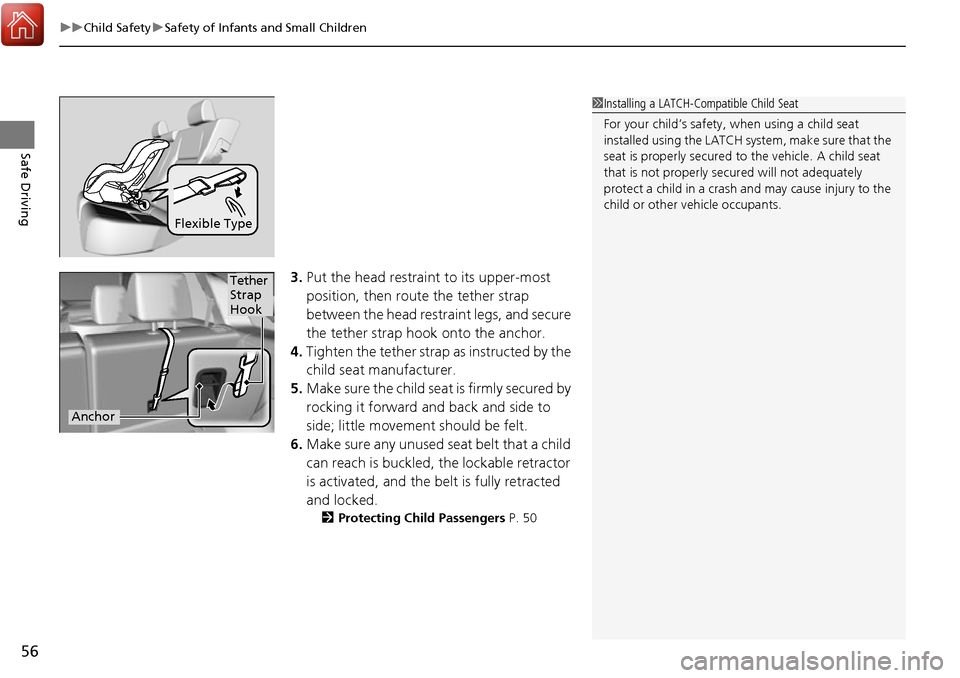
3. Put the head restraint to its upper-most
position, then rout e the tether strap
between the head restraint legs, and secure
the tether strap hook onto the anchor.
4. Tighten the tether strap as instructed by the
child seat manufacturer.
5. Make sure the child seat is firmly secured by
rocking it forward and back and side to
side; little movement should be felt.
6. Make sure any unused se at belt that a child
can reach is buckled, the lockable retractor
is activated, and the be lt is fully retracted
and locked.
2 Protecting Child Passengers P. 50
Flexible Type
1Installing a LATCH-Compatible Child Seat
For your child’s safety, when using a child seat
installed using the LATCH system, make sure that the
seat is properly secured to the vehicle. A child seat
that is not properly secu red will not adequately
protect a child in a crash and may cause injury to the
child or other vehicle occupants.
Tether
Strap
Hook
Anchor
Page 58 of 449
Continued57
uuChild Safety uSafety of Infants and Small Children
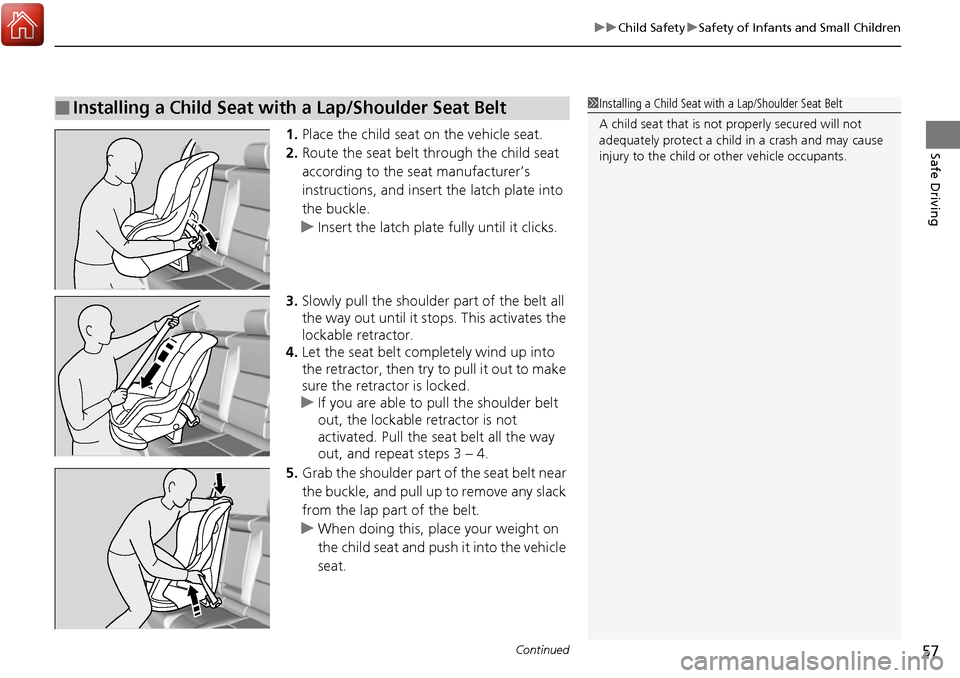
Safe Driving1. Place the child seat on the vehicle seat.
2. Route the seat belt through the child seat
according to the seat manufacturer’s
instructions, and insert the latch plate into
the buckle.
u Insert the latch plate fully until it clicks.
3. Slowly pull the shoulder part of the belt all
the way out until it stops. This activates the
lockable retractor.
4. Let the seat belt completely wind up into
the retractor, then try to pull it out to make
sure the retractor is locked.
u If you are able to pull the shoulder belt
out, the lockable retractor is not
activated. Pull the seat belt all the way
out, and repeat steps 3 – 4.
5. Grab the shoulder part of the seat belt near
the buckle, and pull up to remove any slack
from the lap part of the belt.
u When doing this, place your weight on
the child seat and push it into the vehicle
seat.
■Installing a Child Seat with a Lap/Shoulder Seat Belt1Installing a Child Seat with a Lap/Shoulder Seat Belt
A child seat that is not properly secured will not
adequately protect a child in a crash and may cause
injury to the child or other vehicle occupants.
Page 59 of 449
uuChild Safety uSafety of Infants and Small Children
58
Safe Driving
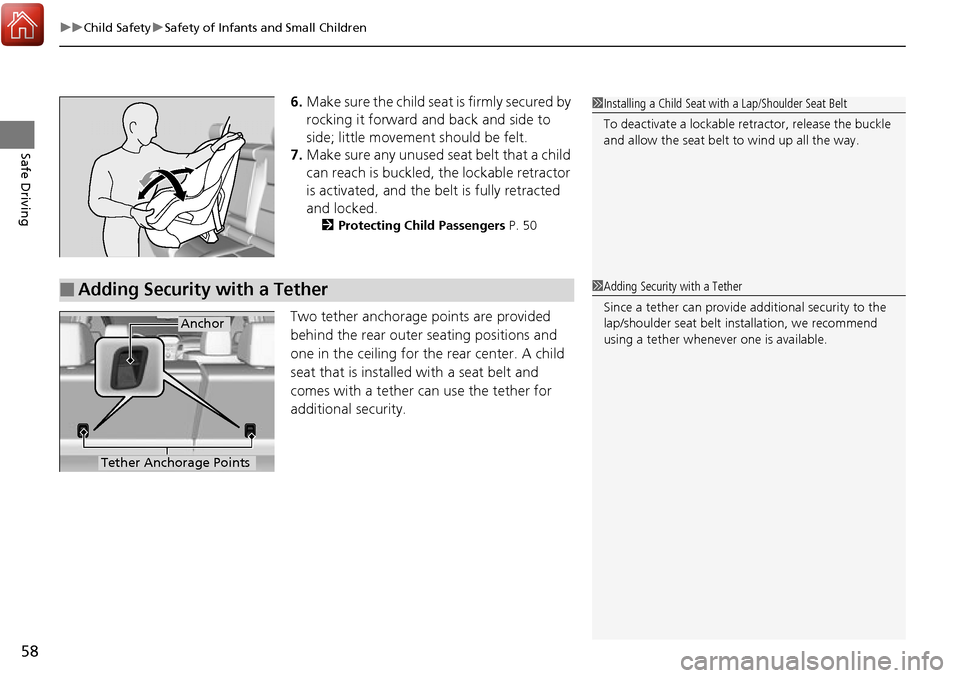
6. Make sure the child seat is firmly secured by
rocking it forward and back and side to
side; little movement should be felt.
7. Make sure any unused se at belt that a child
can reach is buckled, the lockable retractor
is activated, and the be lt is fully retracted
and locked.
2 Protecting Child Passengers P. 50
Two tether anchorage points are provided
behind the rear outer seating positions and
one in the ceiling for the rear center. A child
seat that is installed with a seat belt and
comes with a tether can use the tether for
additional security.
1Installing a Child Seat with a Lap/Shoulder Seat Belt
To deactivate a lockable retractor, release the buckle
and allow the seat belt to wind up all the way.
■Adding Security with a Tether
Tether Anchorage Points
Anchor
1 Adding Security with a Tether
Since a tether can provide additional security to the
lap/shoulder seat belt in stallation, we recommend
using a tether whenever one is available.
Page 61 of 449
60
uuChild Safety uSafety of Larger Children
Safe Driving
Safety of Larger Children
The following pages give instructions on how to check proper seat belt fit, what kind
of booster seat to use if one is needed , and important precautions for a child who
must sit in front.
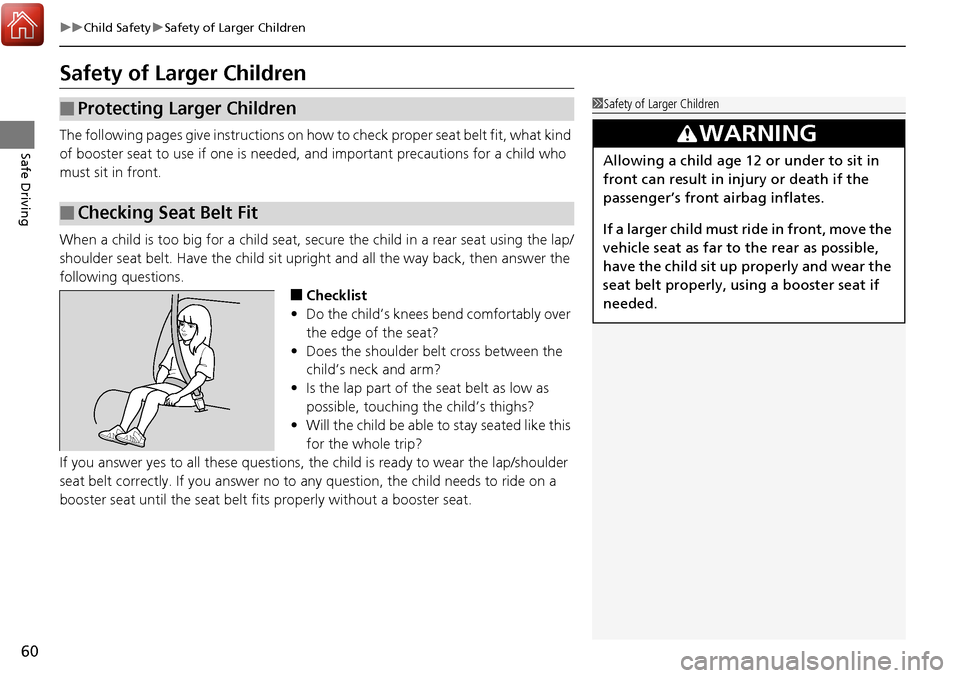
When a child is too big for a child seat, secure the child in a rear seat using the lap/
shoulder seat belt. Have the child sit upright and all the way back, then answer the
following questions.
■Checklist
• Do the child’s knees bend comfortably over
the edge of the seat?
• Does the shoulder belt cross between the
child’s neck and arm?
• Is the lap part of the seat belt as low as
possible, touching the child’s thighs?
• Will the child be able to stay seated like this
for the whole trip?
If you answer yes to all these questions, the child is ready to wear the lap/shoulder
seat belt correctly. If you answer no to any question, the child needs to ride on a
booster seat until the seat belt fits properly without a booster seat.
■Protecting Larger Children
■Checking Seat Belt Fit
1 Safety of Larger Children
3WARNING
Allowing a child age 12 or under to sit in
front can result in injury or death if the
passenger’s front airbag inflates.
If a larger child must ri de in front, move the
vehicle seat as far to the rear as possible,
have the child sit up properly and wear the
seat belt properly, us ing a booster seat if
needed.
Page 62 of 449

61
uuChild Safety uSafety of Larger Children
Safe DrivingIf a lap/shoulder seat belt cannot be used
properly, position the child in a booster seat in
a rear seating position. For the child’s safety,
check that the child meets the booster seat
manufacturer’s recommendations.
Your vehicle has a rear seat where children can be properly restrained. If you ever
have to carry a group of children, and a child must ride in front:
• Make sure you read and fully understand the instructions and safety information
in this manual.
• Move the front passenger seat as far back as possible.
• Have the child sit upright and well back in the seat.
• Check that the seat belt is properly positi oned so that the child is secure in the
seat.
■Monitoring child passengers
We strongly recommend that you keep an ey e on child passengers. Even older, more
mature children sometimes need to be remind ed to fasten their seat belts and sit up
properly.
■Booster Seats1 Booster Seats
When installing a booster seat, make sure to read the
instructions that came with it, and install the seat
accordingly.
There are high- and low-type booster seats. Choose a
booster seat that allows the child to wear the seat
belt correctly.
Some U.S. states and Canadian provinces and
territories require children to use a booster seat until
they reach a given age or weight (e.g. 6 years or 60
lbs). Be sure to check current laws in the state or
province, or territory where you intend to drive.
■Protecting Larger Children-Final Checks
Page 267 of 449

266
Driving
Off-Highway Driving Guidelines
General Information
Your vehicle has been designed primarily for use on pavement, however, its higher
ground clearance allows you to occasionally travel on unpaved roads. It is not
designed for trail-blazing, or othe r challenging off-road activities.
If you decide to drive on unpaved roads, you will find that it requires somewhat
different driving skills and that your vehicle will handle somewhat differently than it
does on pavement. Pay attention to the precautions and tips in this section, and get
acquainted with your vehicle before leaving the pavement.
Important Safety Precautions
To avoid loss of control or rollover, be sure to follow all precautions and
recommendations:
• Be sure to store cargo properly and do not exceed your cargo load limits.
2 Maximum Load Limit P. 259
•Whenever you drive, make sure you and your passengers always wear seat belts.
• Keep your speed low, and never go faster than the conditions allow.
• It’s up to you to continually assess the situation and drive within the limits.
1Off-Highway Driving Guidelines
Failure to operate your vehi cle correctly might result
in a crash or a rollover. 2 Important Handling Information P. 26
2 Precautions While Driving P. 273
3WARNING
Improperly operating this vehicle on or off-
pavement can cause a crash or rollover in
which you and your passengers could be
seriously injured or killed.
•Follow all instructions and guidelines in
this owner’s manual.
• Keep your speed low, and don’t drive
faster than conditions permit.
Page 443 of 449
442
Index
Bluetooth® HandsFreeLink ®..................... 224
Booster Seats (For Children) ....................... 61
Brake System ............................................. 318
Anti-lock Brake System (ABS) ................... 320
Brake Assist System ................................. 321
Fluid ........................................................ 361
Foot Brake ............................................... 319
Indicator ............................................ 66, 422
Parking Brake .......................................... 318
Brightness Control (Instrument Panel) .... 154
BSI (Blind spot information) System ........ 311
Bulb Replacement ..................................... 363
Back-Up Light and Taillight ...................... 368
Brake Light/Taillight/Rear Side Marker Light and
Rear Turn Signal Light Bulbs ................... 366
Fog Lights ................................................ 363
Front Turn Signal Light /Parking Light/Daytime
Running Light and Front Side Marker Light
Bulbs ..................................................... 365
Headlights ............................................... 363
High-Mount Brake Light .......................... 369
Rear License Plate Light............................ 369
Side Turn Signal Light /Emergency Indicator
Light ...................................................... 364
Bulb Specifications .................................... 430
C
Carbon Monoxide Gas ................................ 62
Cargo Hook ............................................... 175
Carrying Cargo .................................. 257, 259 CD Player
................................................... 202
Certification Label .................................... 432
Changing Bulbs ........................................ 363
Charging System Indicator ................. 68, 420
Child Safety ................................................. 50
Childproof Door Locks............................. 129
Child Seat .................................................... 50
Booster Seats ............................................ 61
Child Seat for Infants................................. 52
Child Seat for Small Children ..................... 53
Installing a Child Seat with a Lap/Shoulder Seat
Belt ......................................................... 57
Larger Children ......................................... 60
Rear-facing Child Seat ............................... 52
Selecting a Child Seat ................................ 54
Childproof Door Locks ............................. 129
Cleaning the Exterior ............................... 389
Cleaning the Interior ................................ 387
Client Service Information ....................... 440
Climate Control System ............................ 180
Changing the Mode ................................ 180
Defrosting the Windshield and
Windows ............................................... 181
Dust and Pollen Filter............................... 386
Recirculation/Fresh Air Mode ................... 180
Sensors ................................................... 183
Synchronized Mode................................. 182
Using Automatic Climate Control ............ 180
Clock .......................................................... 118
CMBSTM (Collision Mitigation Braking
SystemTM) ................................................. 322 Coat Hook
................................................ 175
Collision Mitigation Braking System
TM
(CMBSTM) ................................................. 322
Compact Spare Tire .......................... 395, 431
Compass .................................................... 253
Console Compartment ............................. 172
Controls .................................................... 117
Coolant (Engine) ...................................... 358
Adding to the Radiator ........................... 359
Adding to the Reserve Tank .................... 358
Overheating ............................................ 418
Creeping (Automatic Transmission) ........ 274
Cross Traffic Monitor ............................... 335
Cruise Control .......................................... 279
Indicator ................................................... 76
Cup Holders .............................................. 173
Customized Features ....................... 100, 106
D
Daytime Running Lights .......................... 150
Dead Battery ............................................ 415
Defrosting the Windshield and Windows ................................................. 181
Detachable Anchor .................................... 34
Devices that Emit Radio Waves ............... 433
Dimming
Headlights .............................................. 147
Rearview Mirror ...................................... 159
Dipstick (Engine Oil) ................................ 354
Directional Signals (Turn Signal) ............. 147