ABS Acura RL 2000 3.5 User Guide
[x] Cancel search | Manufacturer: ACURA, Model Year: 2000, Model line: RL, Model: Acura RL 2000Pages: 330, PDF Size: 4.53 MB
Page 241 of 330
Wipe
r Blade s
Wipe r Blade s
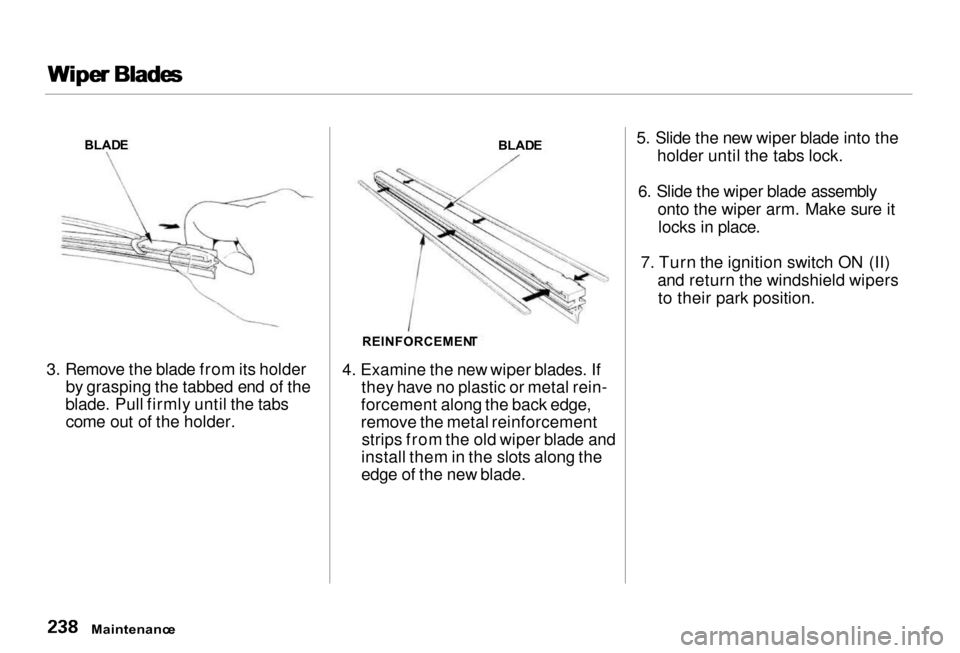
3. Remove the blade from its holder by grasping the tabbed end of the
blade. Pull firmly until the tabs come out of the holder. 4. Examine the new wiper blades. If
they have no plastic or metal rein-
forcement along the back edge,
remove the metal reinforcement strips from the old wiper blade and
install them in the slots along the
edge of the new blade. 5. Slide the new wiper blade into the
holder until the tabs lock.
6. Slide the wiper blade assembly onto the wiper arm. Make sure itlocks in place.
7. Turn the ignition switch ON (II) and return the windshield wipersto their park position.
Maintenanc e
BLAD
E
BLADE
REINFORCEMEN T
Page 249 of 330
Tire
s
The ABS and VSA system work by comparing the speed of the wheels.
When replacing tires, use the same size originally supplied with the car.
Tire size and construction can affect wheel speed and may cause the system to work inconsistently.
If you ever need to replace a wheel,
make sure you use an identical style
aluminum alloy wheel that originally
came on your Acura. Replacement
wheels are available at your Acura
dealer.
Wheel
s an d Tire s
Wheels:16x 7 J J
Tires:
P215/60R1694 V
See page 301 for information about
DOT Tire Quality Grading.
Winte
r Drivin g
Tires that are marked "M
+ S" or
"All Season
" on the sidewall have an
all-weather tread design. They should be suitable for most winter
driving conditions. Tires without
these markings are designed for optimum traction in dry conditions.
They may not provide adequate performance in winter driving.For the best performance in snowy
or icy conditions, you should installsnow tires or tire chains. They may
be required by local laws under certain conditions.
Maintenanc e
Page 259 of 330
Light
s
Replacing a Rea r License Bulb
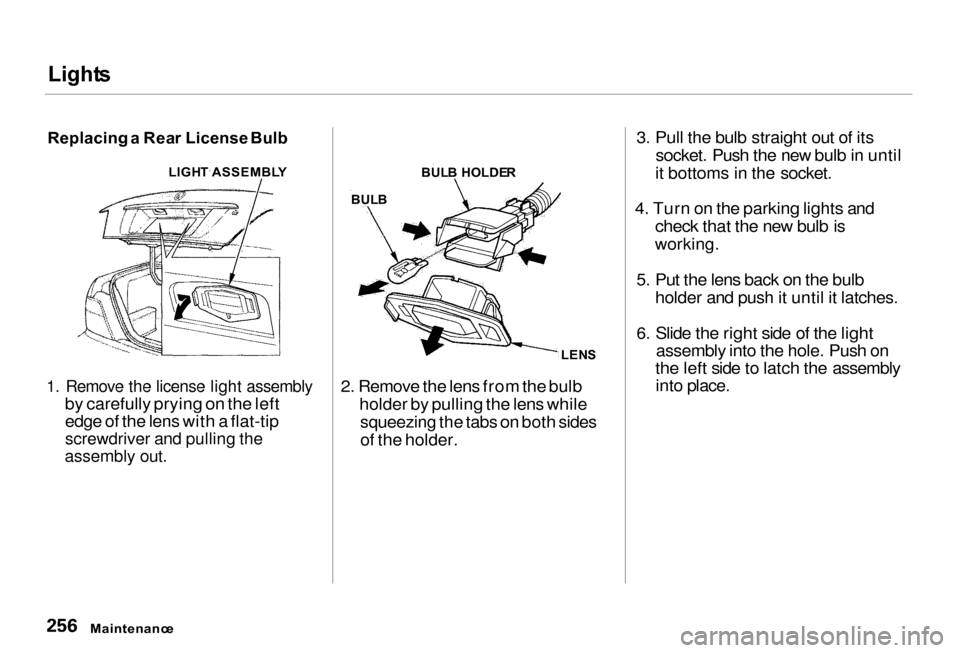
1. Remove the license light assembly
by carefully prying on the left
edge of the lens with a flat-tip
screwdriver and pulling the
assembly out.
2. Remove the lens from the bulb
holder by pulling the lens whilesqueezing the tabs on both sides
of the holder. 3. Pull the bulb straight out of its
socket. Push the new bulb in until
it bottoms in the socket.
4. Turn on the parking lights and check that the new bulb is
working.
5. Put the lens back on the bulb holder and push it until it latches.
6. Slide the right side of the light assembly into the hole. Push on
the left side to latch the assembly into place.
Maintenanc e
LIGH
T ASSEMBL Y
BULB HOLDE R
BUL B
LENS
Page 261 of 330
Light
s
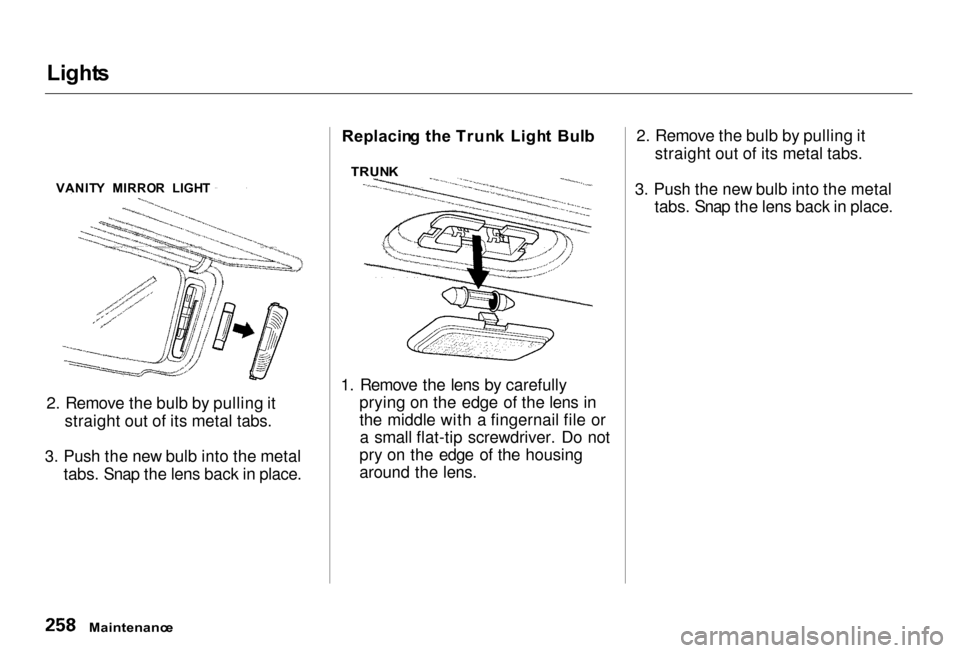
2. Remove the bulb by pulling it straight out of its metal tabs.
3. Push the new bulb into the metal tabs. Snap the lens back in place. Replacin
g th e Trun k Ligh t Bul b
1. Remove the lens by carefully prying on the edge of the lens in
the middle with a fingernail file ora small flat-tip screwdriver. Do not
pry on the edge of the housing
around the lens. 2. Remove the bulb by pulling it
straight out of its metal tabs.
3. Push the new bulb into the metal tabs. Snap the lens back in place.
Maintenanc e
VANIT
Y MIRRO R LIGH T
TRUN
K
Page 269 of 330
Corrosion
Protectio n
Two factors normally contribute to causing corrosion in your car:
1. Moisture trapped in body cavities. Dirt and road salt that collects in
hollows on the underside of the
vehicle stays damp, promoting corrosion in that area.
2. Removal of paint and protective coatings from the exterior and
underside of the car. Many corrosion-preventive measures
are built into your Acura. You can
help keep your car from corroding
by performing some simple periodic
maintenance:
Repair chips and scratches in the
paint as soon as you discover them. Inspect and clean out the drain
holes in the bottom of the doors
and body. Check the floor coverings for
dampness. Carpeting and floor
mats may remain damp for a long
time, especially in winter. This dampness can eventually cause
the floor panels to corrode. Use a high-pressure spray to clean
the underside of your car. This is especially important in areas that
use road salt in winter. It is also a
good idea in humid climates and areas subject to salt air. Be carefulof the ABS wheel sensors and
wiring at each wheel. Have the corrosion-preventive
coatings on the underside of your
car inspected and repaired
periodically.
Appearanc e Car e
Page 288 of 330
Brak
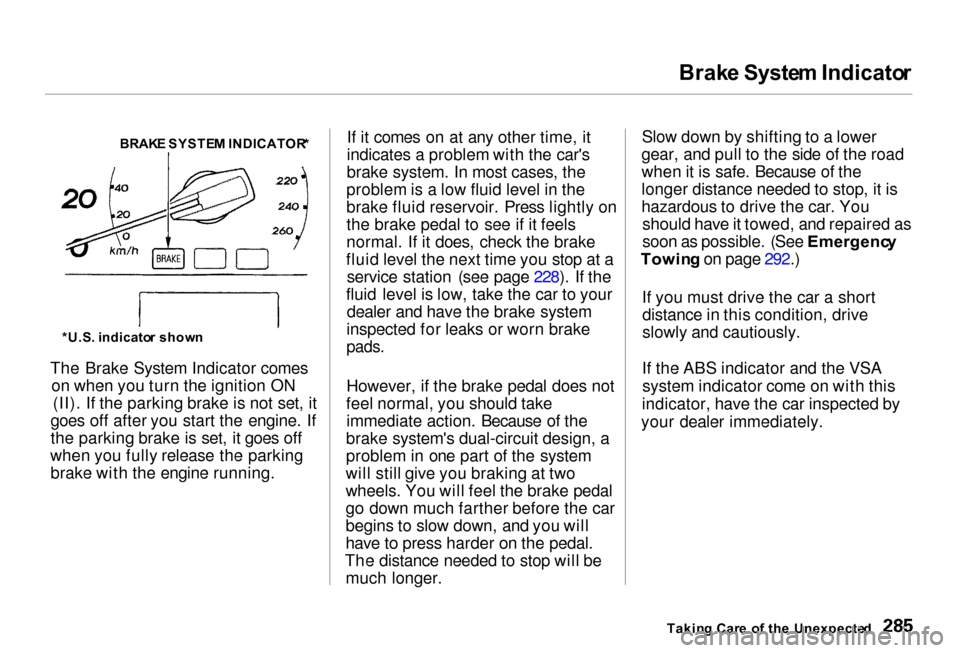
e Syste m Indicato r
The Brake System Indicator comes on when you turn the ignition ON (II). If the parking brake is not set, it
goes off after you start the engine. If
the parking brake is set, it goes off
when you fully release the parking brake with the engine running. If it comes on at any other time, it
indicates a problem with the car's
brake system. In most cases, the
problem is a low fluid level in the
brake fluid reservoir. Press lightly on
the brake pedal to see if it feels
normal. If it does, check the brake
fluid level the next time you stop at a service station (see page 228). If the
fluid level is low, take the car to your dealer and have the brake system
inspected for leaks or worn brake
pads.
However, if the brake pedal does not
feel normal, you should take immediate action. Because of the
brake system's dual-circuit design, a
problem in one part of the system
will still give you braking at two
wheels. You will feel the brake pedal
go down much farther before the car
begins to slow down, and you will
have to press harder on the pedal.
The distance needed to stop will be much longer. Slow down by shifting to a lower
gear, and pull to the side of the road
when it is safe. Because of the
longer distance needed to stop, it is
hazardous to drive the car. You should have it towed, and repaired as
soon as possible. (See Emergenc y
Towin g on page 292.)
If you must drive the car a short distance in this condition, drive
slowly and cautiously.
If the ABS indicator and the VSA system indicator come on with this
indicator, have the car inspected by
your dealer immediately.
Takin g Car e o f th e Unexpecte d
*U.S
. indicato r show n
BRAK
E SYSTE M INDICATOR *
Page 303 of 330
Vehicl
e Stabilit y Assis t (VSA ) Syste m
The Vehicle Stability Assist system (VSA) monitors the car's actions
during straight-line acceleration and
cornering behavior. It reduces
engine power and applies selective
braking if it senses any loss of
traction.
Controllin g Tractio n Durin g
Straight-lin e Acceleratio n
If one drive wheel is turning faster
than the other, or both drive wheels
are turning faster than the non- driven wheels, VSA senses
wheelspin. It reduces engine power and applies braking at the wheels as
necessary to increase traction.
To do this, VSA monitors the pulse frequencies from the wheel speed sensors. It also uses information
from the steering wheel angle sensor
and the lateral acceleration sensor to determine if the car is accelerating in
a straight line or if it is cornering.
VSA can then calculate how much wheelspin, if any, to allow. It signals
the ECU to reduce fuel flow andretard ignition timing. This reduces
available engine power. The ECU
will also apply braking at the wheels as necessary. When wheelspin has
been controlled, braking and engine
control return to normal.
Controllin g Tractio n Durin g
Cornerin g
VSA monitors steering input and the car's expected response to that input.
VSA's yaw rate sensor measures the car's actual cornering behavior. If VSA determines that the car is
turning more or less than expected,
the system reduces engine power
and applies braking at the
appropriate wheel to try and
maintain adequate traction during
cornering.
VSA uses the same wheel speed sensor assemblies as the ABS.
Additional sensors measure steering wheel angle, lateral acceleration, and
yaw rate.
The control unit monitors the VSA circuitry while driving. If it senses a
problem, it turns off the system and illuminates the VSA System
Indicator on the instrument panel.
Technica l Informatio n
Page 320 of 330
Inde
x
Accessories and Modifications.... 174 Accessories................................. 174
Additional Safety Precautions.. 175Modifications............................. 175
ACCESSORY (Ignition Key Position)........................................ 80
Accessory Power Socket.............. 114
Adding Automatic Transmission
Fluid........................................ 226
Brake Fluid................................. 227
Differential Oil........................... 227
Engine Coolant........................... 219
Engine Oil................................... 215
Power Steering Fluid................. 228
Windshield Washer Fluid......... 225
Additional Information About Your Airbags............................ 48
Additional Safety Precautions.... 48
Airbag Service.............................. 48
Additional Information About Your Front Airbags................. 43
How the SRS Indicator Works... 45
How Your Front Airbags
Work.......................................... 43
SRS Components......................... 43
Additional Information About Your Seat Belts........................ 40
Automatic Seat Belt Tensioners................................ 41
Lap/Shoulder Belt....................... 40
Seat Belt Maintenance................ 42
Seat Belt System Components... 40
Additional Information About
Your Side Airbags.................... 46
How The Side Airbag Indicator Light Works............................. 47
How Your Side Airbags Work.... 46
Additives, Engine Oil..................... 216
Adjustments Head Restraints........................... 95
Mirrors.......................................... 98
Seats.............................................. 93
Steering Wheel............................ 71
Airbag (SRS).......................... 9, 43, 46
Air Cleaner Element...................... 229
Air Conditioning Filter.................. 240
Air Conditioning System............... 120
Maintenance............................... 239
Usage.................................. 122, 127
Air Outlet
s (Vents)........................ 120
Air Pressure, Tires........................ 242
Alarm, Anti-theft............................ 162
Alcohol in Gasoline........................ 303
Aluminum Wheels, Cleaning........ 263
Antifreeze....................................... 219
Anti-lock Brakes (ABS)
Indicator Light..................... 56, 187
Operation.................................... 18
6
Anti-theft, Audio System............... 162
Anti-theft Steering Column
Lock............................................... 80
Anti-theft System........................... 163
Appearance Care........................... 261
Armrest............................................. 96
Ashtrays.......................................... 116 Audio Controls, Remote................ 161
Audio System................................. 134
Automatic Climate Control System......................................... 120
Automatic Lighting.......................... 64
Automatic Seat Belt Tensioners.................................... 41
CONTINUED
Page 321 of 330
Inde
x
Automatic Speed Control................ 73
Automatic Transmission............... 180
Capacity, Fluid........................... 298
Checking Fluid Level................ 226
Shifting........................................ 180
Shift Lever Position Indicator.. 180
Shift Lever Positions................. 180
Shift Lock Release..................... 183
Battery
Charging System
Indicator............................ 54, 283
Jump Starting............................. 278
Maintenance............................... 234
Specifications............................. 299
Before Driving............................... 165
Belts, Seat..................................... 8, 40
Beverage Holder............................ 111
Body Repair.................................... 267
Brakes
Anti-lock System (ABS)............ 186
Break-in, New Linings .............. 166
Fluid............................................ 227
Light, Burned-out...................... 254 Parking........................................ 108
System Indicator.................. 54, 285
Wear Indicators......................... 185
Brakes, ABS Operation.................................... 186System Indicator.................. 56, 187
Braking System.............................
. 185
Break-in, New Car......................... 166
Brightness Control, Instruments... 66
Brights, Headlights......................... 63
Bulb Replacement Back-up Lights........................... 254
Brake Lights............................... 254
Ceiling Lights............................. 257
Courtesy Lights......................... 257
Fog Lights.................................. 251 Front Side Marker Lights......... 253
Headlights.................................. 250
High-mount Brake Light.......... 255
License Plate Lights.................. 256
Specifications............................. 299
Trunk Light................................ 258
Turn Signal Lights..................... 253
Bulbs, Halogen............................... 250
Cables, Jump Starting With.......... 278
Cancel Button................................... 75
Capacities Chart............................. 298
Carbon Monoxide Hazard.............. 49
Carrying, Cargo............................. 174
Cassette Player
Care............................................. 154
Operation........................... 139, 151
CAUTION, Explanation of............... ii
CD Changer................. 142, 155, 157
Ceiling Lights................................. 117
Certification Label......................... 296
Chains............................................. 247
Change Oil
How to......................................... 217
When to....................................... 206
Changing a Flat Tire..................... 271
Changing Engine Coolant............. 221
Charging System Indicator.... 54, 283
Checking Automatic Transmission
Fluid........................................ 226
Battery Condition...................... 234
Brake Fluid................................. 227