oil Acura RL 2000 3.5 User Guide
[x] Cancel search | Manufacturer: ACURA, Model Year: 2000, Model line: RL, Model: Acura RL 2000Pages: 330, PDF Size: 4.53 MB
Page 218 of 330
Engin
e Oil
Addin g Oi l
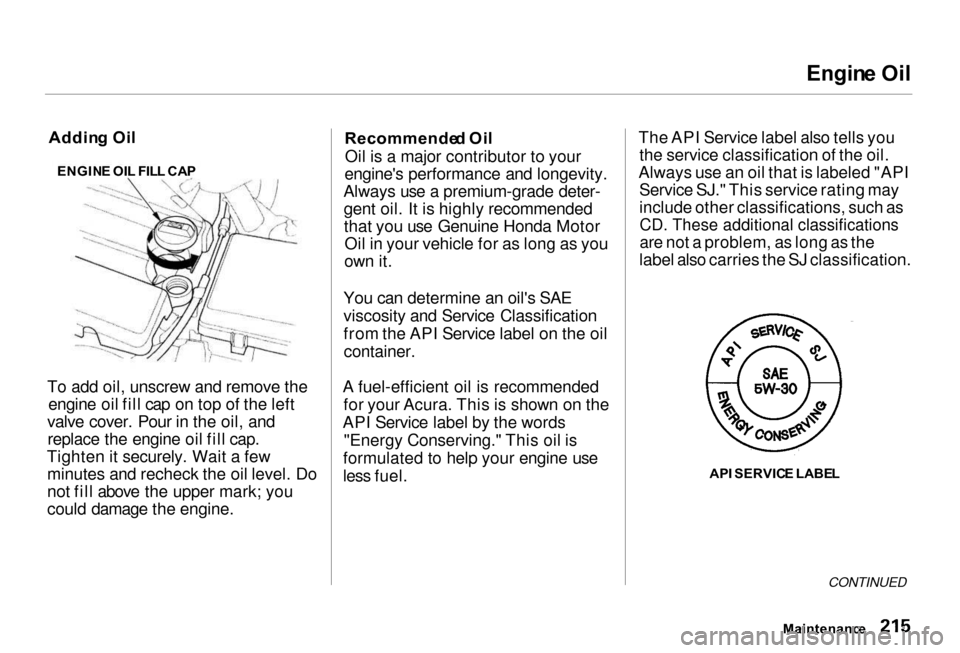
To add oil, unscrew and remove the engine oil fill cap on top of the left
valve cover. Pour in the oil, and replace the engine oil fill cap.
Tighten it securely. Wait a few minutes and recheck the oil level. Do
not fill above the upper mark; you
could damage the engine. Recommende
d Oi l
Oil is a major contributor to your
engine's performance and longevity.
Always use a premium-grade deter- gent oil. It is highly recommended
that you use Genuine Honda Motor Oil in your vehicle for as long as you
own it.
You can determine an oil's SAE
viscosity and Service Classification
from the API Service label on the oil container.
A fuel-efficient oil is recommended for your Acura. This is shown on the
API Service label by the words "Energy Conserving." This oil is
formulated to help your engine use
less fuel. The API Service label also tells you
the service classification of the oil.
Always use an oil that is labeled "API Service SJ." This service rating may
include other classifications, such as
CD. These additional classifications
are not a problem, as long as the
label also carries the SJ classification.
API SERVIC E LABE L
CONTINUED
Maintenanc e
ENGIN
E OI L FIL L CA P
Page 219 of 330
Engin
e Oi l
The oil container may also display the API Certification seal. Make sure
it says "For Gasoline Engines."
API CERTIFICATIO N SEA L The SAE numbers tell you the oil's
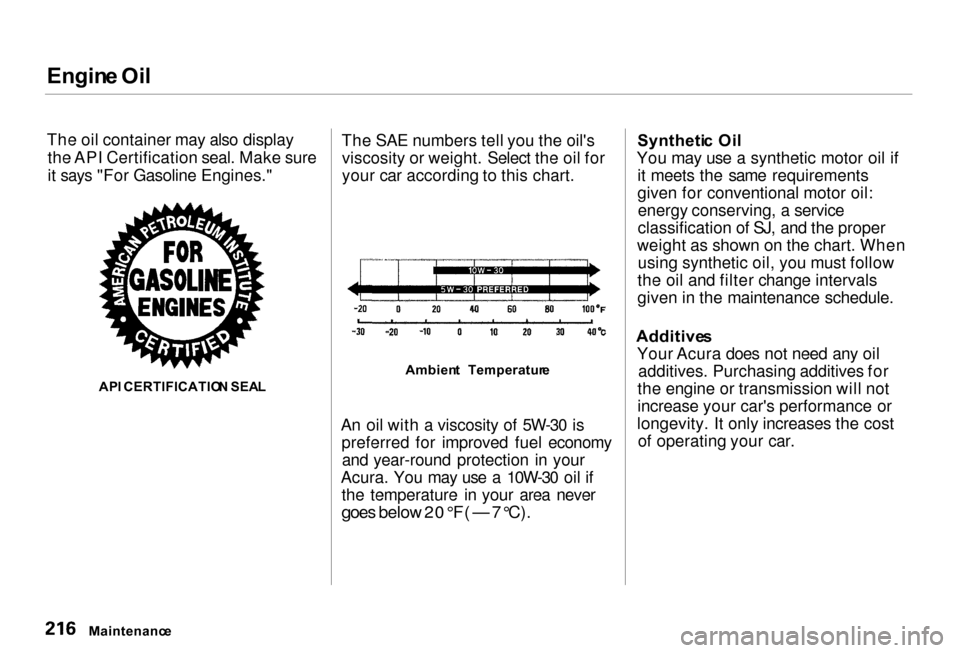
viscosity or weight. Select the oil for
your car according to this chart.
An oil with a viscosity of 5W-30 is preferred for improved fuel economyand year-round protection in your
Acura. You may use a 10W-30 oil if the temperature in your area never
goes below 20°F( — 7°C).
Syntheti
c Oi l
You may use a synthetic motor oil if it meets the same requirements
given for conventional motor oil:energy conserving, a service
classification of SJ, and the proper
weight as shown on the chart. When using synthetic oil, you must follow
the oil and filter change intervals
given in the maintenance schedule.
Additive s
Your Acura does not need any oil additives. Purchasing additives for
the engine or transmission will not
increase your car's performance or
longevity. It only increases the cost of operating your car.
Maintenanc e Ambien
t Temperatur e
Page 220 of 330
Engin
e Oi l
Changin g th e Oi l an d Filte r
Always change the oil and filter according to the time and distance (miles/kilometers) recommenda-
tions in the maintenance schedule.
The oil and filter collect contami- nants that can damage your engine if
they are not removed regularly.
Changing the oil and filter requires
special tools and access from
underneath the car. The car should
be raised on a service station-type hydraulic lift for this service. Unless
you have the knowledge and proper equipment, you should have this
maintenance done by a skilled
mechanic. 1. Run the engine until it reaches
normal operating temperature,
then shut it off.
2. Ope
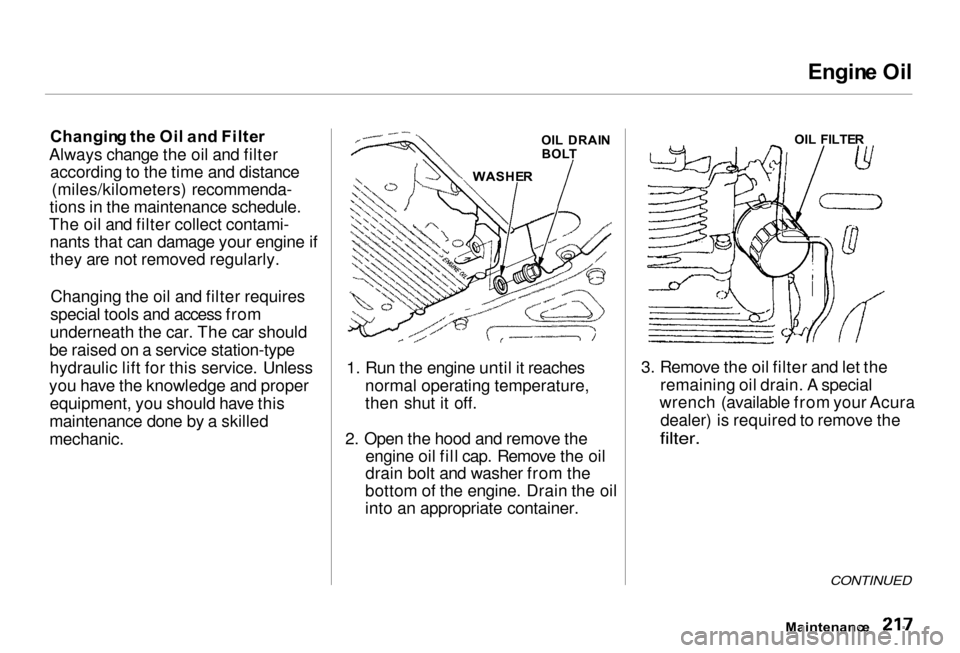
n the hood and remove the
engine oil fill cap. Remove the oil
drain bolt and washer from the
bottom of the engine. Drain the oil
into an appropriate container.
3. Remov
e the oil filter and let the
remaining oil drain. A special
wrench (available from your Acura dealer) is required to remove the
filter.
CONTINUED
Maintenanc e
WASHE
R
OI
L DRAI N
BOL T OI
L
FILTE
R
Page 221 of 330
Engin
e Oi l
4. Install a new oil filter according to
instructions that come with it.
5. Put a new washer on the drain bolt,
then reinstall the drain bolt.
Tighten it to:
3 3 lbf.ft (44 N.m , 4.5 kgf.m)
6. Refill the engine with the recom-
mended oil.
Engine oil change capacity
(including filter):
4.9 US qt (4.6 , 4.0 Imp qt)
7. Reinstall the engine oil fill cap.
Start the engine. The oil pressure
indicator light should go out within
five seconds. If it does not, turn off
the engine and reinspect your
work.
8. Let the engine run for several
minutes and check the drain bolt
and oil filter for leaks.
9. Turn off the engine, let it sit for
several minutes, then check the oil
level. If necessary, add oil to bring
the level to the upper mark on the
dipstick.
Improper disposal of engine oil can be
harmful to the environment. If you
change your own oil, please dispose of
the used oil properly. Put it in a sealed
container and take it to a recycling
center. Do not discard it in a trash bin
or dump it on the ground.
Maintenanc e
NOTIC
E
Page 230 of 330
Differentia
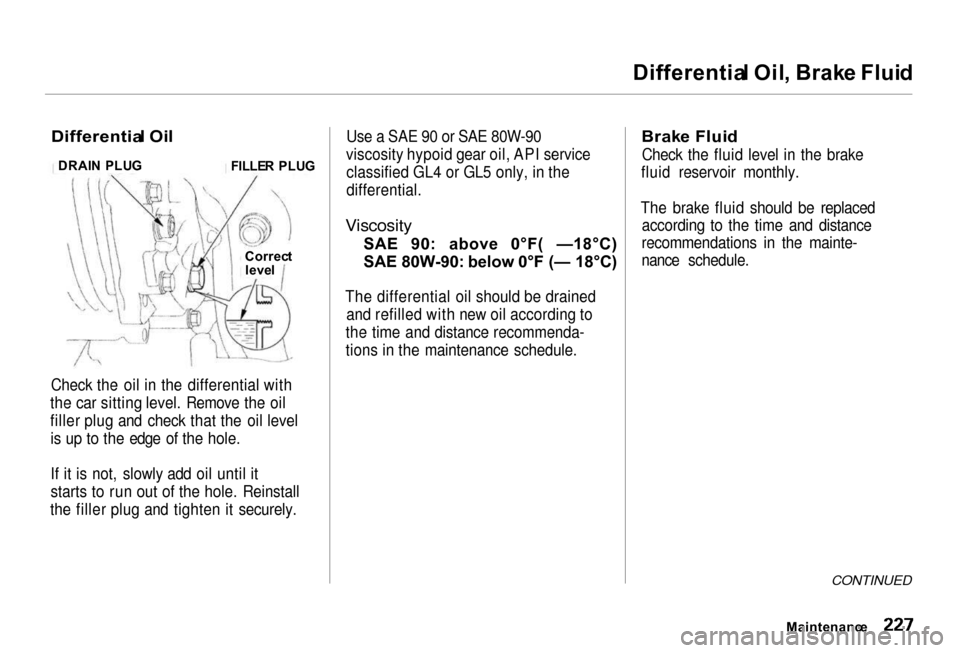
l Oil , Brak e Flui dCheck the oil in the differential with
the car sitting level. Remove the oil
filler plug and check that the oil level is up to the edge of the hole.
If it is not, slowly add oil until it
starts to run out of the hole. Reinstall
the filler plug and tighten it securely. Use a SAE 90 or SAE 80W-90
viscosity hypoid gear oil, API service classified GL4 or GL5 only, in the
differential.
Viscosity
SAE 90: above 0°F( —18°C)
SAE 80W-90: below 0°F (— 18°C)
The differential oil should be drained and refilled with new oil according to
the time and distance recommenda-
tions in the maintenance schedule.
Brak e Flui d
Check the fluid level in the brake
fluid reservoir monthly.
The brake fluid should be replaced according to the time and distance
recommendations in the mainte-
nance schedule.
CONTINUED
Maintenanc e
Correc
t
leve l
Differentia
l Oi l
FILLER PLU G
DRAI
N PLU G
Page 234 of 330
Spar
k Plug s
The spark plugs in your car are a special platinum-tipped design for
longer life. The spark plugs should
be replaced according to the time
and distance recommendations in
the maintenance schedule. Replacemen
t
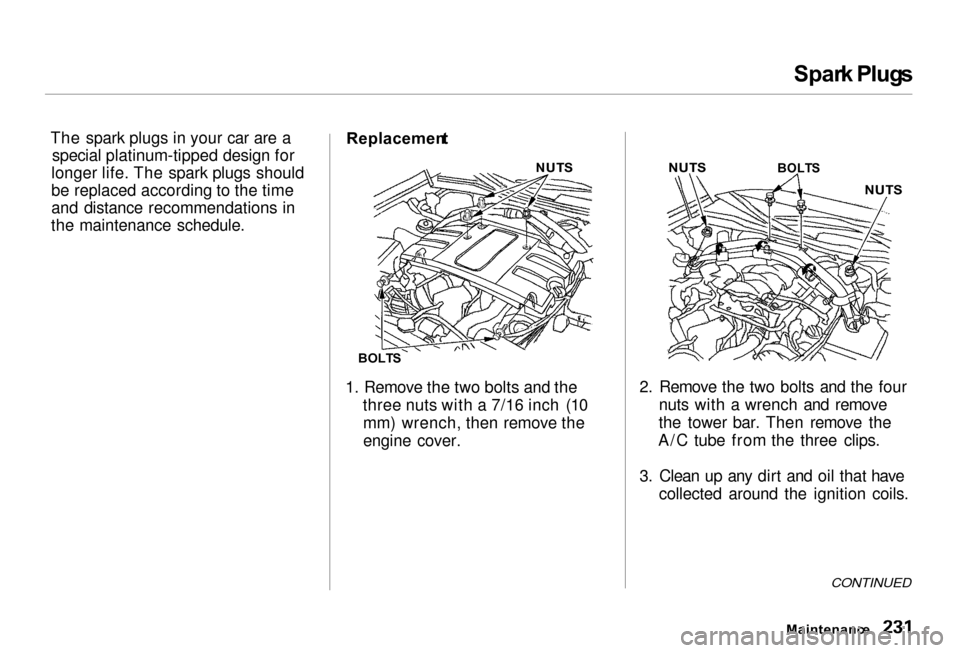
1. Remove the two bolts and the three nuts with a 7/16 inch (10mm) wrench, then remove the
engine cover. 2. Remove the two bolts and the four
nuts with a wrench and remove
the tower bar. Then remove the
A/C tube from the three clips.
3. Clean up any dirt and oil that have collected around the ignition coils.
CONTINUED
Maintenanc e
NUT
S
BOLT S
NUT
S
BOLTS
NUTS
Page 235 of 330
Spar
k Plug s
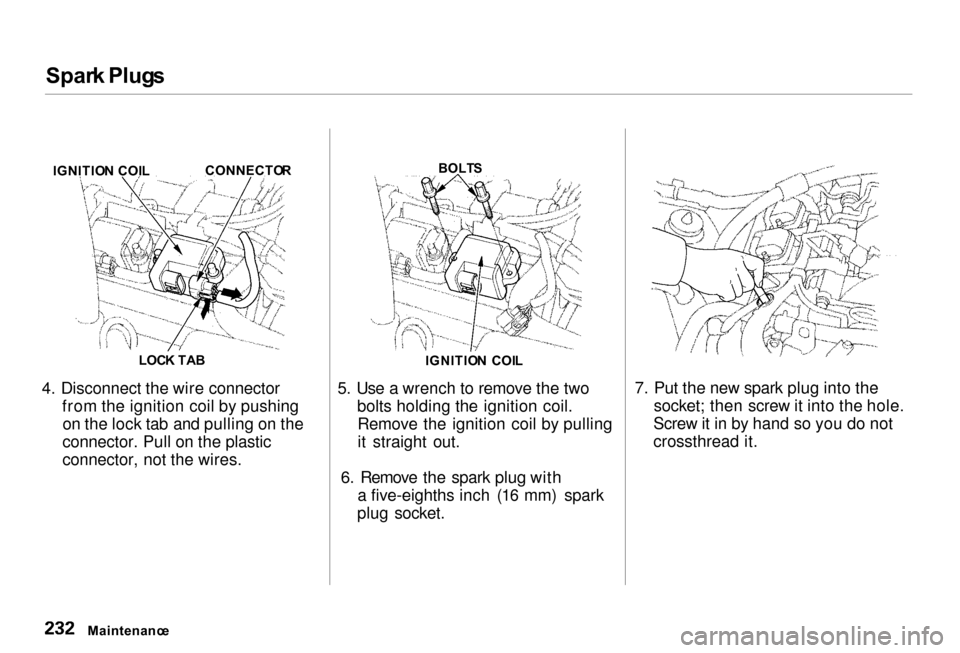
4. Disconnect the wire connector from the ignition coil by pushingon the lock tab and pulling on the
connector. Pull on the plastic
connector, not the wires. 5. Use a wrench to remove the two
bolts holding the ignition coil.Remove the ignition coil by pulling
it straight out.
6. Remove the spark plug with a five-eighths inch (16 mm) spark
plug socket. 7. Put the new spark plug into the
socket; then screw it into the hole.
Screw it in by hand so you do not
crossthread it.
Maintenanc e
IGNITIO
N COI L CONNECTO
R
LOC K TA B
BOLT
S
IGNITIO N COI L
Page 236 of 330
Spar
k Plug s
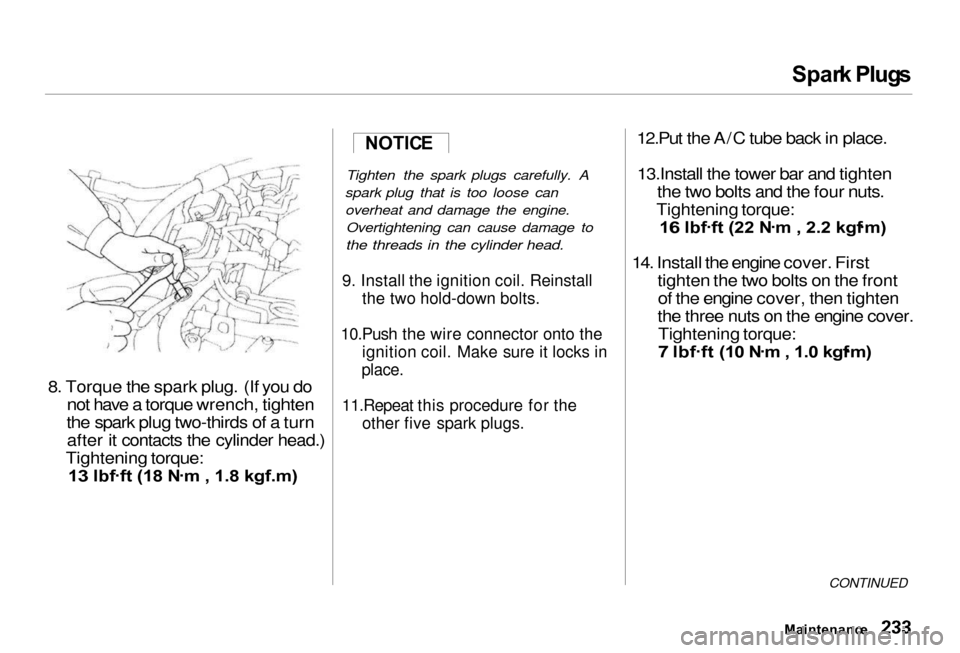
8. Torque th e spark plug . (If you do
not hav
e a torque wrench, tighten
the spark plug two-thirds of a turn after it contacts the cylinder head.)
Tightening torque:
13 lbf .
ft (18 N .
m , 1.8 kgf.m)
Tighten the spark plugs carefully. A
spark plug that is too loose can overheat and damage the engine. Overtightening can cause damage to
the threads in the cylinder head.
9. Install the ignition coil. Reinstall the two hold-down bolts.
10.Push the wire connector onto the ignition coil. Make sure it locks in
place.
11.Repeat this procedure for the other five spark plugs.
12.Put the A/C tube back in place.
13.Install the tower bar and tighten the two bolts and the four nuts.
Tightening torque:
16 lbf .
ft (22 N .
m , 2.2 kgf .
m)
14. Install the engine cover. First
tighten th e two bolts on the front
of the engine cover, then tighten
the three nuts on the engine cover.
Tightening torque:
7 lbf .
ft (10 N .
m , 1.0 kgf .
m)
CONTINUED
Maintenanc e
NOTIC
E
Page 242 of 330
Ai
r Conditionin g Syste m
Your car's air conditioning is a sealed system. Any major maintenance,
such as recharging, should be done
by a qualified mechanic. You can do a couple of things to make sure the
air conditioning works efficiently.
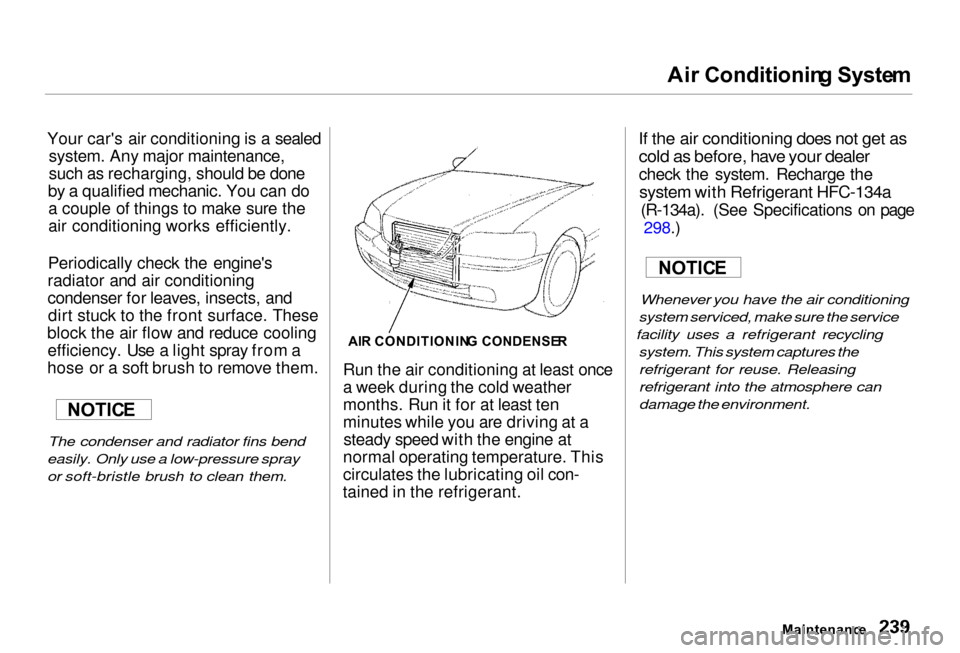
Periodically check the engine's
radiator and air conditioning
condenser for leaves, insects, and dirt stuck to the front surface. These
block the air flow and reduce cooling efficiency. Use a light spray from a
hose or a soft brush to remove them.
The condenser and radiator fins bend
easily. Only use a low-pressure spray
or soft-bristle brush to clean them.
Run the air conditioning at least once
a week during the cold weather
months. Run it for at least ten
minutes while you are driving at a
steady speed with the engine at
normal operating temperature. This
circulates the lubricating oil con-
tained in the refrigerant.
If the air conditioning does not get as
cold as before, have your dealer
check the system. Recharge the
system with Refrigerant HFC-134a
(R-134a). (See Specifications on page 298.)
Whenever you have the air conditioning
system serviced, make sure the service
facility uses a refrigerant recycling
system. This system captures the
refrigerant for reuse. Releasing
refrigerant into the atmosphere can
damage the environment.
Maintenance
AI
R CONDITIONIN G CONDENSE R
NOTIC
E
NOTIC E
Page 253 of 330
Replacin
g a Hig h Bea m Headligh t
Bul b
The low beam headlight bulbs are a type of high voltage discharge tube.
High voltage can remain in the
circuit even with the light switch off
and the key removed. Because of
this, you should not attempt to
examine or change a low beam
headlight bulb yourself. If a low
beam headlight bulb fails, take the car to your dealer to have it replaced. Halogen bulbs are used for the high
beam headlight bulbs. When replacing a high beam headlight bulb,
handle it by its base and protect the
glass from contact with your skin or
hard objects. If you touch the glass, clean it with denatured alcohol and a
clean cloth.
Halogen bulbs get very hot when lit. Oil,
perspiration, or a scratch on the glass
can cause the bulb to overheat and
shatter.
1. Open the hood.
2. Remove the electrical connector from the bulb by pulling theconnector straight back.
3. Remove the rubber weather seal by pulling on the tab.
Maintenanc e
NOTIC
E