tires Acura RL 2000 3.5 User Guide
[x] Cancel search | Manufacturer: ACURA, Model Year: 2000, Model line: RL, Model: Acura RL 2000Pages: 330, PDF Size: 4.53 MB
Page 244 of 330
Timin
g Belt , Tire s
Timin g Bel t
The timing belt and balancer belt should normally be replaced at the
intervals shown in the maintenance
schedule.
Replace these belts at 60,000 miles (U.S.) or 100,000 km (Canada) if you
regularly drive your car in one or
more of these conditions:
In very high temperatures
(over 110°F,43°C).
In very low temperatures
(under —20°F, — 29°C). Tire
s
To safely operate your car, your tires must be the proper type and size, in
good condition with adequate tread, and correctly inflated. The following
pages give more detailed information on how and when to check air
pressure, how to inspect your tires
for damage and wear, and what to do
when your tires need to be replaced.
Inflatio
n
Keeping the tires properly inflated
provides the best combination of
handling, tread life and riding comfort. Underinflated tires wear
unevenly, adversely affect handling and fuel economy, and are more
likely to fail from being overheated. Overinflated tires can make your car
ride more harshly, are more prone to damage from road hazards, and wear
unevenly.
We recommend that you visually check your tires every day. If you
think a tire might be low, check it immediately with a tire gauge.
CONTINUED
Maintenanc e
Using tires that are excessively
worn or improperly inflated can
cause a crash in which you can be seriously hurt or killed.
Follow all instructions in this
owner's manual regarding tire inflation and maintenance.
Page 245 of 330
Tire
s
Use a gauge to measure the air
pressure at least once a month. Even
tires that are in good condition may
lose one to two psi (10 to 20 kPa, 0.1
to 0.2 kgf/cm2) per month.
Remember t
o check the spare tire at
the same time you check all the other tires.
Check the pressure in the tires when
they are cold. This means the car
has been parked for at least three
hours. If you have to drive the car
before checking the tire pressure,
the tires can still be considered "cold" if you drive less than 1 mile
(1.6 km).
If you check the pressure when the
tires are hot (the car has been driven several miles), you will see readings
4 to 6 psi (30 to 40 kPa, 0.3 to 0.4
kgf/cm
2) higher than the cold
reading. Thi
s is normal. Do not let
air out to match the specified cold
pressure. The tire will be
underinflated.
You should get your own tire pressure gauge and use it whenever
you check your tire pressures. This will make it easier for you to tell if apressure loss is due to a tire problem
and not due to a variation between
gauges.
Recommended Tire Pressures for
Normal Driving
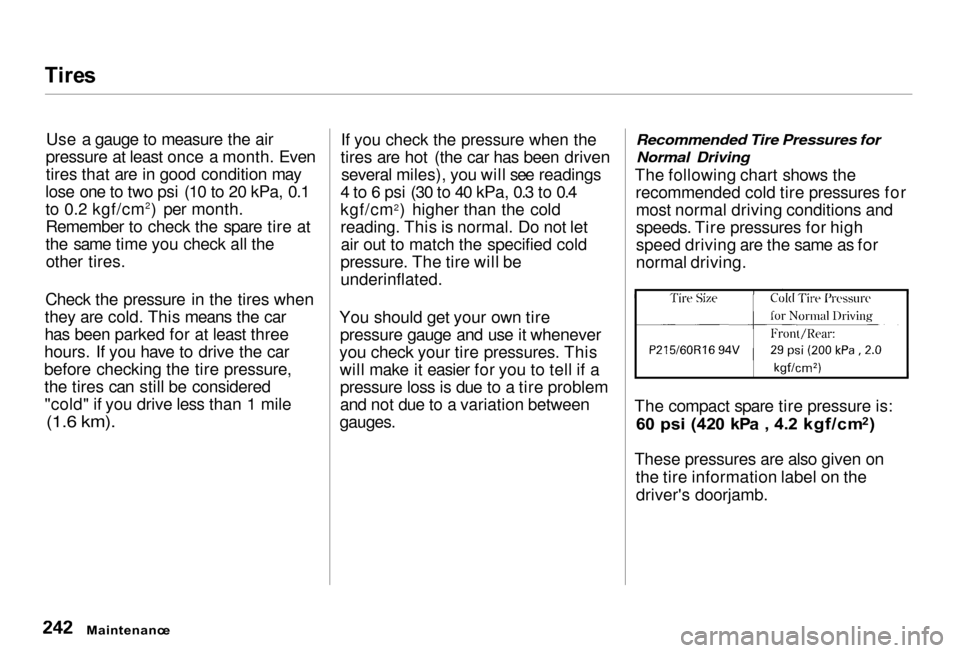
The following chart shows the recommended cold tire pressures formost normal driving conditions and
speeds. Tire pressures for high
speed driving are the same as for
normal driving.
The compact spare tire pressure is:
6 0 ps i (42 0 kP a , 4. 2 kgf/cm 2
)
These pressures are also given on
the tire information label on thedriver's doorjamb.
Maintenanc e
Page 246 of 330
Tire
s
Tubeless tires have some ability to self-seal if they are punctured.
However, because leakage is often
very slow, you should look closely
for punctures if a tire starts losing
pressure. Inspectio
n
Every time you check inflation, you
should also examine the tires for
damage, foreign objects, and wear.
You should look for: Bumps or bulges in the tread or
side of the tire. Replace the tire if
you find either of these conditions. Cuts, splits, or cracks in the side
of the tire. Replace the tire if you
can see fabric or cord. Excessive tread wear.
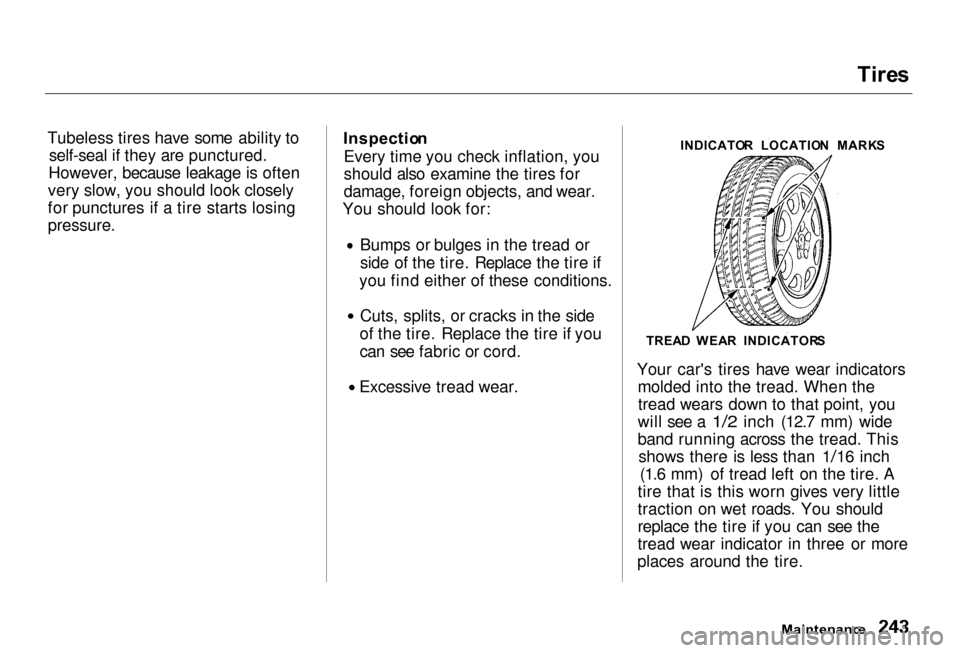
Your car's tires have wear indicators
molded into the tread. When thetread wears down to that point, you
will see a 1/2 inch (12.7 mm) wide
band running across the tread. This shows there is less than 1
/16 inch
(1.6 mm) of tread left on the tire. A
tire that is this worn gives very little
traction on wet roads. You should
replace the tire if you can see the
tread wear indicator in three or more
places around the tire.
Maintenance
INDICATO
R LOCATIO N MARK S
TREA D WEA R INDICATOR S
Page 247 of 330
Tire
s
Maintenanc e
In addition to proper inflation,
correct wheel alignment helps to
decrease tire wear. If you find a tire
is worn unevenly, have your dealer
check the wheel alignment.
The tires were properly balanced by the factory. They may need to be
rebalanced at some time before theyare worn out. Have your dealer
check the tires if you feel a consis-
tent vibration while driving. A tire should always be rebalanced if it is
removed from the wheel for repair. Make sure the installer balances the
wheels when you have new tires installed. This increases riding
comfort and tire life. Your car'soriginal tires were dynamic or "spin"
balanced at the factory. For best results, have the installer perform adynamic balance.
Improper wheel weights can damage your vehicle's aluminum wheels. Use
only Genuine Acura wheel weights for
balancing.
Tir
e Rotatio n
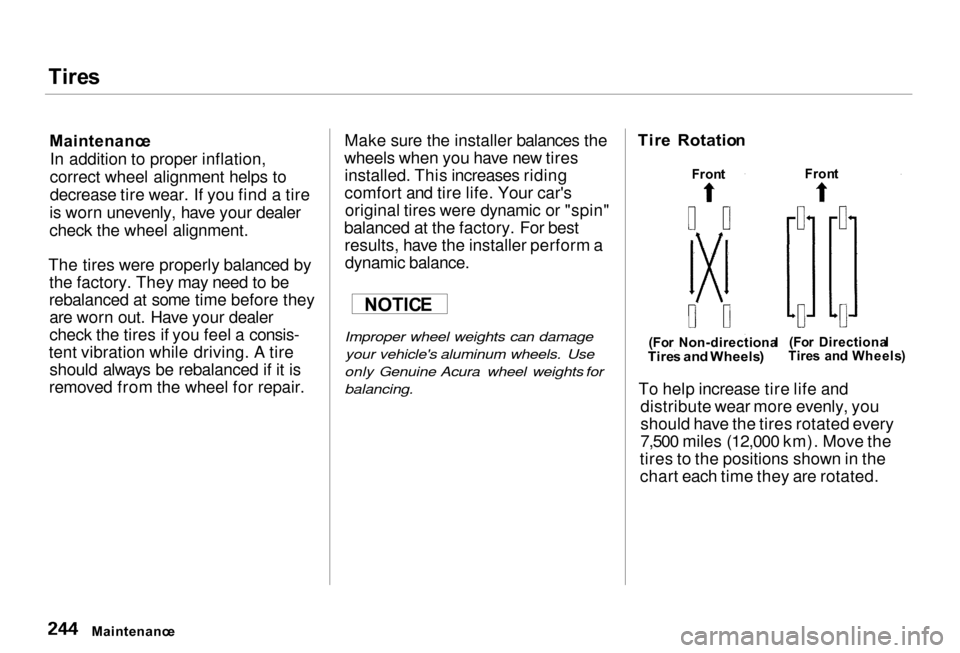
To help increase tire life and distribute wear more evenly, you
should have the tires rotated every
7,500 miles (12,000 km). Move the
tires to the positions shown in the chart each time they are rotated.
Maintenanc e
NOTIC
E
Fron
t Fron
t
(Fo r Non-directiona l
Tire s an d Wheels )
(Fo
r Directiona l
Tire s an d Wheels )
Page 248 of 330
Tire
s
When shopping for replacement tires, you may find that some tiresare "directional." This means they
are designed to rotate only in one
direction. If you use directional tires,
they should be rotated only front-to-
back. Replacin
g Tire s an d Wheel s
The tires that came with your car were selected to match the perform- ance capabilities of the car while
providing the best combination of
handling, ride comfort, and long life.
You should replace them with radial tires of the same size, load range,speed rating, and maximum cold tire
pressure rating (as shown on the
tire's sidewall). Mixing radial and
bias-ply tires on your car can reduce its braking ability, traction, andsteering accuracy. It is best to replace all four tires at
the same time. If that is not possible or necessary, then replace the two
front tires or the two rear tires as a pair. Replacing just one tire canseriously affect your car's handling.
CONTINUED
Maintenanc e
Installing improper tires on your
car can affect handling and
stability. This can cause a crash in which you can be seriously
hurt or killed.
Always use the size and type of
tires recommended in this owner's manual.
Page 249 of 330
Tire
s
The ABS and VSA system work by comparing the speed of the wheels.
When replacing tires, use the same size originally supplied with the car.
Tire size and construction can affect wheel speed and may cause the system to work inconsistently.
If you ever need to replace a wheel,
make sure you use an identical style
aluminum alloy wheel that originally
came on your Acura. Replacement
wheels are available at your Acura
dealer.
Wheel
s an d Tire s
Wheels:16x 7 J J
Tires:
P215/60R1694 V
See page 301 for information about
DOT Tire Quality Grading.
Winte
r Drivin g
Tires that are marked "M
+ S" or
"All Season
" on the sidewall have an
all-weather tread design. They should be suitable for most winter
driving conditions. Tires without
these markings are designed for optimum traction in dry conditions.
They may not provide adequate performance in winter driving.For the best performance in snowy
or icy conditions, you should installsnow tires or tire chains. They may
be required by local laws under certain conditions.
Maintenanc e
Page 250 of 330
Tire
s
Snow Tires
If you mount snow tires on your
Acura, make sure they are radial tires of the same size and load rangeas the original tires. Mount snow
tires on all four wheels to balance
your car's handling in all weather conditions. Keep in mind the traction
provided by snow tires on dry roads
may not be as high as your car's original equipment tires. You should
drive cautiously even when the roads
are clear. Check with the tire dealer
for maximum speed recommen-
dations.
Tire Chains
Because your Acura has limited tire
clearance, mount only SAE Class "S"
cable-type traction devices on the
front tires. Use traction devices only when required by driving conditionsor local laws. Make sure they are the
correct size for your tires.
Metal link-type "chains" should not
be used. No matter how tight they seem to be installed, they can come
into contact with the body and
suspension, causing serious damage. When installing cables, follow the
manufacturer's instructions and
mount them as tightly as you can.
Drive slowly with them installed. If
you hear them coming in contact with the body or chassis, stop andinvestigate. Make sure the cables are
installed tightly, and that they are
not contacting the brake lines or
suspension.
Remove them as soon as you begin driving on cleared roads.
Traction devices that are the wrong
size or improperly installed can damage your car's brake lines,
suspension, body, and wheels. Stop
driving if they are hitting any part of the car.
Maintenance
NOTIC
E
Page 262 of 330
Storin
g You r Ca r
If you need to park your car for an
extended period (more than one
month), there are several things you
should do to prepare it for storage.
Proper preparation helps prevent
deterioration and makes it easier to
get your car back on the road. If
possible, store your car indoors. Fill the fuel tank.
Change the engine oil and filter
(see page 217). Wash and dry the exterior
completely.
Clean the interior. Make sure the
carpeting, floor mats, etc. are
completely dry. Leave the parking brake off. Put
the transmission in Park. Block the rear wheels.
If the car is to be stored for a
longer period, it should be supported on jackstands so the
tires are off the ground. Leave one window open slightly (if
the car is being stored indoors). Disconnect the battery.
Support the front wiper blade
arms with a folded towel or rag so
they do not touch the windshield.
To minimize sticking, apply a silicone spray lubricant to all door
and trunk seals. Also, apply a
vehicle body wax to the painted surfaces that mate with the door
and trunk seals. Cover the car with a "breathable"
cover, one made from a porous
material such as cotton.
Nonporous materials, such as
plastic sheeting, trap moisture,
which can damage the paint. If possible, run the engine for a
while periodically (preferably once a month).
If you store your car for 12 months or longer, have your Acura dealer
perform the inspections called for in
the 24 months/30,000 miles (48,000
km) maintenance schedule (Normal Conditions) as soon as you take it
out of storage (see page 206). The
replacements called for in the
maintenance schedule are not
needed unless the car has actually
reached that time or mileage.
Maintenance
Page 273 of 330
Compac
t Spar e Tir e
Your car has a compact spare tire that takes up less space. Use this spare tire as a temporary replace-
ment only. Get your regular tire
repaired or replaced and put back on
your car as soon as you can.
Check the inflation pressure of the
compact spare tire every time you
check the other tires. It should be
inflated to:6 0 ps i (42 0 kP a , 4. 2 kgf/cm 2)
Follow these precautions whenever
you are using the compact spare tire: Do not exceed 50 mph (80 km/h)
under any circumstances.
This tire gives a harsher ride and less traction on some road sur-
faces than the regular tire. Use
greater caution while driving on
this tire. Do not mount snow chains on the
compact spare.
The wheel of the compact spare
tire is designed especially to fit
your car. Do not use your spare
tire on another vehicle unless it is
the same make and model.
Turn off the VSA system (see page 190).Driving with the compact spare
tire may activate the VSA system.
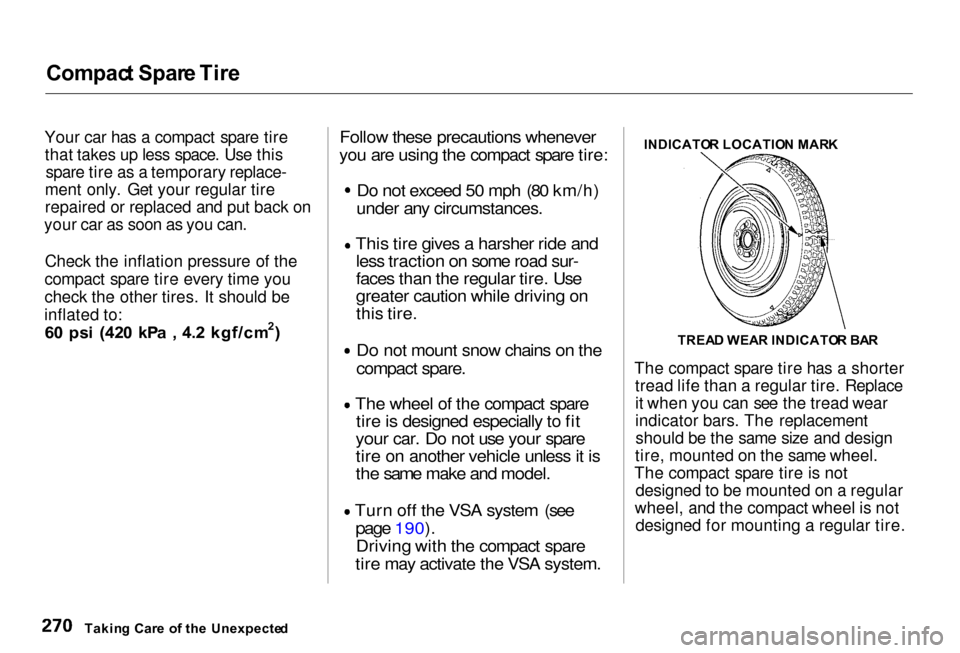
The compact spare tire has a shorter
tread life than a regular tire. Replace
it when you can see the tread wear
indicator bars. The replacementshould be the same size and design
tire, mounted on the same wheel.
The compact spare tire is not designed to be mounted on a regular
wheel, and the compact wheel is not designed for mounting a regular tire.
Takin g Car e o f th e Unexpecte d INDICATO
R LOCATIO N MAR K
TREA D WEA R INDICATO R BA R
Page 295 of 330
Emergenc
y Towin g
If your car needs to be towed, call a
professional towing service or, if you
belong to one, an organization that
provides roadside assistance. Never
tow your car behind another vehicle
with just a rope or chain. It is very
dangerous.
There are three popular types of professional towing equipment:
Flat-bed Equipment — The operator
loads your car on the back of a truck.
Thi s is th e bes t wa y to transpor t
you r Acura .
Wheel-Lift Equipment — The tow
truck uses two pivoting arms that go
under the tires (front or rear) and lift
them off the ground. The other two
tires remain on the ground. Thi s i s
a n acceptabl e wa y to to w you r
Acura .
Sling-type Equipment — The tow
truck uses metal cables with hooks on the ends. These hooks go around
parts of the frame or suspension and
the cables lift that end of the car off the ground. Your car's suspensionand body can be seriously damaged.
Thi s metho d o f towin g is
unacceptable .
If your Acura cannot be transported
by flat-bed, it should be towed by
wheel-lift equipment with the front
wheels off the ground. If, due to damage, your car must be towed
with the front wheels on the ground, do the following. Release the parking brake.
Shift the transmission to Neutral.
Improper towing preparation will
damage the transmission. Follow the
above procedure exactly. If you cannot
shift the transmission or start theengine, your car must be transportedwith the front wheels off the ground.
With the front wheels on the ground, it is best to tow the car no farther
than 50 miles (80 km), and keep thespeed below 35 mph (55 km/h).
Takin g Car e o f th e Unexpecte d
NOTIC
E