brake Acura RL 2000 3.5 Owner's Guide
[x] Cancel search | Manufacturer: ACURA, Model Year: 2000, Model line: RL, Model: Acura RL 2000Pages: 330, PDF Size: 4.53 MB
Page 188 of 330

Th
e Brakin g Syste m
Your Acura is equipped with disc brakes at all four wheels. A powerassist helps reduce the effort needed
on the brake pedal. The ABS helps
you retain steering control when braking very hard.
Put your foot on the brake pedal only
when you intend to brake. Resting
your foot on the pedal keeps the brakes applied lightly, causing them
to build up heat. Heat build-up can
reduce how well your brakes work. Italso keeps your brake lights on all
the time, confusing drivers behind
you.
Constant application of the brakes
when going down a long hill builds up heat and reduces their effective-
ness. Use the engine to assist the
brakes by downshifting to a lower
gear and taking your foot off the accelerator pedal.
Check your brakes after driving
through deep water. Apply the
brakes moderately to see if they feel normal. If not, apply them gently and
frequently until they do. Since a
longer distance is needed to stop
with wet brakes, be extra cautious and alert in your driving. Brak
e Wea r Indicator s
All four brakes have audible brake wear indicators.
When the brake pads need replacing, you will hear a distinctive metallic "screeching" sound when you apply
the brakes. If you do not have the
brake pads replaced, they will begin screeching all the time.
Your brakes may sometimes squeal or squeak when you apply them
lightly. Do not confuse this with the
brake wear indicators. They make a
very audible "screeching."
Driving
Page 189 of 330
Th
e Brakin g Syste m
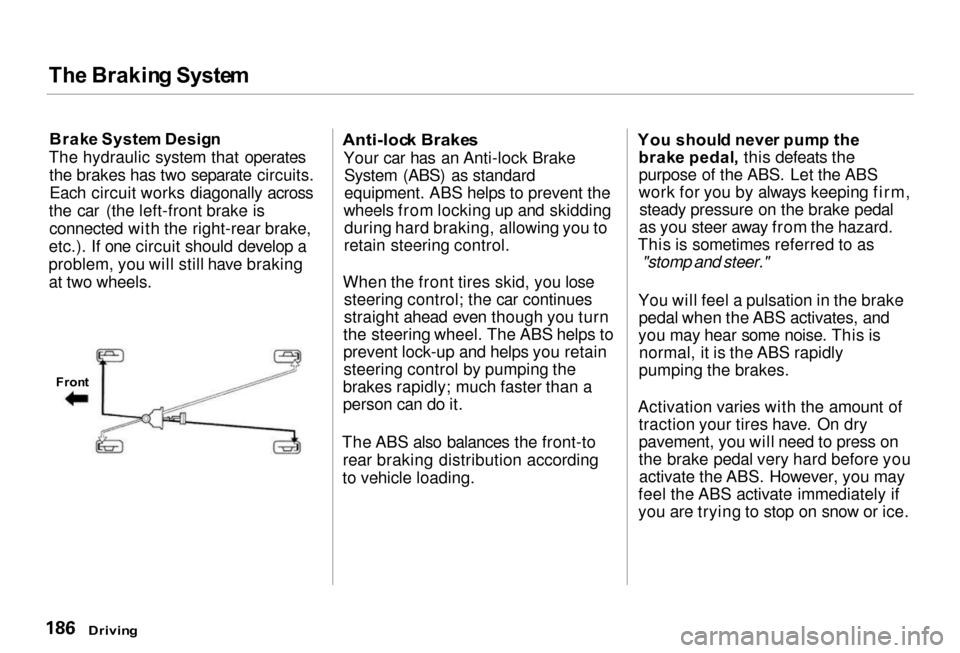
Brak e Syste m Desig n
The hydraulic system that operates the brakes has two separate circuits.Each circuit works diagonally across
the car (the left-front brake is connected with the right-rear brake,
etc.). If one circuit should develop a
problem, you will still have braking at two wheels.
Anti-loc
k Brake s
Your car has an Anti-lock Brake System (ABS) as standard
equipment. ABS helps to prevent the
wheels from locking up and skidding during hard braking, allowing you to
retain steering control.
When the front tires skid, you lose steering control; the car continues
straight ahead even though you turn
the steering wheel. The ABS helps to
prevent lock-up and helps you retain steering control by pumping the
brakes rapidly; much faster than a
person can do it.
The ABS also balances the front-to rear braking distribution according
to vehicle loading. Yo
u shoul d neve r pum p th e
brak e pedal , this defeats the
purpose of the ABS. Let the ABS
work for you by always keeping firm, steady pressure on the brake pedal
as you steer away from the hazard.
This is sometimes referred to as
"stomp and steer."
You will feel a pulsation in the brake pedal when the ABS activates, and
you may hear some noise. This is normal, it is the ABS rapidly
pumping the brakes.
Activation varies with the amount of traction your tires have. On dry
pavement, you will need to press on
the brake pedal very hard before youactivate the ABS. However, you may
feel the ABS activate immediately if
you are trying to stop on snow or ice.
Drivin g
Fron
t
Page 190 of 330
Th
e Brakin g Syste m
Important Safety Reminders
AB S doe s no t reduc e th e tim e o r
distanc e i t take s t o sto p th e car , it
only helps with steering control
during braking. You should always
maintain a safe following distance
from other vehicles.
AB S wil l no t preven t a ski d tha t
result s fro m changin g directio n
abruptly , such as trying to take a
corner too fast or making a sudden
lane change. Always drive at a safe,
prudent speed for the road and
weather conditions.
AB S canno t preven t a los s o f
stability . Always steer moderately
when you are braking hard. Severe or sharp steering wheel movement
can still cause your car to veer into
oncoming traffic or off the road. A
vehicl e wit h AB S ma y requir e a
longe r distanc e t o sto p on loose or
uneven surfaces, such as gravel or snow, than a vehicle without anti-
lock. Slow down and allow a greater distance between vehicles under
those conditions.
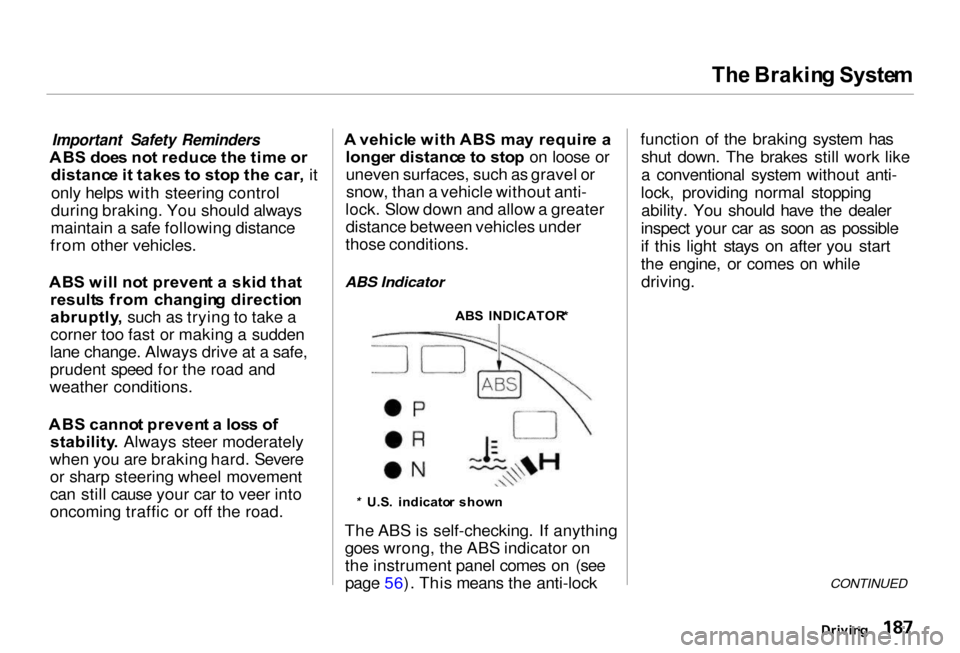
ABS Indicator
* U.S . indicato r show n
The ABS is self-checking. If anything goes wrong, the ABS indicator on
the instrument panel comes on (see
page 56). This means the anti-lock function of the braking system has
shut down. The brakes still work like
a conventional system without anti-
lock, providing normal stopping ability. You should have the dealer
inspect your car as soon as possible
if this light stays on after you start
the engine, or comes on while driving.
CONTINUED
Drivin g
AB
S INDICATOR *
Page 191 of 330

Th
e Brakin g Syste m
If the ABS indicator and the brake system indicator come on together,
and the parking brake is fully
released, the front-to-rear braking distribution system may also shut
down.
Test your brakes as instructed on page 285 . If the brakes feel normal,drive slowly and have your car
repaired by your dealer as soon as
possible. Avoid sudden hard braking
which could cause the rear wheels to lock up and possibly lead to a loss of
control.
The VSA system indicator may come on along with the ABS indicator if
there is a problem with the anti-lock
brake system.
Driving
Page 195 of 330
Drivin
g in Ba d Weathe r
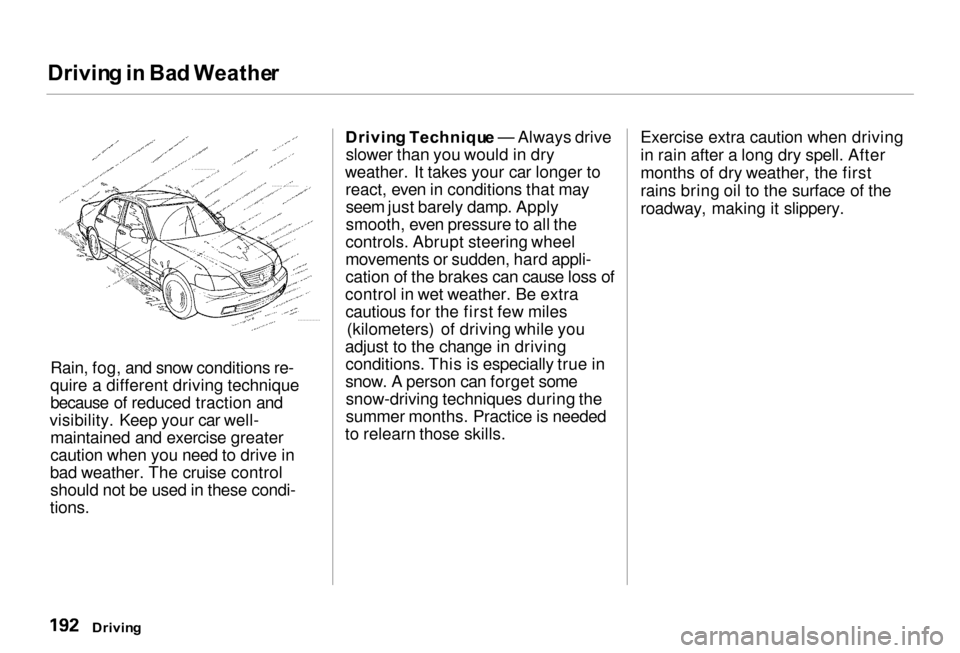
Rain, fog, and snow conditions re-
quire a different driving technique
because of reduced traction and
visibility. Keep your car well- maintained and exercise greater
caution when you need to drive in
bad weather. The cruise control should not be used in these condi-
tions. Drivin
g Techniqu e — Always drive
slower than you would in dry
weather. It takes your car longer to react, even in conditions that mayseem just barely damp. Apply
smooth, even pressure to all the
controls. Abrupt steering wheel
movements or sudden, hard appli-
cation of the brakes can cause loss of
control in wet weather. Be extra cautious for the first few miles (kilometers) of driving while you
adjust to the change in driving conditions. This is especially true in
snow. A person can forget somesnow-driving techniques during the
summer months. Practice is needed
to relearn those skills. Exercise extra caution when driving
in rain after a long dry spell. After
months of dry weather, the first
rains bring oil to the surface of the
roadway, making it slippery.
Drivin g
Page 199 of 330

Towin
g a Traile r
Towin g Equipmen t an d
Accessorie s
Towing can require a variety of equipment, depending on the size of
your trailer, how it will be used, and
how much load you are towing.
Discuss your needs with your trailersales or rental agency, and follow the
guidelines in the rest of this section.
Also make sure that all equipment is properly installed and that it meets
federal, state, province, and localregulations.
Hitches
Any hitch used on your vehicle must be properly bolted to the underbody.
Safety Chain
Always use a safety chain. Make sure that it is secured to both the
trailer and hitch, and that it crosses
under the tongue so it can catch the
trailer if it becomes unhitched. Leave enough slack to allow the
trailer to turn corners easily, but do
not let the chain drag on the ground.
Trailer Brakes
Acura recommends that any trailer having a total weight of 1,000 Ibs (450 kg) or more be equipped with
its own electric or surge-type brakes.
If you choose electric brakes, be sure they are electronically actuated.
Do not attempt to tap into your
vehicle's hydraulic system. No matter how successful it may seem,any attempt to attach trailer brakes
to your vehicle's hydraulic system
will lower braking effectiveness and create a potential hazard.
Drivin g
Page 201 of 330
Towin
g a Traile r
Additional Trailer Equipment Many states and Canadian provinces
require special outside mirrors when
towing a trailer. Even if they don't,
you should install special mirrors if
you cannot clearly see behind you, or if the trailer creates a blind spot.
Ask your trailer sales or rental agency if any other items are
recommended or required for your
towing situation.
Pre-To
w Checklis t
When preparing to tow, and before driving away, be sure to check the
following: The vehicle has been properly
serviced, and the tires, brakes,
suspension, and cooling system
are in good operating condition.
All weights and loads are within limits (see pages 194 and 195 ).
The hitch, safety chain, and any other attachments are secure. All items on and in the trailer are
properly secured and cannot shift
while you drive. The lights and brakes on your
vehicle and the trailer are working
properly. Your vehicle tires and spare are
properly inflated (see page 242 ),and the trailer tires and spare are
inflated as recommended by the
trailer maker.
Drivin g
Page 202 of 330

Towin
g a Traile r
Drivin g Safel y Wit h a Traile r
The added weight, length, and height of a trailer will affect your
vehicle's handling and performance, so driving with a trailer requires
some special driving skills and
techniques.
For your safety and the safety of
others, take time to practice driving
maneuvers before heading for the open road, and follow the guidelines
discussed below.
Towing Speeds and Gears
Driving slower than normal in all driving situations, and obey posted
speed limits for vehicles with trailers.
Use the D4 position when towing a
trailer on level roads. D3 is the
proper shift lever position to use
when towing a trailer in hilly terrain. (See "Driving on Hills" in the next
column for additional gear
information.) Making Turns and Braking
Make turns more slowly and wider
than normal. The trailer tracks a smaller arc than your vehicle, and it
can hit or run over something the
vehicle misses. Allow more time and distance for braking. Do not brake or
turn suddenly as this could cause the
trailer to jackknife or turn over.
Driving on Hills
When climbing hills, closely watch
your temperature gauge. If it nears the red (Hot) mark, turn the airconditioning off, reduce speed and, if
necessary, pull to the side of the
road to let the engine cool.
If the automatic transmission shifts
frequently between 3rd and 4th
gears while going up a hill, shift to
D3.
If you must stop when facing uphill,
use the foot brake or parking brake. Do not try to hold the vehicle in
place by pressing on the accelerator, as this can cause the automatic
transmission to overheat.
When driving down hills, reduce
your speed and shift down to 2nd gear. Do not "ride" the brakes, andremember it will take longer to slowdown and stop when towing a trailer.
CONTINUED
Drivin g
Page 203 of 330

Towin
g a Traile r
Handling Crosswinds and Buffeting
Crosswinds and air turbulence
caused by passing trucks can disrupt
your steering and cause trailer
swaying. When being passed by a
large vehicle, keep a constant speed
and steer straight ahead. Do not try
to make quick steering or braking
corrections.
Backing Up
Always drive slowly and have someone guide you when backing up.
Grip the bottom of the steering
wheel; then turn the wheel to the left to get the trailer to move to the left,and turn the wheel right to move the
trailer to the right.
Parking
Follow all normal precautions when
parking, including putting the
transmission in Park and firmly setting the parking brake. Also, place
wheel chocks at each of the trailer's
tires.
Drivin g
Page 204 of 330
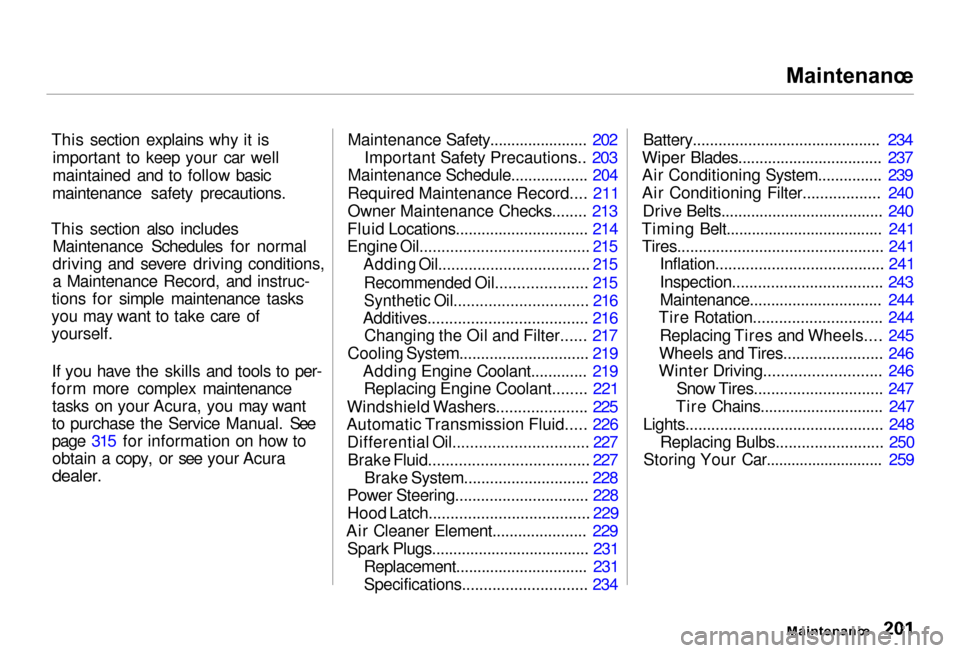
Maintenanc
e
This section explains why it is important to keep your car well
maintained and to follow basic
maintenance safety precautions.
This section also includes Maintenance Schedules for normal
driving and severe driving conditions,
a Maintenance Record, and instruc-
tions for simple maintenance tasks
you may want to take care of
yourself.
If you have the skills and tools to per-
form more complex maintenance tasks on your Acura, you may want
to purchase the Service Manual. See
page 315 for information on how to obtain a copy, or see your Acura
dealer.
Maintenance Safety....................... 202
Important Safety Precautions.. 203
Maintenance Schedule.................. 204
Required Maintenance Record.... 211
Owner Maintenance Checks........ 213
Fluid Locations............................... 214
Engine Oil....................................... 215 Adding Oil................................... 215
Recommended Oil..................... 215
Synthetic Oil............................... 216
Additives..................................... 216 Changing the Oil and Filter...... 217
Cooling System.............................. 219 Adding Engine Coolant............. 219Replacing Engine Coolant........ 221
Windshield Washers..................... 225
Automatic Transmission Fluid..... 226
Differential Oil............................... 227
Brake Fluid..................................... 227
Brake System............................. 228
Power Steering............................... 228
Hood Latch..................................... 229
Air Cleaner Element...................... 229 Spark Plugs..................................... 231 Replacement............................... 231
Specifications............................. 234 Battery............................................ 234
Wiper Blades.................................. 237
Air Conditioning System............... 239
Air Conditioning Filter.................. 240
Drive Belts...................................... 240
Timing Belt..................................... 241 Tires................................................ 241 Inflation....................................... 241
Inspection................................... 243
Maintenance............................... 244
Tire Rotation.............................. 244
Replacing Tires and Wheels.... 245
Wheels and Tires....................... 246
Winter Driving........................... 246
Snow Tires.............................. 247
Tire Chains............................. 247
Lights.............................................. 248 Replacing Bulbs......................... 250
Storing Your Car............................ 259
Maintenance