belt Acura RL 2000 3.5 Service Manual
[x] Cancel search | Manufacturer: ACURA, Model Year: 2000, Model line: RL, Model: Acura RL 2000Pages: 330, PDF Size: 4.53 MB
Page 57 of 330
Indicato
r Light s
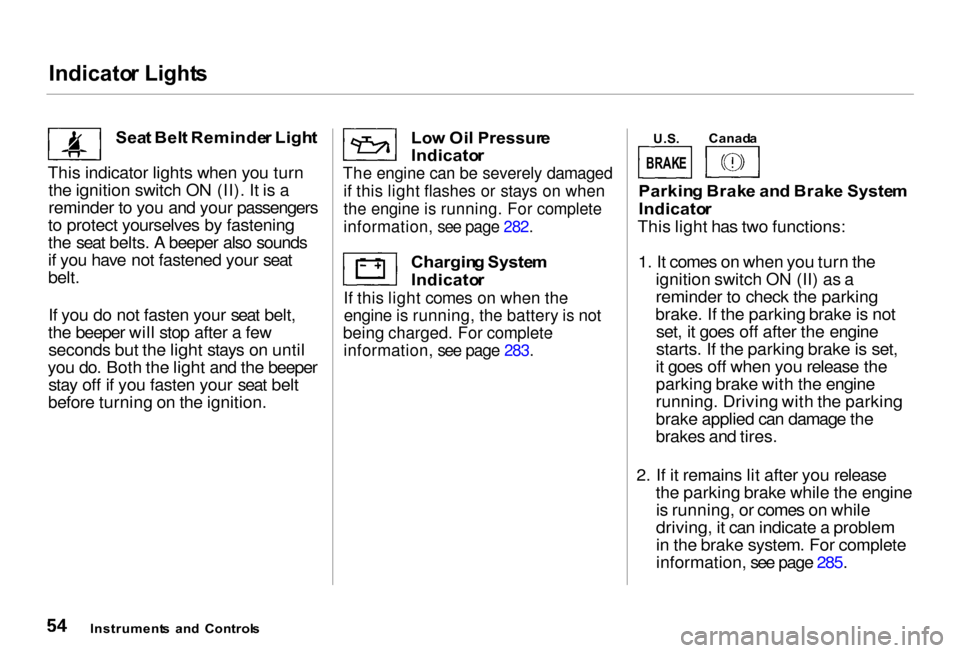
Sea t Bel t Reminde r Ligh t
This indicator lights when you turn the ignition switch ON (II). It is a
reminder to you and your passengers
to protect yourselves by fastening
the seat belts. A beeper also sounds
if you have not fastened your seat
belt.
If you do not fasten your seat belt,
the beeper will stop after a few seconds but the light stays on until
you do. Both the light and the beeper stay off if you fasten your seat belt
before turning on the ignition. Lo
w Oi l Pressur e
Indicato r
The engine can be severely damaged if this light flashes or stays on when
the engine is running. For complete
information, see page 282.
Charging Syste m
Indicato r
If this light comes on when the
engine is running, the battery is not
being charged. For complete
information, see page 283.
Parkin
g Brak e an d Brak e Syste m
Indicato r
This light has two functions:
1. It comes on when you turn the ignition switch ON (II) as a
reminder to check the parking
brake. If the parking brake is not set, it goes off after the engine
starts. If the parking brake is set,
it goes off when you release the
parking brake with the engine
running. Driving with the parking
brake applied can damage the
brakes and tires.
2. If it remains lit after you release the parking brake while the engineis running, or comes on while
driving, it can indicate a problem
in the brake system. For complete
information, see page 285.
Instrument s an d Control s U.S
.
Canad
a
BRAK E
Page 58 of 330
Indicato
r Light s
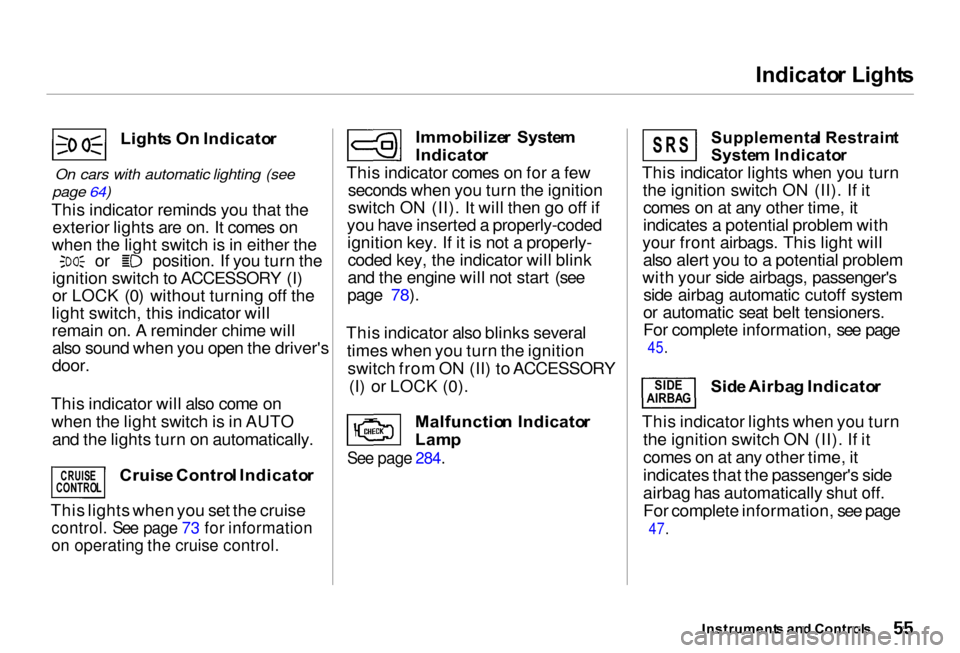
Light s O n Indicato r
On cars with automatic lighting (see
page 64)
This indicator reminds you that the exterior lights are on. It comes on
when the light switch is in either the or position. If you turn the
ignition switch to ACCESSORY (I)
or LOCK (0) without turning off the
light switch, this indicator will
remain on. A reminder chime will also sound when you open the driver's
door.
This indicator will also come on when the light switch is in AUTO and the lights turn on automatically.
Cruise Contro l Indicato r
This lights when you set the cruise
control. See page 73 for information
on operating the cruise control.
Immobilize
r Syste m
Indicato r
This indicator comes on for a few seconds when you turn the ignition
switch ON (II). It will then go off if
you have inserted a properly-coded ignition key. If it is not a properly-coded key, the indicator will blink
and the engine will not start (see
page 78).
This indicator also blinks several times when you turn the ignitionswitch from ON (II) to ACCESSORY (I) or LOCK (0).
Malfunctio n Indicato r
Lam p
See page 284.
Supplementa
l Restrain t
Syste m Indicato r
This indicator lights when you turn the ignition switch ON (II). If itcomes on at any other time, it
indicates a potential problem with
your front airbags. This light will also alert you to a potential problem
with your side airbags, passenger's side airbag automatic cutoff system
or automatic seat belt tensioners.
For complete information, see page
45.
Side Airba g Indicato r
This indicator lights when you turn the ignition switch ON (II). If it
comes on at any other time, it
indicates that the passenger's side
airbag has automatically shut off.
For complete information, see page
47.
Instrument s an d Control s
CRUIS
E
CONTRO L
S
R
S
SID E
AIRBA G
Page 90 of 330
Key
s an d Lock s
2. Lock the glove box with the master key.
3. Make sure the trunk pass-through cover is locked (see page 97).
4. Give the person the valet key. Even if the trunk main switch is
turned off, you can open the trunk
with the master key or the remote transmitter. Glov
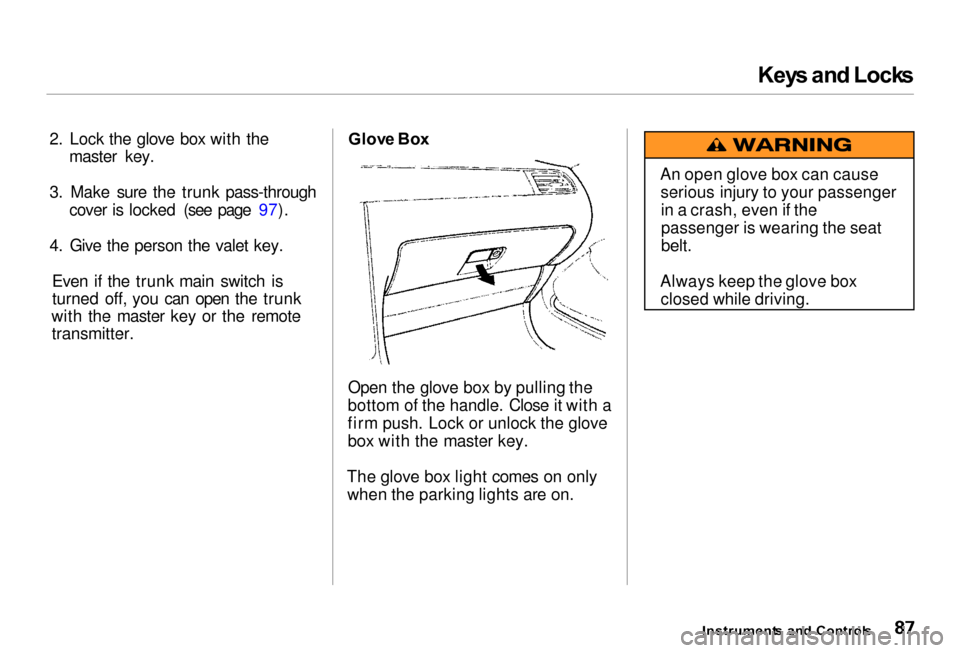
e Bo x
Open the glove box by pulling the
bottom of the handle. Close it with a
firm push. Lock or unlock the glove
box with the master key.
The glove box light comes on only when the parking lights are on.
Instruments an d Control s
An open glove box can cause
serious injury to your passengerin a crash, even if the
passenger is wearing the seat
belt.
Always keep the glove box closed while driving.
Page 181 of 330
Preparin
g to Driv e
You should do the following checks and adjustments every day before
you drive your car.
1. Make sure all windows, mirrors,
and outside lights are clean and
unobstructed. Remove frost, snow, or ice.
2. Check that the hood and trunk are
fully closed.
3. Visually check the tires. If a tire
looks low, use a gauge to check itspressure.
4. Check that any items you may be
carrying with you inside are stored
properly or fastened down
securely.
5. Check the adjustment of the seat
(see page 93 ).
6. Check the adjustment of the
inside and outside mirrors (see
page 98 ).
7. Check the adjustment of the
steering wheel (see page 71).
8. Make sure the doors are securely
closed and locked.
9. Fasten your seat belt. Check that
your passengers have fastened their seat belts (see page 15 ).
10.Turn the ignition switch ON (II).
Check the indicator lights in the
instrument panel.
11.Start the engine (see page 179 ).
12.Check the gauges and indicator
lights in the instrument panel (see
page 53).
Drivin g
Page 204 of 330
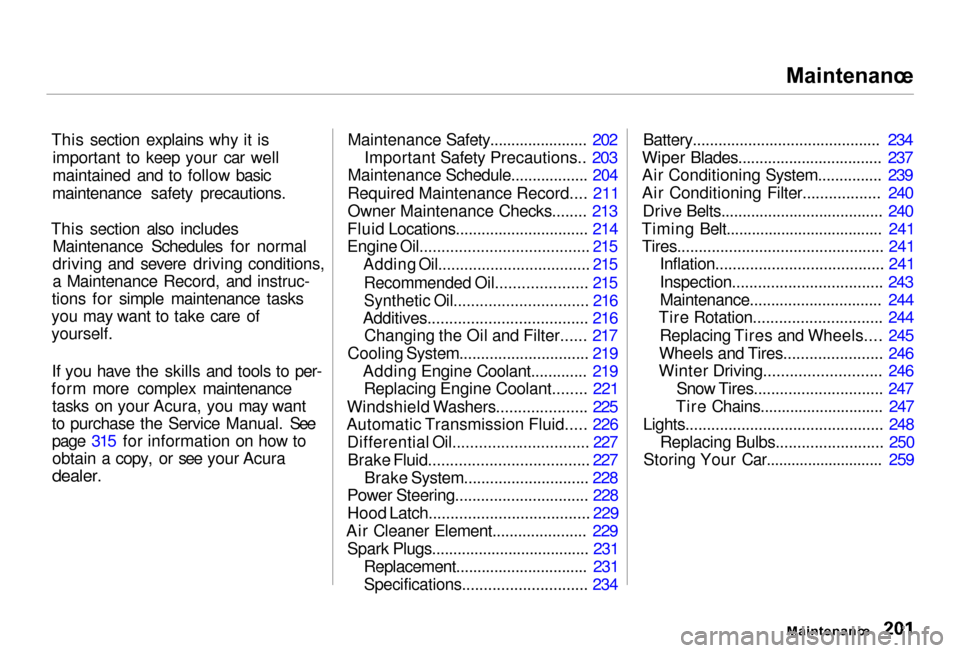
Maintenanc
e
This section explains why it is important to keep your car well
maintained and to follow basic
maintenance safety precautions.
This section also includes Maintenance Schedules for normal
driving and severe driving conditions,
a Maintenance Record, and instruc-
tions for simple maintenance tasks
you may want to take care of
yourself.
If you have the skills and tools to per-
form more complex maintenance tasks on your Acura, you may want
to purchase the Service Manual. See
page 315 for information on how to obtain a copy, or see your Acura
dealer.
Maintenance Safety....................... 202
Important Safety Precautions.. 203
Maintenance Schedule.................. 204
Required Maintenance Record.... 211
Owner Maintenance Checks........ 213
Fluid Locations............................... 214
Engine Oil....................................... 215 Adding Oil................................... 215
Recommended Oil..................... 215
Synthetic Oil............................... 216
Additives..................................... 216 Changing the Oil and Filter...... 217
Cooling System.............................. 219 Adding Engine Coolant............. 219Replacing Engine Coolant........ 221
Windshield Washers..................... 225
Automatic Transmission Fluid..... 226
Differential Oil............................... 227
Brake Fluid..................................... 227
Brake System............................. 228
Power Steering............................... 228
Hood Latch..................................... 229
Air Cleaner Element...................... 229 Spark Plugs..................................... 231 Replacement............................... 231
Specifications............................. 234 Battery............................................ 234
Wiper Blades.................................. 237
Air Conditioning System............... 239
Air Conditioning Filter.................. 240
Drive Belts...................................... 240
Timing Belt..................................... 241 Tires................................................ 241 Inflation....................................... 241
Inspection................................... 243
Maintenance............................... 244
Tire Rotation.............................. 244
Replacing Tires and Wheels.... 245
Wheels and Tires....................... 246
Winter Driving........................... 246
Snow Tires.............................. 247
Tire Chains............................. 247
Lights.............................................. 248 Replacing Bulbs......................... 250
Storing Your Car............................ 259
Maintenance
Page 213 of 330
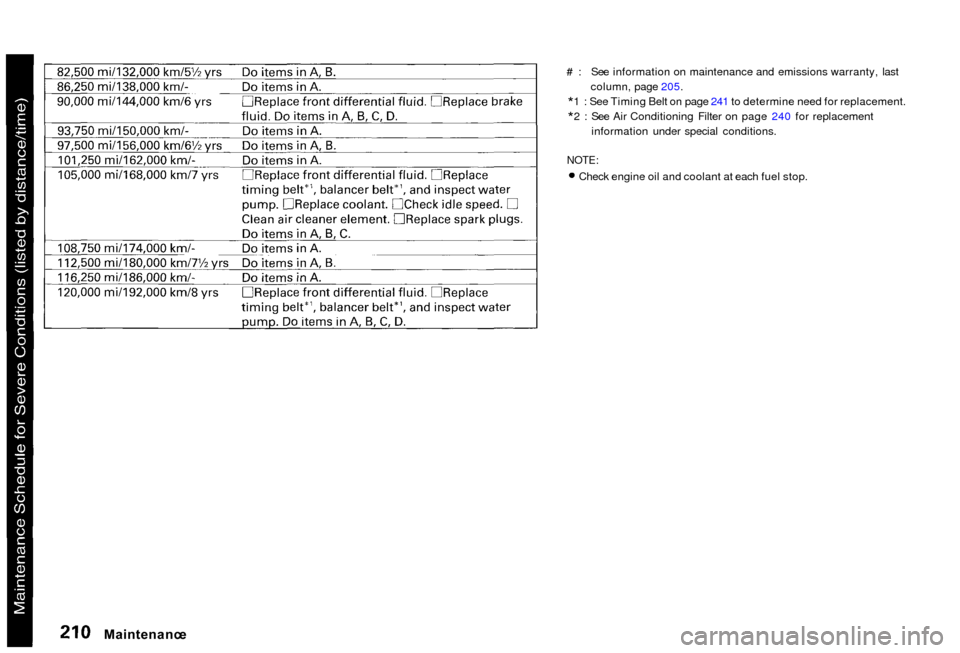
# : See information on maintenance and emissions warranty, last
column, page 205.
* 1 : See Timing Belt on page 241 to determine need for replacement.
* 2 : See Air Conditioning Filter on page 240 for replacement
information under special conditions.
NOTE:
Check engine oil and coolant at each fuel stop.
Maintenanc e
Page 243 of 330
Ai
r Conditionin g Filter , Driv e Belt s
Ai r Conditionin g Filte r
The air conditioning filter removes pollen and dust that is brought in
from the outside through the climate control system.
This filter should be replaced every 30,000 miles (48,000 km) under nor-
mal conditions. It should be replaced every 15,000 miles (24,000 km) if you
drive primarily in urban areas that
have high concentrations of soot in
the air from industry and diesel-pow- ered vehicles. Replace it more often
if air flow from the climate control system becomes less than usual.
Have the air conditioning filter re-
placed by your Acura dealer. Driv
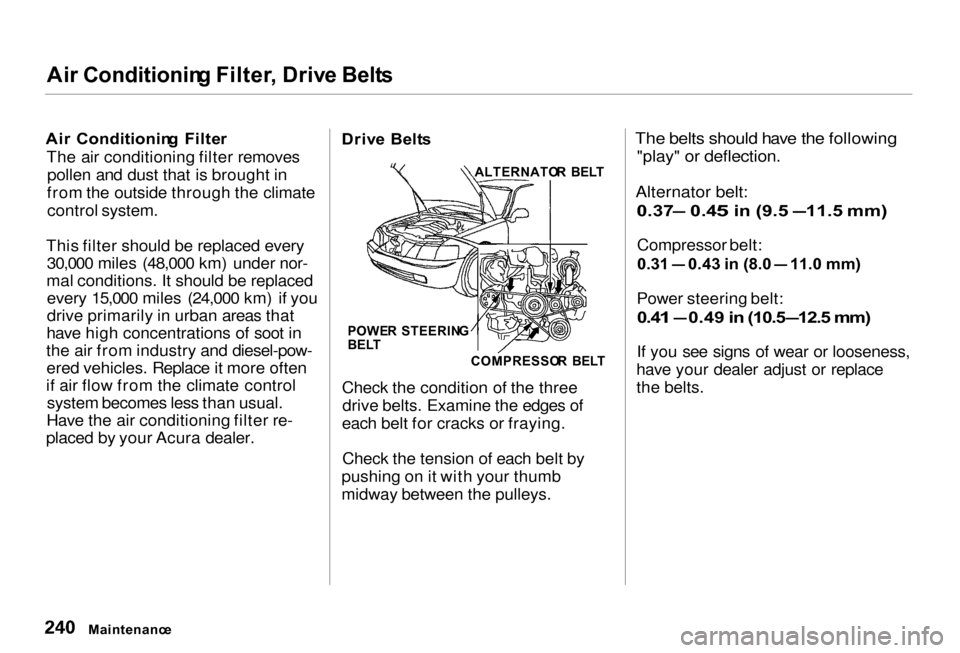
e Belt s
Check the condition of the three drive belts. Examine the edges of
each belt for cracks or fraying.
Check the tension of each belt by
pushing on it with your thumb
midway between the pulleys.
The belts should have the following
"play" or deflection.
Alternator belt:
0.37— 0.45 in (9.5 —11.5 mm)
Compressor belt:
0.31 — 0.43 in (8.0 — 11.0 mm)
Power steering belt:
0.41 — 0.49 in (10.5 —12.5 mm)
If you see signs of wear or looseness,
have your dealer adjust or replace
the belts.
Maintenanc e
ALTERNATO
R BEL T
COMPRESSO R BEL T
POWE
R STEERIN G
BEL T
Page 244 of 330
Timin
g Belt , Tire s
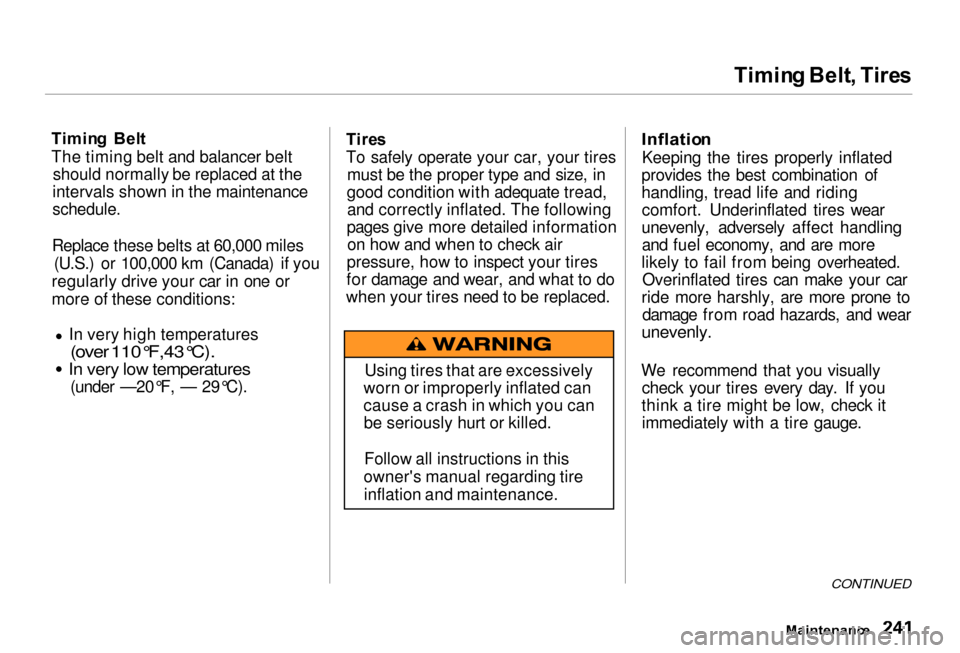
Timin g Bel t
The timing belt and balancer belt should normally be replaced at the
intervals shown in the maintenance
schedule.
Replace these belts at 60,000 miles (U.S.) or 100,000 km (Canada) if you
regularly drive your car in one or
more of these conditions:
In very high temperatures
(over 110°F,43°C).
In very low temperatures
(under —20°F, — 29°C). Tire
s
To safely operate your car, your tires must be the proper type and size, in
good condition with adequate tread, and correctly inflated. The following
pages give more detailed information on how and when to check air
pressure, how to inspect your tires
for damage and wear, and what to do
when your tires need to be replaced.
Inflatio
n
Keeping the tires properly inflated
provides the best combination of
handling, tread life and riding comfort. Underinflated tires wear
unevenly, adversely affect handling and fuel economy, and are more
likely to fail from being overheated. Overinflated tires can make your car
ride more harshly, are more prone to damage from road hazards, and wear
unevenly.
We recommend that you visually check your tires every day. If you
think a tire might be low, check it immediately with a tire gauge.
CONTINUED
Maintenanc e
Using tires that are excessively
worn or improperly inflated can
cause a crash in which you can be seriously hurt or killed.
Follow all instructions in this
owner's manual regarding tire inflation and maintenance.
Page 264 of 330

Appearanc
e Car e
Regular cleaning and polishing of
your Acura helps to keep it "new" looking. This section gives you hintson how to clean your car and
preserve its appearance: the paint,
brightwork, wheels and interior. Also
included are several things you can do to help prevent corrosion. Exterior Care.................................. 262
Washing...................................... 262
Waxing........................................ 263
Aluminum Wheels..................... 263Paint Touch-up........................... 263
Interior Care................................... 264
Carpeting.................................... 264
Fabric.......................................... 264
Vinyl............................................ 264
Leather........................................ 264
Seat Belts.................................... 264
Wood Trim................................. 265
Windows..................................... 265
Air Fresheners........................... 265
Corrosion Protection..................... 266
Body Repairs.................................. 267
Appearance Car e
Page 267 of 330
Interio
r Car e
Carpetin g
Vacuum the carpeting frequently to remove dirt. Ground-in dirt will make
the carpet wear out faster.
Periodically shampoo the carpet to
keep it looking new. Use one of the
foam-type carpet cleaners on the
market. Follow the instructions that come with the cleaner, applying it
with a sponge or soft brush. Keep
the carpeting as dry as possible by
not adding water to the foam.
Fabri c
Vacuum dirt and dust out of the material frequently. For general
cleaning, use a solution of mild soap
and lukewarm water, letting it air dry.
To clean off stubborn spots, use a commercially-available fabric cleaner.
Test it on a hidden area of the fabric first, to make sure it does not bleachor stain the fabric. Follow the
instructions that come with the
cleaner.
Viny
l
Remove dirt and dust with a vacuum
cleaner. Wipe the vinyl with a soft
cloth dampened in a solution of mild
soap and water. Use the same
solution with a soft-bristle brush on
more difficult spots. You can also use
commercially-available spray or
foam-type vinyl cleaners.
Leathe r
Vacuum dirt and dust from the leather frequently. Pay particularattention to the pleats and seams.
Clean the leather with a soft clothdampened with clear water, then
buff it with a clean, dry cloth. If
further cleaning is needed, use a soap specifically for leather, such as
saddle soap. Apply this soap with a
damp, soft cloth. Wipe down and
buff as described above. Sea
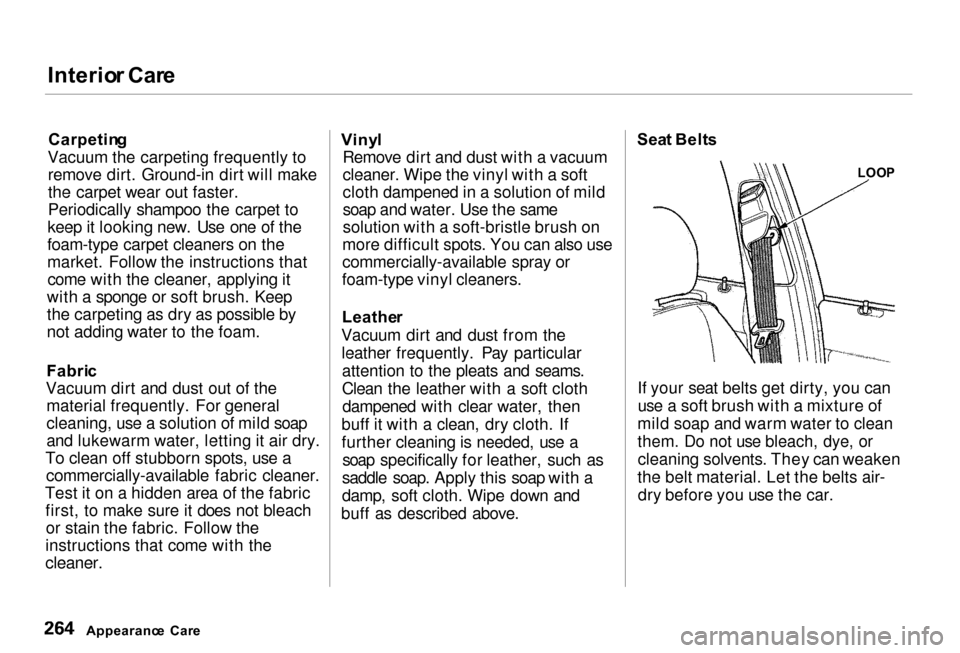
t Belt s
If your seat belts get dirty, you can use a soft brush with a mixture of
mild soap and warm water to clean
them. Do not use bleach, dye, or
cleaning solvents. They can weaken
the belt material. Let the belts air- dry before you use the car.
Appearanc e Car e
LOO
P