coolant level Acura RL 2000 3.5 Owner's Manual
[x] Cancel search | Manufacturer: ACURA, Model Year: 2000, Model line: RL, Model: Acura RL 2000Pages: 330, PDF Size: 4.53 MB
Page 63 of 330
Gauge
s
Outside Temperature Indicator
This indicator displays the outside temperature in Fahrenheit in U.S.
models, and in Centigrade inCanadian models.
The temperature sensor is located in the front bumper. Therefore, the
temperature reading can be affected
by heat reflection from the road sur-
face, engine heat, and the exhaust
from the surrounding traffic. This can cause the temperature reading
not to be correct when your speed is
under 19 mph (30 km/h).
In certain weather conditions,
temperature readings near freezing (32°F, 0°C) could mean that ice is
forming on the road surface. Temperatur
e Gaug e
This shows the temperature of the engine's coolant. During normal
operation, the pointer should rise
from the bottom white mark to about
the middle of the gauge. In severe driving conditions, such as very hot
weather or a long period of uphill driving, the pointer may rise to near
the upper white mark. If it reaches
the red (Hot) mark, pull safely to the side of the road. Turn to page 280 for
instructions and precautions on checking the engine's cooling
system.
Fue
l Gaug e
This shows how much fuel you have. It is most accurate when the car is on
level ground. It may show slightly more or less than the actual amount
when you are driving on curvy or hilly roads.
The gauge stays at the same fuel level reading after you turn off theignition. When you add fuel, the
gauge slowly changes to the new
reading after you turn the ignitionswitch back ON (II).
Instrument s an d Control s
Page 168 of 330
Before
Driving
Before you begin driving your Acura,
you should know what gasoline to use, and how to check the levels of
important fluids. You also need to
know how to properly store luggage or packages. The information in this
section will help you. If you plan to
add any accessories to your car,
please read the information in this section first. Break-in Period.............................. 166
Gasoline.......................................... 166
Service Station Procedures .......... 167 Filling the Fuel Tank................. 167Opening the Hood..................... 168
Oil Check................................ 169
Engine Coolant Check.......... 170
Fuel Economy................................ 171 Car Condition............................. 171
Driving Habits............................ 171
Accessories and Modifications.... 172 Carrying Cargo.............................. 174
Before Drivin g
Page 173 of 330
Servic
e Statio n Procedure s
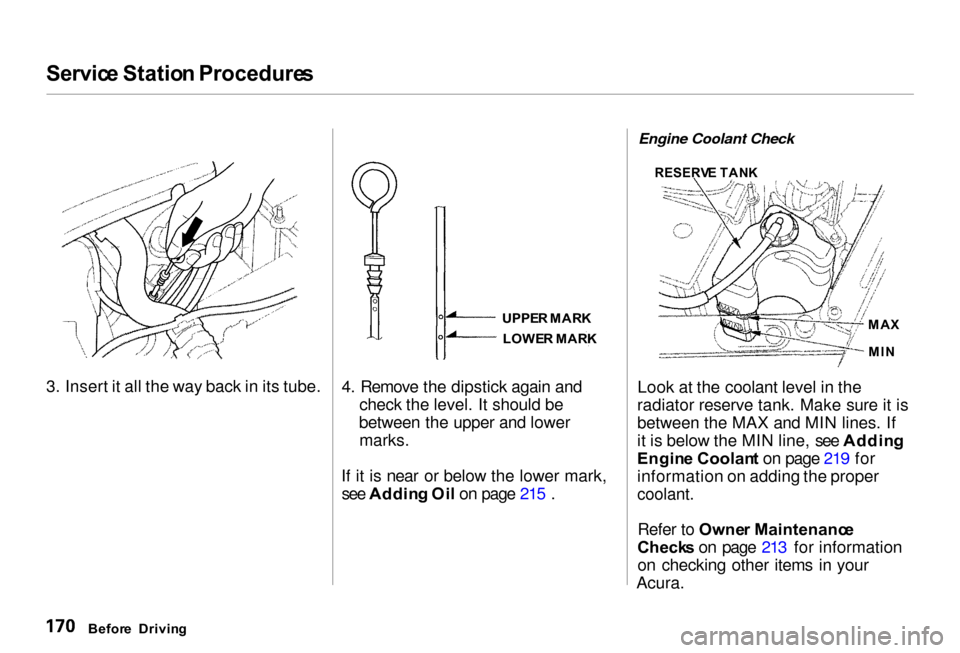
3. Insert it all the way back in its tube.
4. Remove the dipstick again and
check the level. It should be
between the upper and lower marks.
If it is near or below the lower mark,
see Addin g Oi l on page 215 . Engine Coolant Check
Look at the coolant level in the
radiator reserve tank. Make sure it is
between the MAX and MIN lines. If
it is below the MIN line, see Addin g
Engin e Coolan t on page 219 for
information on adding the proper
coolant.
Refer to Owne r Maintenanc e
Check s on page 213 for information
on checking other items in your
Acura.
Befor e Drivin g
RESERV
E TAN K
UPPE R MAR K
LOWE R MAR K
MA
X
MI N
Page 216 of 330
Owne
r Maintenanc e Check s
You should check the following items at the specified intervals. If
you are unsure of how to perform any check, turn to the page given. Engine oil level — Check every
time you fill the fuel tank. See
page 169.
Engine coolant level — Check the
radiator reserve tank every time
you fill the fuel tank. See page 170.
Windshield washer fluid — Check the level in the reservoir monthly.If weather conditions cause you to
use the washers frequently, check
the reservoir each time you stop
for fuel. See page 225 . Automatic transmission — Check
the fluid level monthly. See page
226.
Brakes — Check the fluid level
monthly. See page 22 8 . Tires —
Check the tire pressure
monthly. Examine the tread for
wear and foreign objects. See page
241.
Lights — Check the operation of
the headlights, parking lights,
taillights, high-mount brake light,
turn signals, brake lights, and license plate lights monthly. See
page 248.
Maintenance
Page 222 of 330
Coolin
g Syste m
Addin g Engin e Coolan t
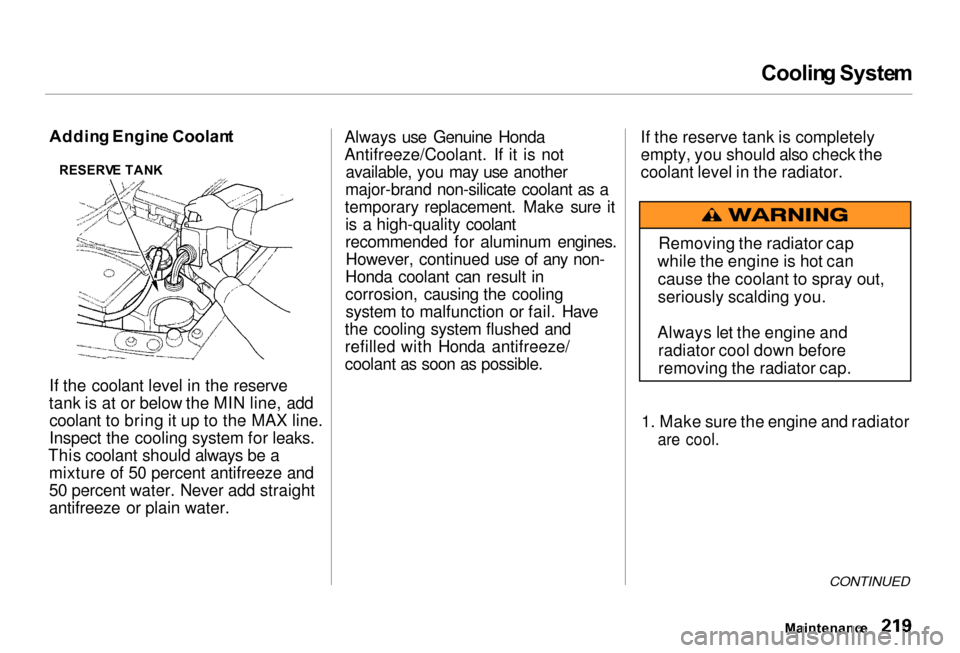
If the coolant level in the reserve
tank is at or below the MIN line, add coolant to bring it up to the MAX line.
Inspect the cooling system for leaks.
This coolant should always be a mixture of 50 percent antifreeze and
50 percent water. Never add straight
antifreeze or plain water. Always use Genuine Honda
Antifreeze/Coolant. If it is not
available, you may use another
major-brand non-silicate coolant as a
temporary replacement. Make sure it is a high-quality coolant
recommended for aluminum engines.However, continued use of any non-
Honda coolant can result in
corrosion, causing the cooling system to malfunction or fail. Have
the cooling system flushed and
refilled with Honda antifreeze/
coolant as soon as possible. If the reserve tank is completely
empty, you should also check the
coolant level in the radiator.
1. Make sure the engine and radiator
are cool.
CONTINUED
Maintenanc e
RESERV
E TAN K
Removing the radiator cap
while the engine is hot can cause the coolant to spray out,
seriously scalding you.
Always let the engine and radiator cool down before
removing the radiator cap.
Page 223 of 330
Coolin
g Syste m
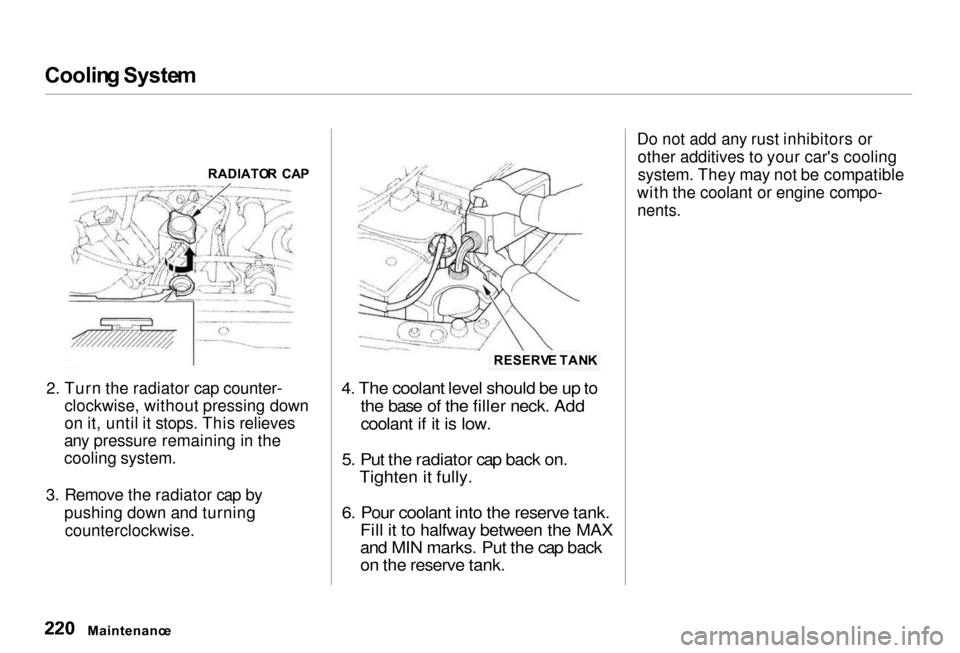
2. Turn the radiator cap counter-
clockwise, without pressing down
on it, until it stops. This relieves
any pressure remaining in the
cooling system.
3. Remove the radiator cap by
pushing down and turning
counterclockwise.
4. The coolant level should be up to
the base of the filler neck. Add
coolant if it is low.
5. Put the radiator cap back on.
Tighten it fully.
6. Pour coolant into the reserve tank.
Fill it to halfway between the MAX
and MIN marks. Put the cap back
on the reserve tank.
Do not add any rust inhibitors or
other additives to your car's cooling
system. They may not be compatible
with the coolant or engine compo-
nents.
Maintenanc e
RADIATO
R CA P
RESERVE TAN K
Page 226 of 330
Coolin
g Syste m
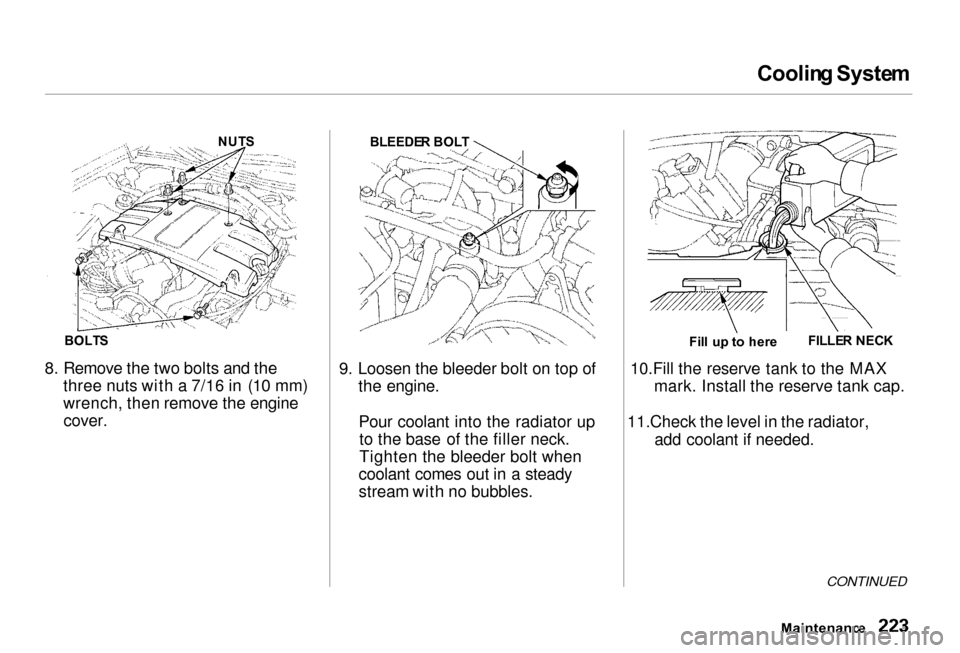
8. Remove the two bolts and the three nuts with a 7/16 in (10 mm)
wrench, then remove the enginecover. 9. Loosen the bleeder bolt on top of
the engine.
Pour coolant into the radiator up to the base of the filler neck.
Tighten the bleeder bolt when
coolant comes out in a steady
stream with no bubbles. 10.Fill the reserve tank to the MAX
mark. Install the reserve tank cap.
11.Check the level in the radiator, add coolant if needed.
CONTINUED
Maintenanc e
NUT
S
BOLT S
BLEEDE
R BOL T
Fill u p t o her e
FILLE
R NEC K
Page 227 of 330
Cooling
Syste m
12.Install the engine cover. First tighten the two bolts on the frontof the engine cover, then tighten
the three nuts on the engine cover.
Tightening torque:
7 lbf .
ft (10 N .
m,1.0 kgf.m)
13.Install the radiator cap, and
tighten it to the first stop.
14.Start the engine and let it run until the radiator cooling fan comes onat least twice. Then stop the
engine.
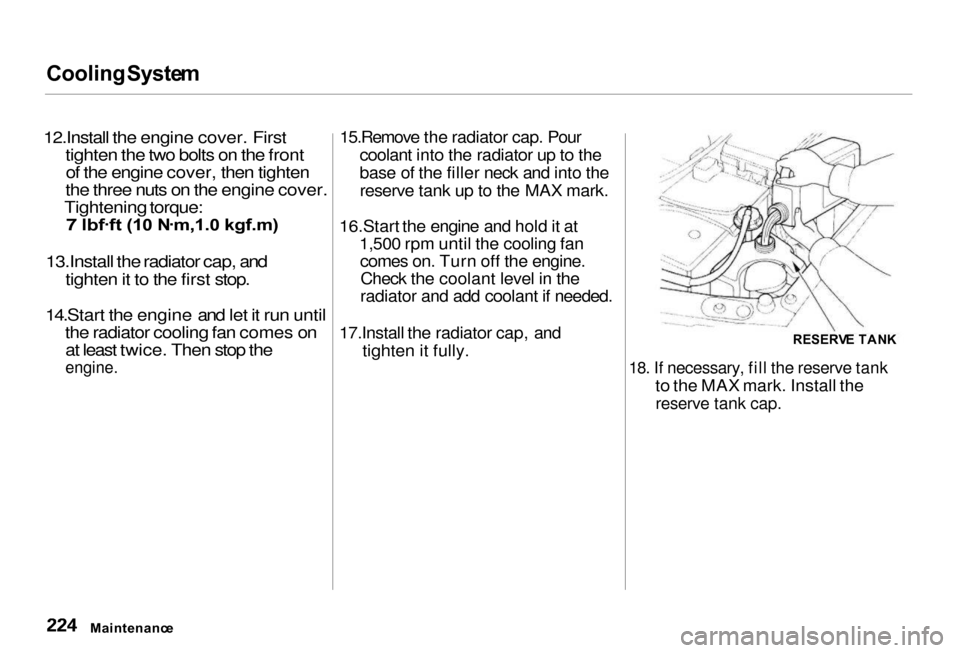
15.Remove the radiator cap. Pour
coolant into the radiator up to the
base of the filler neck and into the
reserve tank up to the MAX mark.
16.Start the engine and hold it at 1,500 rpm until the cooling fancomes on. Turn off the engine.Check the coolant level in the
radiator and add coolant if needed.
17.Install the radiator cap, and tighten it fully.
18. If necessary, fill the reserve tank
to the MAX mark. Install the
reserve tank cap.
Maintenanc e
RESERV
E TAN K
Page 284 of 330
I
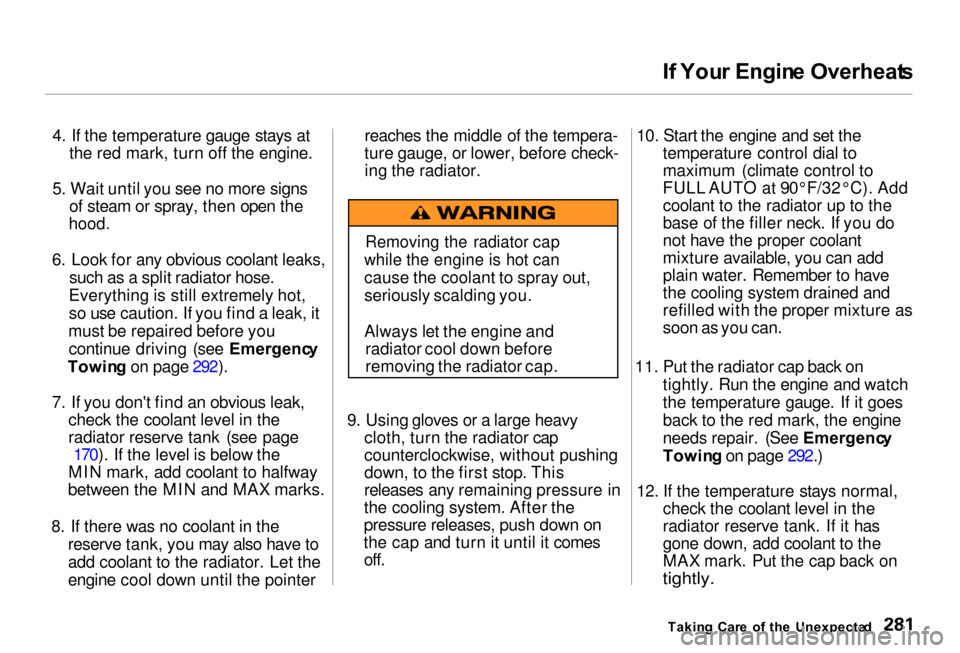
f You r Engin e Overheat s
4. If the temperature gauge stays at the red mark, turn off the engine.
5. Wait until you see no more signs of steam or spray, then open the
hood.
6. Look for any obvious coolant leaks, such as a split radiator hose.
Everything is still extremely hot,
so use caution. If you find a leak, it
must be repaired before you continue driving (see Emergenc y
Towin g on page 292).
7. If you don't find an obvious leak, check the coolant level in the
radiator reserve tank (see page170). If the level is below the
MIN mark, add coolant to halfway
between the MIN and MAX marks.
8. If there was no coolant in the reserve tank, you may also have to
add coolant to the radiator. Let the
engine cool down until the pointer reaches the middle of the tempera-
ture gauge, or lower, before check- ing the radiator.
9. Using gloves or a large heavy cloth, turn the radiator cap
counterclockwise, without pushing
down, to the first stop. This
releases any remaining pressure in
the cooling system. After the
pressure releases, push down on
the cap and turn it until it comes off. 10. Start the engine and set the
temperature control dial to
maximum (climate control to
FULL AUTO at 90° F/32° C). Add
coolant to the radiator up to the
base of the filler neck. If you do
not have the proper coolant
mixture available, you can add
plai
n water. Remember to have
the cooling system drained and
refilled with the proper mixture as
soon as you can.
11. Put the radiator cap back
on
tightly. Run the engine and watch
the temperature gauge. If it goes
back t
o the red mark, the engine
needs repair. (See Emergenc y
Towin g o
n page 29
2.)
12. If the temperature stays normal, check the coolant level in the
radiator reserve tank. If it has
gone down, add coolant to the
MAX mark. Put the cap back
on
tightly.
Takin g Car e
o
f th e Unexpecte d
Removing the radiator cap
while the engine is hot can
cause the coolant to spray out,
seriously scalding you.
Always let the engine and radiator cool down before
removing the radiator cap.
Page 321 of 330
Inde
x
Automatic Speed Control................ 73
Automatic Transmission............... 180
Capacity, Fluid........................... 298
Checking Fluid Level................ 226
Shifting........................................ 180
Shift Lever Position Indicator.. 180
Shift Lever Positions................. 180
Shift Lock Release..................... 183
Battery
Charging System
Indicator............................ 54, 283
Jump Starting............................. 278
Maintenance............................... 234
Specifications............................. 299
Before Driving............................... 165
Belts, Seat..................................... 8, 40
Beverage Holder............................ 111
Body Repair.................................... 267
Brakes
Anti-lock System (ABS)............ 186
Break-in, New Linings .............. 166
Fluid............................................ 227
Light, Burned-out...................... 254 Parking........................................ 108
System Indicator.................. 54, 285
Wear Indicators......................... 185
Brakes, ABS Operation.................................... 186System Indicator.................. 56, 187
Braking System.............................
. 185
Break-in, New Car......................... 166
Brightness Control, Instruments... 66
Brights, Headlights......................... 63
Bulb Replacement Back-up Lights........................... 254
Brake Lights............................... 254
Ceiling Lights............................. 257
Courtesy Lights......................... 257
Fog Lights.................................. 251 Front Side Marker Lights......... 253
Headlights.................................. 250
High-mount Brake Light.......... 255
License Plate Lights.................. 256
Specifications............................. 299
Trunk Light................................ 258
Turn Signal Lights..................... 253
Bulbs, Halogen............................... 250
Cables, Jump Starting With.......... 278
Cancel Button................................... 75
Capacities Chart............................. 298
Carbon Monoxide Hazard.............. 49
Carrying, Cargo............................. 174
Cassette Player
Care............................................. 154
Operation........................... 139, 151
CAUTION, Explanation of............... ii
CD Changer................. 142, 155, 157
Ceiling Lights................................. 117
Certification Label......................... 296
Chains............................................. 247
Change Oil
How to......................................... 217
When to....................................... 206
Changing a Flat Tire..................... 271
Changing Engine Coolant............. 221
Charging System Indicator.... 54, 283
Checking Automatic Transmission
Fluid........................................ 226
Battery Condition...................... 234
Brake Fluid................................. 227