lock Acura RL 2001 3.5 User Guide
[x] Cancel search | Manufacturer: ACURA, Model Year: 2001, Model line: RL, Model: Acura RL 2001Pages: 333, PDF Size: 4.28 MB
Page 33 of 333
Protecting Children
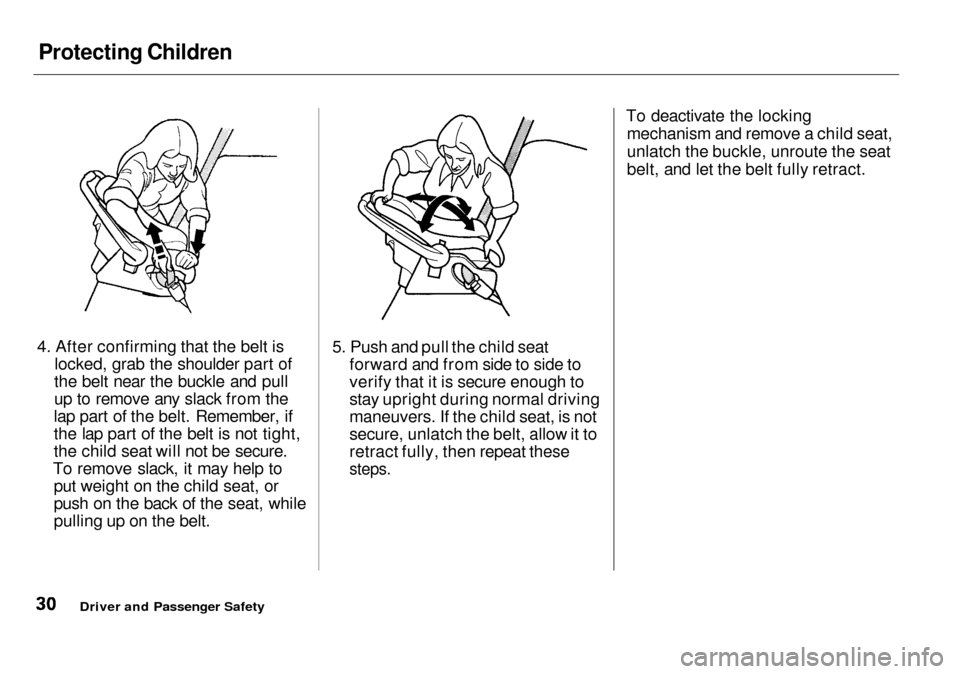
4. After confirming that the belt is locked, grab the shoulder part of
the belt near the buckle and pull
up to remove any slack from the
lap part of the belt. Remember, if
the lap part of the belt is not tight,
the child seat will not be secure.
To remove slack, it may help to put weight on the child seat, or
push on the back of the seat, while
pulling up on the belt. 5. Push and pull the child seat
forward and from side to side to
verify that it is secure enough to
stay upright during normal driving
maneuvers. If the child seat, is not
secure, unlatch the belt, allow it to
retract fully, then repeat these
steps.
To deactivate the locking
mechanism and remove a child seat,
unlatch the buckle, unroute the seat
belt, and let the belt fully retract.
Driver and Passenger Safety
Page 34 of 333
Protecting Children
Rear-Facing Child Seat Installation
Tips
For proper protection, an infant must
ride in a reclined, or semi-reclined
position. To determine the proper
reclining angle, check with the baby's doctor or follow the seat maker's
recommendations.
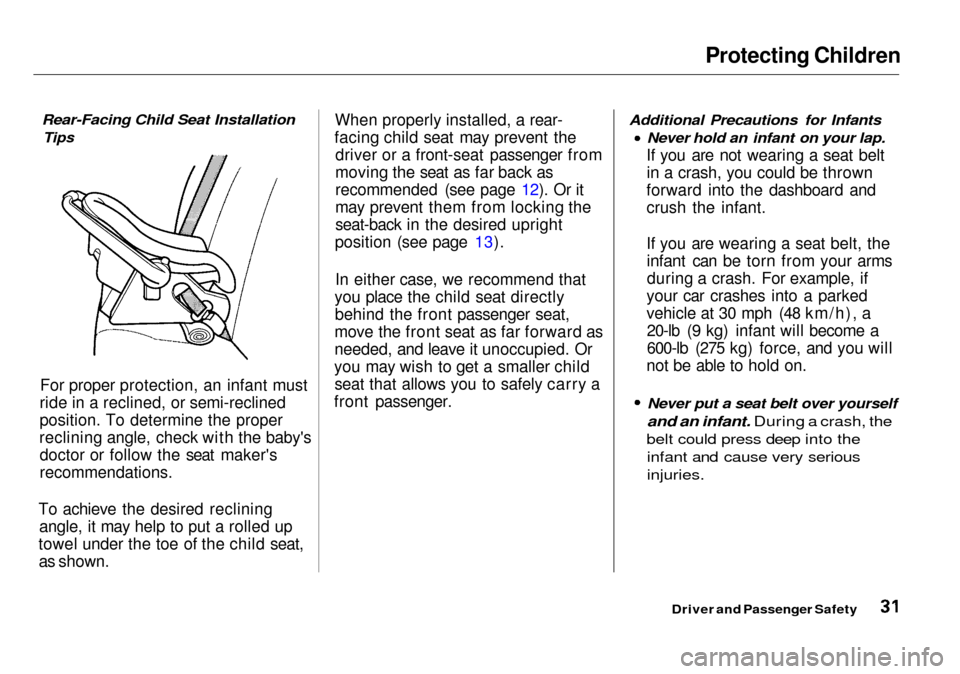
To achieve the desired reclining angle, it may help to put a rolled up
towel under the toe of the child seat, as shown. When properly installed, a rear-
facing child seat may prevent the driver or a front-seat passenger from
moving the seat as far back as
recommended (see page 12). Or it
may prevent them from locking the
seat-back in the desired upright
position (see page 13).
In either case, we recommend that
you place the child seat directly behind the front passenger seat,
move the front seat as far forward as
needed, and leave it unoccupied. Or
you may wish to get a smaller child seat that allows you to safely carry a
front passenger.
Additional Precautions for Infants
Never hold an infant on your lap.
If you are not wearing a seat belt in a crash, you could be thrown
forward into the dashboard and
crush the infant.
If you are wearing a seat belt, the infant can be torn from your arms
during a crash. For example, if
your car crashes into a parked
vehicle at 30 mph (48 km/h), a 20-lb (9 kg) infant will become a
600-lb (275 kg) force, and you will
not be able to hold on.
Never put a seat belt over yourself
and an infant. During a crash, the
belt could press deep into the infant and cause very serious
injuries.
Driver and Passenger Safety
Page 36 of 333
Protecting Children
Child Seat Installation
The lap/shoulder belts in the back and front passenger seating positions
have a locking mechanism that must
be activated to secure a child seat.
The following pages provide instructions on how to secure a
forward-facing child seat with this type of seat belt.
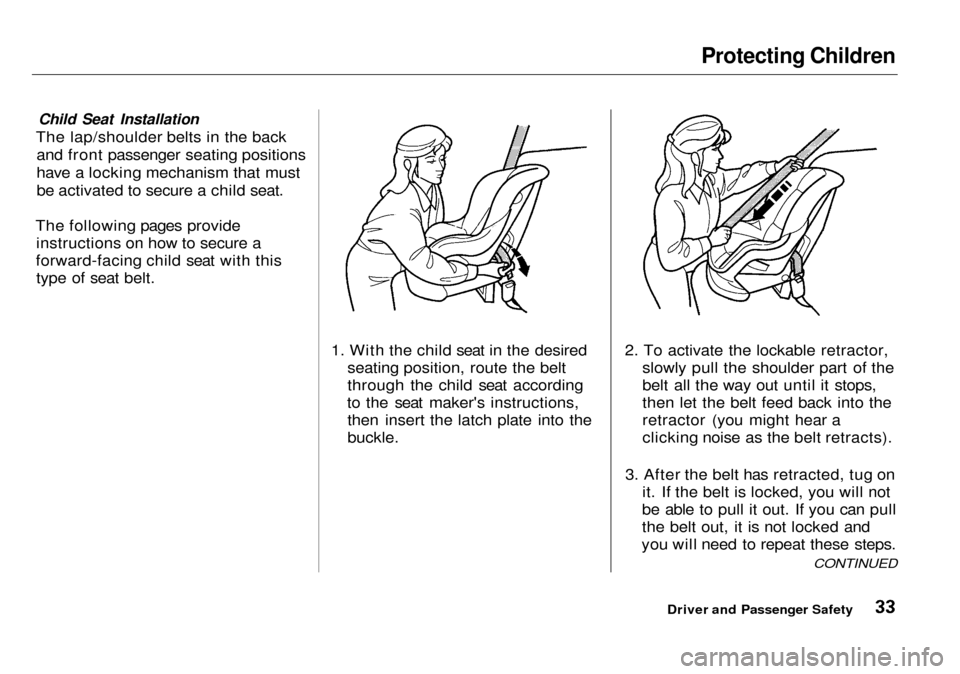
1. With the child seat in the desiredseating position, route the belt
through the child seat according
to the seat maker's instructions, then insert the latch plate into the
buckle. 2. To activate the lockable retractor,
slowly pull the shoulder part of the
belt all the way out until it stops,
then let the belt feed back into the
retractor (you might hear a
clicking noise as the belt retracts).
3. After the belt has retracted, tug on it. If the belt is locked, you will not
be able to pull it out. If you can pull
the belt out, it is not locked and
you will need to repeat these steps.
Driver and Passenger Safety
CONTINUED
Page 37 of 333
Protecting Children
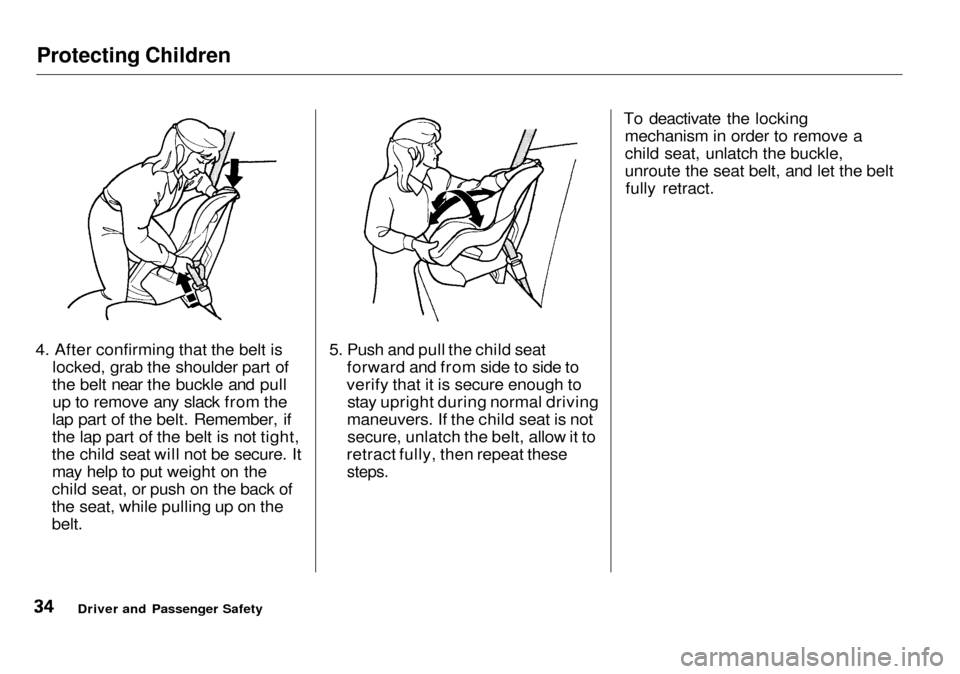
4. After confirming that the belt is locked, grab the shoulder part of
the belt near the buckle and pull up to remove any slack from the
lap part of the belt. Remember, if
the lap part of the belt is not tight,
the child seat will not be secure. It may help to put weight on the
child seat, or push on the back of
the seat, while pulling up on the
belt. 5. Push and pull the child seat
forward and from side to side to
verify that it is secure enough to stay upright during normal driving
maneuvers. If the child seat is not secure, unlatch the belt, allow it to
retract fully, then repeat these
steps.
To deactivate the locking
mechanism in order to remove a
child seat, unlatch the buckle,
unroute the seat belt, and let the beltfully retract.
Driver and Passenger Safety
Page 43 of 333

Additional Information About Your Seat Belts
Seat Belt System Components
Your seat belt system includes lap/ shoulder belts in all five seating
positions. The front seat belts are
also equipped with automatic seat
belt tensioners.
The seat belt system alsoincludes a light on the
instrument panel to remind you and
your passengers to fasten your belts. If the driver's seat belt is not
fastened before the ignition is turned ON (II), the light will come on and a
beeper will also sound. The beeper
will stop after a few seconds, but the
light will stay on until the driver's seat belt is fastened. Lap/Shoulder Belt
This seat belt has a single belt that goes over your shoulder, across yourchest and across your hips.
To fasten the belt, insert the latch plate into the buckle, then tug on the
belt to make sure the buckle is
latched.
To unlock the belt, push the red
PRESS button on the buckle.Guide the belt across your body to
the door pillar. After exiting the car,
be sure the belt is out of the way and
will not get closed in the door.
All seat belts have an emergency locking retractor. In normal driving,
the retractor lets you move freely in
your seat while it keeps some tension on the belt. During a collision
or sudden stop, the retractor
automatically locks the belt to help
restrain your body.
The seat belts in all seating positions except the driver's have an additional
locking mechanism that must be activated to secure a child seat. (See
pages 29 and 33 for instructions on
how to secure child seats with this
type of seat belt.)
Driver and Passenger Safety
Page 44 of 333

Additional Information About Your Seat Belts
If the shoulder part of the belt is
pulled all the way out, the locking mechanism will activate. The belt
will retract, but it will not allow the passenger to move freely.
To deactivate the locking mechanism, unlatch the buckle and
let the seat belt fully retract. To refasten the belt, pull it out only as
far as needed.
See page 15 for instructions on how
to wear the lap/shoulder belt
properly. Automatic Seat Belt Tensioners
For added protection, the front seat
belts are equipped with automatic
seat belt tensioners. When activated,
the tensioners immediately tighten
the belts to help hold the driver and
a front passenger in place.
The tensioners are designed to activate primarily in frontal collisions.
The tensioners are independent of the airbag system, so they can beactivated during a collision that might not cause the airbags to
deploy. In this case, the airbags
would not be needed but the additional seat belt tension can behelpful.
The tensioners will be activated in a collision severe enough to cause the
front airbags to inflate.
When the tensioners are activated, the seat belts will remain tight until
they are unbuckled in the normal
way.
The SRS indicator light willcome on if there is a
problem with your automatic seat
belt tensioners (see page 45).
Driver and Passenger Safety
SRS
Page 54 of 333
Instruments and Controls
This section gives information about the controls and displays thatcontribute to the daily operation of
your Acura. All the essential controls are within easy reach.
Control Locations............................ 52
Indicator Lights................................ 53 Gauges.............................................. 58 Speedometer................................ 58
Tachometer.................................. 58
Odometer...................................... 59
Trip Meter/Outside Temperature Indicator............ 59
Temperature Gauge.................... 60 Fuel Gauge................................... 60
Maintenance Required Indicator.................................... 61
Controls Near the Steering Wheel........ 62
Headlights.................................... 63
Automatic Lighting..................... 64 Daytime Running Lights............. 65
Instrument Panel Brightness..... 66
Turn Signals................................. 66
Fog Lights.................................... 67
Windshield Wipers...................... 68 Windshield Washers................... 70
Hazard Warning........................... 70
Rear Window Defogger.............. 71
Steering Wheel Adjustments..... 71
Steering Wheel Controls ................ 73
Cruise Control.............................. 73
Remote Audio Controls .............. 76
Keys and Locks................................ 77
Keys...............................................77
Immobilizer System..................... 78
Ignition Switch............................. 80
Power Door Locks....................... 81
Remote Transmitter.................... 82
Childproof Door Locks............... 85
Trunk............................................ 86
Emergency Trunk Opener......... 87Glove Box..................................... 88
HomeLink Universal Transmitter......... 89
Customer Assistance.................. 89
Important Safety Precautions.... 89
Training the Transmitter............ 90
Training With a Rolling Code
System.......................................92
Erasing Codes.............................. 93
Seat Adjustments............................. 94 Driver's Seat Adjustments.......... 94
Driver's Lumbar Support............ 96
Front Passenger's SeatAdjustments............................. 96
Head Restraints........................... 96
Armrest............................................. 97
Mirrors.............................................. 99
Adjusting the Power Mirrors..... 99
Driving Position Memory
System......................................... 101
Seat Heaters................................... 103
Ski Sleeve........................................ 104
Power Windows............................. 106
Moonroof........................................ 107
Parking Brake................................ 109
Digital Clock................................... 109Sunglasses Holder......................... 111
Beverage Holder............................ 112Console Compartment.................. 113
Coin Box......................................... 113
Sun Visor......................................... 114
Vanity Mirror................................. 114
Accessory Power Socket.............. 115 Cigarette Lighter........................... 116
Ashtrays.......................................... 117 Ceiling Lights................................. 118
Courtesy Lights............................. 119
Instruments and Controls
Page 55 of 333
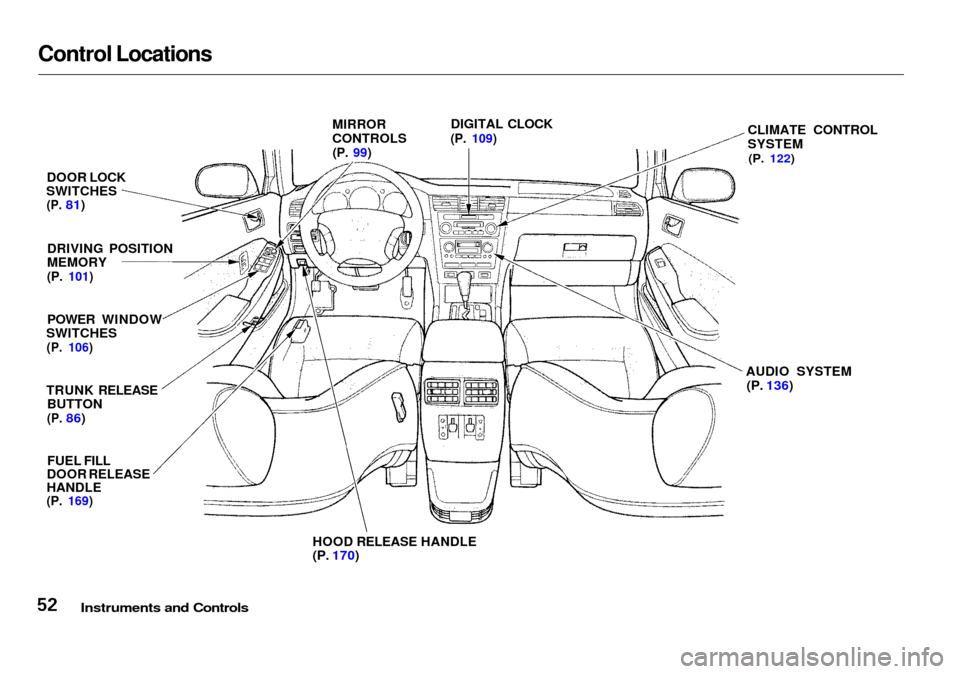
Control Locations
Instruments and Controls
MIRROR
CONTROLS
(P. 99)
DIGITAL CLOCK
(P. 109)
CLIMATE CONTROL
SYSTEM
(P. 122)
AUDIO SYSTEM (P. 136)
DOOR LOCK
SWITCHES
(P.
81)
DRIVING POSITION
MEMORY
(P. 101)
POWER WINDOW
SWITCHES
(P. 106)
TRUNK RELEASE BUTTON
(P.
86)
FUEL FILL
DOOR RELEASE
HANDLE
(P. 169)
HOOD RELEASE HANDLE
(P. 170)
Page 56 of 333
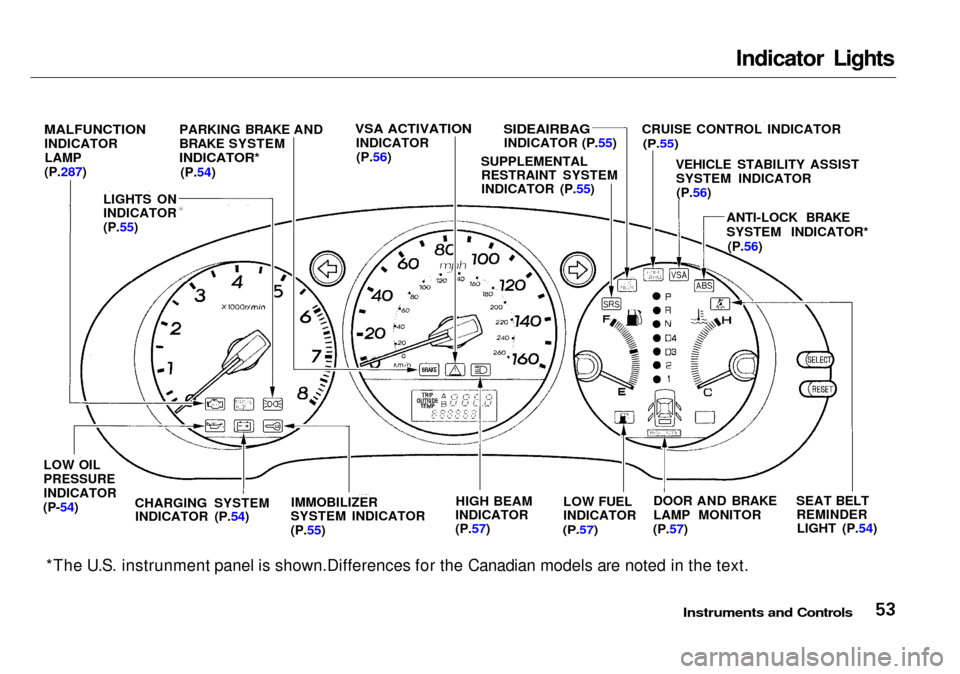
Indicator Lights
*The U.S. instrunment panel is shown.Differences for the Canadian models are noted in the text.
Instruments and Controls
MALFUNCTION
INDICATOR
LAMP
(P.287)
LIGHTS ON
INDICATOR
(P.55) PARKING BRAKE AND
BRAKE SYSTEM
INDICATOR*
(P.54)
VSA ACTIVATION
INDICATOR(P.56)
SIDEAIRBAG
INDICATOR (P.55) CRUISE CONTROL INDICATOR
(P.55)
VEHICLE STABILITY ASSISTSYSTEM INDICATOR(P.56)
ANTI-LOCK BRAKE
SYSTEM INDICATOR*(P.56)
LOW OIL
PRESSURE
INDICATOR
(P-54)
CHARGING SYSTEM
INDICATOR (P.54) IMMOBILIZER
SYSTEM INDICATOR
(P.55) HIGH BEAM
INDICATOR
(P.57) LOW FUEL
INDICATOR
(P.57)
DOOR AND BRAKE
LAMP MONITOR
(P.57) SEAT BELT
REMINDERLIGHT (P.54)
SUPPLEMENTAL
RESTRAINT SYSTEM
INDICATOR (P.55)
Page 58 of 333

Indicator Lights
Lights On Indicator
(U.S. models only)
On cars with automatic lighting (see
page 64)
This indicator reminds you that the exterior lights are on. It comes on
when the light switch is in either the or position. If you turn the
ignition switch to ACCESSORY (I)
or LOCK (0) without turning off the
light switch, this indicator will
remain on. A reminder chime willalso sound when you open the driver's
door.
This indicator will also come on
when the light switch is in AUTO and the lights turn on automatically.
Cruise Control Indicator
This lights when you set the cruise control. See page 73 for information
on operating the cruise control.
Immobilizer System
Indicator
This indicator comes on for a few seconds when you turn the ignition
switch ON (II). It will then go off if
you have inserted a properly-coded ignition key. If it is not a properly-
coded key, the indicator will blink
and the engine will not start (see
page 78).
This indicator also blinks several times when you turn the ignitionswitch from ON (II) to ACCESSORY (I) or LOCK (0).
Malfunction Indicator
Lamp
See page 287.
Supplemental Restraint
System Indicator
This indicator lights when you turn the ignition switch ON (II). If itcomes on at any other time, it
indicates a potential problem with
your front airbags. This light will also alert you to a potential problem
with your side airbags, passenger's side airbag automatic cutoff system
or automatic seat belt tensioners.
For complete information, see page
45.
Side Airbag Indicator
This indicator lights when you turn the ignition switch ON (II). If itcomes on at any other time, it
indicates that the passenger's side airbag has automatically shut off.
For complete information, see page
47.
Instruments and Controls
SRS
SIDE
AIRBAG
CRUISE
CONTROL