radiator cap Acura RL 2001 3.5 Owner's Manual
[x] Cancel search | Manufacturer: ACURA, Model Year: 2001, Model line: RL, Model: Acura RL 2001Pages: 333, PDF Size: 4.28 MB
Page 53 of 333

Safety Labels
These labels are in the locations shown. They warn you of potential
hazards that could cause serious injury. Read these labels carefully.
If a label comes off or becomes hard
to read, contact your Acura dealer
for a replacement.
Driver and Passenger Safety
SUN VISOR
U.S. models
Canadian models
RADIATOR CAP
DASHBOARD
U.S. models only
HOOD
Page 219 of 333

Fluid Locations
AUTOMATIC
TRANSMISSION
FLUID DIPSTICK
(Yellow loop)
POWER STEERING
FLUID
(Red cap)
RADIATOR CAP BRAKE FLUID
(Gray cap)
ENGINE OIL
FILL CAP
ENGINE
COOLANT
RESERVOIR
WASHER FLUID (Blue cap)
ENGINE OIL DIPSTICK
(Orange loop)
Maintenance
Page 224 of 333

Cooling System
Adding Engine Coolant
If the coolant level in the reserve
tank is at or below the MIN line, add
coolant to bring it up to the MAX line.
Inspect the cooling system for leaks.
This coolant should always be a mixture of 50 percent antifreeze and
50 percent water. Never add straight
antifreeze or plain water.
Always use Honda All Season
Antifreeze/Coolant Type 2. This coolant is pre-mixed with 50 percent
antifreeze and 50 percent water. It
does not require any additional
mixing.
If it is not available, you may use
another major-brand non-silicate
coolant as a temporary replacement.
Make sure it is a high-quality coolant
recommended for aluminum engines.
However, continued use of any non-
Honda coolant can result in
corrosion, causing the cooling system to malfunction or fail. Have
the cooling system flushed and
refilled with Honda antifreeze/ coolant as soon as possible.
If the reserve tank is completely
empty, you should also check the
coolant level in the radiator.
1. Make sure the engine and radiator
are cool.
CONTINUED
Maintenance
RESERVE TANK
Removing the radiator cap
while the engine is hot can cause the coolant to spray out,
seriously scalding you.
Always let the engine and radiator cool down before
removing the radiator cap.
Page 225 of 333
Cooling System
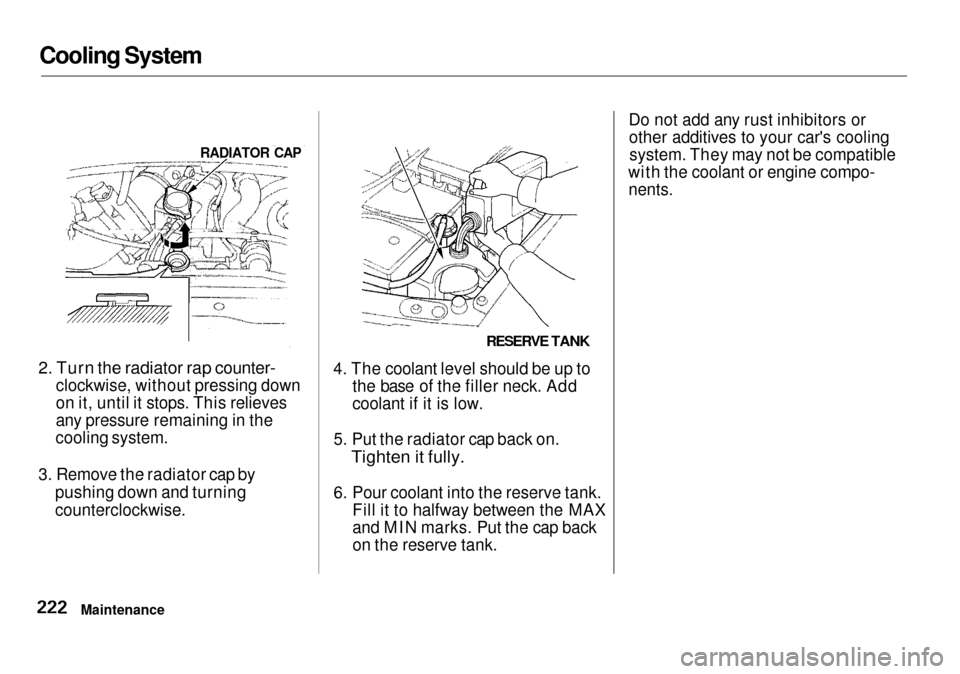
2. Turn the radiator rap counter-
clockwise, without pressing down
on it, until it stops. This relieves
any pressure remaining in the
cooling system.
3. Remove the radiator cap by pushing down and turning
counterclockwise. 4. The coolant level should be up to
the base of the filler neck. Add
coolant if it is low.
5. Put the radiator cap back on.
Tighten it fully.
6. Pour coolant into the reserve tank.
Fill it to halfway between the MAX
and MIN marks. Put the cap back
on the reserve tank.
Do not add any rust inhibitors or
other additives to your car's coolingsystem. They may not be compatible
with the coolant or engine compo- nents.
Maintenance RADIATOR CAP
RESERVE TANK
Page 226 of 333

Cooling System
Replacing Engine Coolant
The cooling system should be completely drained and refilled with
new coolant according to the time
and distance recommendations in
the maintenance schedule. Only use Honda All Season Antifreeze/Coolant Type 2. Use of any non-
Honda coolant or plain water can
result in corrosion and deposits in
the cooling system.
Draining the coolant requires access
to the underside of the car. Unless
you have the tools and knowledge,
you should have this maintenance done by a skilled mechanic.
1. Turn the ignition ON (II). Turn
the heater temperature control
dial to maximum heat (climate
control to 90°F/32°C). Turn off
the ignition. Open the hood. Make
sure the engine and radiator are
cool to the touch.
2. Remove the radiator cap.
3. Loosen the drain plug on the
bottom of the radiator. The
coolant will come out through the
hole in the splash cover.
CONTINUED
Maintenance
DRAIN PLUG
Page 227 of 333

Cooling System
4. On the right side of the engine
block, remove the clip with a plier, and then remove the drain cap.
5. Remove the reserve tank from its
holder by pulling it straight up.Drain the coolant, then put the
tank back in its holder.
6. When the coolant stops draining,
tighten the drain plug at the
bottom of the radiator.
Put the drain cap back in place
tightly, then reinstall the clip on
the drain cap securely.
Maintenance
CLIP
DRAIN CAP RESERVE TANK CAP
RESERVE TANK
HOLDER
Page 228 of 333

Cooling System
7. Remove the two bolts and the
three nuts with a 7/16 in (10 mm)
wrench, then remove the engine
cover.
8. Loosen the bleeder bolt on top of
the engine.
9. Pour Honda All Season
Antifreeze/Coolant Type 2 into the radiator up to the base of the
filler neck. This coolant is a
mixture of 50 percent antifreeze
and 50 percent water. Pre-mixing
is not required.
The cooling system capacity is:
1.61 US gal (6.1 , 1.34 Imp gal)
10.Tighten the bleeder bolt when
coolant comes out in a steady
stream with no bubbles.
CONTINUED
Maintenance
BOLTS
NUTS
BLEEDER BOLT
Page 229 of 333

Cooling System
11.Fill the reserve tank to the MAX
mark. Install the reserve tank cap.
12.Check the level in the radiator,
add coolant if needed.
13.Install the engine cover. First
tighten the two bolts on the front of the engine cover, then tighten
the three nuts on the engine cover.
Tightening torque:
7 lbf .
ft (10 N .
m , 1.0 kgf .
m)
14.Install the radiator cap, and
tighten it to the first stop.
15.Start the engine and let it run until
the radiator cooling fan comes on
at least twice. Then stop the
engine.
16.Remove the radiator cap. Pour
coolant into the. radiator up to the base of the filler neck and into the
reserve tank up to the MAX mark.
17.Start the engine and hold it at
1,500 rpm until the cooling fan comes on. Turn off the engine.
Check the coolant level in the
radiator and add coolant if needed.
18.Install the radiator cap, and
tighten it fully.
19.If necessary, fill the reserve tank
to the MAX mark. Install the
reserve tank cap.
Maintenance
Fill up to here
FILLER NECK
RESERVE TANK
Page 244 of 333

Air Conditioning System
Your car's air conditioning is a sealed system. Any major maintenance,such as recharging, should be done
by a qualified mechanic. You can do a couple of things to make sure the
air conditioning works efficiently.
Periodically check the engine's
radiator and air conditioning
condenser for leaves, insects, anddirt stuck to the front surface. These
block the air flow and reduce cooling efficiency. Use a light spray from a
hose or a soft brush to remove them.
The condenser and radiator fins bend
easily. Only use a low-pressure spray
or soft-bristle brush to clean them.
Run the air conditioning at least once
a week during the cold weather
months. Run it for at least ten
minutes while you are driving at asteady speed with the engine at
normal operating temperature. This
circulates the lubricating oil con-
tained in the refrigerant. If the air conditioning does not get as
cold as before, have your dealer
check the system. Recharge the
system with Refrigerant HFC-134a (R-134a). (See Specifications on page 302.)
Whenever you have the air conditioning
system serviced, make sure the service
facility uses a refrigerant recycling
system. This system captures the
refrigerant for reuse. Releasingrefrigerant into the atmosphere can
damage the environment.
Maintenance
NOTICE
NOTICE
AIR CONDITIONING CONDENSER
Page 287 of 333

If Your Engine Overheats
4. If the temperature gauge stays at the red mark, turn off the engine.
5. Wait until you see no more signs of steam or spray, then open the
hood.
6. Look for any obvious coolant leaks, such as a split radiator hose.
Everything is still extremely hot,so use caution. If you find a leak, it
must be repaired before you
continue driving (see Emergency
Towing on page 296 ).
7. If you don't find an obvious leak, check the coolant level in the
radiator reserve tank (see page172 ). If the level is below the
MIN mark, add coolant to halfway
between the MIN and MAX marks.
8. If there was no coolant in the reserve tank, you may also have toadd coolant to the radiator. Let the
engine cool down until the pointer reaches the middle of the tempera-
ture gauge, or lower, before check- ing the radiator.
9. Using gloves or a large heavy cloth, turn the radiator capcounterclockwise, without pushing
down, to the first stop. This
releases any remaining pressure in
the cooling system. After the
pressure releases, push down on
the cap and turn it until it comes off. 10.Start the engine and set the
temperature control dial tomaximum (climate control to
FULL AUTO at 90°F/32°C). Add
coolant to the radiator up to the
base of the filler neck. If you do not have the proper coolant
mixture available, you can add
plain water. Remember to have
the cooling system drained andrefilled with the proper mixture assoon as you can.
11. Put the radiator cap back on tightly. Run the engine and watch
the temperature gauge. If it goes
back to the red mark, the engine
needs repair. (See Emergency
Towing on page 296 .)
12.If the temperature stays normal, check the coolant level in the
radiator reserve tank. If it has
gone down, add coolant to the MAX mark. Put the cap back on
tightly.
Taking Care of the Unexpected
Removing the radiator cap
while the engine is hot can
cause the coolant to spray out, seriously scalding you.
Always let the engine and
radiator cool down before
removing the radiator cap.