overheating Acura RLX 2014 Owner's Manual
[x] Cancel search | Manufacturer: ACURA, Model Year: 2014, Model line: RLX, Model: Acura RLX 2014Pages: 518, PDF Size: 15.83 MB
Page 1 of 518
ContentsThis owner’s manual should be considered a permanent part of the
vehicle and should remain with the vehicle when it is sold.
This owner’s manual covers all models of your vehicle. You may find
descriptions of equipment and features that are not on your
particular model.
Images throughout this owner’s manual (including the front cover)
represent features and equipment that are available on some, but
not all, models. Your particular model may not have some of these
features.
This owner’s manual is for vehicles sold in the United States and
Canada.
The information and specifications included in this publication were
in effect at the time of approval for printing. Honda Motor Co., Ltd.
reserves the right, however, to discontinue or change specifications
or design at any time without notice and without incurring any
obligation.
2Safe Driving P. 25For Safe Driving P. 26 Seat Belts P. 30 Airbags P. 372Instrument Panel P. 67Indicators P. 68 Gauges and Multi-Information Display P. 942Controls P. 113Setting the Clock P. 114 Locking and Unlocking the Doors P. 115
Opening and Closing the Moonroof P. 132
Adjusting the Seats P. 1522Features P. 187Audio System P. 188 Audio System Basic Operation P. 193
Customized Features P. 264 HomeLink® Universal Transceiver P. 2852Driving P. 335Before Driving P. 336 Towing a Trailer P. 341
Multi-View Rear Camera P. 402 Refueling P. 4032Maintenance P. 407Before Performing Maintenance P. 408 Maintenance Minder
TM P. 411
Checking and Maintaining Wiper Blades P. 434
Climate Control System Maintenance P. 448
2Handling the Unexpected P. 453Tools P. 454 If a Tire Goes Flat P. 455
Overheating P. 479 Indicator, Coming On/Blinking P. 481
When You Cannot Open the Trunk P. 4922Information P. 495Specifications P. 496 Identification Numbers P. 498
Emissions Testing P. 501 Warranty Coverages P. 503
Page 19 of 518
18Quick Reference Guide
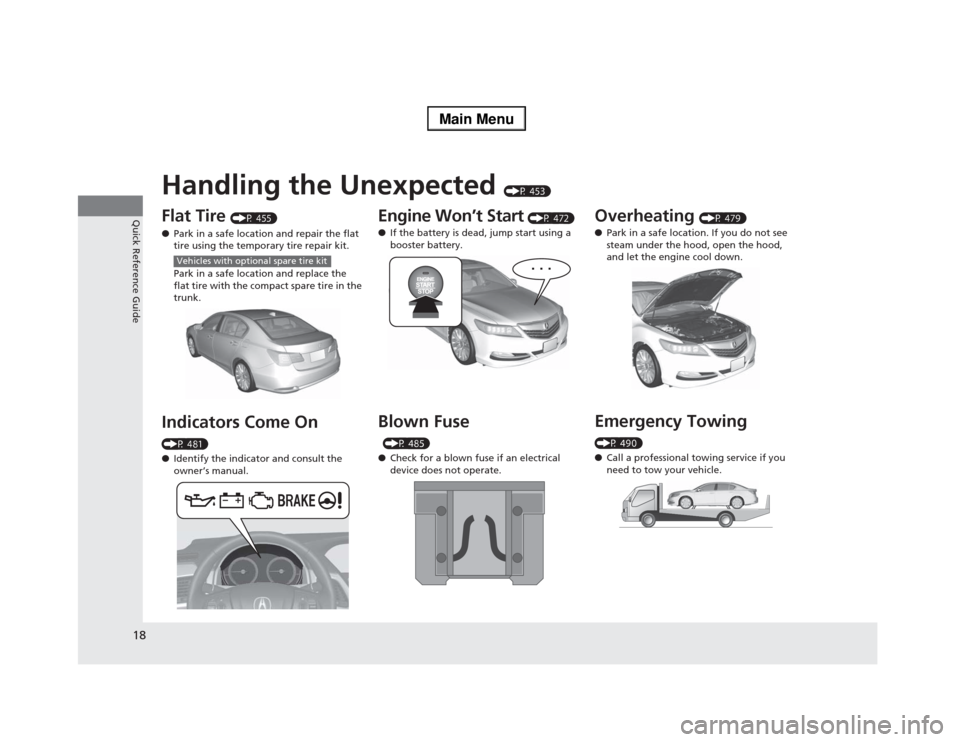
Handling the Unexpected
(P 453)
Flat Tire
(P 455)
●Park in a safe location and repair the flat
tire using the temporary tire repair kit.
Park in a safe location and replace the
flat tire with the compact spare tire in the
trunk.
Indicators Come On (P 481)
●Identify the indicator and consult the
owner’s manual.
Vehicles with optional spare tire kit
Engine Won’t Start
(P 472)
●If the battery is dead, jump start using a
booster battery.
Blown Fuse
(P 485)
●Check for a blown fuse if an electrical
device does not operate.
Overheating
(P 479)
●Park in a safe location. If you do not see
steam under the hood, open the hood,
and let the engine cool down.
Emergency Towing (P 490)
●Call a professional towing service if you
need to tow your vehicle.
Page 85 of 518

84
uuIndicatorsuMulti-Information Display Warning and Information Messages
Instrument Panel
Multi-Information Display Warning and Information MessagesThe following messages appear only on the multi-information display. Roll the right selector wheel to see the message again with the
system message indicator on.
*1:On the left: Models with navigation system
On the right: Models without navigation system
Message
*1
Condition
Explanation
●Appears when the washer fluid is low.
●Refill washer fluid.
2Refilling Window Washer Fluid P. 427
●Appears when the scheduled maintenance is due soon.●Consequently, Maintenance Due Now/SERVICE
DUE NOW and Maintenance Past Due/SERVICE
PAST DUE follow.
2Maintenance Minder Messages on the Multi-
Information Display P. 413
●Appears when the engine coolant temperature gets
abnormally high.
2Overheating P. 479
●Appears when the transmission fluid temperature is
too high.
●Stop in a safe place in
(P
. Let the engine idle until the
message disappears.
●Appears when there is a problem with the sensor on
the battery.
●Have your vehicle checked by a dealer.
2Checking the Battery P. 446
●Appears along with the battery charging system
indicator when the battery is not charging.
●Turn off the climate control system and rear defogger
to reduce electricity consumption.
2If the Charging System Indicator Comes On P. 481
Page 88 of 518
87
uuIndicatorsuMulti-Information Display Warning and Information Messages
Continued
Instrument Panel
*1:On the left: Models with navigation system
On the right: Models without navigation system
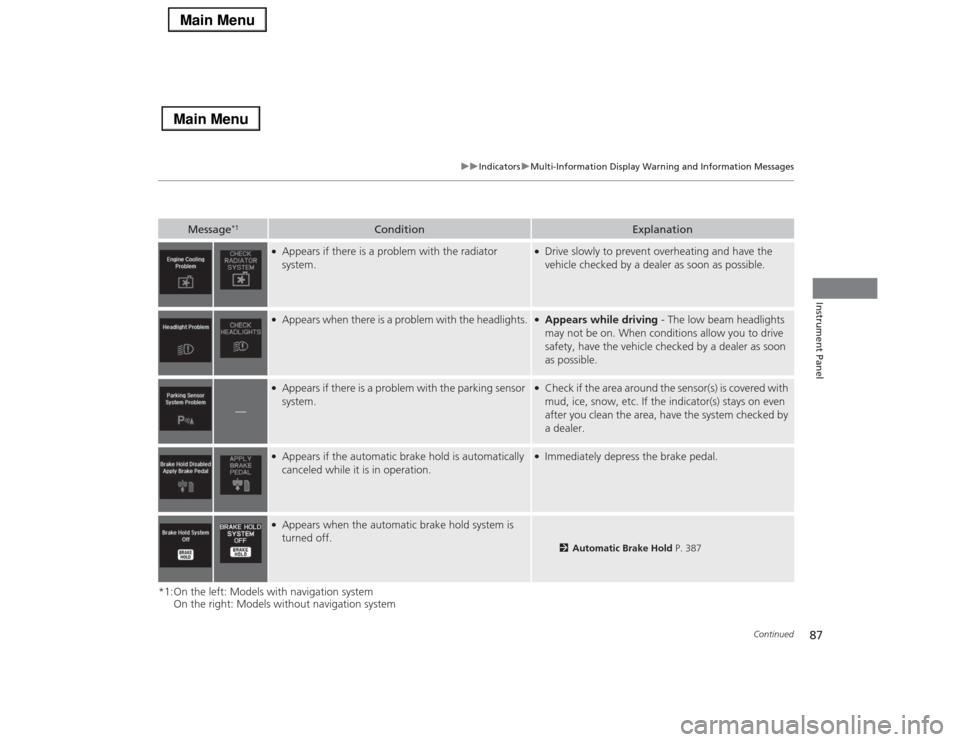
Message
*1
Condition
Explanation
●Appears if there is a problem with the radiator
system.
●Drive slowly to prevent overheating and have the
vehicle checked by a dealer as soon as possible.
●Appears when there is a problem with the headlights.
●Appears while driving - The low beam headlights
may not be on. When conditions allow you to drive
safety, have the vehicle checked by a dealer as soon
as possible.
—
●Appears if there is a problem with the parking sensor
system.
●Check if the area around the sensor(s) is covered with
mud, ice, snow, etc. If the indicator(s) stays on even
after you clean the area, have the system checked by
a dealer.
●Appears if the automatic brake hold is automatically
canceled while it is in operation.
●Immediately depress the brake pedal.
●Appears when the automatic brake hold system is
turned off.
2Automatic Brake Hold P. 387
Page 95 of 518

94Instrument Panel
Gauges and Multi-Information Display GaugesGauges include the speedometer, tachometer, fuel gauge, and related indicators.
They are displayed when the power mode is in ON.
Displays your driving speed in mph or km/h.
Shows the number of engine revolutions per minute.
Displays the amount of fuel left in the fuel tank.
Displays the temperature of the engine coolant.■
Speedometer
■
Tachometer
■
Fuel Gauge
■
Temperature Gauge
1Fuel GaugeNOTICEYou should refuel when the needle approaches .
Running out of fuel can cause the engine to misfire,
damaging the catalytic converter.
The actual amount of remaining fuel may differ from
the fuel gauge reading.
E
1Temperature GaugeNOTICEDriving with the temperature gauge pointer in the
upper zone can cause serious engine damage. Pull
safely to the side of the road and allow engine
temperature to return to normal.
2Overheating P. 479
Page 438 of 518
437Maintenance
Checking and Maintaining TiresChecking TiresTo safely operate your vehicle, your tires must be of the proper type and size, in
good condition with adequate tread, and properly inflated.■Inflation guidelines
Properly inflated tires provide the best combination of handling, tread life, and comfort.
Refer to the driver’s doorjamb label or specification’s page for the specified pressure.
Underinflated tires wear unevenly, adversely affect handling and fuel economy, and
are more likely to fail from overheating.
Overinflated tires make your vehicle ride harshly, are more prone to road hazards,
and wear unevenly.
Every day before you drive, look at each of the tires. If one looks lower than the
others, check the pressure with a tire gauge.
At least once a month or before long trips, use a gauge to measure the pressure in
all tires. Even tires in good condition can lose 1 to 2 psi (10 to 20 kPa, 0.1 to
0.2 kgf/cm
2) per month.
■Inspection guidelines
Every time you check inflation, also examine the tires and valve stems.
Look for:
•Bumps or bulges on the side or in the tread. Replace the tire if you find any cuts,
splits, or cracks in the side of the tire. Replace it if you see fabric or cord.
•Remove any foreign objects and inspect for air leaks.
•Uneven tread wear. Have a dealer check the wheel alignment.
•Excessive tread wear.2Wear Indicators P. 442
•Cracks or other damage around valve stem.
1Checking Tires
Measure the air pressure when tires are cold. This
means the vehicle has been parked for at least three
hours, or driven less than 1 mile (1.6 km). If
necessary, add or release air until the specified
pressure is reached.
If checked when hot, tire pressure can be as much as
4 – 6 psi (30 – 40 kPa, 0.3 – 0.4 kgf/cm
2) higher than
if checked when cold.
Have a dealer check the tires if you feel a consistent
vibration while driving. New tires and any that have
been removed and reinstalled should be properly
balanced.
Measure the spare tire pressure once a month or
before long trips.
3
WARNING
Using tires that are excessively worn or
improperly inflated can cause a crash in
which you can be seriously hurt or killed.
Follow all instructions in this owner’s
manual regarding tire inflation and
maintenance.Vehicles with optional spare tire kit
Page 454 of 518
453
Handling the Unexpected
This chapter explains how to handle unexpected troubles.
Tools
Types of Tools .................................. 454
If a Tire Goes Flat
Temporarily Repairing a Flat Tire....... 455
Changing a Flat Tire ......................... 466
Engine Does Not Start
Checking the Engine ........................ 472
If the Keyless Access Remote Battery is
Weak ............................................. 473
Emergency Engine Stop ................... 474
Jump Starting.................................... 475
Shift Lever Does Not Move.............. 478
Overheating
How to Handle Overheating ............. 479Indicator, Coming On/Blinking
If the Low Oil Pressure Indicator Comes
On ............................................. 481If the Charging System Indicator Comes
On ................................................. 481
If the Malfunction Indicator Lamp Comes
On or Blinks ................................... 482If the Brake System Indicator (Red) Comes On .. 482If the Electric Power Steering (EPS) System
Indicator Comes On .............................. 483
If the Electric Parking Brake System Indicator
Comes On............................................. 483
If the Low Tire Pressure/TPMS Indicator
Comes On or Blinks ....................... 484
Fuses
Fuse Locations ................................. 485
Inspecting and Changing Fuses ........ 489
Emergency Towing........................... 490
When You Cannot Unlock the Fuel Fill
Door................................................. 491When You Cannot Open the Trunk..... 492RefuelingRefueling From a Portable Fuel Container ... 493
Page 480 of 518
479
Continued
Handling the Unexpected
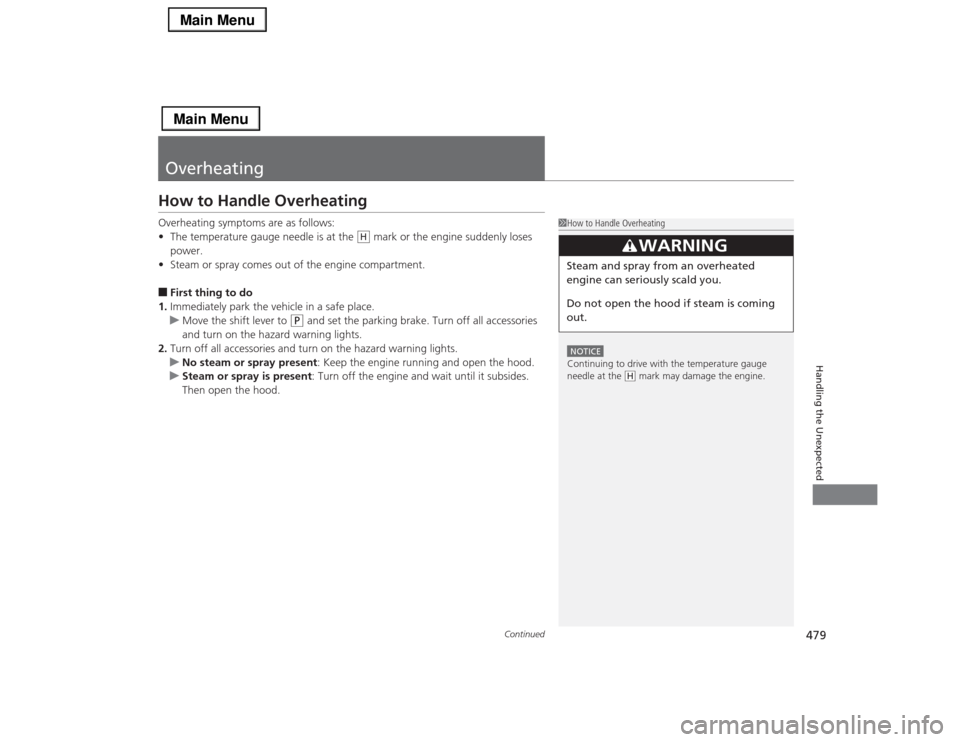
OverheatingHow to Handle OverheatingOverheating symptoms are as follows:
•The temperature gauge needle is at the mark or the engine suddenly loses
power.
•Steam or spray comes out of the engine compartment.■First thing to do
1.Immediately park the vehicle in a safe place.
uMove the shift lever to
(P
and set the parking brake. Turn off all accessories
and turn on the hazard warning lights.
2.Turn off all accessories and turn on the hazard warning lights.
uNo steam or spray present: Keep the engine running and open the hood.
uSteam or spray is present: Turn off the engine and wait until it subsides.
Then open the hood.
1How to Handle OverheatingNOTICEContinuing to drive with the temperature gauge
needle at the mark may damage the engine.
3
WARNING
Steam and spray from an overheated
engine can seriously scald you.
Do not open the hood if steam is coming
out.
H
H
Page 481 of 518

uuOverheatinguHow to Handle Overheating
480Handling the Unexpected
■Next thing to do
1.Check that the cooling fan is operating and
stop the engine once the temperature
gauge needle comes down.
uIf the cooling fan is not operating,
immediately stop the engine.
2.Once the engine has cooled down, inspect
the coolant level and check the cooling
system components for leaks.
uIf the coolant level in the reserve tank is
low, add coolant until it reaches the
MAX mark.
uIf there is no coolant in the reserve tank,
check that the radiator is cool. Cover the
radiator cap with a heavy cloth and open
the cap. If necessary, add coolant up to
the base of the filler neck, and put the
cap back on.■Last thing to do
Once the engine has cooled sufficiently, restart it and check the temperature gauge.
If the temperature gauge needle has gone down, resume driving. If it has not gone
down, contact a dealer for repairs.
1How to Handle Overheating
If the coolant is leaking, contact a dealer for repairs.
Use water as an emergency/temporary measure only.
Have a dealer flush the system with proper antifreeze
as soon as possible.
3
WARNING
Removing the radiator cap while the
engine is hot can cause the coolant to spray
out, seriously scalding you.
Always let the engine and radiator cool
down before removing the radiator cap.
Reserve
TankMAX
MIN
Page 512 of 518
511Index
Belts (Seat).................................................. 30
Beverage Holders..................................... 166
Blind Spot Information (BSI) System....... 378
Bluetooth® Audio..................................... 252
Bluetooth® HandsFreeLink®.................... 287
Booster Seats (For Children)...................... 63
Brake System............................................ 384
Anti-lock Brake System (ABS) .................. 389
Automatic Brake Hold ............................. 387
Brake Assist System................................. 390
Fluid ....................................................... 427
Foot Brake .............................................. 386
Parking Brake.......................................... 384
Brake System (Amber)
Indicator ................................................... 70
Brake System (Red)
Indicator ........................................... 68, 482
Brake System Indicator (Amber)............... 70
Brightness Control (Instrument Panel)... 144
BSI (Blind Spot Information) System....... 378
Bulb Replacement.................................... 428
Back-Up Lights ........................................ 432
Brake/Taillights and Rear Side Marker
Lights .................................................... 431
Door Outer Handle Ambient Lights ......... 433
Front Side Marker Lights ......................... 430
Front Turn Signal/Parking Lights .............. 429
Headlights .............................................. 428
High-Mount Brake Light.......................... 433
Rear License Plate Lights ......................... 433
Rear Turn Signal Lights............................ 431Side Turn Signal/Emergency Indicator
Lights .................................................... 430
Taillights .................................................. 432
Bulb Specifications................................... 496
CCarbon Monoxide Gas................................ 64
Cargo Hooks............................................. 169
Carrying Cargo.................................. 337, 339
CD Player................................................... 225
Center Pocket........................................... 165
Certification Label.................................... 498
Changing Bulbs......................................... 428
Charging System Indicator................. 71, 481
Child Safety................................................. 52
Childproof Door Locks ............................. 123
Child Seat.................................................... 52
Booster Seats ............................................. 63
Child Seat for Infants ................................. 54
Child Seat for Small Children ..................... 55
Installing a Child Seat with a Lap/Shoulder Seat
Belt.......................................................... 59
Larger Children .......................................... 62
Rear-facing Child Seat ............................... 54
Selecting a Child Seat ................................ 56
Using a Tether ........................................... 61
Childproof Door Locks............................. 123
Cleaning the Exterior............................... 451
Cleaning the Interior................................ 449
Client Service Information....................... 506Climate Control System............................ 177
Changing the Mode ................................ 180
Defrosting the Windshield and
Windows ............................................... 183
Dust and Pollen Filter............................... 448
Rear Temperature Control Dial ................ 184
Sensors ................................................... 185
Using Automatic Climate Control ............ 177
Clock.......................................................... 114
CMBS
TM (Collision Mitigation Braking
SystemTM)................................................. 391
Coat Hooks............................................... 168
Collision Mitigation Braking System
TM
(CMBS
TM)................................................. 391
Compact Spare Tire (Optional)........ 466, 497
Console Compartment............................. 164
Controls..................................................... 113
Coolant (Engine)...................................... 424
Adding to the Radiator ............................ 425
Adding to the Reserve Tank..................... 424
Overheating ............................................ 479
Creeping (Automatic Transmission)........ 346
Cruise Control........................................... 352
Indicator.................................................... 78
Cup Holders.............................................. 166
Customized Features........................ 102, 264
DDaytime Running Lights.......................... 140
Dead Battery............................................. 475