radiator Acura TL 2000 3.2 User Guide
[x] Cancel search | Manufacturer: ACURA, Model Year: 2000, Model line: TL, Model: Acura TL 2000Pages: 311, PDF Size: 3.05 MB
Page 228 of 311
Air Conditioning System
Your car's air conditioning is a sealedsystem. Any major maintenance,
such as recharging, should be done
by a qualified mechanic. You can do
a couple of things to make sure the
air conditioning works efficiently.
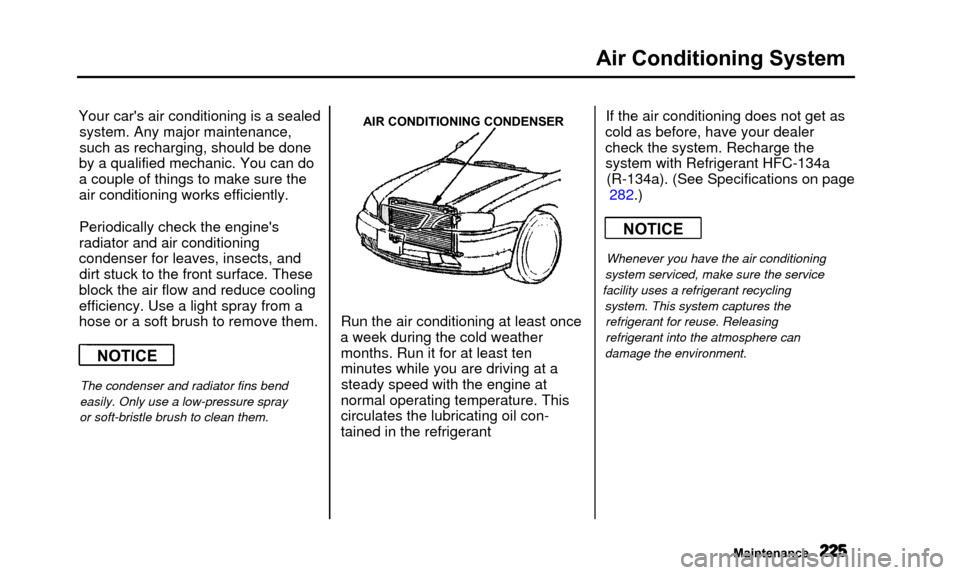
Periodically check the engine's
radiator and air conditioning
condenser for leaves, insects, and dirt stuck to the front surface. These
block the air flow and reduce cooling
efficiency. Use a light spray from a
hose or a soft brush to remove them.
The condenser and radiator fins bend
easily. Only use a low-pressure spray
or soft-bristle brush to clean them. AIR CONDITIONING CONDENSER
Run the air conditioning at least once
a week during the cold weather months. Run it for at least ten
minutes while you are driving at asteady speed with the engine at
normal operating temperature. This
circulates the lubricating oil con-
tained in the refrigerant If the air conditioning does not get as
cold as before, have your dealer
check the system. Recharge the system with Refrigerant HFC-134a (R-134a). (See Specifications on page 282.)
Whenever you have the air conditioning
system serviced, make sure the service
facility uses a refrigerant recycling system. This system captures therefrigerant for reuse. Releasing
refrigerant into the atmosphere can
damage the environment.
Maintenance
NOTICE
NOTICE
Page 239 of 311
Lights
Replacing a Headlight Bulb
The low beam headlight bulbs are a type of high voltage discharge tube.High voltage can remain in the
circuit even with the light switch off
and the key removed. Because of this, you should not attempt to
examine or change a low beam headlight bulb yourself. If a low
beam headlight bulb fails, take the
car to your dealer to have it replaced.
Halogen bulbs are used for the high
beam headlight bulbs. When replacing a high beam headlight bulb,
handle it by its base and protect the
glass from contact with your skin or hard objects. If you touch the glass,
clean it with denatured alcohol and a clean cloth.
Halogen headlight bulbs get very hot
when lit. Oil, perspiration, or a scratch
on the glass can cause the bulb to
overheat and shatter. BULB
TAB
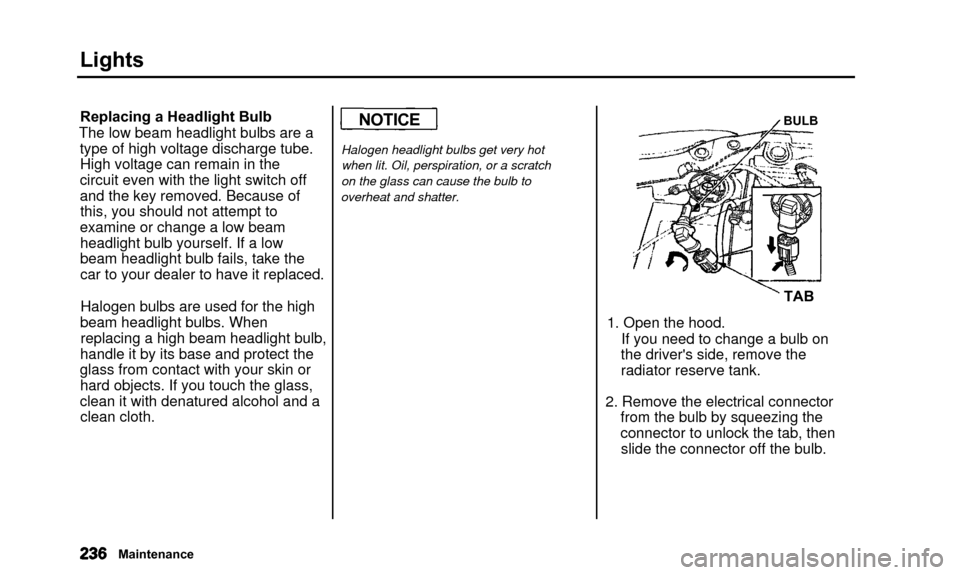
1. Open the hood. If you need to change a bulb on
the driver's side, remove the
radiator reserve tank.
2. Remove the electrical connector from the bulb by squeezing the
connector to unlock the tab, thenslide the connector off the bulb.
Maintenance
NOTICE
Page 240 of 311
Lights
3. Remove the bulb by turning itapproximately one-quarter turn
counterclockwise.
4. Insert the new bulb into the hole and turn it one-quarter turn clock-
wise to lock it in place.
5. Push the electrical connector back onto the bulb. Make sure it is onall the way.
6. Turn on the headlights to test the new bulb.
7. Reinstall the radiator reserve tank. Replacing Front Turn Signal and
Side Marker Light Bulbs
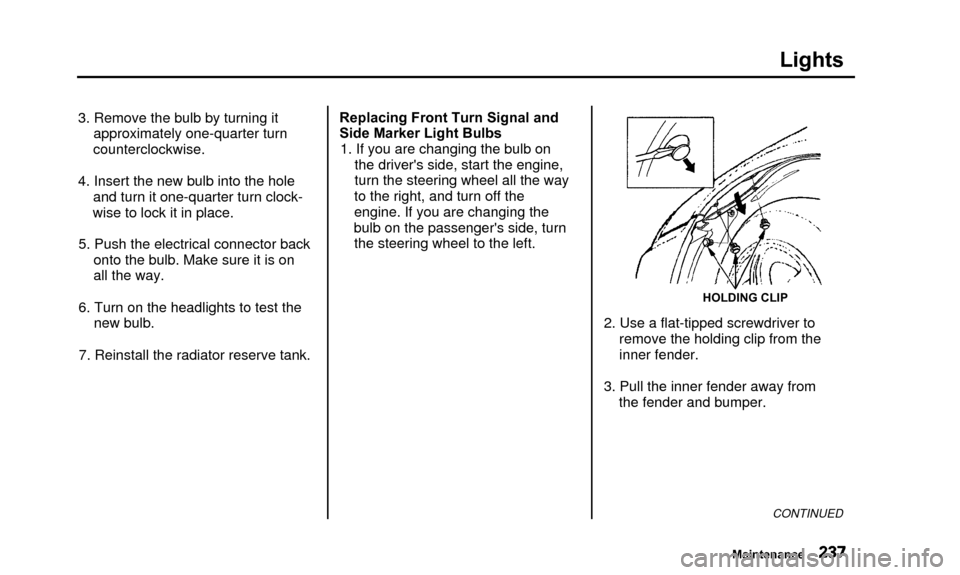
1. If you are changing the bulb on the driver's side, start the engine,
turn the steering wheel all the way
to the right, and turn off the
engine. If you are changing the
bulb on the passenger's side, turn the steering wheel to the left.
HOLDING CLIP
2. Use a flat-tipped screwdriver to remove the holding clip from the
inner fender.
3. Pull the inner fender away from the fender and bumper.
CONTINUED
Maintenance
Page 269 of 311
If Your Engine Overheats
4. If the temperature gauge stays atthe red mark, turn off the engine.
5. Wait until you see no more signs of steam or spray, then open the
hood.
6. Look for any obvious coolant leaks, such as a split radiator hose.
Everything is still extremely hot, so use caution. If you find a leak, it
must be repaired before you
continue driving (see Emergency
Towing on page 277).
7. If you don't find an obvious leak, check the coolant level in the
radiator reserve tank (see page
151). If the level is below the
MIN mark, add coolant to halfway
between the MIN and MAX marks.
8. If there was no coolant in the reserve tank, you may also have toadd coolant to the radiator. Let the
engine cool down until the pointer reaches the middle of the tempera-
ture gauge, or lower, before check-
ing the radiator.
Removing the radiator cap
while the engine is hot can
cause the coolant to spray out,
seriously scalding you.
Always let the engine and radiator cool down before
removing the radiator cap.
9. Using gloves or a large heavy cloth, turn the radiator cap
counterclockwise, without pushing
down, to the first stop. This
releases any remaining pressure in
the cooling system. After the
pressure releases, push down on
the cap and turn it until it comes off. 10. Start the engine and set the
temperature control dial to
maximum (climate control to
FULL AUTO at 90°F/32°C). Add
coolant to the radiator up to the
base of the filler neck. If you do not have the proper coolant
mixture available, you can add
plain water. Remember to have
the cooling system drained and refilled with the proper mixture assoon as you can.
11. Put the radiator cap back on tightly. Run the engine and watch
the temperature gauge. If it goes
back to the red mark, the engine
needs repair. (See Emergency
Towing on page 277
.)
12. If the temperature stays normal, check the coolant level in theradiator reserve tank. If it has
gone down, add coolant to the
MAX mark. Put the cap back on
tightly.
Taking Care of the Unexpected
Page 307 of 311
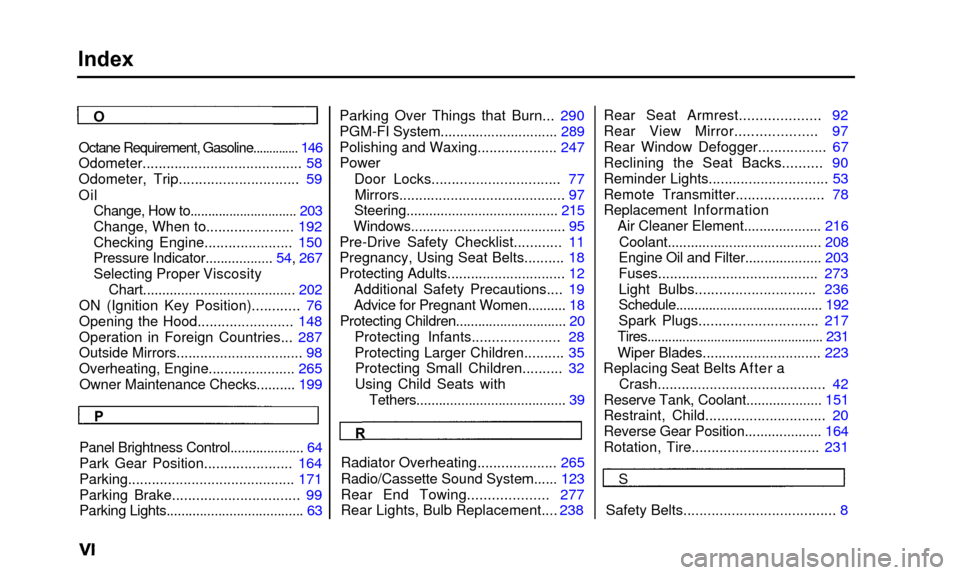
Index
O
Octane Requirement, Gasoline.... .......... 146
Odometer....................................... . 58
Odometer, Trip.............................. 59
Oil Change, How to.......... .................... 203
Change, When to...................... 192
Checking Engine...................... 150
Pressure Indicator......... ......... 54, 267
Selecting Proper Viscosity Chart........................................ 202
ON (Ignition Key Position)......... ... 76
Opening the Hood........................ 148
Operation in Foreign Countries... 287
Outside Mirrors......... ....................... 98
Overheating, Engine...................... 265
Owner Maintenance Checks.......... 199
Parking Over Things that Burn... 290
PGM-FI System.......... .................... 289
Polishing and Waxing.................... 247
Power
Door Locks......... ....................... 77
Mirrors.......................................... 97
Steering.......... .............................. 215
Windows........................................ 95
Pre-Drive Safety Checklist.......... .. 11
Pregnancy, Using Seat Belts.......... 18
Protecting Adults......... ..................... 12
Additional Safety Precautions.... 19
Advice for Pregnant Women.......... 18
Protecting Children......... ..................... 20
Protecting Infants......... ............. 28
Protecting Larger Children.......... 35
Protecting Small Children.......... 32
Using Child Seats with
Tethers......... .............................. . 39Rear Seat Armrest.........
........... 92
Rear View Mirror......... ........... 97
Rear Window Defogger......... ........ 67
Reclining the Seat Backs.......... 90
Reminder Lights......... ..................... 53
Remote Transmitter......... ............. 78
Replacement Information Air Cleaner Element.......... .......... 216
Coolant.......... .............................. 208
Engine Oil and Filter.................... 203
Fuses........................................ 273
Light Bulbs.......... .................... 236
Schedule........................................ 192
Spark Plugs.......... .................... 217
Tires.................................................. 231
Wiper Blades.............................. 223
Replacing Seat Belts After a Crash......... ................................ . 42
Reserve Tank, Coolant.......... .......... 151
Restraint, Child.............................. 20
Reverse Gear Position.......... .......... 164
Rotation, Tire.......... ...................... 231
P
Panel Brightness Control......... ........... 64
Park Gear Position...................... 164
Parking.......................................... 171
Parking Brake................................ 99
Parking Lights.................................... . 63R
S
Radiator Overheating..........
.......... 265
Radio/Cassette Sound System.... .. 123
Rear End Towing.......... .......... 277
Rear Lights, Bulb Replacement.... 238 Safety Belts...................................... 8