towing Acura TL 2000 3.2 User Guide
[x] Cancel search | Manufacturer: ACURA, Model Year: 2000, Model line: TL, Model: Acura TL 2000Pages: 311, PDF Size: 3.05 MB
Page 189 of 311
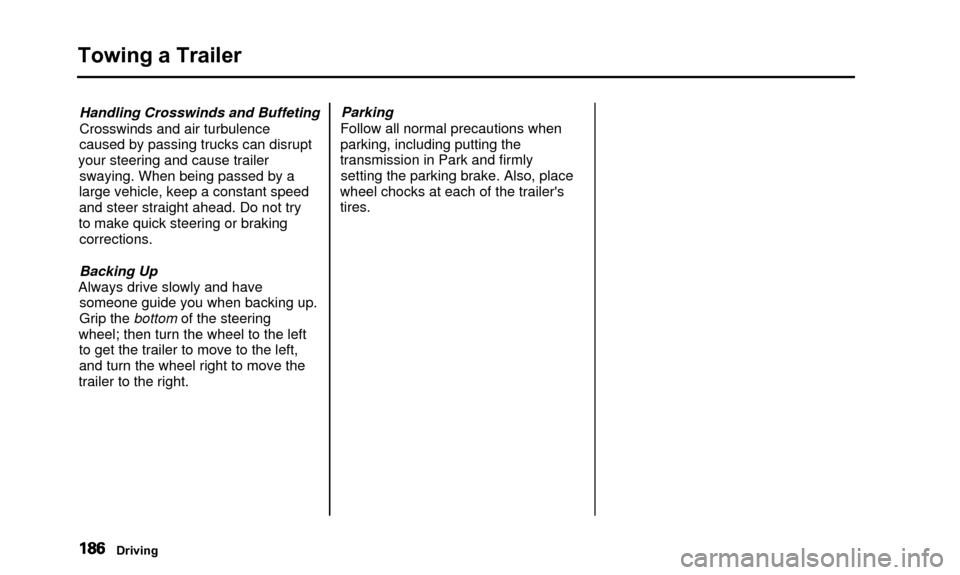
Towing a Trailer
Handling Crosswinds and Buffeting
Crosswinds and air turbulence
caused by passing trucks can disrupt
your steering and cause trailer swaying. When being passed by a
large vehicle, keep a constant speed
and steer straight ahead. Do not try
to make quick steering or braking corrections.
Backing Up
Always drive slowly and have someone guide you when backing up.
Grip the bottom of the steering
wheel; then turn the wheel to the left to get the trailer to move to the left,
and turn the wheel right to move the
trailer to the right. Parking
Follow all normal precautions when
parking, including putting the
transmission in Park and firmly setting the parking brake. Also, place
wheel chocks at each of the trailer's
tires.
Driving
Page 197 of 311
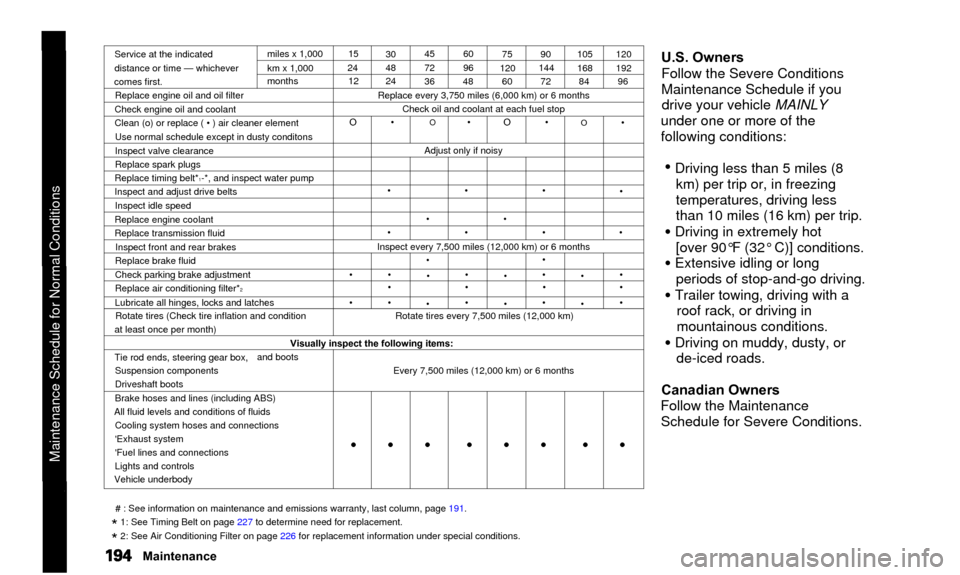
Service at the indicated
distance or time — whichever
comes first. miles x 1,000
km x 1,000
months
Replace engine oil and oil filter
Check engine oil and coolant
Clean (o) or replace ( • ) air cleaner element Use normal schedule except in dusty conditons
Inspect valve clearance
Replace spark plugs
Replace timing belt*
1-*, and inspect water pump
Inspect and adjust drive belts
Inspect idle speed
Replace engine coolant
Replace transmission fluid Inspect front and rear brakes
Replace brake fluid
Check parking brake adjustment
Replace air conditioning filter*
2Lubricate all hinges, locks and latches Rotate tires (Check tire inflation and condition
at least once per month) 15
24 12 30
48
24 45
72
3660
96
48 75
120 60 90
144
72 105
168
84 120
192
96
Replace every 3,750 miles (6,000 km) or 6 months Check oil and coolant at each fuel stop
O •
O • O •
Adjust only if noisy
•
•
•
•
•
•
•
•
O •
•
•
Inspect every 7,500 miles (12,000 km) or 6 months
•
• •
•
•
•
•
••
•
••
•
•
• •
•
•
••
•
•
Rotate tires every 7,500 miles (12,000 km)
Visually inspect the following items:
Tie rod ends, steering gear box, Suspension components
Driveshaft boots and boots
Brake hoses and lines (including ABS)
All fluid levels and conditions of fluids Cooling system hoses and connections
'Exhaust system
'Fuel lines and connections
Lights and controls
Vehicle underbody Every 7,500 miles (12,000 km) or 6 months
U.S. Owners
Follow the Severe Conditions
Maintenance Schedule if you
drive your vehicle MAINLY
under one or more of the
following conditions:
• Driving less than 5 miles (8 km) per trip or, in freezing
temperatures, driving less
than 10 miles (16 km) per trip.
• Driving in extremely hot[over 90°F (32° C)] conditions.
• Extensive idling or long periods of stop-and-go driving.
• Trailer towing, driving with a roof rack, or driving in
mountainous conditions.
• Driving on muddy, dusty, orde-iced roads.
Canadian Owners
Follow the Maintenance Schedule for Severe Conditions.
# : See information on maintenance and emissions warranty, last column, \
page 191.
* 1: See Timing Belt on page 227 to determine need for replacement.
* 2: See Air Conditioning Filter on page 226 for replacement information under special conditions.
Maintenance
Maintenance Schedule for Normal Conditions• • • • • • • \
•
Page 198 of 311

Use this schedule if your vehicle is MAINLY driven in any of the followi\
ng Severe Conditions, or normally driven in Canada; otherwise use the No\
rmalSchedule. Service at the indicated distance or time, whichever comes fir\
st. Do the items in A, B, C, D as required for each distance/time.
3,750 mi/6,000 km/-7,500 mi/12,000 km/6 mos 11,250 mi/18,000 km/-
15,000 mi/24,000 km/1 yr
18,750 mi/30,000 km/-
22,500 mi/36,000 km/1½ yrs
26,250 mi/42,000 km/-
30,000 mi/48,000 km/2 yrs
33,750 mi/54,000 km/-
37,500 mi/60,000 km/2½ yrs
41,250 mi/66,000 km/-
45,000 mi/72,000 km/3 yrs
48,750 mi/78,000 km/-
52,500 mi/84,000 km/3½ yrs
56,250 mi/90,000 km/-
60,000 mi/96,000 km/4 yrs
63,750 mi/102,000 km/-
67,500 mi/108,000 km/4½ yrs
71,250 mi/114,000 km/-
75,000 mi/120,000 km/5 yrs
78,750 mi/126,000 km/- Do items in A.
Do items in A, B. Do items in A.
CIean air cleaner element. Do items in A, B, C.Do items in A. Do items in A, B.Do items in A.
Do items in A, B, C, D.
Do items in A.
Do items in A, B.
Do items in A. Replace coolant. Replace brake fluid.
CIean air cleaner element. Do items in A, B, C.Do items in A.
Do items in A, B.
Do items in A.
'
Replace timing belt*1, inspect water pump.Do items in A, B, C, D.
Do items in A.
Do items in A, B.
Do items in A.
Replace coolant, Clean air cleaner element.Do items in A, B.
Do items in A.
NOTE:• Check engine oil and coolant at each fuel stop.• Check and adjust valve clearance, cold engine, if noisy.
CONTINUED
Maintenance
Severe Conditions:• Driving less than 5 miles (8 km) per trip or, in freezingtemperatures, driving less than 10 miles (16 km) per trip.• Driving in extremely hot (over 90°F/32°C) conditions.
• Extensive idling or long periods of stop-and-go driving.• Trailer towing, driving with a roof rack, or driving in mountainous conditions.
• Driving, on muddy, dusty, or de-iced roads.
A
B• Replace engine oil and filter. Inspect front and rear brakes.
Rotate tires (follow pattern on page 231 ). Inspect tie rod ends, steering gear box and boots.
Inspect suspension components. Inspect driveshaft boots.
# : See information on maintenance and emissions warranty, lastcolumn, page 191.
* 1 : See Timing Belt on page 227 to determine need for replacement.
* 2 : See Air Conditioning Filter on page 226 for replacement
information under special conditions.
Maintenance Schedule for Normal Conditions (listed by distance/time)
Page 256 of 311
Taking Care of the Unexpected
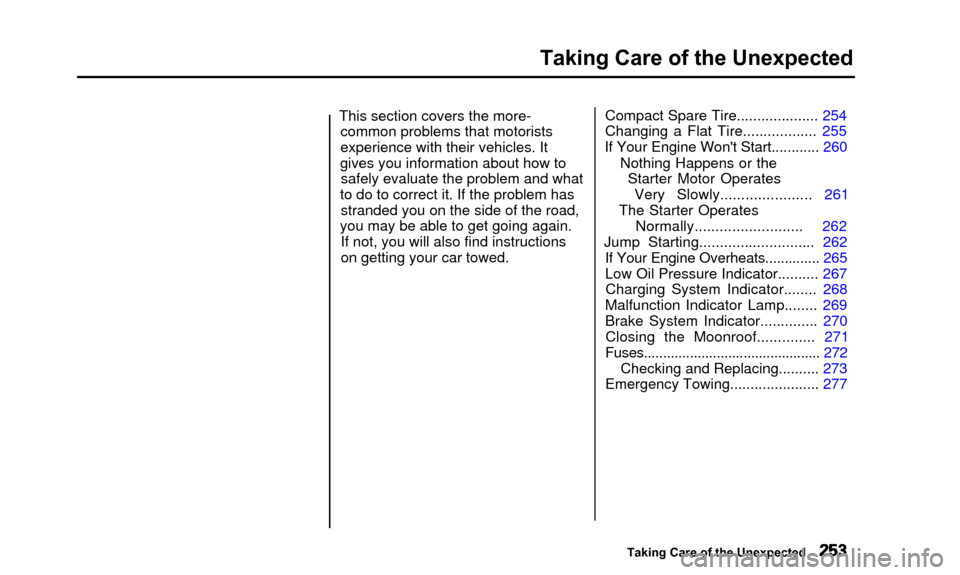
This section covers the more-common problems that motorists
experience with their vehicles. It
gives you information about how to safely evaluate the problem and what
to do to correct it. If the problem has stranded you on the side of the road,
you may be able to get going again. If not, you will also find instructions
on getting your car towed. Compact Spare Tire.................... 254
Changing a Flat Tire.................. 255
If Your Engine Won't Start............ 260
Nothing Happens or theStarter Motor OperatesVery Slowly...................... 261
The Starter Operates
Normally.......................... 262
Jump Starting............................ 262
If Your Engine Overheats.............. 265
Low Oil Pressure Indicator.......... 267 Charging System Indicator........ 268
Malfunction Indicator Lamp ........ 269
Brake System Indicator .............. 270
Closing the Moonroof.............. 271
Fuses.............................................. 272
Checking and Replacing.......... 273
Emergency Towing ...................... 277
Taking Care of the Unexpected
Page 264 of 311

If Your Engine Won't Start
Nothing Happens or the Starter
Motor Operates Very Slowly
When you turn the ignition switch to START (III), you do not hear the
normal noise of the engine trying tostart. You may hear a clicking sound
or series of clicks, or nothing at all.
Check these things:• Check the transmission interlock. The transmission must be in Parkor Neutral or the starter will not
operate.
• Turn the ignition switch to ON (II).
Turn on the headlights and check their brightness. If the headlightsare very dim or don't light at all,
the battery is discharged. See
Jump Starting on page 262.
• Turn the ignition switch to START (III). If the headlights do not dim,
check the condition of the fuses. If
the fuses are OK, there is proba-
bly something wrong with the electrical circuit for the ignitionswitch or starter motor. You will
need a qualified technician to determine the problem. (See
Emergency Towing on page 277.)
If the headlights dim noticeably or
go out when you try to start the engine, either the battery is dis-
charged or the connections are
corroded. Check the condition of
the battery and terminal connec- tions (see page 220). You can
then try jump starting the car froma booster battery (see page 262).
Taking Care of the Unexpected
Page 265 of 311

If Your Engine Won't Start, Jump Starting
The Starter Operates NormallyIn this case, the starter motor's
speed sounds normal, or even faster
than normal, when you turn the
ignition switch to START (III), but
the engine does not run.
• Your car has the Immobilizer System. You should use a
properly-coded master or valet key
to start the engine (see page 74).
A key that is not properly coded will cause the immobilizer systemindicator in the dash panel to blink
rapidly.
• Are you using the proper starting procedure? Refer to Starting theEngine on page 161.
• Do you have fuel? Turn the
ignition switch to ON (II) for a
minute and watch the fuel gauge.
The low fuel level warning light may not be working, so you were
not reminded to fill the tank.
• There may be an electrical problem, such as no power to the
fuel pump. Check all the fuses (see page 273).
If you find nothing wrong, you will
need a qualified technician to find
the problem. See Emergency
Towing on page 277. Jump Starting
If your car's battery has run down,
you may be able to start the engine by using a booster battery. Although
this seems like a simple procedure,
you should take several precautions.
A battery can explode if you donot follow the correct procedure,
seriously injuring anyone nearby.
Keep all sparks, open flames,
and smoking materials away
from the battery.
You cannot start your Acura by pushing or pulling it.
Taking Care of the Unexpected
Page 269 of 311
If Your Engine Overheats
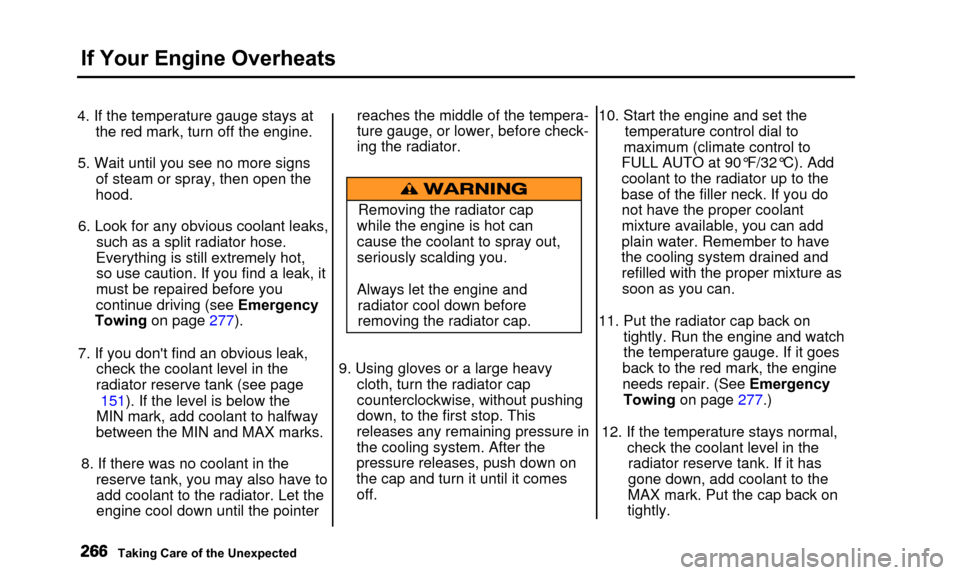
4. If the temperature gauge stays atthe red mark, turn off the engine.
5. Wait until you see no more signs of steam or spray, then open the
hood.
6. Look for any obvious coolant leaks, such as a split radiator hose.
Everything is still extremely hot, so use caution. If you find a leak, it
must be repaired before you
continue driving (see Emergency
Towing on page 277).
7. If you don't find an obvious leak, check the coolant level in the
radiator reserve tank (see page
151). If the level is below the
MIN mark, add coolant to halfway
between the MIN and MAX marks.
8. If there was no coolant in the reserve tank, you may also have toadd coolant to the radiator. Let the
engine cool down until the pointer reaches the middle of the tempera-
ture gauge, or lower, before check-
ing the radiator.
Removing the radiator cap
while the engine is hot can
cause the coolant to spray out,
seriously scalding you.
Always let the engine and radiator cool down before
removing the radiator cap.
9. Using gloves or a large heavy cloth, turn the radiator cap
counterclockwise, without pushing
down, to the first stop. This
releases any remaining pressure in
the cooling system. After the
pressure releases, push down on
the cap and turn it until it comes off. 10. Start the engine and set the
temperature control dial to
maximum (climate control to
FULL AUTO at 90°F/32°C). Add
coolant to the radiator up to the
base of the filler neck. If you do not have the proper coolant
mixture available, you can add
plain water. Remember to have
the cooling system drained and refilled with the proper mixture assoon as you can.
11. Put the radiator cap back on tightly. Run the engine and watch
the temperature gauge. If it goes
back to the red mark, the engine
needs repair. (See Emergency
Towing on page 277
.)
12. If the temperature stays normal, check the coolant level in theradiator reserve tank. If it has
gone down, add coolant to the
MAX mark. Put the cap back on
tightly.
Taking Care of the Unexpected
Page 270 of 311
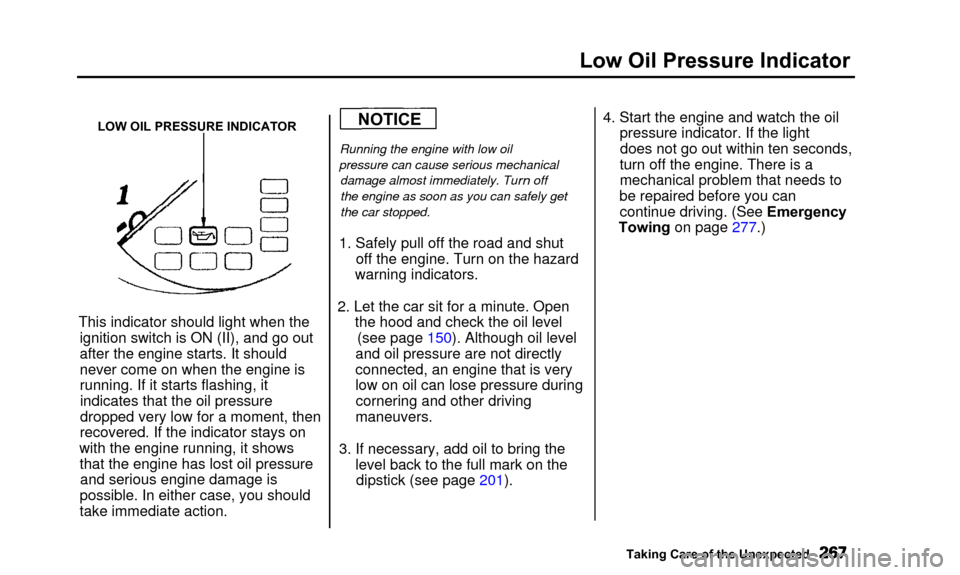
Low Oil Pressure Indicator
LOW OIL PRESSURE INDICATOR
This indicator should light when theignition switch is ON (II), and go out
after the engine starts. It should
never come on when the engine is
running. If it starts flashing, itindicates that the oil pressure
dropped very low for a moment, then
recovered. If the indicator stays on
with the engine running, it shows that the engine has lost oil pressureand serious engine damage is
possible. In either case, you should
take immediate action.
Running the engine with low oil
pressure can cause serious mechanical damage almost immediately. Tu
rn off
the engine as soon as you can safely get
the car stopped.
1. Safely pull off the road and shut off the engine. Turn on the hazard
warning indicators.
2. Let the car sit for a minute. Open the hood and check the oil level(see page 150). Although oil level
and oil pressure are not directly
connected, an engine that is very
low on oil can lose pressure during cornering and other driving
maneuvers.
3. If necessary, add oil to bring the level back to the full mark on thedipstick (see page 201). 4. Start the engine and watch the oil
pressure indicator. If the lightdoes not go out within ten seconds,
turn off the engine. There is a
mechanical problem that needs to
be repaired before you can continue driving. (See Emergency
Towing on page 277.)
Taking Care of the Unexpected
NOTICE
Page 273 of 311

Brake System Indicator
BRAKE SYSTEM INDICATOR
The Brake System Indicator lightcomes on when you turn the ignitionON (II). If the parking brake is not
set, it goes off after you start the
engine. If the parking brake is set, it
goes off when you fully release the parking brake with the engine
running. If it comes on at any other time, it
indicates a problem with the car's
brake system. In most cases, the problem is a low fluid level in the
brake fluid reservoir. Press lightly on
the brake pedal to see if it feels normal. If it does, check the brake
fluid level the next time you stop at a service station (see page 214). If the
fluid level is low, take the car to your dealer and have the brake system
inspected for leaks or worn brake
pads.
However, if the brake pedal does not
feel normal, you should take immediate action. Because of the
brake system's dual-circuit design, a
problem in one part of the system will still give you braking at two
wheels. You will feel the brake pedal
go down much farther before the car
begins to slow down, and you will
have to press harder on the pedal.
The distance needed to stop will be much longer. Slow down by shifting to a lower
gear, and pull to the side of the road
when it is safe. Because of the longer distance needed to stop, it is
hazardous to drive the car. Youshould have it towed, and repaired as
soon as possible. (See Emergency
Towing on page 277.)
If you must drive the car a shortdistance in this condition, driveslowly and cautiously.
Taking Care of the Unexpected
Page 280 of 311

Emergency Towing
If your car needs to be towed, call a
professional towing service or, if you
belong to one, an organization that
provides roadside assistance. Never
tow your car behind another vehicle
with just a rope or chain. It is very dangerous.
There are three popular types of professional towing equipment:
Flat-bed Equipment — The operator
loads your car on the back of a truck.
This is the best way to transport
your Acura.
Wheel-Lift Equipment — The tow
truck uses two pivoting arms that go
under the tires (front or rear) and lift
them off the ground. The other two
tires remain on the ground. This is an acceptable way to tow your
Acura.
Sling-type Equipment — The tow
truck uses metal cables with hooks on the ends. These hooks go around
parts of the frame or suspension and
the cables lift that end of the car off
the ground. Your car's suspension and body can be seriously damaged.
This method of towing is unacceptable.
If your Acura cannot be transported
by flat-bed, it should be towed by
wheel-lift equipment with the front
wheels off the ground. If, due to damage, your car must be towed
with the front wheels on the ground, do the following.
• Release the parking brake.
• Start the engine.
• Shift to D5, then to N.
• Turn off the engine.
Improper towing preparation will
damage the transmission. Follow the
above procedure exactly. If you cannot
shift the transmission or start theengine, your car must be transported
with the front wheels off the ground.
• With the front wheels on the ground, it is best to tow the car no
farther than 50 miles (80 km), and
keep the speed below 35 mph (55
km/h).
CONTINUED
Taking Care of the Unexpected
NOTICE