weight Acura TL 2000 3.2 User Guide
[x] Cancel search | Manufacturer: ACURA, Model Year: 2000, Model line: TL, Model: Acura TL 2000Pages: 311, PDF Size: 3.05 MB
Page 183 of 311

Towing a Trailer
Your Acura has been designedprimarily to carry passengers and
their cargo. You can use it to tow a
trailer if you carefully observe the
load limits, use the proper equipment, and follow the guidelines in thissection. Load Limits
• Total Trailer Weight: The total
weight of the trailer andeverything loaded in it must not
exceed 1,000 lbs (450kg).Towinga load that is too heavy can
seriously affect your vehicle's
handling and performance. It can also damage the engine and
drivetrain.
• Tongue Load: The weight that the tongue of a fully-loaded trailer
puts on the hitch should be
approximately 10 percent of the
trailer weight. Too little tongue
load can make the trailer unstable and cause it to sway. Too much
tongue load reduces front-tire
traction and steering control. To achieve a proper tongue load,
start by loading 60 percent of the
load toward the front of the trailer and 40 percent toward the rear, then
readjust the load as needed.
Driving
Page 184 of 311

Towing a Trailer
• Gross Vehicle Weight Rating(GVWR):
The total weight of the vehicle, all occupants, all cargo, and the
tongue load must not exceed: 4,430 lbs (2,010 kg)
• Gross Axle Weight Rating
(GAWR):
The total weight of the vehicle, all occupants, all cargo, and the
tongue load must not exceed:
2,425 lbs (1,100 kg)
on the front axle
2,050 lbs (930 kg)
on the rear axle Exceeding load limits or
improperly loading your vehicle
and trailer can cause a crash in
which you can be seriously injured or killed.
Check the loading of your
vehicle and trailer carefully before starting to drive. Checking Loads
The best way to confirm that vehicle and trailer weights are within limits
is to have them checked at a publicscale.
Using a suitable scale or a special
tongue load gauge, check the tongue
load the first time you set up a towing combination (a fully-loaded
vehicle and trailer), then recheck the tongue load whenever the conditions
change.
Driving
Page 186 of 311
Towing a Trailer
Trailer Brakes
Honda recommends that any trailer
having a total weight of 1,000 lbs (450 kg) or more be equipped with
its own electric or surge-type brakes.
If you choose electric brakes, be sure they are electronically actuated.
Do not attempt to tap into your
vehicle's hydraulic system. No matter how successful it may seem,any attempt to attach trailer brakes
to your vehicle's hydraulic system
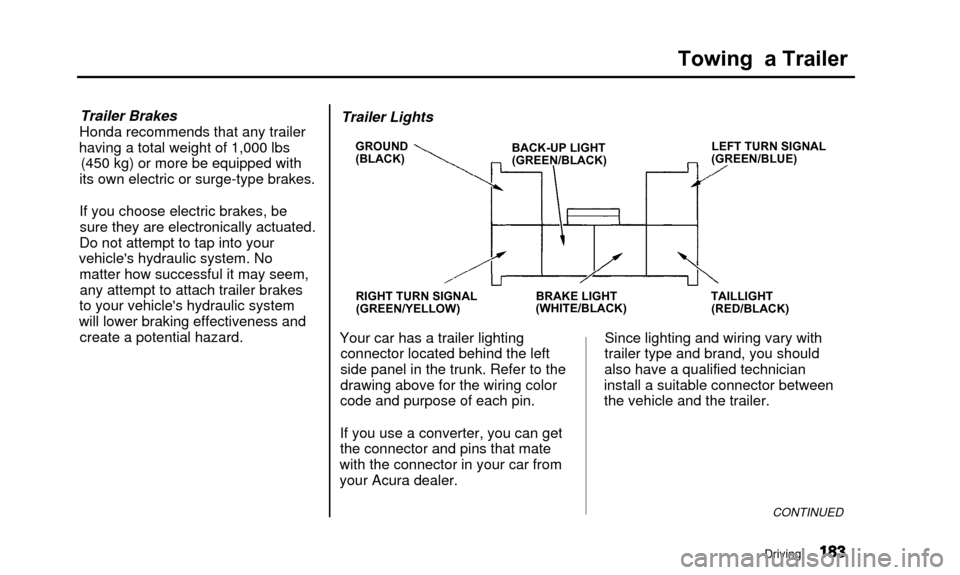
will lower braking effectiveness and create a potential hazard. Trailer Lights
GROUND
(BLACK)
BACK-UP LIGHT
(GREEN/BLACK)
RIGHT TURN SIGNAL
(GREEN/YELLOW) BRAKE LIGHT
(WHITE/BLACK) LEFT TURN SIGNAL
(GREEN/BLUE)
TAILLIGHT (RED/BLACK)
Your car has a trailer lighting
connector located behind the left
side panel in the trunk. Refer to the
drawing above for the wiring color
code and purpose of each pin.
If you use a converter, you can get
the connector and pins that mate
with the connector in your car from
your Acura dealer. Since lighting and wiring vary with
trailer type and brand, you should
also have a qualified technician
install a suitable connector between
the vehicle and the trailer.
CONTINUED
Driving
Page 187 of 311
Towing a Trailer
Additional Trailer EquipmentMany states and Canadian provinces
require special outside mirrors when
towing a trailer. Even if they don't,
you should install special mirrors if
you cannot clearly see behind you, or if the trailer creates a blind spot.
Ask your trailer sales or rental agency if any other items are
recommended or required for your towing situation. Pre-Tow Checklist
When preparing to tow, and before driving away, be sure to check the
following:
• The vehicle has been properly serviced, and the tires, brakes,
suspension, and cooling system
are in good operating condition.
• All weights and loads are within limits (see pages 180 and 181).
• The hitch, safety chain, and any other attachments are secure.
• All items on and in the trailer areproperly secured and cannot shift
while you drive.
• The lights and brakes on your vehicle and the trailer are workingproperly.
• Your vehicle tires and spare are properly inflated (see page 254),and the trailer tires and spare are
inflated as recommended by the
trailer maker.
Driving
Page 188 of 311

Towing a Trailer
Driving Safety With a Trailer
The added weight, length, and height of a trailer will affect your
vehicle's handling and performance, so driving with a trailer requires
some special driving skills and
techniques.
For your safety and the safety ofothers, take time to practice driving
maneuvers before heading for the open road, and follow the guidelines
discussed below.
Towing Speeds and Gears
Drive slower than normal in all
driving situations, and obey posted
speed limits for vehicles with trailers.
Use the D
5 or D4 positions when
towing a trailer on level roads. D
3 is
the proper shift lever position to use
when towing a trailer in hilly terrain. (See "Driving on Hills" in the next
column for additional gear
information.) Making Turns and Braking
Make turns more slowly and wider
than normal. The trailer tracks a smaller arc than your vehicle, and it
can hit or run over something the
vehicle misses. Allow more time and distance for braking. Do not brake or
turn suddenly as this could cause the
trailer to jackknife or turn over.
Driving on Hills
When climbing hills, closely watch your temperature gauge. If it nears
the red (Hot) mark, turn the airconditioning off, reduce speed and, if
necessary, pull to the side of the
road to let the engine cool.
If the transmission shifts frequently
between 4th and 5th gears while
going up a hill, shift to D
4. And if the
transmission shifts frequently
between 3rd and 4th gears, shift to D
3.
If you must stop when facing uphill,
use the foot brake or parking brake. Do not try to hold the vehicle in
place by pressing on the accelerator, as this can cause the automatic
transmission to overheat.
When driving down hills, reduce
your speed and shift down to 2nd gear. Do not "ride" the brakes, and
remember it will take longer to slow
down and stop when towing a trailer.
CONTINUED
Driving
Page 205 of 311

Engine Oil
The API Service label also tells youthe service classification of the oil.
Always use an oil that is labeled "API Service SJ." This service rating may
include other classifications, such asCD. These additional classifications
are not a problem, as long as the
label also carries the SJ classification.
API SERVICE LABEL
The oil container may also display the API Certification seal. Make sure
it says "For Gasoline Engines."
API CERTIFICATION MARK
The SAE numbers tell you the oil'sviscosity or weight. Select the oil for
your car according to this chart.
Ambient Temperature
An oil with a viscosity of 5W-30 ispreferred for improved fuel economyand year-round protection in your
Acura. You may use a 10W-30 oil if the temperature in your area never
goes below 20°F(-7°C).
Maintenance
Page 206 of 311

Engine Oil
Synthetic Oil
You may use a synthetic motor oil if it meets the same requirements
given for conventional motor oil:
energy conserving, a service
classification of SJ, and the proper
weight as shown on the chart. When using synthetic oil, you must follow
the oil and filter change intervals
given in the maintenance schedule. Additives
Your Acura does not need any oil additives. Purchasing additives for
the engine or transmission will not
increase your car's performance or
longevity. It only increases the cost of operating your car. Changing the Oil and Filter
Always change the oil and filter according to the time and distance (miles/kilometers) recommenda-
tions in the maintenance schedule.
The oil and filter collect contami- nants that can damage your engine if
they are not removed regularly.
Changing the oil and filter requires
special tools and access from
underneath the car. The car should
be raised on a service station-type
hydraulic lift for this service. Unless
you have the knowledge and proper equipment, you should have this
maintenance done by a skilledmechanic.
1. Run the engine until it reaches normal operating temperature,
then shut it off.
CONTINUED
Maintenance
Page 233 of 311
Tires
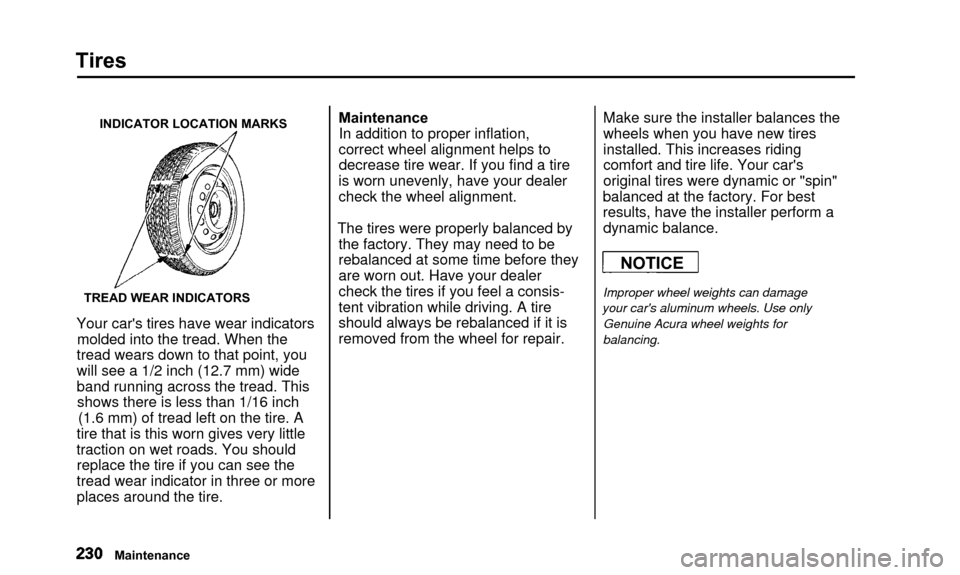
INDICATOR LOCATION MARKS
TREAD WEAR INDICATORS
Your car's tires have wear indicators molded into the tread. When the
tread wears down to that point, you
will see a 1/2 inch (12.7 mm) wide
band running across the tread. This shows there is less than 1/16 inch (1.6 mm) of tread left on the tire. A
tire that is this worn gives very little
traction on wet roads. You should replace the tire if you can see the
tread wear indicator in three or more
places around the tire. Maintenance
In addition to proper inflation,
correct wheel alignment helps to decrease tire wear. If you find a tire
is worn unevenly, have your dealer
check the wheel alignment.
The tires were properly balanced by the factory. They may need to be
rebalanced at some time before they
are worn out. Have your dealer
check the tires if you feel a consis-
tent vibration while driving. A tire
should always be rebalanced if it is
removed from the wheel for repair. Make sure the installer balances the
wheels when you have new tires
installed. This increases riding
comfort and tire life. Your car's
original tires were dynamic or "spin"
balanced at the factory. For best
results, have the installer perform a dynamic balance.
Improper wheel weights can damage
your car's aluminum wheels. Use only Genuine Acura wheel weights for
balancing.
Maintenance
NOTICE
Page 281 of 311

Emergency Towing
If you decide to tow your car with all
four wheels on the ground, make sure you use a properly-designed and
attached tow bar. Prepare the car for
towing as described above, and leave
the ignition switch in Accessory (I) so the steering wheel does not lock.
Make sure the radio and any items
plugged into the accessory power socket are turned off so they do not
run down the battery.
The steering system can be damaged if
the steering wheel is locked. Leave the ignition switch in Accessory (I), and
make sure the steering wheel turns
freely before you begin towing. Trying to lift or tow your car by the
bumpers will cause serious damage. The bumpers are not designed to
support the car's weight.
Taking Care of the Unexpected
NOTICE
NOTICE
Page 285 of 311

Specifications
DimensionsLength
Width Height
Wheelbase
Track Front Rear 192.9 in (4,900 mm)
70.3 in (1,785 mm)
55.7 in (1,415 mm)
108.1 in (2,745 mm)
61.2 in (1,555 mm)
60.4 in (1,535 mm) Capacities
Weights
Gross vehicle weight rating See the certification label attached to the driver's doorjamb.
Air Conditioning
Refrigerant type
Charge quantity Lubricant type HFC-134a(R-134a)
25-27 oz (700-750 g) ND-OIL8
Engine
coolant
Engine oil
Automatic
transmission
fluid
Windshield washer
reservoir Change*1Total
Change Including
filter
Without
filter
Total
Change
Total
U.S. Cars
Canada Cars 1.48 US gal (5.6 l ,1.23 Imp gal)
1.98 US gal (7.5 l ,1.65 Imp qal)
4.6 US qt (4.4 l ,3.9 Imp qt)
4.2 US qt (4.0 l , 3.5 Imp qt) 5.3 US qt (5.0 l , 4.4 Imp qt)
3.1 US qt (2.9 l , 2.6 Imp qt)
7.6 US qt (7.2 l , 6.3 Imp qt)
2.6 US qt (2.5 l , 2.2 Imp qt)
4.8 US qt (4.5 l ,4.0 Imp qt)
Capacities
Fuel tank Approx. 17.17 US gal (65.0 l ,14.30 Imp gal)
* 1 : Including the coolant in the reserve tank and that remaining in the
engine.
Reserve tank capacity: 0.16 US gal (0.6 l , 0.13 Imp gal)
* 2 : Excluding the oil remaining in the engine.
Technical Information