Fuel Acura TLX 2015 Owner's Guide
[x] Cancel search | Manufacturer: ACURA, Model Year: 2015, Model line: TLX, Model: Acura TLX 2015Pages: 545, PDF Size: 19.64 MB
Page 423 of 545
422Driving
Fuel EconomyImproving Fuel EconomyFuel economy depends on several conditions, including driving conditions, your
driving habits, the condition of your vehicle, and loading. Depending on these and
other conditions, you may or may not achieve the rated fuel economy of this vehicle.
You can optimize your fuel economy with proper maintenance of your vehicle.
Always maintain your vehicle in accordance with the messages displayed on the
multi-information display.
•Use the recommended viscosity engine oil, displaying the API Certification Seal.
• Maintain the specified tire pressure.
• Do not load the vehicle with excess cargo.
• Keep your vehicle clean. A buildup of snow or mud on your vehicle’s underside
adds weight and increases wind resistance.■
Maintenance and Fuel Economy
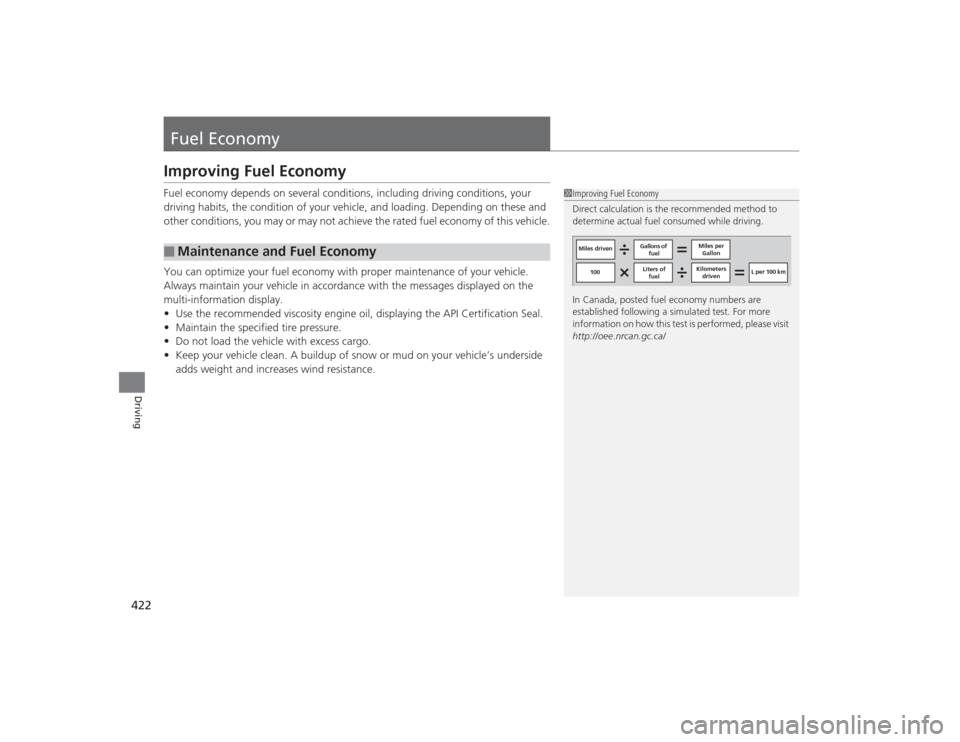
1Improving Fuel Economy
Direct calculation is the recommended method to
determine actual fuel consumed while driving.
In Canada, posted fuel economy numbers are
established following a simulated test. For more
information on how this test is pe rformed, please visit
http://oee.nrcan.gc.ca/
Miles driven Gallons of
fuel Miles per
Gallon
100 L per 100 km
Liters of
fuel Kilometers
driven
Page 427 of 545
426Maintenance
Before Performing MaintenanceInspection and MaintenanceFor your safety, perform all listed inspections and maintenance to keep your vehicle
in good condition. If you become aware of any abnormality (noise, smell, insufficient
brake fluid, oil residue on the ground, etc.), have your vehicle inspected by a dealer.
(Note, however, that service at a dealer is not mandatory to keep your \
warranties in
effect.) Refer to the separate maintenance booklet for detailed maintenance and
inspection information.■Daily inspections
Perform inspections before long distance trips, when washing the vehicle, or when
refueling.■Periodic inspections
• Check the brake fluid level monthly.2 Brake Fluid P. 446
•Check the tire pressure monthly. Examine the tread for wear and foreign objects.
2 Checking and Maintaining Tires P. 456
•Check the operation of the exterior lights monthly.
2 Replacing Light Bulbs P. 447
•Check the condition of the wiper blades at least every six months.
2Checking and Maintaining Wiper Blades P. 454
■
Types of Inspection and Maintenance
1Inspection and Maintenance
Maintenance, replacement, or repair of
emissions control devices and systems may be
done by any automotive repair establishment or
individuals using parts that are “certified” to
EPA standards.
According to state and federal regulations, failure to
perform maintenance on the maintenance main
items marked with # will not void your emissions
warranties. However, all maintenance services should
be performed in accordance with the intervals
indicated by the multi-information display.
2 Maintenance Service Items P. 432
If you want to perform complex maintenance tasks
that require mor e skills and tools, you can purchase a
subscription to the Service Express website at
www.techinfo.honda.com .
2 Authorized Manuals P. 531
If you want to perform maintenance yourself, make
sure that you have the necessa ry tools and skills first.
After performing maintenance, update the records in
the separate maintenance booklet.U.S. models
Page 428 of 545

427
uuBefore Performing Maintenance uSafety When Performing Maintenance
Maintenance
Safety When Performing MaintenanceSome of the most important safety precautions are given here.
However, we cannot warn you of every conc eivable hazard that can arise in
performing maintenance. Only you can decide whether or not you should perform
a given task.
• To reduce the possibility of fire or explosion, keep cigarettes, sparks, and flames
away from the battery and all fuel related parts.
• Never leave rags, towels, or other flammable objects under the hood.
u Heat from the engine and exhaust can ignite them causing a fire.
• To clean parts, use a commercially available degreaser or parts cleaner, not
gasoline.
• Wear eye protection and protective clothing when working with the battery or
compressed air.
• Engine exhaust contains carbon monoxide, which is poisonous and can kill you.
u Operate the engine only when there is sufficient ventilation.
• The vehicle must be in a stationary condition.
u Make sure your vehicle is parked on level ground, the parking brake is set, and
the engine is off.
• Be aware that hot parts can burn you.
u Make sure to let the engine and exhaust system cool thoroughly before
touching vehicle parts.
• Be aware that moving parts can injure you.
u Do not start the engine unless instructed, and keep your hands and limbs away
from moving parts.
u Do not open the hood while the Auto Idle Stop function
* is activated.
■
Maintenance Safety
■
Vehicle Safety
1Safety When Performing Maintenance
3
WARNING
Improperly maintaining this vehicle or
failing to correct a problem before driving
can cause a crash in which you can be
seriously hurt or killed.
Always follow the inspection and
maintenance recommendations according
to the schedules in this owner’s manual.
3
WARNING
Failure to properly follow maintenance
instructions and precautions can cause you
to be seriously hurt or killed.
Always follow th e procedures and
precautions in this owner’s manual.
* Not available on all models
Page 433 of 545
432
uuMaintenance Minder
TMuTo Use Maintenance Minder
TM
Maintenance
■
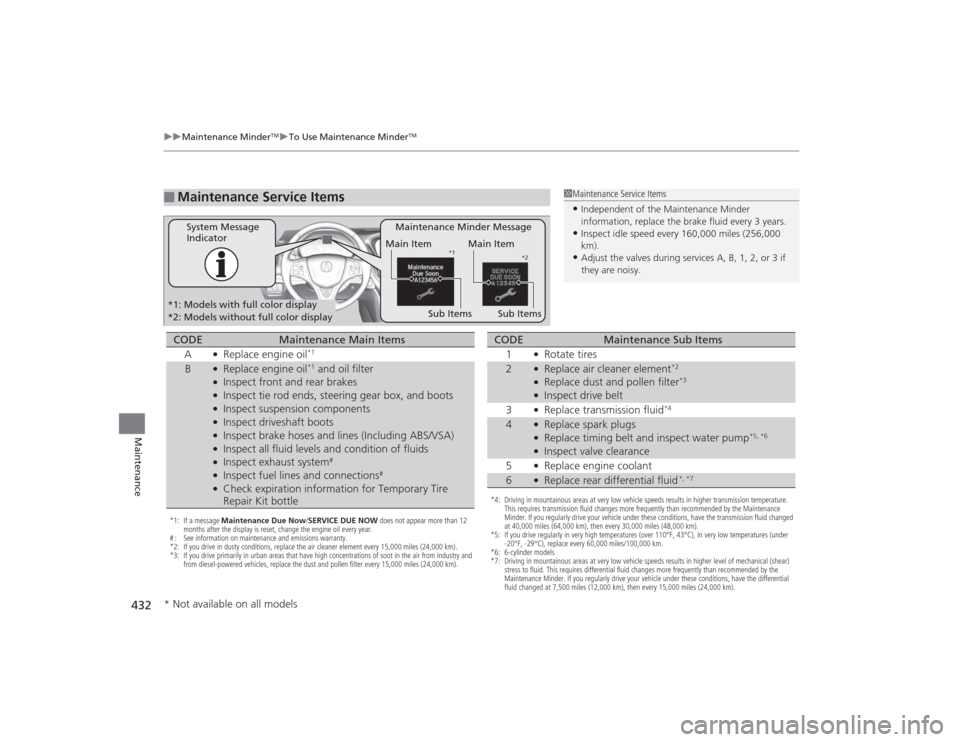
Maintenance Service Items
1Maintenance Service Items•Independent of the Maintenance Minder
information, replace the brake fluid every 3 years.•Inspect idle speed every 160,000 miles (256,000
km).•Adjust the valves during services A, B, 1, 2, or 3 if
they are noisy.
Maintenance Minder Message
System Message
Indicator
Main Item
Sub Items
Main ItemSub Items
*1 *2
*1: Models with full color display
*2: Models without full color display*1: If a message Maintenance Due Now/SERVICE DUE NOW does not appear more than 12
months after the display is reset, change the engine oil every year.
# : See information on maintenance and emissions warranty.
*2: If you drive in dusty conditions, replace the air cleaner element every 15,000 miles (24,000 km).
*3: If you drive primarily in urban areas that have high concentrations of soot in the air from industry and from diesel-powered vehicles, replace the dust and pollen filter every 15,000 miles (24,000 km).CODE
Maintenance Main Items
A
●Replace engine oil
*1
B
●Replace engine oil
*1 and oil filter
●Inspect front and rear brakes●Inspect tie rod ends, steering gear box, and boots●Inspect suspension components●Inspect driveshaft boots●Inspect brake hoses and lines (Including ABS/VSA)●Inspect all fluid levels and condition of fluids●Inspect exhaust system
#
●Inspect fuel lines and connections
#
●Check expiration information for Temporary Tire
Repair Kit bottle
*4: Driving in mountainous areas at very low vehicle speeds results in higher transmission temperature. This requires transmission fluid changes more frequently than recommended by the Maintenance
Minder. If you regularly drive your vehicle under these conditions, have the transmission fluid changed
at 40,000 miles (64,000 km), then every 30,000 miles (48,000 km).
*5: If you drive regularly in very high temperatures (over 110°F, 43°C), in very low temperatures (under -20°F, -29°C), replace every 60,000 miles/100,000 km.
*6: 6-cylinder models
*7: Driving in mountainous areas at very low vehicle speeds results in higher level of mechanical (shear) stress to fluid. This requires differential fluid changes more frequently than recommended by the
Maintenance Minder. If you regularly drive your vehicle under these conditions, have the differential
fluid changed at 7,500 miles (12,000 km), then every 15,000 miles (24,000 km).CODE
Maintenance Sub Items
1
●Rotate tires
2
●Replace air cleaner element
*2
●Replace dust and pollen filter
*3
●Inspect drive belt
3●Replace transmission fluid
*4
4
●Replace spark plugs●Replace timing belt and inspect water pump
*5, *6
●Inspect valve clearance
5●Replace engine coolant
6
●Replace rear differential fluid
*, *7
* Not available on all models
Page 439 of 545
438
uuMaintenance Under the Hood uOil Check
Maintenance
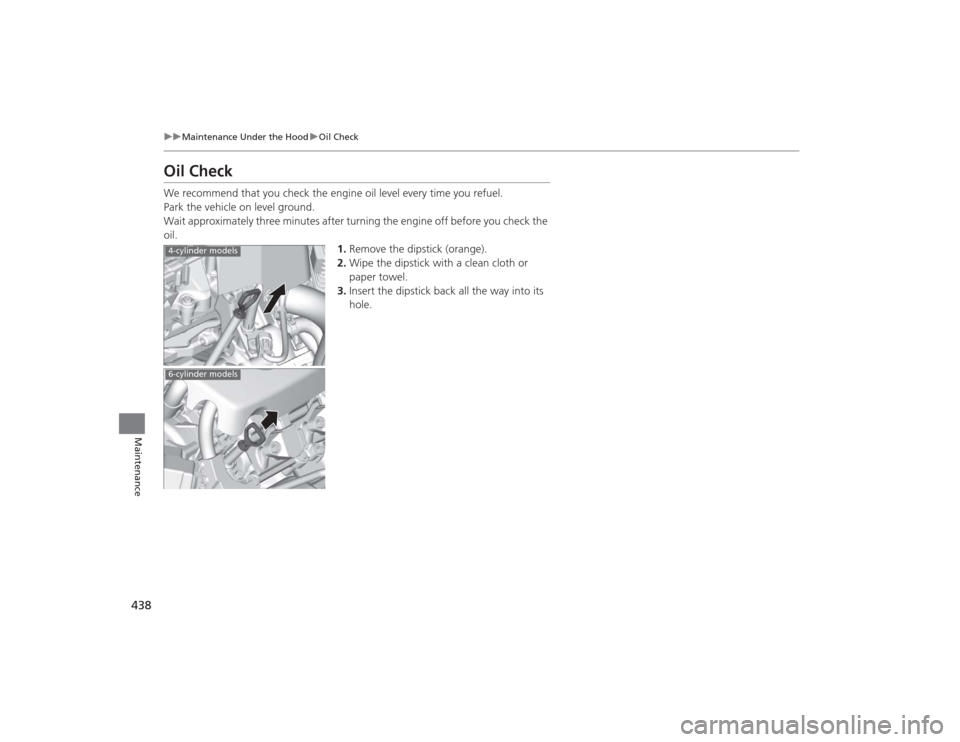
Oil CheckWe recommend that you check the engine oil level every time you refuel.
Park the vehicle on level ground.
Wait approximately three minutes after turning the engine off before you check the
oil.
1.Remove the dipstick (orange).
2. Wipe the dipstick with a clean cloth or
paper towel.
3. Insert the dipstick back all the way into its
hole.4-cylinder models6-cylinder models
Page 444 of 545
443
uuMaintenance Under the Hood uEngine Coolant
Continued
Maintenance
Engine CoolantThis coolant is premixed with 50% antifreeze and 50% water. Do not add any
straight antifreeze or water.
We recommend you check the engine coolant level every time you refuel. Check the
reserve tank first. If it is completely empty, also check the coolant level in the
radiator. Add the engine coolant accordingly.
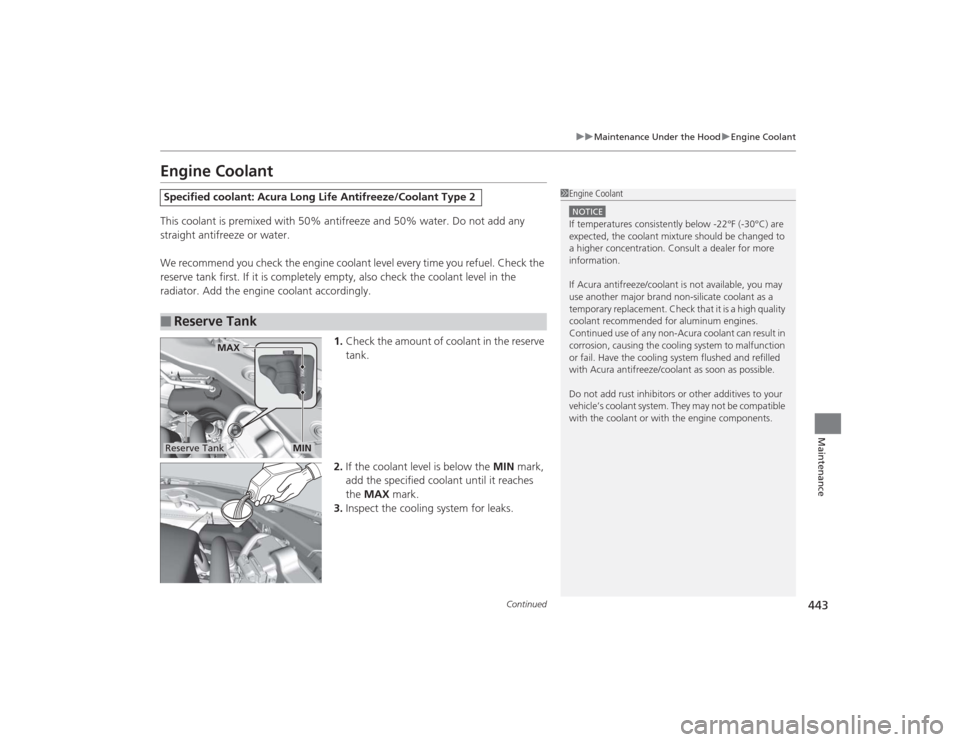
1.Check the amount of coolant in the reserve
tank.
2. If the coolant level is below the MIN mark,
add the specified coolant until it reaches
the MAX mark.
3. Inspect the cooling system for leaks.Specified coolant: Acura Long Life Antifreeze/Coolant Type 2■
Reserve Tank
1Engine CoolantNOTICEIf temperatures consistently below -22°F (-30°C) are
expected, the coolant mixture should be changed to
a higher concentration. Consult a dealer for more
information.
If Acura antifreeze/coolant is not available, you may
use another major brand non-silicate coolant as a
temporary replacement. Check that it is a high quality
coolant recommended for aluminum engines.
Continued use of any non-Acura coolant can result in
corrosion, causing the cooling system to malfunction
or fail. Have the cooling system flushed and refilled
with Acura antifreeze/coolant as soon as possible.
Do not add rust inhibitors or other additives to your
vehicle’s coolant system. They may not be compatible
with the coolant or with the engine components.
Reserve Tank
MAX
MIN
Page 457 of 545
456Maintenance
Checking and Maintaining TiresChecking TiresTo safely operate your vehicle, your tires must be of the proper type and size, in
good condition with adequate tread, and properly inflated.■Inflation guidelines
Properly inflated tires provide the best combination of handling, tread life, and comfort.
Refer to the driver’s doorjamb label or specification’s page for the specified pressure.
Underinflated tires wear unevenly, adversely affec t handling and fuel economy, and
are more likely to fail from overheating.
Overinflated tires make your vehicle ride harshly, are more prone to road hazards,
and wear unevenly.
Every day before you drive, look at each of the tires. If one looks lower than the
others, check the pressure with a tire gauge.
At least once a month or before long trips, use a gauge to measure the pressure in all
tires. Even tires in good condition can lose 1 to 2 psi (10 to 20 kPa, 0.1 to 0.2 kgf/cm
2)
per month.
■Inspection guidelines
Every time you check inflation, also examine the tires and valve stems.
Look for:
• Bumps or bulges on the side or in the tread. Replace the tire if you find any cuts,
splits, or cracks in the side of the tire. Re place it if you see fabric or cord.
• Remove any foreign objects and inspect for air leaks.
• Uneven tread wear. Have a dealer check the wheel alignment.
• Excessive tread wear.2 Wear Indicators P. 461
•Cracks or other damage around valve stem.
1Checking Tires
Measure the air pressure when tires are cold. This
means the vehicle has been par ked for at least three
hours, or driven less than 1 mile (1.6 km). If
necessary, add or release air until the specified
pressure is reached.
If checked when hot, tire pressure can be as much as
4 – 6 psi (30 – 40 kPa, 0.3 – 0.4 kgf/cm
2) higher than
if checked when cold. 2 Tire Fill Assist P. 392
Have a dealer check the tires if you feel a consistent
vibration while driving. New tires and any that have
been removed and reinstalled should be properly
balanced.
Measure the spare tire pressure once a month or
before long trips.
3
WARNING
Using tires that are excessively worn or
improperly inflated can cause a crash in
which you can be seri ously hurt or killed.
Follow all instruc tions in this owner’s
manual regarding tire inflation and
maintenance.Vehicles with optional spare tire
Page 476 of 545

475
Handling the Unexpected
This chapter explains how to handle unexpected troubles.
Tools
Types of Tools .................................. 476
If a Tire Goes Flat Temporarily Repairing a Flat Tire....... 477
Changing a Flat Tire ......................... 489
Engine Does Not Start Checking the Engine ........................ 495
If the Keyless Access Remote Battery is Weak ............................................. 496
Emergency Engine Stop ................... 497
Jump Starting .................................... 498
Shift Lever Does Not Move .............. 502Overheating
How to Handle Overheating............. 503
Indicator, Coming On/Blinking
If the Low Oil Pressure Indicator Comes On .. 505If the Charging System Indicator Comes On ................................................. 505
If the Malfunction Indicator Lamp Comes On or Blinks ................................... 506If the Brake System Indicator (Red) Comes On .. 506If the Electric Power Steering (EPS) System Indicator Comes On ........................... 507
If the Electric Parking Brake System Indicator Comes On ....................... 507 If the Low Tire Pressure/TPMS Indicator
Comes On or Blinks ....................... 508
If the Transmission Indicator Blinks along with the Warning Message.............. 509
Fuses Fuse Locations ................................. 510
Inspecting and Changing Fuses ........ 514
Emergency Towing ........................... 515
When You Cannot Unlock the Fuel Fill Door ................................................. 516
When You Cannot Open the Trunk ..... 517RefuelingRefueling From a Portable Fuel Container ... 518
Page 496 of 545
495Handling the Unexpected
Engine Does Not StartChecking the EngineIf the engine does not start, check the starter.
Starter condition
Checklist
Starter doesn’t turn or turns
over slowly.
The battery may be dead. Check
each of the items on the right and
respond accordingly.
Check for a message on the multi-information display.●If the To Start, Hold Remote Near Start Button message appears
2If the Keyless Access Remote Battery is Weak P. 496
uMake sure the keyless access remote is in its operating range.
2 ENGINE START/STOP Button Operating Range P. 161
Check the brightness of the interior lights.
Turn on the interior lights and check the brightness.●If the interior lights are dim or do not come on at all
2Battery P. 465
●If the interior lights come on normally
2 Fuses P. 510
The starter turns over normally
but the engine doesn’t start.
There may be a problem with the
fuse. Check each of the items on
the right and respond accordingly. Review the engine start procedure.
Follow its instructions, and try to start the engine again.
2
Starting the Engine P. 322
Check the immobilizer system indicator.
When the immobilizer system indicator is blinking, the engine cannot be started.
2Immobilizer System P. 155
Check the fuel level.
There should be enough fuel in the tank.
2 Fuel Gauge P. 117
Check the fuse.
Check all fuses, or have the vehicle checked by a dealer.
2Inspecting and Changing Fuses P. 514
If the problem continues:
2Emergency Towing P. 515
1Checking the Engine
If you must start the vehicle immediately, use an
assisting vehicle to jump start it.
2 Jump Starting P. 498
Page 513 of 545
512
uuFuses uFuse Locations
Handling the Unexpected
Located under the dashboard.
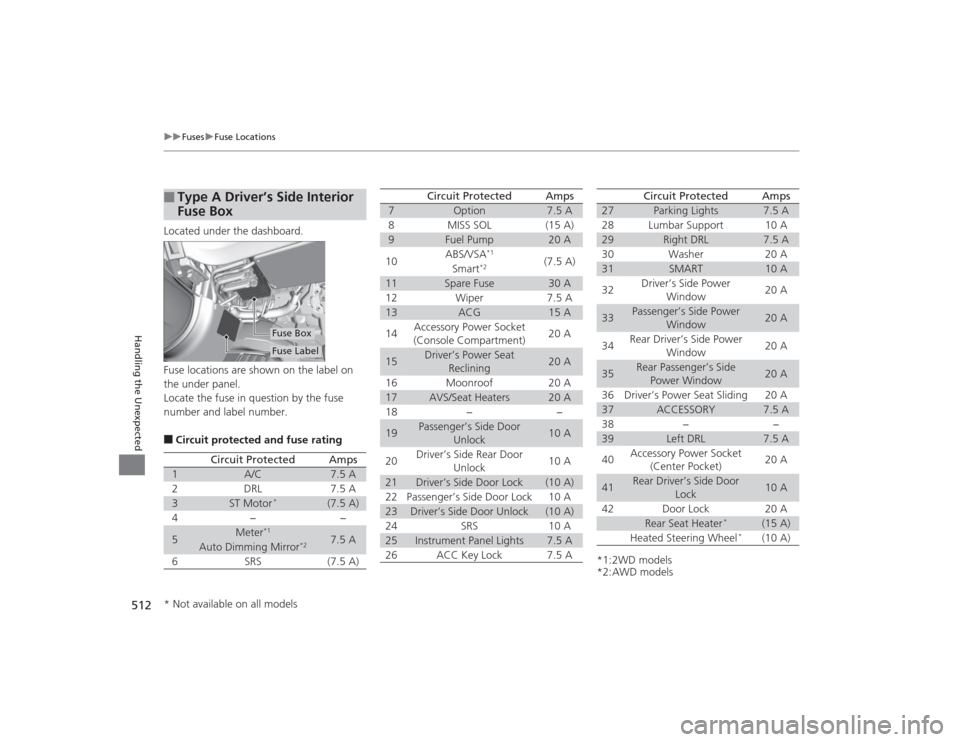
Fuse locations are shown on the label on
the under panel.
Locate the fuse in question by the fuse
number and label number.■Circuit protected and fuse rating■
Type A Driver’s Side Interior
Fuse Box
Fuse LabelFuse Box
Circuit Protected
Amps
1
A/C
7.5 A
2
DRL
7.5 A
3
ST Motor
*
(7.5 A)
4
−
−
5
Meter
*1
7.5 A
Auto Dimming Mirror
*2
6
SRS
(7.5 A)
7
Option
7.5 A
8
MISS SOL
(15 A)
9
Fuel Pump
20 A
10
ABS/VSA
*1
(7.5 A)
Smart
*2
11
Spare Fuse
30 A
12
Wiper
7.5 A
13
ACG
15 A
14
Accessory Power Socket
(Console Compartment)
20 A
15
Driver’s Power Seat Reclining
20 A
16
Moonroof
20 A
17
AVS/Seat Heaters
20 A
18
−
−
19
Passenger’s Side Door Unlock
10 A
20
Driver’s Side Rear Door
Unlock
10 A
21
Driver’s Side Door Lock
(10 A)
22
Passenger’s Side Door Lock
10 A
23
Driver’s Side Door Unlock
(10 A)
24
SRS
10 A
25
Instrument Panel Lights
7.5 A
26
ACC Key Lock
7.5 A
Circuit Protected
Amps
*1:2WD models
*2:AWD models27
Parking Lights
7.5 A
28
Lumbar Support
10 A
29
Right DRL
7.5 A
30
Washer
20 A
31
SMART
10 A
32
Driver’s Side Power Window
20 A
33
Passenger’s Side Power Window
20 A
34
Rear Driver’s Side Power Window
20 A
35
Rear Passenger’s Side
Power Window
20 A
36
Driver’s Power Seat Sliding
20 A
37
ACCESSORY
7.5 A
38
−
−
39
Left DRL
7.5 A
40
Accessory Power Socket (Center Pocket)
20 A
41
Rear Driver’s Side Door Lock
10 A
42
Door Lock
20 A
Rear Seat Heater
*
(15 A)
Heated Steering Wheel
*
(10 A)
Circuit Protected
Amps
* Not available on all models