brake light Acura TSX 2012 Owner's Guide
[x] Cancel search | Manufacturer: ACURA, Model Year: 2012, Model line: TSX, Model: Acura TSX 2012Pages: 324, PDF Size: 9.45 MB
Page 232 of 324
231
uuMaintenance Under the HooduOpening the Hood
Continued
Maintenance
Opening the Hood
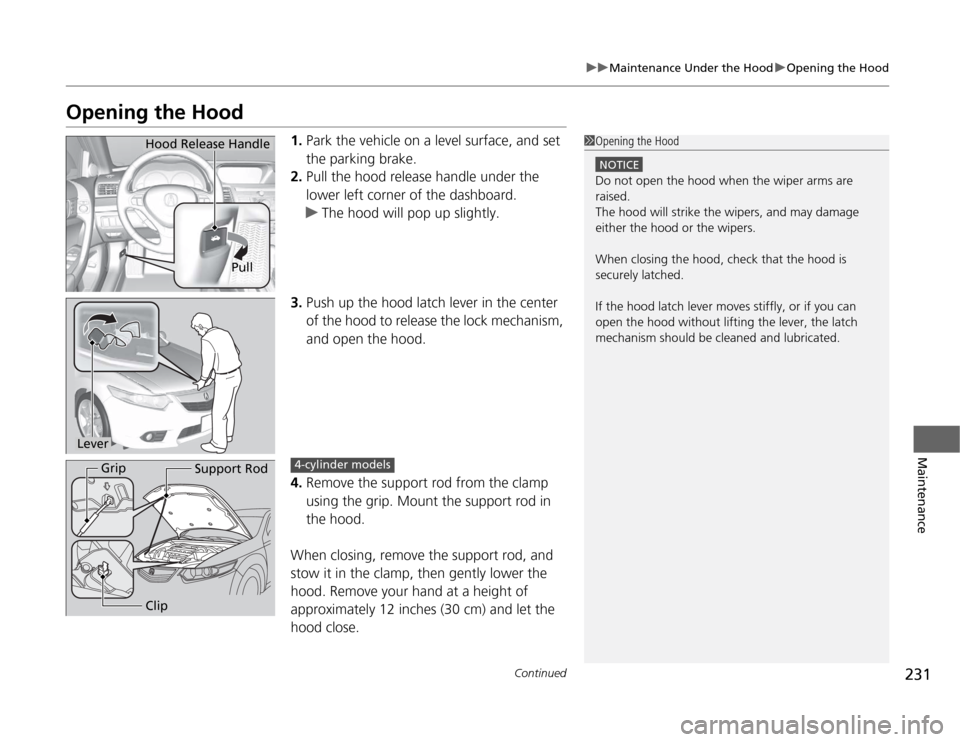
1.Park the vehicle on a level surface, and set
the parking brake.
2.Pull the hood release handle under the
lower left corner of the dashboard.
uThe hood will pop up slightly.
3.Push up the hood latch lever in the center
of the hood to release the lock mechanism,
and open the hood.
4.Remove the support rod from the clamp
using the grip. Mount the support rod in
the hood.
When closing, remove the support rod, and
stow it in the clamp, then gently lower the
hood. Remove your hand at a height of
approximately 12 inches (30 cm) and let the
hood close.
1Opening the Hood
NOTICEDo not open the hood when the wiper arms are
raised.
The hood will strike the wipers, and may damage
either the hood or the wipers.
When closing the hood, check that the hood is
securely latched.
If the hood latch lever moves stiffly, or if you can
open the hood without lifting the lever, the latch
mechanism should be cleaned and lubricated.
Hood Release Handle
Pull
Lever
Support Rod Grip
Clip
4-cylinder models
Page 249 of 324
uuReplacing Light BulbsuHeadlight Bulbs
248Maintenance
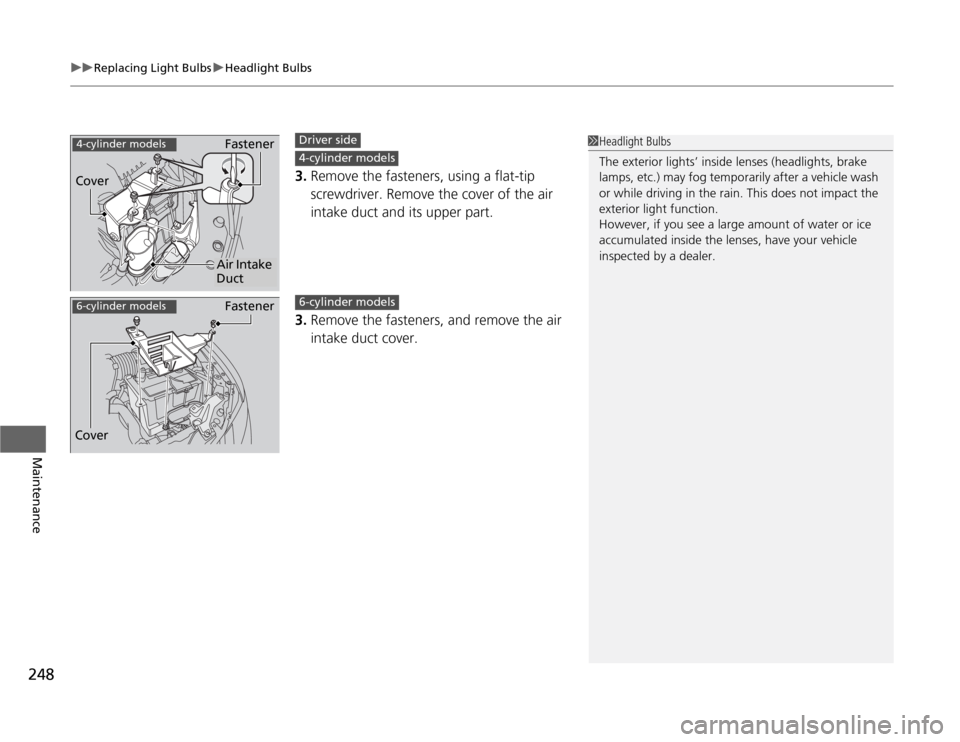
3.Remove the fasteners, using a flat-tip
screwdriver. Remove the cover of the air
intake duct and its upper part.
3.Remove the fasteners, and remove the air
intake duct cover.
1Headlight Bulbs
The exterior lights’ inside lenses (headlights, brake
lamps, etc.) may fog temporarily after a vehicle wash
or while driving in the rain. This does not impact the
exterior light function.
However, if you see a large amount of water or ice
accumulated inside the lenses, have your vehicle
inspected by a dealer.
4-cylinder models
Fastener
CoverAir Intake
Duct
Driver side4-cylinder models
6-cylinder models
Fastener
Cover
6-cylinder models
Page 254 of 324

253
uuReplacing Light BulbsuSide Turn Signal/Emergency Indicator Light Bulbs
Continued
Maintenance
Side Turn Signal/Emergency Indicator Light BulbsDoor mirrors have the side turn lights. Have an authorized Acura dealer inspect and
replace the light bulbs.Brake Light, Taillight, Rear Turn Signal Light and Rear Side Marker Light BulbsWhen replacing, use the following bulbs.
1.Pull out and remove the cover.Brake/Taillight: 21/5 W
Rear Turn Signal Light: 21 W
Rear Side Marker Light: 3 CPCover
Page 257 of 324
256
uuReplacing Light BulbsuHigh-Mount Brake Light Bulbs
Maintenance
High-Mount Brake Light BulbsWhen replacing, use the following bulbs.
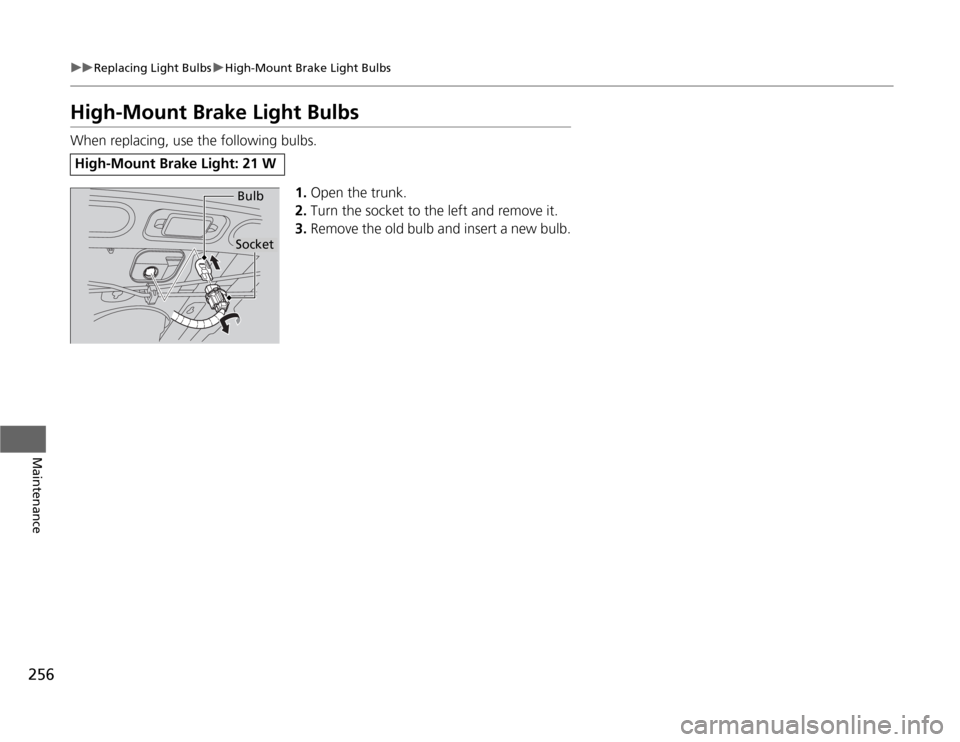
1.Open the trunk.
2.Turn the socket to the left and remove it.
3.Remove the old bulb and insert a new bulb.High-Mount Brake Light: 21 W
BulbSocket
Page 278 of 324
277
Continued
Handling the Unexpected
If a Tire Goes FlatChanging a Flat TireIf a tire goes flat while driving, grasp the steering wheel firmly, and brake gradually
to reduce speed. Then, stop in a safe place. Replace the flat tire with a compact
spare tire. Go to a dealer as soon as possible to have the full size tire repaired or
replaced.
1.Park the vehicle on firm, level, and non-slippery ground.
2.Put the shift lever in
(P
.
2.Put the shift lever in
(R
.
3.Set the parking brake.
4.Turn on the hazard warning lights and turn the ignition switch to LOCK
(0
.
1Changing a Flat Tire
Periodically check the tire pressure of the compact
spare. It should be set to the specified pressure.
Specified Pressure: 60 psi (420 kPa, 4.2 kgf/cm
2)
When driving with the compact spare tire, keep the
vehicle speed under 50 mph (80 km/h). Replace with
a full size tire as soon as possible.
The compact spare tire and wheel in your vehicle are
specifically for this model.
Do not use them with another vehicle.
Do not use another type of compact spare tire or
wheel with your vehicle.
Do not mount tire chains on a compact spare tire.
If a chain-mounted front tire goes flat, remove one of
the full-size rear tires and replace it with the compact
spare tire. Remove the flat front tire and replace it will
the full size tire that was removed from the rear.
Mount the tire chains on the front tire.
Do not use a puncture-repairing agent on a flat tire,
as it can damage the tire pressure sensor.
Automatic transmission modelsManual transmission modelsAll models
Page 289 of 324
288Handling the Unexpected
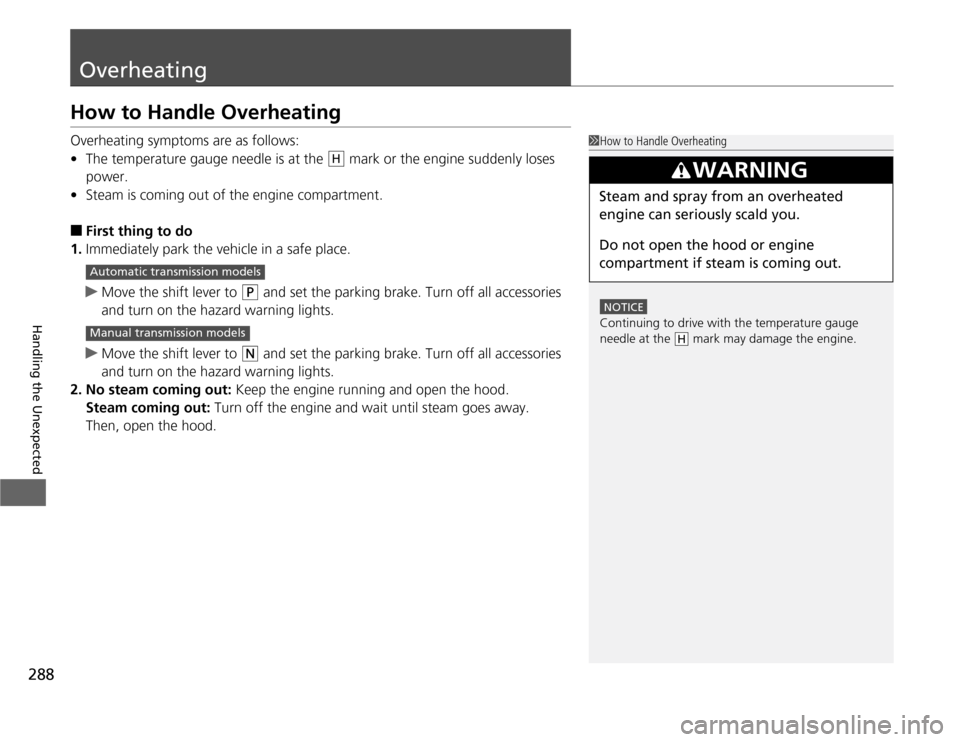
OverheatingHow to Handle OverheatingOverheating symptoms are as follows:
•The temperature gauge needle is at the mark or the engine suddenly loses
power.
•Steam is coming out of the engine compartment.■
First thing to do
1.Immediately park the vehicle in a safe place.
uMove the shift lever to
(P
and set the parking brake. Turn off all accessories
and turn on the hazard warning lights.
uMove the shift lever to
(N
and set the parking brake. Turn off all accessories
and turn on the hazard warning lights.
2. No steam coming out: Keep the engine running and open the hood.
Steam coming out: Turn off the engine and wait until steam goes away.
Then, open the hood.
1How to Handle Overheating
NOTICEContinuing to drive with the temperature gauge
needle at the mark may damage the engine.
3
WARNING
Steam and spray from an overheated
engine can seriously scald you.
Do not open the hood or engine
compartment if steam is coming out.
H
H
Automatic transmission modelsManual transmission models
Page 293 of 324
292
uuIndicator, Coming On/BlinkinguIf the Brake System Indicator Comes On
Handling the Unexpected
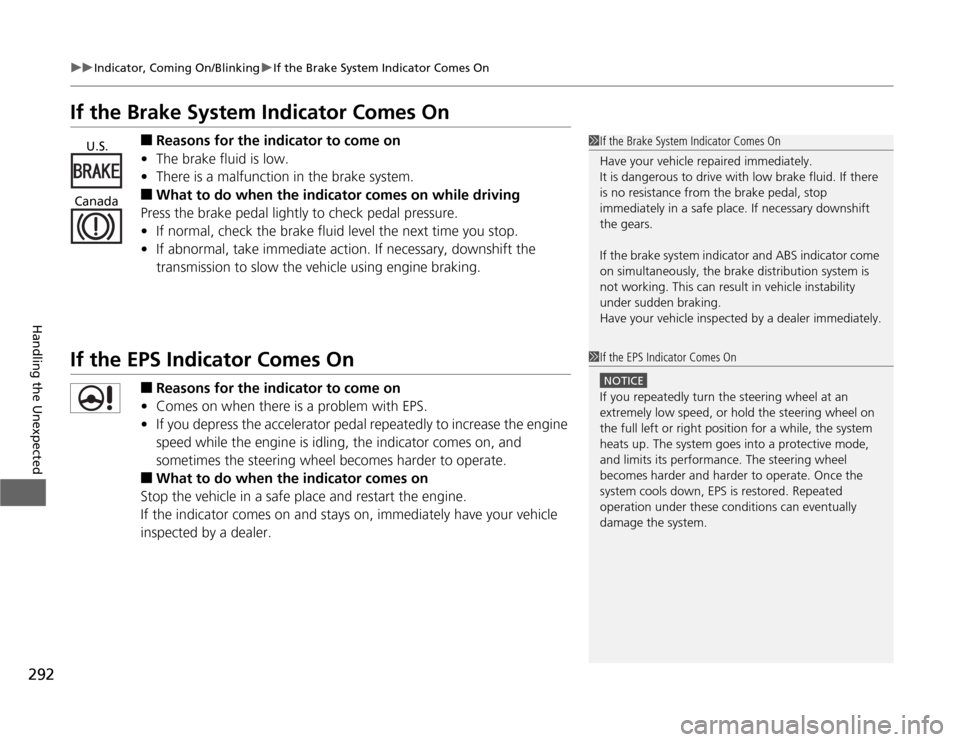
If the Brake System Indicator Comes On
■
Reasons for the indicator to come on
•The brake fluid is low.
•There is a malfunction in the brake system.
■
What to do when the indicator comes on while driving
Press the brake pedal lightly to check pedal pressure.
•If normal, check the brake fluid level the next time you stop.
•If abnormal, take immediate action. If necessary, downshift the
transmission to slow the vehicle using engine braking.
If the EPS Indicator Comes On
■
Reasons for the indicator to come on
•Comes on when there is a problem with EPS.
•If you depress the accelerator pedal repeatedly to increase the engine
speed while the engine is idling, the indicator comes on, and
sometimes the steering wheel becomes harder to operate.
■
What to do when the indicator comes on
Stop the vehicle in a safe place and restart the engine.
If the indicator comes on and stays on, immediately have your vehicle
inspected by a dealer.
1If the Brake System Indicator Comes On
Have your vehicle repaired immediately.
It is dangerous to drive with low brake fluid. If there
is no resistance from the brake pedal, stop
immediately in a safe place. If necessary downshift
the gears.
If the brake system indicator and ABS indicator come
on simultaneously, the brake distribution system is
not working. This can result in vehicle instability
under sudden braking.
Have your vehicle inspected by a dealer immediately.
U.S.
Canada
1If the EPS Indicator Comes On
NOTICEIf you repeatedly turn the steering wheel at an
extremely low speed, or hold the steering wheel on
the full left or right position for a while, the system
heats up. The system goes into a protective mode,
and limits its performance. The steering wheel
becomes harder and harder to operate. Once the
system cools down, EPS is restored. Repeated
operation under these conditions can eventually
damage the system.
Page 305 of 324
304Information
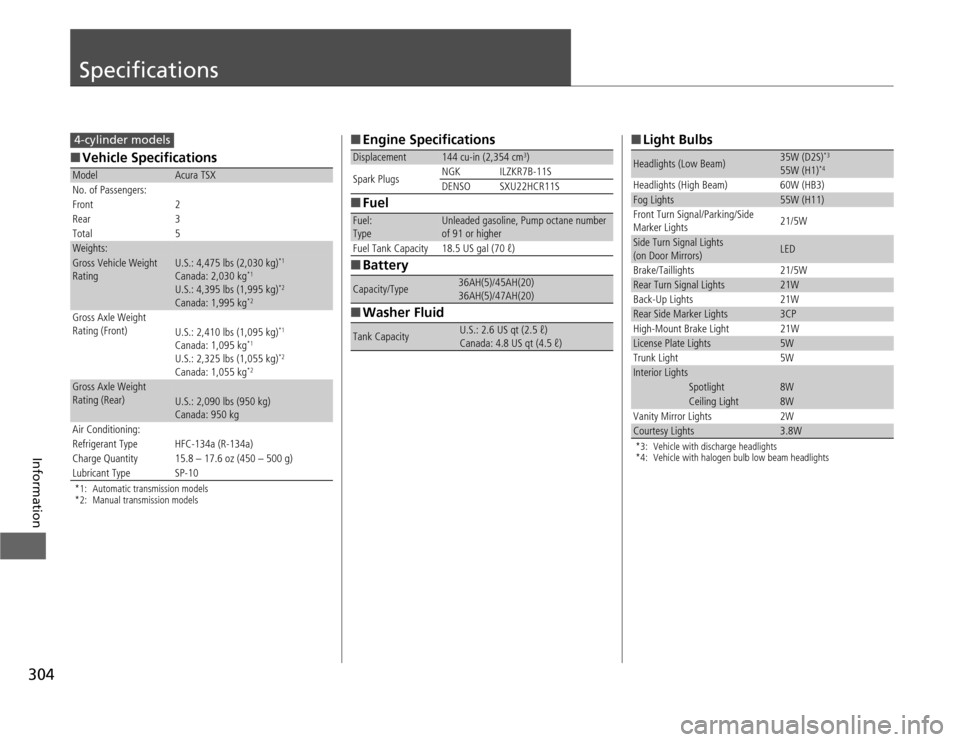
Specifications■Vehicle Specifications*1: Automatic transmission models
*2: Manual transmission modelsModel
Acura TSX
No. of Passengers:
Front 2
Rear 3
Total 5
Weights:Gross Vehicle Weight
Rating
U.S.: 4,475 lbs (2,030 kg)
*1
Canada: 2,030 kg
*1
U.S.: 4,395 lbs (1,995 kg)
*2
Canada: 1,995 kg
*2
Gross Axle Weight
Rating (Front)
U.S.: 2,410 lbs (1,095 kg)
*1
Canada: 1,095 kg
*1
U.S.: 2,325 lbs (1,055 kg)
*2
Canada: 1,055 kg
*2
Gross Axle Weight
Rating (Rear)
U.S.: 2,090 lbs (950 kg)
Canada: 950 kg
Air Conditioning:
Refrigerant Type HFC-134a (R-134a)
Charge Quantity 15.8 – 17.6 oz (450 – 500 g)
Lubricant Type SP-10
4-cylinder models
■Engine Specifications
■Fuel
■Battery
■Washer FluidDisplacement
144 cu-in (2,354 cm
3)
Spark PlugsNGK ILZKR7B-11S
DENSO SXU22HCR11S
Fuel:
Type
Unleaded gasoline, Pump octane number
of 91 or higher
Fuel Tank Capacity 18.5 US gal (70 ℓ)
Capacity/Type
36AH(5)/45AH(20)
36AH(5)/47AH(20)
Tank Capacity
U.S.: 2.6 US qt (2.5 ℓ)
Canada: 4.8 US qt (4.5 ℓ)
■Light Bulbs*3: Vehicle with discharge headlights
*4: Vehicle with halogen bulb low beam headlightsHeadlights (Low Beam)
35W (D2S)
*3
55W (H1)
*4
Headlights (High Beam) 60W (HB3)Fog Lights
55W (H11)
Front Turn Signal/Parking/Side
Marker Lights21/5W
Side Turn Signal Lights
(on Door Mirrors)
LED
Brake/Taillights 21/5W
Rear Turn Signal Lights
21W
Back-Up Lights 21W
Rear Side Marker Lights
3CP
High-Mount Brake Light 21W
License Plate Lights
5W
Trunk Light 5W
Interior Lights
Spotlight
8W
Ceiling Light
8W
Vanity Mirror Lights 2W
Courtesy Lights
3.8W
Page 307 of 324
306
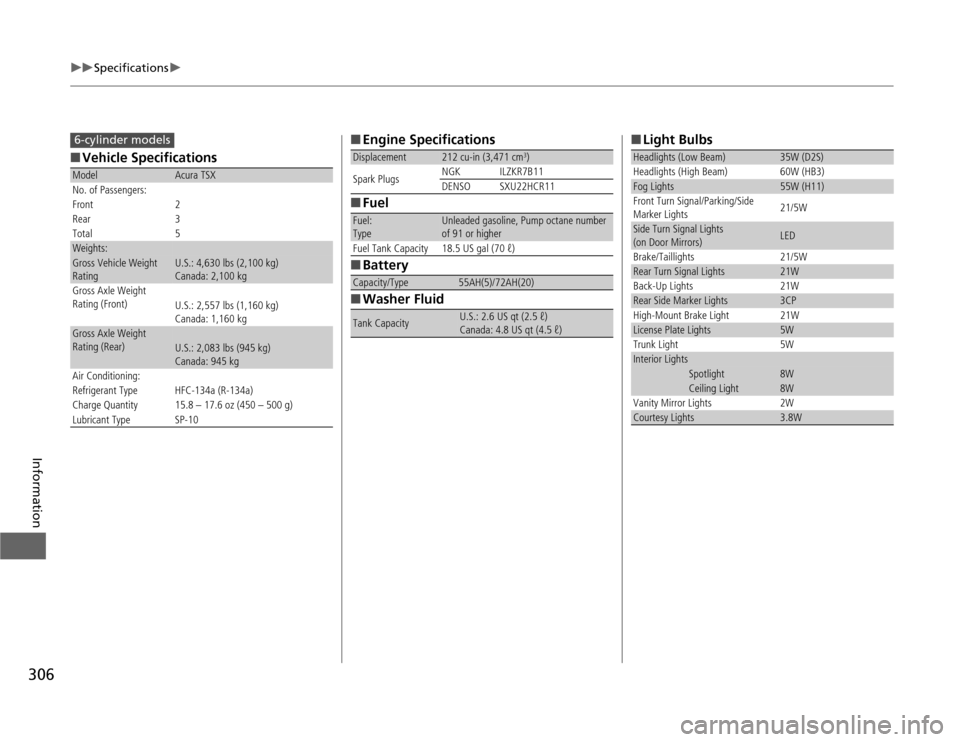
uuSpecificationsu
Information
■Vehicle SpecificationsModel
Acura TSX
No. of Passengers:
Front 2
Rear 3
Total 5
Weights:Gross Vehicle Weight
Rating
U.S.: 4,630 lbs (2,100 kg)
Canada: 2,100 kg
Gross Axle Weight
Rating (Front)
U.S.: 2,557 lbs (1,160 kg)
Canada: 1,160 kg
Gross Axle Weight
Rating (Rear)
U.S.: 2,083 lbs (945 kg)
Canada: 945 kg
Air Conditioning:
Refrigerant Type HFC-134a (R-134a)
Charge Quantity 15.8 – 17.6 oz (450 – 500 g)
Lubricant Type SP-10
6-cylinder models
■Engine Specifications
■Fuel
■Battery
■Washer FluidDisplacement
212 cu-in (3,471 cm
3)
Spark PlugsNGK ILZKR7B11
DENSO SXU22HCR11
Fuel:
Type
Unleaded gasoline, Pump octane number
of 91 or higher
Fuel Tank Capacity 18.5 US gal (70 ℓ)
Capacity/Type
55AH(5)/72AH(20)
Tank Capacity
U.S.: 2.6 US qt (2.5 ℓ)
Canada: 4.8 US qt (4.5 ℓ)
■Light BulbsHeadlights (Low Beam)
35W (D2S)
Headlights (High Beam) 60W (HB3)
Fog Lights
55W (H11)
Front Turn Signal/Parking/Side
Marker Lights21/5W
Side Turn Signal Lights
(on Door Mirrors)
LED
Brake/Taillights 21/5W
Rear Turn Signal Lights
21W
Back-Up Lights 21W
Rear Side Marker Lights
3CP
High-Mount Brake Light 21W
License Plate Lights
5W
Trunk Light 5W
Interior Lights
Spotlight
8W
Ceiling Light
8W
Vanity Mirror Lights 2W
Courtesy Lights
3.8W
Page 313 of 324

312
uuEmissions TestinguTesting of Readiness Codes
Information
7.Select a nearby, lightly traveled major highway where you can maintain a speed
of 50 to 60 mph (80 to 97 km/h) for at least 20 minutes. Drive on the highway in
(D
(automatic) or 5th (manual). Do not use cruise control. When traffic allows,
drive for 90 seconds without moving the accelerator pedal. (Vehicle speed may
vary slightly; this is okay.) If you cannot do this for a continuous 90 seconds
because of traffic conditions, drive for at least 30 seconds, then repeat it two
more times (for a total of 90 seconds).
8.Drive in city/suburban traffic for at least 10 minutes. When traffic conditions
allow, let the vehicle coast for several seconds without using the accelerator pedal
or the brake pedal.
9.Park the vehicle and leave the engine off for 30 minutes.