clutch Alfa Romeo 147 2009 Owner handbook (in English)
[x] Cancel search | Manufacturer: ALFA ROMEO, Model Year: 2009, Model line: 147, Model: Alfa Romeo 147 2009Pages: 291, PDF Size: 5.52 MB
Page 177 of 291
CORRECT USE OF THE CAR
175
STARTING PROCEDURE
IMPORTANTIt is important never to
press the accelerator before the engine has
started.
1) Make sure the handbrake is engaged.
2) Move the gear lever to neutral.
3) Fully depress the clutch pedal, so that
the starter motor is not forced to crank the
gears.
4) Ensure that the electric systems and de-
vices, especially if they absorb high quanti-
ties of energy (e.g. heated rearscreen) are
switched off.
5) Turn the ignition key to the AV Vpo-
sition and release it as soon as the engine
starts.
6) If the engine does not start, return the
key to STOPthen repeat the procedure.
IMPORTANTIf it is difficult to start the
engine do not insist with extended attempts
which may damage the catalyst, but con-
tact Alfa Romeo Authorised Services. The ignition switch is fitted with a safety
device which obliges the driver to return the
key to the STOPposition before repeat-
ing the starting operation if the engine does
not start immediately.
Similarly, when the engine is running, the
device prevents the key being moved from
theMARto the AV Vposition.
STARTING
THE ENGINE
IMPORTANTThe car is fitted with an
electronic engine lock device. If the engine
fails to start, see “The Alfa Romeo CODE sys-
tem”.
C C
O O
R R
R R
E E
C C
T T
U U
S S
E E
O O
F F
T T
H H
E E
C C
A A
R R
We recommend that dur-
ing the initial period you do
not drive to full vehicle
performance (for example exces-
sive acceleration, long journeys at
top speed, hard braking etc.).When the engine is
switched off never leave
the ignition key in the MAR
position to prevent pointless cur-
rent absorption from draining the
battery.
Running the engine in con-
fined areas is extremely
dangerous. The engines consumes
oxygen and produces carbon
monoxide which is a highly toxic
and lethal gas.
WARNING
Page 184 of 291
CORRECT USE OF THE CAR
182
Tyres
Check the pressure of the tyres routinely at
an interval of no more than 4 weeks: if the
pressure is too low consumption levels in-
crease as resistance to rolling is higher. It
should be underscored that in these condi-
tions tyre wear increases and vehicle per-
formance is lower, therefore also its safety.
Useless loads
Never travel with an overload in the boot.
The weight of the vehicle (especially in ur-
ban traffic), and its geometry heavily affect
consumption levels and stability.
Luggage/ski racks
Remove the luggage rack or ski rack from
the roof as soon as they are no longer used.
These accessories lower air penetration and
adversely affect consumption levels. When
needing to carry particularly voluminous ob-
jects, preferably use a trailer.Electric services
Use electric devices only for the amount of
time needed. Rearscreen heating, addition-
al headlights, windscreen wipers and heater
fan need a considerable amount of energy
therefore, increasing the requirement of cur-
rent increases fuel consumption (up to
+25% in the urban cycle).
Climate control system
The climate control system is a further load
bearing heavily on the engine inducing high-
er consumption levels (up to +20% on av-
erage). Outside temperature permitting,
preferably use the air vents.
Aerodynamic items
The use of non-certified aerodynamic items
may adversely affect air drag and con-
sumption levels.DRIVING STYLE
Starting
Do not warm the engine with the car at a
standstill or at idle or high speed: under
these conditions the engine warms up much
more slowly, increasing electrical consump-
tion and emissions. It is therefore advisable
to move off immediately, slowly, avoiding
high speeds. This way the engine will warm
faster.
Pointless manoeuvres
Avoid accelerating when waiting at traffic
lights or before switching off the engine. This
and also double declutching is absolutely
pointless on modern cars and also increase
consumption and pollution.
Gear shifting
As soon as the conditions of the traffic and
road allow, use a higher gear. Using a low
gear to obtain brilliant performance increases
consumption. In the same way improper use
of a high gear increases consumption, emis-
sions and engine wear.
Page 189 of 291
CORRECT USE OF THE CAR
187
USEFUL ACCESSORIES
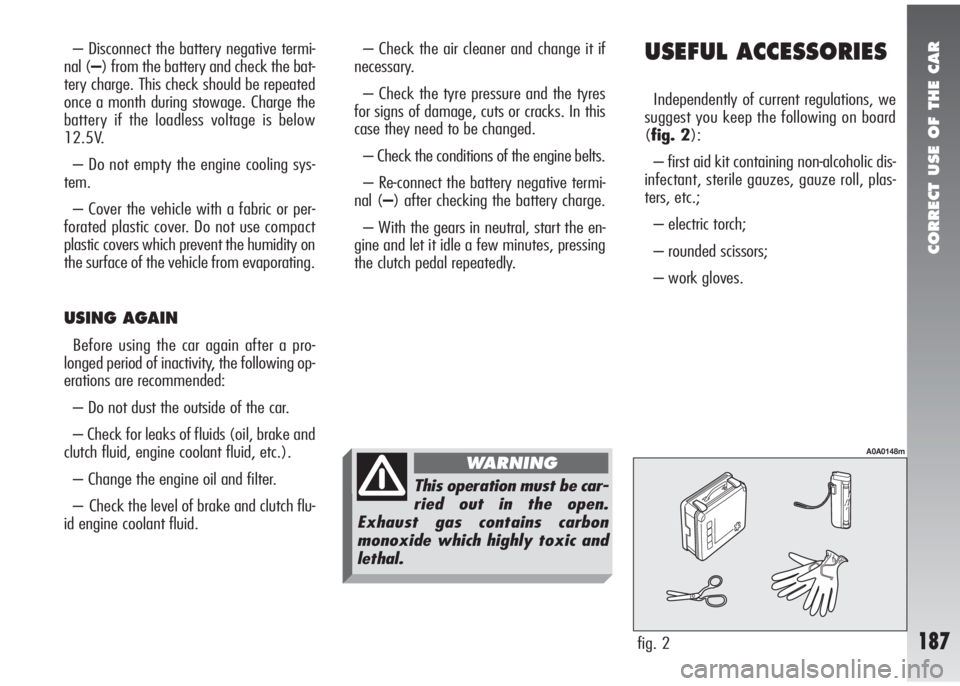
Independently of current regulations, we
suggest you keep the following on board
(fig. 2):
– first aid kit containing non-alcoholic dis-
infectant, sterile gauzes, gauze roll, plas-
ters, etc.;
– electric torch;
– rounded scissors;
– work gloves.
fig. 2
A0A0148m
– Disconnect the battery negative termi-
nal (–) from the battery and check the bat-
tery charge. This check should be repeated
once a month during stowage. Charge the
battery if the loadless voltage is below
12.5V.
– Do not empty the engine cooling sys-
tem.
– Cover the vehicle with a fabric or per-
forated plastic cover. Do not use compact
plastic covers which prevent the humidity on
the surface of the vehicle from evaporating.
USING AGAIN
Before using the car again after a pro-
longed period of inactivity, the following op-
erations are recommended:
– Do not dust the outside of the car.
– Check for leaks of fluids (oil, brake and
clutch fluid, engine coolant fluid, etc.).
– Change the engine oil and filter.
– Check the level of brake and clutch flu-
id engine coolant fluid.– Check the air cleaner and change it if
necessary.
– Check the tyre pressure and the tyres
for signs of damage, cuts or cracks. In this
case they need to be changed.
– Check the conditions of the engine belts.
– Re-connect the battery negative termi-
nal (–) after checking the battery charge.
– With the gears in neutral, start the en-
gine and let it idle a few minutes, pressing
the clutch pedal repeatedly.
This operation must be car-
ried out in the open.
Exhaust gas contains carbon
monoxide which highly toxic and
lethal.
WARNING
Page 226 of 291
VEHICLE MAINTENANCE
224
ADDITIONAL
OPERATIONS
Every 1000 kmor before long journeys,
check and if necessary top up:
– engine coolant fluid level
– brake/hydraulic clutch control fluid level
– power steering fluid level
– windscreen/rearscreen and headlamp
washer fluid level
– tyre pressure and conditions.
Every 3000 kmcheck and if necessary
top up the engine oil level.
The use of products of the FL Seleniais
recommended which have been designed
and made expressly for Alfa Romeo cars
(see “Refuelling” in the “Technical Specifi-
cations” chapter).
ANNUAL INSPECTION
PROGRAMME
For cars with an annual mileage
of below 20,000 km (for example
about 10,000 km) the following
yearly inspection programme is ad-
vised:
– Check tyre conditions/wear and if nec-
essary adjust the pressure
– Check operation of lighting system
(headlights, direction indicators, hazard
warning lights, boot, passenger compart-
ment, glovebox lights, warning lights )
– Check operation of windscreen wiper
system, spray jet adjustment
– Check position/wear of windscreen/
rearscreen wiper blades
– Check front disk brake pad conditions
and wear
– Check for bonnet and boot lock clean-
ness, lever cleanness and lubrication– Sight check for conditions of: engine,
gearbox, transmission, pipes (exhaust - fu-
el supply - brakes) rubber parts (boots -
sleeves - bushes etc..), brake and fuel sup-
ply system hoses
– Check battery charge
– Sight check for conditions of various dri-
ve belts
– Check and if necessary top up fluid lev-
els (engine coolant, brakes, windscreen
washer, battery, etc...)
– Change engine oil
– Change engine oil filter
– Change pollen filter.
Page 232 of 291
VEHICLE MAINTENANCE
230
If the oil level in the reservoir is below the
specified one, top up only with one of the
products listed in the “Fluids and lubricants”
table in the “Technical Specifications” chap-
ter proceeding as follows.
– Start the engine and wait for the oil lev-
el in the reservoir to stabilise.
– With the engine running, turn the steer-
ing wheel lock to lock a few times.
– Top up to the MAXlevel notch, then
refit the cap.
Oil consumption is very
low, if topping up again is
needed shortly afterwards,
have the system checked for pos-
sible leaks by Alfa Romeo Autho-
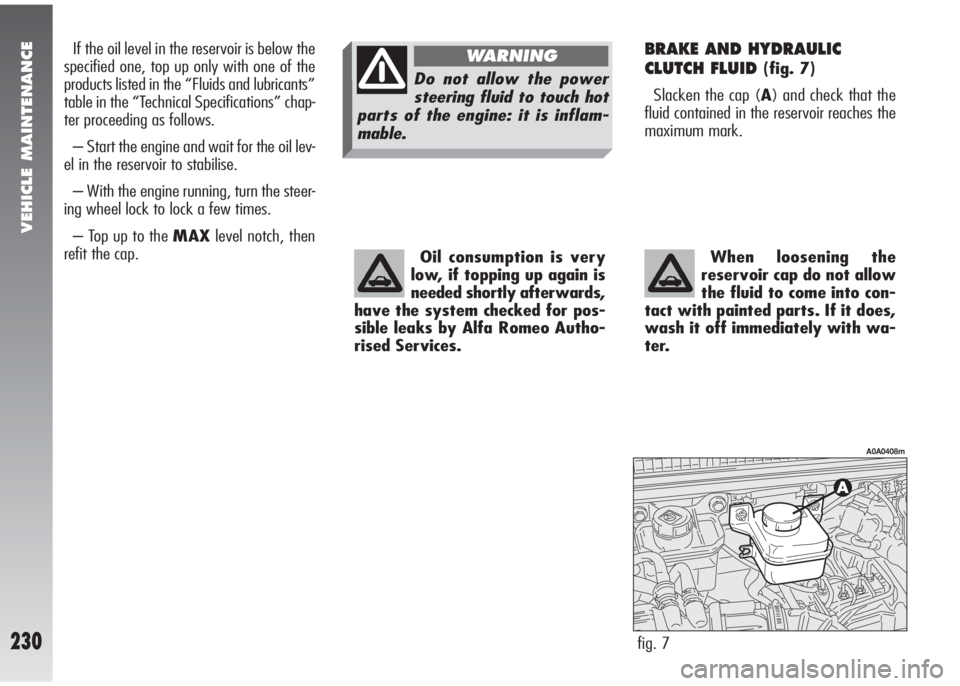
rised Services.BRAKE AND HYDRAULIC
CLUTCH FLUID
(fig. 7)
Slacken the cap (A) and check that the
fluid contained in the reservoir reaches the
maximum mark.
fig. 7
A0A0408m
When loosening the
reservoir cap do not allow
the fluid to come into con-
tact with painted parts. If it does,
wash it off immediately with wa-
ter.
Do not allow the power
steering fluid to touch hot
parts of the engine: it is inflam-
mable.
WARNING
Page 233 of 291
VEHICLE MAINTENANCE
231
To avoid damaging the
pump motor, do not use
the windscreen/rearscreen
washers when the reservoir is
empty.
IMPORTANTBrake and hydraulic clutch
fluid is hygroscopic (i.e. it absorbs moisture).
For this reason, if the car is mainly used in
areas with a high degree of atmospheric hu-
midity, the fluid should be replaced at more
frequent intervals than specified in the
Scheduled Maintenance Programme.
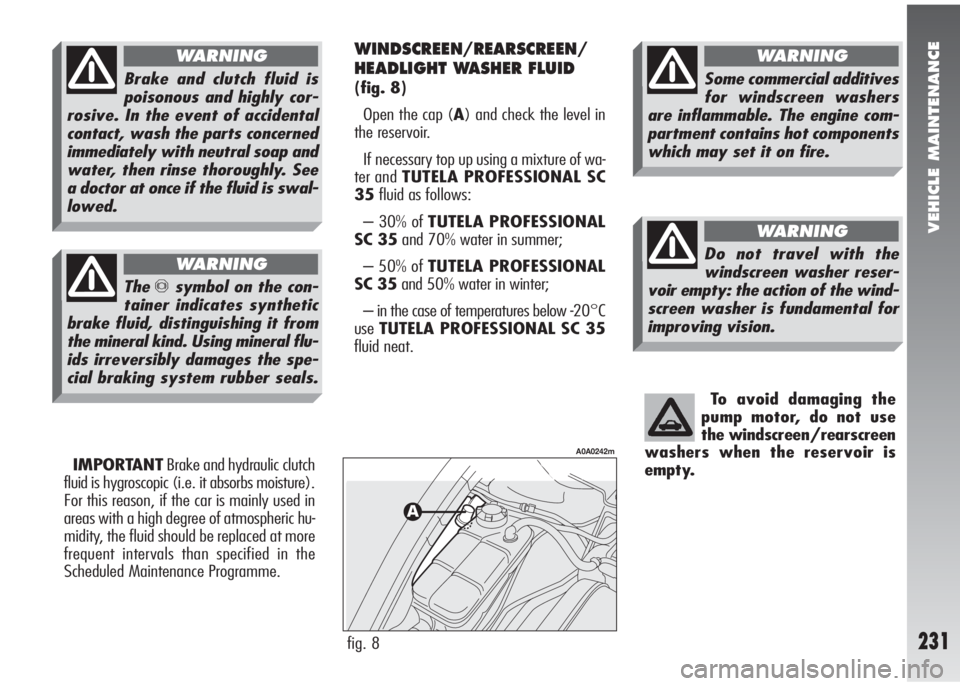
WINDSCREEN/REARSCREEN/
HEADLIGHT WASHER FLUID
(fig. 8)
Open the cap (A) and check the level in
the reservoir.
If necessary top up using a mixture of wa-
ter and TUTELA PROFESSIONAL SC
35fluid as follows:
– 30% of TUTELA PROFESSIONAL
SC 35and 70% water in summer;
– 50% of TUTELA PROFESSIONAL
SC 35and 50% water in winter;
– in the case of temperatures below -20°C
useTUTELA PROFESSIONAL SC 35
fluid neat.
fig. 8
A0A0242m
Theπsymbol on the con-
tainer indicates synthetic
brake fluid, distinguishing it from
the mineral kind. Using mineral flu-
ids irreversibly damages the spe-
cial braking system rubber seals.
WARNING
Brake and clutch fluid is
poisonous and highly cor-
rosive. In the event of accidental
contact, wash the parts concerned
immediately with neutral soap and
water, then rinse thoroughly. See
a doctor at once if the fluid is swal-
lowed.
WARNING
Do not travel with the
windscreen washer reser-
voir empty: the action of the wind-
screen washer is fundamental for
improving vision.
WARNING
Some commercial additives
for windscreen washers
are inflammable. The engine com-
partment contains hot components
which may set it on fire.
WARNING
Page 248 of 291
TECHNICAL SPECIFICATIONS
246
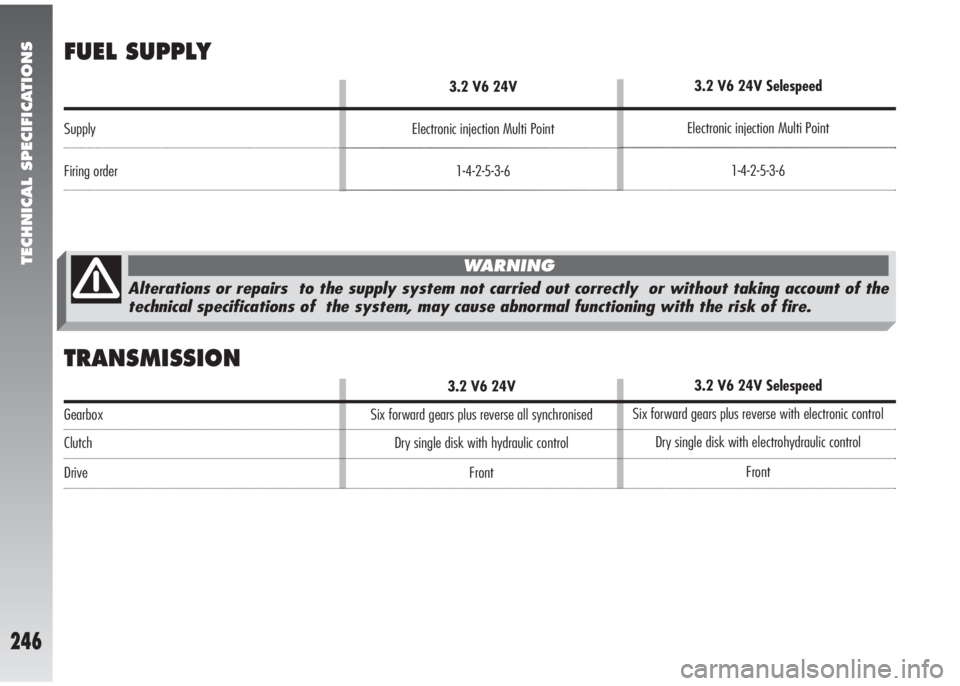
Supply
Firing order
FUEL SUPPLY
TRANSMISSION
3.2 V6 24V
Electronic injection Multi Point
1-4-2-5-3-6
Gearbox
Clutch
Drive
3.2 V6 24V
Six forward gears plus reverse all synchronised
Dry single disk with hydraulic control
Front
3.2 V6 24V Selespeed
Electronic injection Multi Point
1-4-2-5-3-6
3.2 V6 24V Selespeed
Six forward gears plus reverse with electronic control
Dry single disk with electrohydraulic control
Front
Alterations or repairs to the supply system not carried out correctly or without taking account of the
technical specifications of the system, may cause abnormal functioning with the risk of fire.
WARNING
Page 258 of 291

TECHNICAL SPECIFICATIONS
256
Use
Brake fluid
Protective agent for radiators
Windscreen/
rearscreen/headlamp
washer fluid
(*)IMPORTANTDo not add or mix with fluids with specifications other than the specified ones.Recommended fluids
and lubricants
TUTELA CAR
MATRYX
TUTELA CAR
CS SPEED
TUTELA GI/A
TUTELA MRM 2
TUTELA CAR TOP 4
for Alfa Romeo
PARAFLU 11 (*)
or
PARAFLU UP (*)
TUTELA
PROFESSIONAL
SC 35
Applications
Mechanical gearbox and
differential
Selespeed transmission
electrically-operated
electrohydraulic drive
Hydraulic power steering
C.V. joints
Hydraulic brake and
clutch control
Cooling ducts
Percentage:
50% down to –35°C
To be used neat
or diluted Lubricants and greases
for transmissionsQuality features of fluids and lubricants
for correct vehicle operation
SAE 75W-85 synthetic oil.
Meets API GL 4 and MIL-L-2105 D LEV specifications
ATF DEXRON III type oil
“ATF DEXRON II D LEV“, type oil
Lithium-soap-based grease with molybdenum bisulphate.
Consistency NLGI 2
F.M.V.S.S. n° 116 DOT 4, ISO 4925, SAE J1704
CUNA NC 956-01 synthetic fluid
Protective with antifreeze action, blue color, based on inhibited monoethylene
glycol, CUNA NC 956-16
Protective with antifreeze action, red colour, based on inhibited monoethylen
glycol, with O.A.T.-based organic formula, that passes CUNA NC 956-16,
ASTM D 3306 specifications
Mixture of spirits and surface-active agents CUNA NC 956-11
Page 277 of 291

ALPHABETICAL INDEX
275
Brake and clutch hydraulic fluid
- checking level and topping up.... 230
Brakes
- checking fluid level and
topping up .............................. 230
- handbrake .............................. 108
- specifications .......................... 247
Braking lights
- changing bulbs ........................ 205
Bulbs
- general instructions .................. 196
- replacement............................ 198
- types of bulbs ......................... 196
Card holder ................................ 123
Catalyst ...................................... 174
Cell phones (provision) ................. 125
Changing battery of key with
remote control .......................... 10
Changing bulbs- general information.................. 196
- types of bulbs ......................... 196
Checking levels ............................ 226
- checking level and topping
up brake and clutch fluid........... 230
- checking level and topping
up coolant fluid ....................... 229
- checking level and topping
up engine oil ........................... 227
- checking level and topping
up power steering oil................ 229
- checking level and topping up
windscreen/rearscreen/
headlamp washer fluid ............. 231
Children (carrying safely) .............. 31
Cigar lighter ................................ 122
Cleaning and maintenance
- body ...................................... 240
- car interior .............................. 242
- engine compartment ................ 242- leather seats ........................... 242
- plastic parts ............................ 242
- windows ................................ 241
Climate control, automatic
two-zone.................................. 91
Climate control system.............. 89
- air vents ........................ 89-90
- controls .................................. 93
Clock.......................................... 60
Clutch
- checking fluid level and
topping up .............................. 230
CO
2emissions ............................. 258
CODE card................................... 7
Controls ...................................... 106
Correct use of the car............ 175
Courtesy light .............................. 121
- changing bulbs ........................ 207
Cruise control .............................. 47