brake Alfa Romeo 147 2010 Owner handbook (in English)
[x] Cancel search | Manufacturer: ALFA ROMEO, Model Year: 2010, Model line: 147, Model: Alfa Romeo 147 2010Pages: 291, PDF Size: 5.52 MB
Page 177 of 291
CORRECT USE OF THE CAR
175
STARTING PROCEDURE
IMPORTANTIt is important never to
press the accelerator before the engine has
started.
1) Make sure the handbrake is engaged.
2) Move the gear lever to neutral.
3) Fully depress the clutch pedal, so that
the starter motor is not forced to crank the
gears.
4) Ensure that the electric systems and de-
vices, especially if they absorb high quanti-
ties of energy (e.g. heated rearscreen) are
switched off.
5) Turn the ignition key to the AV Vpo-
sition and release it as soon as the engine
starts.
6) If the engine does not start, return the
key to STOPthen repeat the procedure.
IMPORTANTIf it is difficult to start the
engine do not insist with extended attempts
which may damage the catalyst, but con-
tact Alfa Romeo Authorised Services. The ignition switch is fitted with a safety
device which obliges the driver to return the
key to the STOPposition before repeat-
ing the starting operation if the engine does
not start immediately.
Similarly, when the engine is running, the
device prevents the key being moved from
theMARto the AV Vposition.
STARTING
THE ENGINE
IMPORTANTThe car is fitted with an
electronic engine lock device. If the engine
fails to start, see “The Alfa Romeo CODE sys-
tem”.
C C
O O
R R
R R
E E
C C
T T
U U
S S
E E
O O
F F
T T
H H
E E
C C
A A
R R
We recommend that dur-
ing the initial period you do
not drive to full vehicle
performance (for example exces-
sive acceleration, long journeys at
top speed, hard braking etc.).When the engine is
switched off never leave
the ignition key in the MAR
position to prevent pointless cur-
rent absorption from draining the
battery.
Running the engine in con-
fined areas is extremely
dangerous. The engines consumes
oxygen and produces carbon
monoxide which is a highly toxic
and lethal gas.
WARNING
Page 179 of 291
CORRECT USE OF THE CAR
177
EMERGENCY STARTING
If the Alfa Romeo CODE system does not
recognise the code transmitted by the igni-
tion key (
Y)warning light on the instru-
ment cluster on glowing steadily) emer-
gency starting may be carried out using the
code of the CODE card.
For the correct procedure see the chapter
“In an emergency”.
PARKING
When the vehicle is parked, proceed as fol-
lows:
– Switch off the engine.
– Engage the handbrake.
– Engage first gear if the vehicle is fac-
ing uphill or reverse if the vehicle is facing
downhill.
– Turn the front wheels so that the vehi-
cle will immediately come to a halt if the
handbrake slips. Never bump, tow, or
coast start the vehicle as
this would cause fuel to
flow into the catalyst causing irre-
versible damage.
To avoid useless con-
sumption of power and
possibly draining the bat-
tery, never leave the ignition key
in the MAR position when the en-
gine is not running.
Sharp accelerating before
switching the engine off
should be avoided. A
“kick” on the accelerator serves
no purposes and consumes fuel
pointlessly.
IMPORTANT
If the engine turns off with
the vehicle on the move, the next time it
is started, the Alfa Romeo CODE warning
light may turn on (
Y). In this case, check
that switching off and starting the engine
again with the vehicle stationary, the warn-
ing light stays off. If not, contact Alfa Romeo
Authorised Services.
Remember that the servo-
brake and power steering
are not operational until the engine
has been started, therefore much
more effort than usual is required
on the brake pedal and steering
wheel.
WARNING
Never leave children unat-
tended in the vehicle. Al-
ways remove the ignition key
when leaving the vehicle and take
it with you.
WARNING
Page 180 of 291
CORRECT USE OF THE CAR
178
SAFE DRIVING
In designing your Alfa 147 GTA, Al-
fa Romeo has worked thoroughly to achieve
a vehicle able to offer top levels of safety to
its passengers. However, the behaviour of
the driver is still a decisive factor for road
safety.
Below you will find a few simple rules for
travelling safely under different conditions.
You are certainly familiar with many of them
but it is still helpful to read them all care-
fully.
BEFORE DRIVING OFF
– Make sure the lights and headlights are
working properly.
– Adjust the seat, steering wheel and rear-
view mirrors, in order to obtain a correct po-
sition for driving.
– Carefully adjust the headrests so that
the head and not the neck rests on them.
Check that nothing (mats etc.) can get un-
der the foot pedals.– Make sure that any child restraint sys-
tems (seats, cradles, etc.) are correctly fas-
tened on the rear seat.
– Place any objects in the boot with care
to prevent abrupt braking from throwing
them forwards.
– Avoid heavy meals before a journey. A
light meal will help to keep reflexes ready.
Above all avoid alcohol.
Routinely remember to check:
– tyre pressure and conditions;
– engine oil level;
– engine coolant fluid level and system
conditions;
– brake fluid level;
– power steering oil level;
– windscreen washer fluid level.
WHEN TRAVELLING
– The first rule for safe driving is care.
– Care also means being able to predict
the actions of other road users.
– Strictly respect the traffic regulations in
all countries, especially the speed limits.
– Ensure that both yourself and your pas-
sengers are wearing their seat belts, that
children are carried with the appropriate
seats and that any animals are in appropri-
ate compartments.
– Long distances should be tackled in good
health.
Driving under the influence
of drugs and/or some
medicines is highly dangerous for
oneself and for others.
WARNING
Page 181 of 291
CORRECT USE OF THE CAR
179
– Do not drive for long periods without a
break. During breaks get out of the vehicle
and move around a bit to shake off the
drowsiness.
– Make sure the air in the passenger com-
partment is changed constantly.
– Never coast the vehicle downhill with
the engine switched off: this eliminates the
engine braking and power steering effect
thus requiring a greater effort on the pedal
and steering wheel.
NIGHT DRIVING
Here are some suggestions for night dri-
ving.
– Drive with particular care: night driving
involves a greater degree of concentration.
– Reduce speed, especially on unlit roads.
– At the first signs of drowsiness stop the
car: continuing the journey is dangerous for
yourself and others. Continue driving only
after sufficient rest.
– Maintain a greater distance from the ve-
hicle in front than in the day: it is more dif-
ficult to judge the speed of a vehicle when
only the lights can be seen.
– Ensure that the headlights are correctly
aimed: if they are too low, visibility is re-
duced and eyesight is tired. If they are too
high they may cause disturbance to other
road users.
– Use the main beams only outside built-
up areas and only when you are certain that
other drivers are not disturbed by their use.
– When meeting oncoming vehicles,
switch off the main beams and drive with
the dipped-beam headlights on.
– Keep the headlights and light units
clean.
– Outside built-up areas take care of ani-
mal crossings.Always fasten the front and
rear seat belts including
those of any children’s seat. Trav-
elling without seat belts increases
the risks of serious injury or even
death in the event of an accident.
WARNING
Take car when fitting addi-
tional spoilers, alloy wheels
and wheel caps: they might reduce
ventilation of the brakes, thus their
efficiency, during abrupt and re-
peated braking, or long downhill
slopes.
WARNING
Never drive with objects
on the floor in front of the
driver’s seat: they might get stuck
under the pedals making it impos-
sible to accelerate or brake.
WARNING
Make sure any mats are
appropriate in size: even a
slight inconvenience to the braking
system may require a higher ped-
al stroke than normal.
WARNING
Water, ice and salt on the
roads may deposit on the
brake disks, reducing the effec-
tiveness of the brakes the first
time they are used.
WARNING
Page 182 of 291

CORRECT USE OF THE CAR
180
DRIVING WITH RAIN
Rain and wet roads can be dangerous.
If the road is wet, the traction between
wheel and asphalt is greatly reduced, thus
increasing the stopping distance and de-
creasing road holding.
Here are a few suggestions in the case of
rain:
– Reduce speed and keep further back
from the vehicle in front.
– Heavy rain also reduces visibility. In
these cases, turn on the headlights even dur-
ing the day to make yourself more visible
to others.
– Do not drive over puddles at high speed
and hold the steering wheel firmly: you may
lose control of the car (aquaplaning).
– Position the ventilation controls for
demisting (as described in the chapter (“Get-
ting to know your car”), to prevent visibili-
ty from worsening.
– Routinely check the conditions of the
windscreen wiper blades.
DRIVING IN FOG
– If fog is very thick, avoid travelling
where possible. If travelling with mist,
ground fog or the possibility of fog banks:
– Drive at moderate speed.
– Also in the day turn on the dipped-beam
headlights, rear fog guards and front fog
lights. Do not use the main-beam headlights.
IMPORTANTIf visibility in some parts
improves, switch off the rear fog guards; the
intense light disturbs the occupants of ve-
hicles behind.
– Remember that fog also involves wet
asphalt, thus greater difficulty in all types of
manoeuvres and longer stopping distances.
– Keep well away from the vehicle in
front.
– Where possible avoid sudden changes
in speed.
– Possibly avoid overtaking other vehicles.
– If the vehicle is forced to stop (faults,
impossibility to continue due to poor visi-
bility, etc.), firstly try to pull off the road.
Then turn on the hazard warning lights and,
if possible the dipped-beam headlights.
Rhythmically sound the horn if you note an-
other car coming.
MOUNTAIN DRIVING
– When travelling down hill use the en-
gine braking by engaging lower gears to pre-
vent the brakes from overheating.
– Never coast down hill with the engine
off or in neutral and especially not with the
ignition key removed.
– Drive at a moderate speed and avoid
cutting corners.
– Remember that overtaking up hill is
slower and therefore requires a greater
length of clear road. If you are being over-
taken on a hill, move over to enable the oth-
er vehicle to pass in safety.
Page 183 of 291
CORRECT USE OF THE CAR
181
DRIVING ON SNOW AND ICE
Here are a few suggestions for driving in
these conditions:
– Drive very slowly.
– On a snowy road, fit winter tyres or
snow chains; see the related paragraphs in
this chapter.
– Use engine braking where possible and
avoid abrupt braking.
– Braking with a car without ABS, avoid
locking the wheels, modulating the pressure
on the brake pedal.
– Avoid abrupt acceleration and changes
of direction.
– During cold weather even apparently dry
roads may be covered with occasional patch-
es of ice. Pay great attention therefore when
driving on roads which are in the shade, or
where rocks or trees line the road and on
which ice may persist.
– Keep further back from the vehicle in
front.
DRIVING WITH ABS
The ABS is a part of the braking system
which essentially offers 2 advantages:
1) it prevents locking, thus skidding, of the
wheels during emergency braking and es-
pecially under conditions with poor grip;
2) it allows braking and steering at the
same time, to avoid any sudden obstacles
or to direct the car as required when brak-
ing, compatibly with the physical limits of
lateral grip of the tyre.
To make the most of the ABS:
– In emergency braking or when grip is
low, a slight pulsing can be felt on the brake
pedal: this means that the ABS has come in-
to action. Do not release the pedal, but con-
tinue pressing it to give continuity to the
braking action.
– The ABS prevents the wheels from lock-
ing but it does not increase the physical lim-
its of grip between the asphalt and the road.
Therefore, also with a car fitted with ABS,
keep within a safety distance from the ve-
hicle in front and limit speed when ap-
proaching bends.
The ABS serves to increase vehicle con-
trollability not to go faster.
REDUCING RUNNING
COSTS AND
ENVIRONMENT
POLLUTION
By following a few simple guidelines, it
is possible to save vehicle running costs and
reduce harmful emissions.
GENERAL CONSIDERATIONS
Vehicle maintenance
The conditions of the vehicle represent an
important factor which affects fuel con-
sumption as well as travelling tranquillity
and the life of the vehicle. For this reason,
it is wise to take care of its maintenance
have the checks and adjustments carried out
in accordance with the “Scheduled Mainte-
nance Programme” (see... spark plugs, air
cleaner, timing).
Page 188 of 291
CORRECT USE OF THE CAR
186
VEHICLE
INACTIVITY
If the vehicle is to be left inactive for long
periods, the following precautions should be
noted:
– House the vehicle under cover in a dry
and possibly ventilated place.
– Engage a gear.
– Check that the handbrake is not en-
gaged.
– Clean and protect the paintwork by pro-
tective wax.
– Cover the rubber windscreen and
rearscreen wiper blades with talcum powder
and raise them off the glass.
– Open the windows slightly.
– Inflate the tyres to a pressure of 0.5 bars
above normal. If possible rest the tyres on
wooden planks and periodically check the
pressure.
– Do not turn on the electronic alarm sys-
tem. Keep you speed
down when snow
chains are fitted.
Do not exceed 50 km/h. Avoid
potholes, steps and pavements to
prevent damaging the tyres, sus-
pension and steering.
Snow chains should only be applied to the
drive wheels (front).
Before purchasing or using snow chains,
you are recommended to contact Alfa
Romeo Authorised Services.
Check the tension of the chain after the
first few metres have been driven.SNOW CHAINS
Use of snow chains should be in compli-
ance with local regulations.
Use snow chains with reduced size with
maximum protrusion beyond the tyre pro-
file of 12 mm.
Snow chains may not be
used on tyres type 225/45
ZR 17”, 235/35 R18”.
Only spider type chains can be used
on tyres type 215/45 R17” and
215/45 ZR17”. SPIKES SPIDER
COMPACT snow chains (17003
compact model) with 9 arms and 16
mm adjustable length and 17"
wheel cover adapter are available
at Lineaccessori Alfa Romeo. Keep
your speed down when this type of
chains is fitted. Do not exceed 50
km/h with this type of chains,
avoid sudden acceleration and de-
activate the ASR system (the warn-
ing light on the button shall be on).
Remember that snow chains make
braking distance longer.
Page 189 of 291
CORRECT USE OF THE CAR
187
USEFUL ACCESSORIES
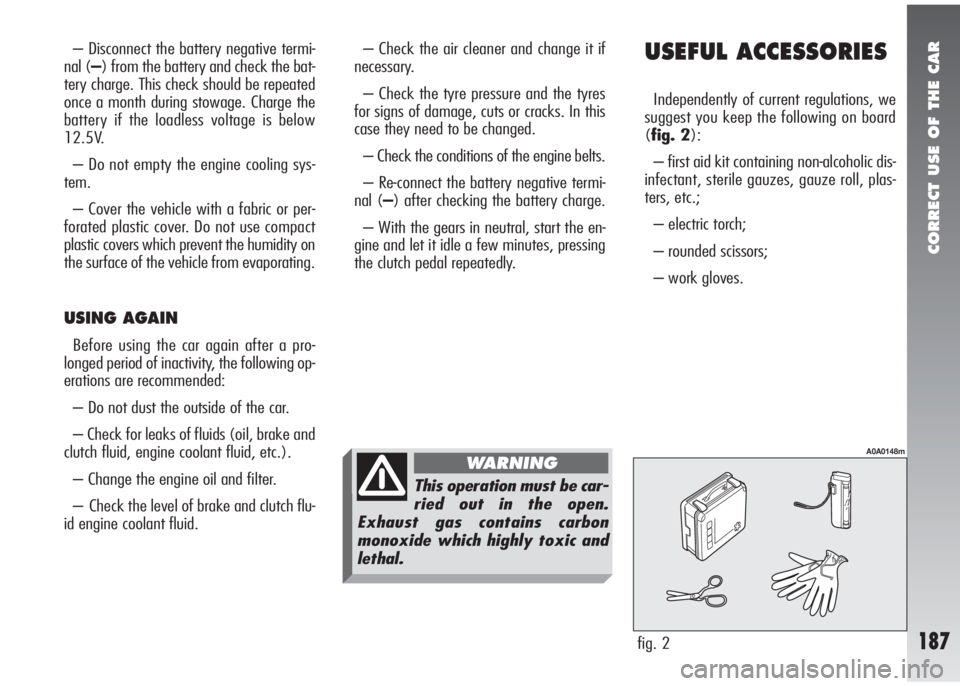
Independently of current regulations, we
suggest you keep the following on board
(fig. 2):
– first aid kit containing non-alcoholic dis-
infectant, sterile gauzes, gauze roll, plas-
ters, etc.;
– electric torch;
– rounded scissors;
– work gloves.
fig. 2
A0A0148m
– Disconnect the battery negative termi-
nal (–) from the battery and check the bat-
tery charge. This check should be repeated
once a month during stowage. Charge the
battery if the loadless voltage is below
12.5V.
– Do not empty the engine cooling sys-
tem.
– Cover the vehicle with a fabric or per-
forated plastic cover. Do not use compact
plastic covers which prevent the humidity on
the surface of the vehicle from evaporating.
USING AGAIN
Before using the car again after a pro-
longed period of inactivity, the following op-
erations are recommended:
– Do not dust the outside of the car.
– Check for leaks of fluids (oil, brake and
clutch fluid, engine coolant fluid, etc.).
– Change the engine oil and filter.
– Check the level of brake and clutch flu-
id engine coolant fluid.– Check the air cleaner and change it if
necessary.
– Check the tyre pressure and the tyres
for signs of damage, cuts or cracks. In this
case they need to be changed.
– Check the conditions of the engine belts.
– Re-connect the battery negative termi-
nal (–) after checking the battery charge.
– With the gears in neutral, start the en-
gine and let it idle a few minutes, pressing
the clutch pedal repeatedly.
This operation must be car-
ried out in the open.
Exhaust gas contains carbon
monoxide which highly toxic and
lethal.
WARNING
Page 192 of 291
IN AN EMERGENCY
190
IMPORTANTThe car is equipped with
“Kit for tyre quick repair Fix&Go“, see the
instructions contained in the following chap-
ter.
STARTING BY INERTIAIN THE EVENT OF A PUNCTURE
Never push, tow or coast
start the vehicle. This could
cause fuel to flow into the
catalyst damaging it irreversibly.
Remember that the engine
brake and power steering
are not operational until the engine
is started, therefore, much greater
effort than usual is needed on the
brake pedal and steering wheel.
WARNING
Signal the presence of the
stationary vehicle according
to the current regulations: hazard
warning lights, reflecting triangle,
etc. Any passengersshould leave
the car.
WARNING
Should the type of wheels
used be changed (alloy
rims instead of steel), it is also nec-
essary to replace the complete kit
of fastening bolts with others of
suitable size.
WARNING
Page 195 of 291
IN AN EMERGENCY
193
INFLATING PROCEDURE
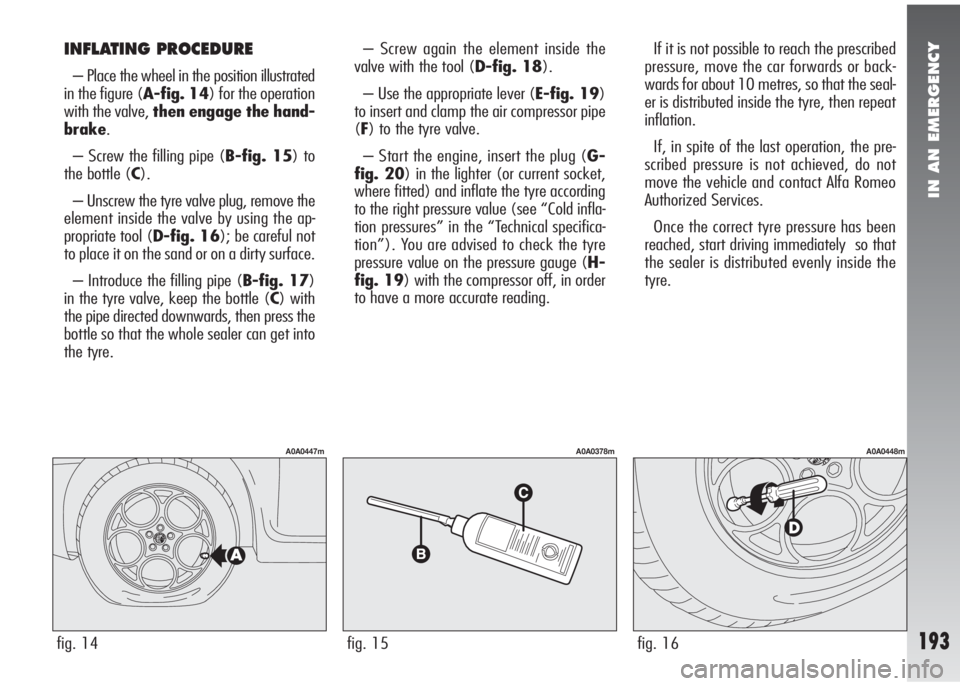
– Place the wheel in the position illustrated
in the figure (A-fig. 14) for the operation
with the valve, then engage the hand-
brake.
– Screw the filling pipe (B-fig. 15) to
the bottle (C).
– Unscrew the tyre valve plug, remove the
element inside the valve by using the ap-
propriate tool (D-fig. 16); be careful not
to place it on the sand or on a dirty surface.
– Introduce the filling pipe (B-fig. 17)
in the tyre valve, keep the bottle (C) with
the pipe directed downwards, then press the
bottle so that the whole sealer can get into
the tyre.– Screw again the element inside the
valve with the tool (D-fig. 18).
– Use the appropriate lever (E-fig. 19)
to insert and clamp the air compressor pipe
(F) to the tyre valve.
– Start the engine, insert the plug (G-
fig. 20) in the lighter (or current socket,
where fitted) and inflate the tyre according
to the right pressure value (see “Cold infla-
tion pressures” in the “Technical specifica-
tion”). You are advised to check the tyre
pressure value on the pressure gauge (H-
fig. 19) with the compressor off, in order
to have a more accurate reading.If it is not possible to reach the prescribed
pressure, move the car forwards or back-
wards for about 10 metres, so that the seal-
er is distributed inside the tyre, then repeat
inflation.
If, in spite of the last operation, the pre-
scribed pressure is not achieved, do not
move the vehicle and contact Alfa Romeo
Authorized Services.
Once the correct tyre pressure has been
reached, start driving immediately so that
the sealer is distributed evenly inside the
tyre.
fig. 14
A0A0447m
fig. 15
A0A0378m
fig. 16
A0A0448m