lights Alfa Romeo 147 2011 Owner handbook (in English)
[x] Cancel search | Manufacturer: ALFA ROMEO, Model Year: 2011, Model line: 147, Model: Alfa Romeo 147 2011Pages: 291, PDF Size: 5.52 MB
Page 124 of 291

GETTING TO KNOW YOUR CAR
122
PUDDLE LIGHTS (fig. 113)
(for versions/markets
where applicable)
The light (A) housed in the doors turns on
when the associated door is opened, re-
gardless of the position of the ignition key.DETERRENT LED (fig. 114)
The led (A) on the instrument cluster
comes into operation when the doors are
locked (ignition key at STOPor removed)
and it remains in the “deterrence” condition,
flashing with a red light until the next time
the doors are unlocked.
IMPORTANTIf a door or the tailgate
are not closed perfectly, the deterrent led
flashes at a higher frequency for 4 seconds
and then flashes at normal frequency again.FRONT ASHTRAY AND CIGAR
LIGHTER
(fig. 115)
To use the ashtray open the lid (A).
To use the ashtray, with the key at MAR,
press button (B); after a few seconds the
button will return automatically to its initial
position and the cigar lighter is ready for use.
Remove the tray to empty and clean the
ashtray (C).
The position of the cigar lighter in relation
to the ashtray and viceversa, may vary de-
pending on the trim level.
fig. 113
A0A0243m
fig. 114
A0A0005m
fig. 115
A0A0433m
Page 127 of 291

GETTING TO KNOW YOUR CAR
125
CELL PHONE
PROVISION
The car may be fitted with a provision for
installing a cell phone.
The mobile phone provision consists in:
– Radio + cell phone dual-purpose anten-
na;
– Connection and supply cables with spe-
cific connector for connecting hands-free kit.
For the installation of a
cell phone and connection
to the provision in the car,
contact only Alfa Romeo Autho-
rised Services; this will guarantee
first-rate results with no possibil-
ity of any inconvenience that may
compromise the safety of the ve-
hicle.
The voice kit should be
purchased by the customer
as it must be compatible
with the customer’s phone.
SUN VISORS (fig. 121)
The visors can be directed at the front and
side.
Behind the visors have a courtesy mirror
with a light at the side (A). To use, open
the cover (B).
The lights allow use of the mirrors with dim
light.
fig. 121
A0A0121m
ACCESSORIES
PURCHASED
BY THE OWNER
If after buying the car, you decide to install
electrical accessories that require a perma-
nent electric supply (alarm, voice feature,
radionavigator with satellite antitheft, etc.)
or accessories that in any case burden the
electric supply, contact Alfa Romeo Autho-
rised Services, whose qualified personnel,
besides suggesting the most suitable devices
belonging to Lineaccessori Alfa Romeo, will
also evaluate the overall electric absorption,
checking whether the vehicle’s electric sys-
tem is able to withstand the load required,
or whether it needs to be integrated with a
more powerful battery.
Page 131 of 291
GETTING TO KNOW YOUR CAR
129fig. 128
A0A0132m
TAILGATE CLOSING
To lock, push in correspondence with the
Alfa Romeo badge to lower tailgate, until
you feel the click of the lock.
LUGGAGE COMPARTMENT
LIGHTING
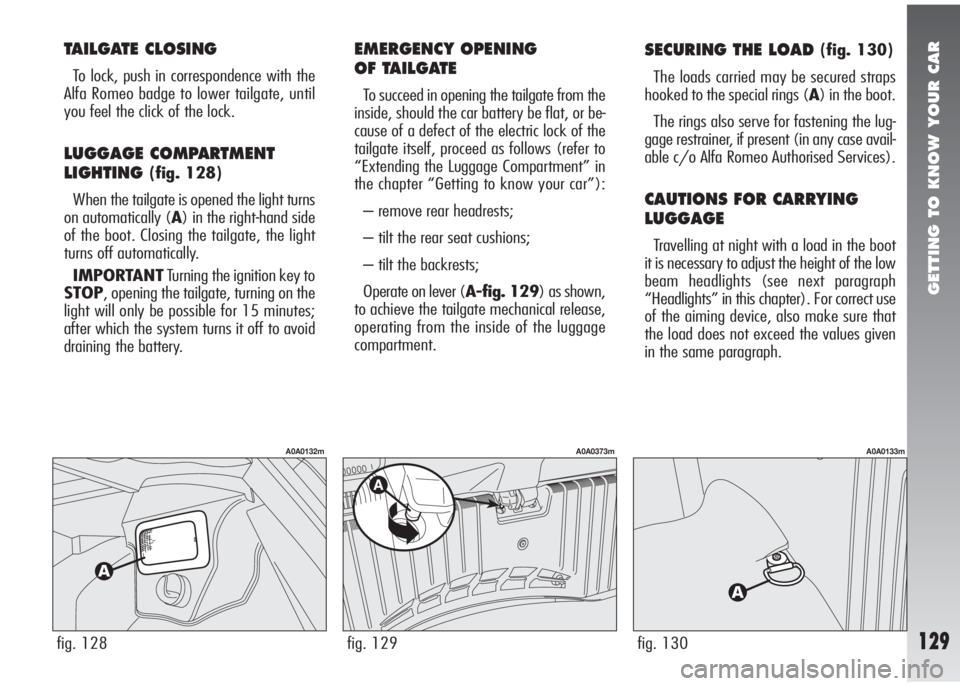
(fig. 128)
When the tailgate is opened the light turns
on automatically (A) in the right-hand side
of the boot. Closing the tailgate, the light
turns off automatically.
IMPORTANTTurning the ignition key to
STOP, opening the tailgate, turning on the
light will only be possible for 15 minutes;
after which the system turns it off to avoid
draining the battery.
SECURING THE LOAD (fig. 130)
The loads carried may be secured straps
hooked to the special rings (A) in the boot.
The rings also serve for fastening the lug-
gage restrainer, if present (in any case avail-
able c/o Alfa Romeo Authorised Services).
CAUTIONS FOR CARRYING
LUGGAGE
Travelling at night with a load in the boot
it is necessary to adjust the height of the low
beam headlights (see next paragraph
“Headlights” in this chapter). For correct use
of the aiming device, also make sure that
the load does not exceed the values given
in the same paragraph.
fig. 130
A0A0133m
fig. 129
A0A0373m
EMERGENCY OPENING
OF TAILGATE
To succeed in opening the tailgate from the
inside, should the car battery be flat, or be-
cause of a defect of the electric lock of the
tailgate itself, proceed as follows (refer to
“Extending the Luggage Compartment” in
the chapter “Getting to know your car”):
– remove rear headrests;
– tilt the rear seat cushions;
– tilt the backrests;
Operate on lever (A-fig. 129) as shown,
to achieve the tailgate mechanical release,
operating from the inside of the luggage
compartment.
Page 134 of 291
GETTING TO KNOW YOUR CAR
132fig. 135
A0A0199m
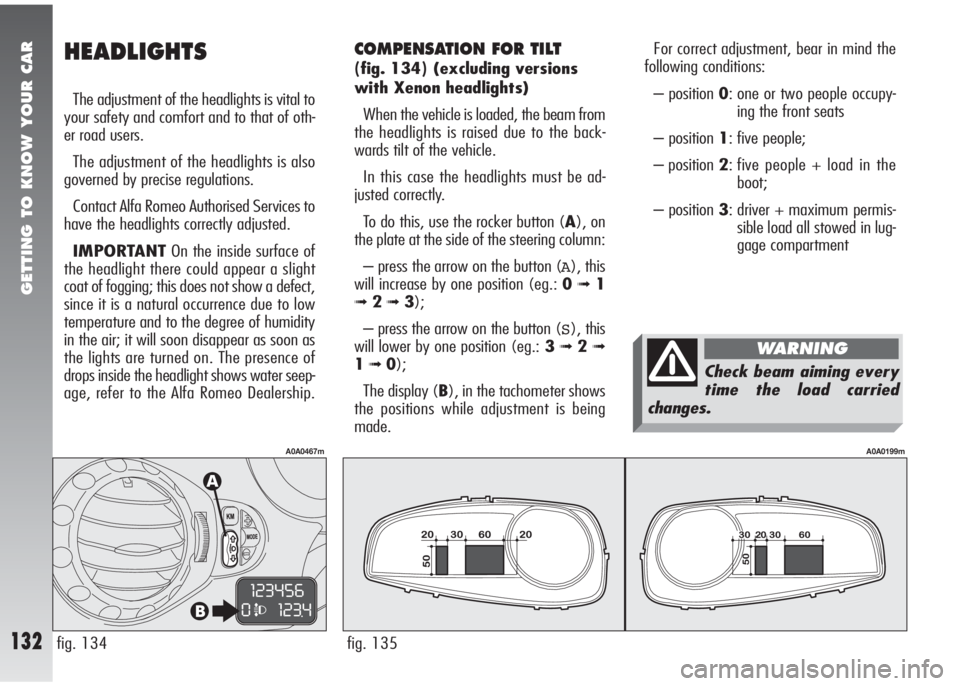
For correct adjustment, bear in mind the
following conditions:
– position 0: one or two people occupy-
ing the front seats
– position 1: five people;
– position 2: five people + load in the
boot;
– position 3: driver + maximum permis-
sible load all stowed in lug-
gage compartmentCOMPENSATION FOR TILT
(fig. 134)(excluding versions
with Xenon headlights)
When the vehicle is loaded, the beam from
the headlights is raised due to the back-
wards tilt of the vehicle.
In this case the headlights must be ad-
justed correctly.
To do this, use the rocker button (A), on
the plate at the side of the steering column:
– press the arrow on the button (
A), this
will increase by one position (eg.: 0
➟1
➟ 2➟3);
– press the arrow on the button (
S), this
will lower by one position (eg.: 3
➟2➟
1➟0);
The display (B), in the tachometer shows
the positions while adjustment is being
made.
fig. 134
A0A0467m
HEADLIGHTS
The adjustment of the headlights is vital to
your safety and comfort and to that of oth-
er road users.
The adjustment of the headlights is also
governed by precise regulations.
Contact Alfa Romeo Authorised Services to
have the headlights correctly adjusted.
IMPORTANTOn the inside surface of
the headlight there could appear a slight
coat of fogging; this does not show a defect,
since it is a natural occurrence due to low
temperature and to the degree of humidity
in the air; it will soon disappear as soon as
the lights are turned on. The presence of
drops inside the headlight shows water seep-
age, refer to the Alfa Romeo Dealership.
Check beam aiming every
time the load carried
changes.
WARNING
Page 135 of 291

GETTING TO KNOW YOUR CAR
133
HEADLIGHT ADJUSTMENT
ABROAD
(fig. 135)
The dipped-beam headlights are adjusted
for circulation in the country in which the ve-
hicle is marketed. In countries with opposite
circulation, to avoid glaring oncoming vehi-
cles it is necessary to cover the areas of the
headlight as shown below; this is done us-
ing non-transparent sticker tape.
The illustration refers to passing from right-
hand drive to left-hand drive.
GAS DISCHARGE
HEADLIGHTS
(optional for versions/markets
where applicable)
The gas (xenon) discharge headlights op-
erate with a voltaic arc, in an ambient sat-
urated with pressure xenon, instead of the
glow filament.
The resulting illumination is sensibly high-
er to that of conventional lamps, both for
light quality (clearer light) and for the width
and positioning of the illuminated area.
The advantages of better illumination can
be perceived (due to less eyesight fatigue
and greater orientation capacity for the dri-
ver, which in turn means higher driving safe-
ty) especially in case of bad weather, fog
and/or insufficient road signs, thanks to the
better illumination of the side parts of the
visual field, normally obscured.
The large increase of the side part illumi-
nation increases driving safety since it allows
the driver to better see the other users on
the edge of the road (pedestrians, cyclists
and bikers).The triggering of the voltaic arc requires a
very high voltage, while subsequent power
supply can take place at a low voltage.
The headlights achieve their top luminosi-
ty approx. 15 seconds after they are switched
on.
The intense light produced by this type of
headlights requires the use of an automat-
ic system to keep headlight trim constant
and avoid dazzling the vehicles coming from
the opposite direction in case of braking, ac-
celeration or when carrying loads.
The electric mechanical system for auto-
matically keeping the trim constant, makes
unnecessary the device for compensating
the headlight dip and the visual indication
of the position on the display.
Xenon lights have a very long life, there-
fore breakdowns are unlikely.
If necessary, have the sys-
tem checked and repaired
only by Alfa Romeo Authorized
Services.
WARNING
Page 137 of 291
GETTING TO KNOW YOUR CAR
135
Always take due car when braking on
bends, even with the help of the ABS.
The most important advice of all, howev-
er, is this:
Following these instruction you will be in
the best braking condition under all circum-
stances.
IMPORTANTCars fitted with ABS may
only be fitted with the wheel rims, tyres and
brake linings of type and brand approved by
the Manufacturer.
The system is completed by the EBD (Elec-
tronic Brake Distributor) which distributes
the braking action through the control unit
and the ABS system sensors.IMPORTANTIf the battery is run down
the
>andxwarning lights might turn
on when starting the engine and go off af-
ter starting. This should not be considered
as a fault but as a warning that during start-
ing the ABS is not active. The turning off
of the warning lights ensures normal system
operation.
When the ABS cuts in, and
you feel the pulsing on the
pedal, do not lighten the pressure,
but keep the pedal firmly pressed
with no fear; this way you will
stop in the least space possible,
compatibly with the conditions of
the road surface.
WARNING
The car is fitted with an
electronic braking distribu-
tor (EBD). If the
>andxwarn-
ing lights turn on simultaneously
with the engine running, this indi-
cates an EBD system failure; in this
case with sharp braking the rear
wheels might lock too early, with
the possibility of skidding. Driving
extremely carefully, go to the near-
est Alfa Romeo Authorised Service
to have the system checked.
WARNING
The turning on of only the
>warning light with the
engine running normally indicates a
fault to the ABS system only. In this
case the braking system is still ef-
ficient, though without the aid of
the anti-lock device. Under these
conditions performance of the EBD
system may be reduced. In this case
too, you areadvised to go immedi-
ately to the nearest Alfa Romeo
Authorised Service to have the sys-
tem checked over, driving in such
a way as to avoid sharp braking.
WARNING
If the low brake fluid lev-
el
xwarning light turns
on, stop the car immediately and
contact the nearest Alfa Romeo
Authorised Service. Any loss of
fluid from the hydraulic system
will negatively affect the opera-
tion of the braking system be it of
the conventional type or of the
type with ABS.
WARNING
Page 180 of 291
CORRECT USE OF THE CAR
178
SAFE DRIVING
In designing your Alfa 147 GTA, Al-
fa Romeo has worked thoroughly to achieve
a vehicle able to offer top levels of safety to
its passengers. However, the behaviour of
the driver is still a decisive factor for road
safety.
Below you will find a few simple rules for
travelling safely under different conditions.
You are certainly familiar with many of them
but it is still helpful to read them all care-
fully.
BEFORE DRIVING OFF
– Make sure the lights and headlights are
working properly.
– Adjust the seat, steering wheel and rear-
view mirrors, in order to obtain a correct po-
sition for driving.
– Carefully adjust the headrests so that
the head and not the neck rests on them.
Check that nothing (mats etc.) can get un-
der the foot pedals.– Make sure that any child restraint sys-
tems (seats, cradles, etc.) are correctly fas-
tened on the rear seat.
– Place any objects in the boot with care
to prevent abrupt braking from throwing
them forwards.
– Avoid heavy meals before a journey. A
light meal will help to keep reflexes ready.
Above all avoid alcohol.
Routinely remember to check:
– tyre pressure and conditions;
– engine oil level;
– engine coolant fluid level and system
conditions;
– brake fluid level;
– power steering oil level;
– windscreen washer fluid level.
WHEN TRAVELLING
– The first rule for safe driving is care.
– Care also means being able to predict
the actions of other road users.
– Strictly respect the traffic regulations in
all countries, especially the speed limits.
– Ensure that both yourself and your pas-
sengers are wearing their seat belts, that
children are carried with the appropriate
seats and that any animals are in appropri-
ate compartments.
– Long distances should be tackled in good
health.
Driving under the influence
of drugs and/or some
medicines is highly dangerous for
oneself and for others.
WARNING
Page 181 of 291
CORRECT USE OF THE CAR
179
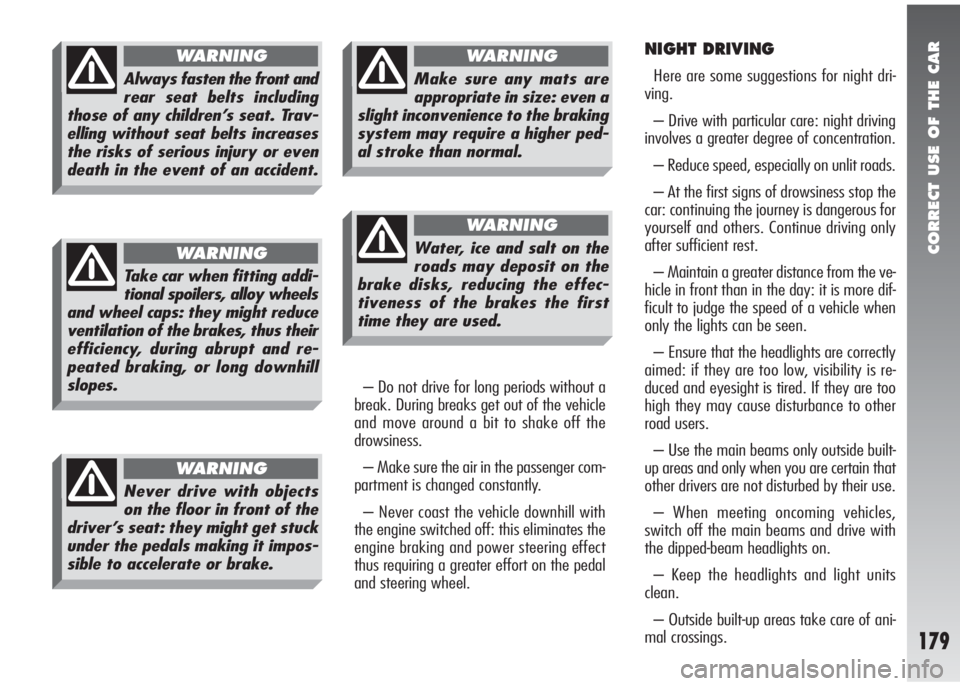
– Do not drive for long periods without a
break. During breaks get out of the vehicle
and move around a bit to shake off the
drowsiness.
– Make sure the air in the passenger com-
partment is changed constantly.
– Never coast the vehicle downhill with
the engine switched off: this eliminates the
engine braking and power steering effect
thus requiring a greater effort on the pedal
and steering wheel.
NIGHT DRIVING
Here are some suggestions for night dri-
ving.
– Drive with particular care: night driving
involves a greater degree of concentration.
– Reduce speed, especially on unlit roads.
– At the first signs of drowsiness stop the
car: continuing the journey is dangerous for
yourself and others. Continue driving only
after sufficient rest.
– Maintain a greater distance from the ve-
hicle in front than in the day: it is more dif-
ficult to judge the speed of a vehicle when
only the lights can be seen.
– Ensure that the headlights are correctly
aimed: if they are too low, visibility is re-
duced and eyesight is tired. If they are too
high they may cause disturbance to other
road users.
– Use the main beams only outside built-
up areas and only when you are certain that
other drivers are not disturbed by their use.
– When meeting oncoming vehicles,
switch off the main beams and drive with
the dipped-beam headlights on.
– Keep the headlights and light units
clean.
– Outside built-up areas take care of ani-
mal crossings.Always fasten the front and
rear seat belts including
those of any children’s seat. Trav-
elling without seat belts increases
the risks of serious injury or even
death in the event of an accident.
WARNING
Take car when fitting addi-
tional spoilers, alloy wheels
and wheel caps: they might reduce
ventilation of the brakes, thus their
efficiency, during abrupt and re-
peated braking, or long downhill
slopes.
WARNING
Never drive with objects
on the floor in front of the
driver’s seat: they might get stuck
under the pedals making it impos-
sible to accelerate or brake.
WARNING
Make sure any mats are
appropriate in size: even a
slight inconvenience to the braking
system may require a higher ped-
al stroke than normal.
WARNING
Water, ice and salt on the
roads may deposit on the
brake disks, reducing the effec-
tiveness of the brakes the first
time they are used.
WARNING
Page 182 of 291
CORRECT USE OF THE CAR
180
DRIVING WITH RAIN
Rain and wet roads can be dangerous.
If the road is wet, the traction between
wheel and asphalt is greatly reduced, thus
increasing the stopping distance and de-
creasing road holding.
Here are a few suggestions in the case of
rain:
– Reduce speed and keep further back
from the vehicle in front.
– Heavy rain also reduces visibility. In
these cases, turn on the headlights even dur-
ing the day to make yourself more visible
to others.
– Do not drive over puddles at high speed
and hold the steering wheel firmly: you may
lose control of the car (aquaplaning).
– Position the ventilation controls for
demisting (as described in the chapter (“Get-
ting to know your car”), to prevent visibili-
ty from worsening.
– Routinely check the conditions of the
windscreen wiper blades.
DRIVING IN FOG
– If fog is very thick, avoid travelling
where possible. If travelling with mist,
ground fog or the possibility of fog banks:
– Drive at moderate speed.
– Also in the day turn on the dipped-beam
headlights, rear fog guards and front fog
lights. Do not use the main-beam headlights.
IMPORTANTIf visibility in some parts
improves, switch off the rear fog guards; the
intense light disturbs the occupants of ve-
hicles behind.
– Remember that fog also involves wet
asphalt, thus greater difficulty in all types of
manoeuvres and longer stopping distances.
– Keep well away from the vehicle in
front.
– Where possible avoid sudden changes
in speed.
– Possibly avoid overtaking other vehicles.
– If the vehicle is forced to stop (faults,
impossibility to continue due to poor visi-
bility, etc.), firstly try to pull off the road.
Then turn on the hazard warning lights and,
if possible the dipped-beam headlights.
Rhythmically sound the horn if you note an-
other car coming.
MOUNTAIN DRIVING
– When travelling down hill use the en-
gine braking by engaging lower gears to pre-
vent the brakes from overheating.
– Never coast down hill with the engine
off or in neutral and especially not with the
ignition key removed.
– Drive at a moderate speed and avoid
cutting corners.
– Remember that overtaking up hill is
slower and therefore requires a greater
length of clear road. If you are being over-
taken on a hill, move over to enable the oth-
er vehicle to pass in safety.
Page 184 of 291
CORRECT USE OF THE CAR
182
Tyres
Check the pressure of the tyres routinely at
an interval of no more than 4 weeks: if the
pressure is too low consumption levels in-
crease as resistance to rolling is higher. It
should be underscored that in these condi-
tions tyre wear increases and vehicle per-
formance is lower, therefore also its safety.
Useless loads
Never travel with an overload in the boot.
The weight of the vehicle (especially in ur-
ban traffic), and its geometry heavily affect
consumption levels and stability.
Luggage/ski racks
Remove the luggage rack or ski rack from
the roof as soon as they are no longer used.
These accessories lower air penetration and
adversely affect consumption levels. When
needing to carry particularly voluminous ob-
jects, preferably use a trailer.Electric services
Use electric devices only for the amount of
time needed. Rearscreen heating, addition-
al headlights, windscreen wipers and heater
fan need a considerable amount of energy
therefore, increasing the requirement of cur-
rent increases fuel consumption (up to
+25% in the urban cycle).
Climate control system
The climate control system is a further load
bearing heavily on the engine inducing high-
er consumption levels (up to +20% on av-
erage). Outside temperature permitting,
preferably use the air vents.
Aerodynamic items
The use of non-certified aerodynamic items
may adversely affect air drag and con-
sumption levels.DRIVING STYLE
Starting
Do not warm the engine with the car at a
standstill or at idle or high speed: under
these conditions the engine warms up much
more slowly, increasing electrical consump-
tion and emissions. It is therefore advisable
to move off immediately, slowly, avoiding
high speeds. This way the engine will warm
faster.
Pointless manoeuvres
Avoid accelerating when waiting at traffic
lights or before switching off the engine. This
and also double declutching is absolutely
pointless on modern cars and also increase
consumption and pollution.
Gear shifting
As soon as the conditions of the traffic and
road allow, use a higher gear. Using a low
gear to obtain brilliant performance increases
consumption. In the same way improper use
of a high gear increases consumption, emis-
sions and engine wear.