tow Alfa Romeo 156 2007 Owner handbook (in English)
[x] Cancel search | Manufacturer: ALFA ROMEO, Model Year: 2007, Model line: 156, Model: Alfa Romeo 156 2007Pages: 357, PDF Size: 5.04 MB
Page 96 of 357
GETTING TO KNOW YOUR CAR94
Warning light Message
on display
ç
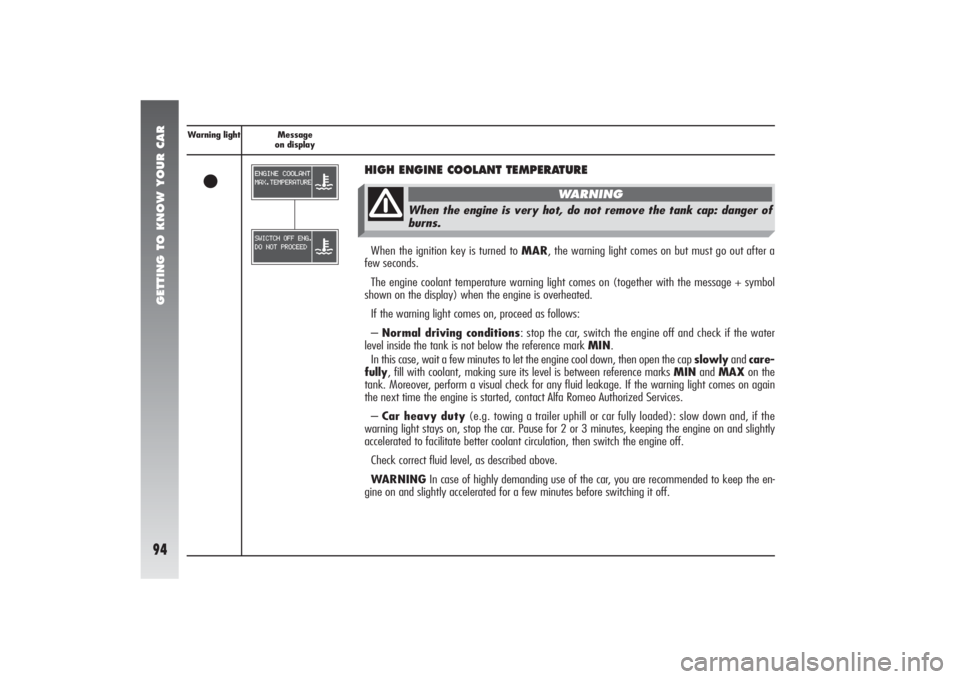
HIGH ENGINE COOLANT TEMPERATUREWhen the ignition key is turned to MAR, the warning light comes on but must go out after a
few seconds.
The engine coolant temperature warning light comes on (together with the message + symbol
shown on the display) when the engine is overheated.
If the warning light comes on, proceed as follows:
– Normal driving conditions: stop the car, switch the engine off and check if the water
level inside the tank is not below the reference mark MIN.
In this case, wait a few minutes to let the engine cool down, then open the cap slowlyand care-
fully, fill with coolant, making sure its level is between reference marks MINand MAXon the
tank. Moreover, perform a visual check for any fluid leakage. If the warning light comes on again
the next time the engine is started, contact Alfa Romeo Authorized Services.
– Car heavy duty(e.g. towing a trailer uphill or car fully loaded): slow down and, if the
warning light stays on, stop the car. Pause for 2 or 3 minutes, keeping the engine on and slightly
accelerated to facilitate better coolant circulation, then switch the engine off.
Check correct fluid level, as described above.
WARNINGIn case of highly demanding use of the car, you are recommended to keep the en-
gine on and slightly accelerated for a few minutes before switching it off.
When the engine is very hot, do not remove the tank cap: danger of
burns.
WARNING
Page 108 of 357

GETTING TO KNOW YOUR CAR
106
l
DIRECTION INDICATORS IF A TRAILER IS TOWEDThe warning light on the dial comes on when the direction indicator control lever is moved up or
down, or when the hazard warning light button is pressed.
Warning light Message
on display1
MAIN-BEAM HEADLIGHTSThe warning light comes on when these lights are turned on.
3Ü
SIDELIGHTS AND DIPPED-BEAM HEADLIGHTSThe warning light on the dial comes on when the sidelights or dipped-beam headlights are
switched on.CONSTANT SPEED ADJUSTMENT (CRUISE CONTROL)
(where applicable)The warning light on the check panel turns on, with the knurled ring of the cruise control in the
ON position, when the device starts to intervene on the engine.
Page 111 of 357

GETTING TO KNOW YOUR CAR
109
UPPER VENT ADJUSTMENT(fig. 95)
The vent has an opening/closing control.•
= Completely closed.
)= Completely open.
CENTRE VENT ADJUSTMENT(fig. 96)
Each vent has a lever which makes it pos-
sible to direct the flow of air towards the
passengers in an horizontal direction. To ad-
just the air flow, use the opening/closing
centre vent device.•
= Completely closed.
(= Completely open.
UPPER SIDE VENT ADJUSTMENT(fig. 97)
On the dashboard ends are adjustable vents
(A) for car interior, and fixed defrosting/
demisting vents (B) for side windows.
Air flow can be adjusted by means of the
knob (C).•
= Completely closed.
)= Completely open.
fig. 95
A0B0572m
fig. 96
A0B0573m
fig. 97
A0B0039m
Page 128 of 357

GETTING TO KNOW YOUR CAR
126
AIR DISTRIBUTION SELECTION
BUTTON
(fig. 108)
By pressing button MODE(8) repeat-
edly, you can manually choose one of the
five possible modes for air distribution:
E
Flow of air to the dashboard centre
and side outlets and rear outlets.
ZE
Splitting of the air flow between the
vents to the lower part of the pas-
senger compartment (warmest air)
and the dashboard centre and side
outlets and the rear outlet (coolest
air). This air flow distribution is par-
ticularly useful in spring and autumn,
when the sun is shining.
Z
Air flow towards the front and rear
lower part of the passenger compart-
ment. Due to the natural tendency of
heat to spread upwards, this type of
distribution allows heating of the pas-
senger compartment in the shortest
time, also giving a prompt feeling of
warmth to the coldest parts of the
body.
Q
Splitting of the air flow between the
windscreen and side window defrost-
ing/demisting vents and the lower
part of the passenger compartment.
This type of air distribution allows sat-
isfactory heating of the passenger
compartment while preventing pos-
sible misting of the windows.
Q
Air flow to the windscreen and front
side window vents to demist or de-
frost them.
To resume automatic air distribution con-
trol after a manual selection, press button
(14) AUTO
.
fig. 108
A0B0069m
Z
Page 134 of 357
GETTING TO KNOW YOUR CAR
132
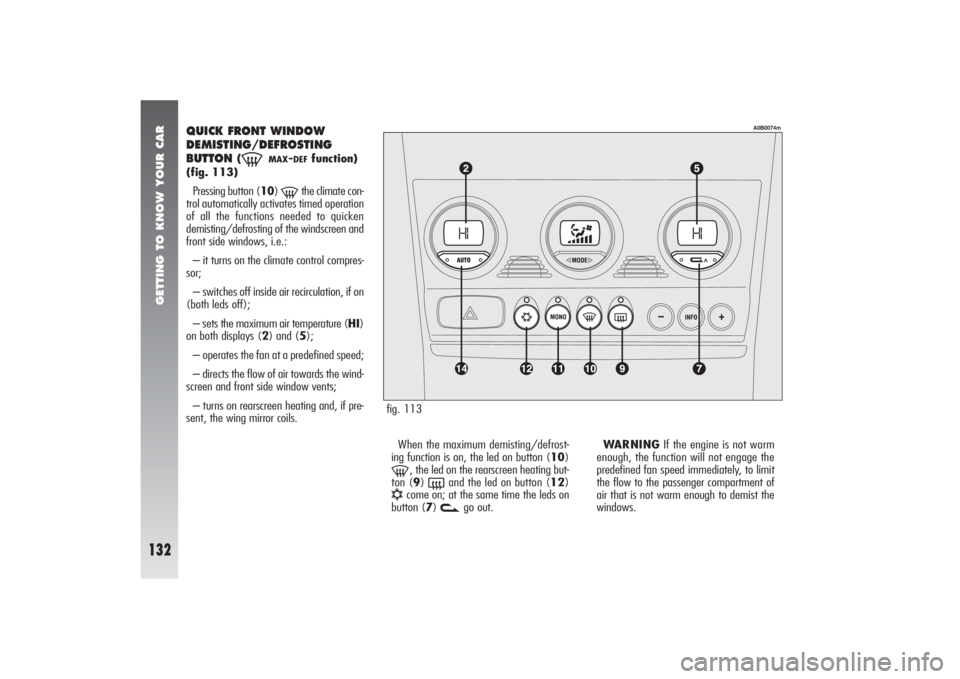
fig. 113
A0B0074m
QUICK FRONT WINDOW
DEMISTING/DEFROSTING
BUTTON
(-
MAX
-DEF
function)
(fig. 113)
Pressing button (10)
-
the climate con-
trol automatically activates timed operation
of all the functions needed to quicken
demisting/defrosting of the windscreen and
front side windows, i.e.:
– it turns on the climate control compres-
sor;
– switches off inside air recirculation, if on
(both leds off);
– sets the maximum air temperature (HI)
on both displays (2) and (5);
– operates the fan at a predefined speed;
– directs the flow of air towards the wind-
screen and front side window vents;
– turns on rearscreen heating and, if pre-
sent, the wing mirror coils.
When the maximum demisting/defrost-
ing function is on, the led on button (10)
-
, the led on the rearscreen heating but-
ton (9)
(
and the led on button (12)
√
come on; at the same time the leds on
button (7)
v
go out.WARNINGIf the engine is not warm
enough, the function will not engage the
predefined fan speed immediately, to limit
the flow to the passenger compartment of
air that is not warm enough to demist the
windows.
Page 143 of 357
GETTING TO KNOW YOUR CAR
141
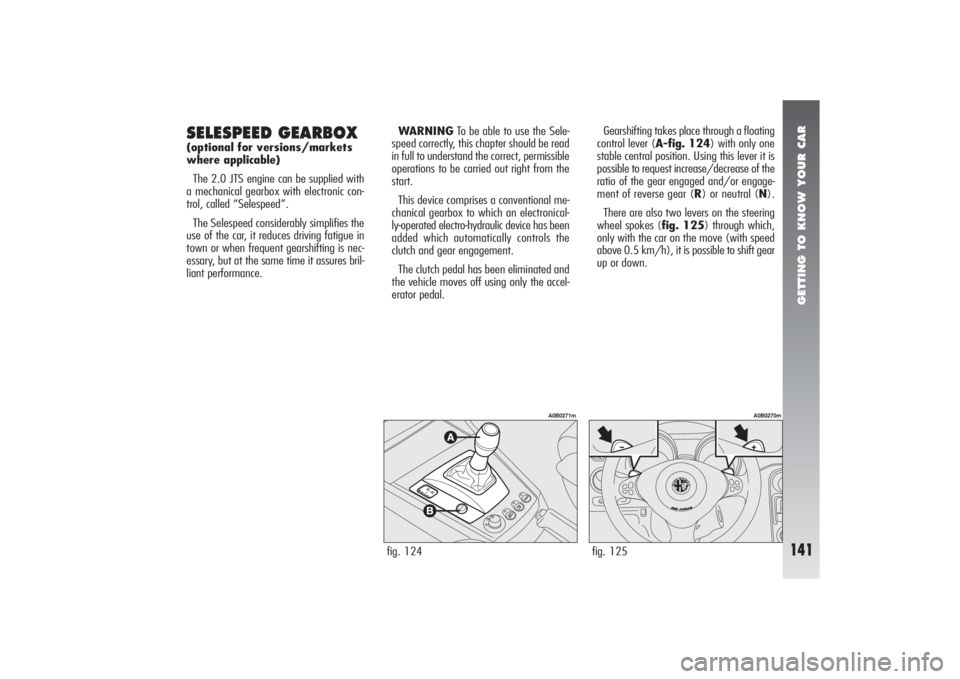
Gearshifting takes place through a floating
control lever (A-fig. 124) with only one
stable central position. Using this lever it is
possible to request increase/decrease of the
ratio of the gear engaged and/or engage-
ment of reverse gear (R) or neutral (N).
There are also two levers on the steering
wheel spokes (fig. 125) through which,
only with the car on the move (with speed
above 0.5 km/h), it is possible to shift gear
up or down.
SELESPEED GEARBOX (optional for versions/markets
where applicable)
The 2.0 JTS engine can be supplied with
a mechanical gearbox with electronic con-
trol, called “Selespeed”.
The Selespeed considerably simplifies the
use of the car, it reduces driving fatigue in
town or when frequent gearshifting is nec-
essary, but at the same time it assures bril-
liant performance.WARNINGTo be able to use the Sele-
speed correctly, this chapter should be read
in full to understand the correct, permissible
operations to be carried out right from the
start.
This device comprises a conventional me-
chanical gearbox to which an electronical-
ly-operated electro-hydraulic device has been
added which automatically controls the
clutch and gear engagement.
The clutch pedal has been eliminated and
the vehicle moves off using only the accel-
erator pedal.
fig. 124
A0B0271m
fig. 125
A0B0270m
Page 153 of 357

GETTING TO KNOW YOUR CAR
151
SIGNALLING WITH THE BUZZERThe buzzer is activated when:
– reverse gear (R) is engaged;
– the vehicle is parked with the gearbox
at neutral (N); this can be seen turning the
ignition key to STOP;
– clutch overheating takes place during
pick-up;
– the car moves in the opposite direction
to the gear engaged (e.g.: the car tends to
do downhill with reverse gear engaged);
– in the event of gearbox failure;
– the system has automatically engaged
neutral (N) after:•
there is no action on the accelerator
and/or brake pedal for at least 3 min-
utes;
•
the brake pedal is pressed for over 10
minutes;
•
the driver’s door is opened and the ac-
celerator and brake pedal are not
pressed for at least 1 second;
•
detection of a gearbox fault.
PARKING THE VEHICLETo park the car safely it is absolutely
necessaryto engage first gear (1) or re-
verse (R) and, when on a sloping road, also
engage the hand-brake.
Turning the engine off with the car facing
uphill and a gear engaged, it is absolutely
necessaryto wait for the display on the
rev counter to go off before releasing the
brake pedal, so that the clutch has innested
completely.
If the gearbox is in neutral (N) and you
want to engage a parking gear, it is neces-
sary to activate the system and engage the
gear (1) or reverse (R) with your foot on
the brake pedal.
TOWING THE VEHICLEWARNINGFor towing the vehicle, ad-
here to local regulations. Make sure that the
gearbox is in neutral (N) (checking that the
car moves when pushed) and proceed as for
towing a normal car with mechanical gear-
box following the instructions given in the
chapter “In an emergency”.
Should it be impossible to set to neutral,
do not tow the vehicle; contact Alfa Romeo
Authorised Services.
Do not start the engine
when towing the vehicle.
WARNING
Page 157 of 357

GETTING TO KNOW YOUR CAR
155
N - Neutral
This is the neutral position to be used when
the car has to be pushed or towed.D - Automatic forward gear
This is the position to be used always un-
der “normal” driving conditions, for exam-
ple on the motorway and urban roads and
when wanting to minimise fuel consumption
(combined with the CITYdriving mode).
When the lever is in this position, the gear-
box automatically selects the four available
speeds. It is also the position to be used
for the ICEdriving mode.Shifting to lower gear
(Kick down)
In the event of the need to accelerate
heavily (e.g. for overtaking) pressing the
accelerator fully home beyond the stiff point
will cause automatic kick down to a shorter
ratio, engine speed conditions permitting.
Releasing the accelerator pedal as soon as
the stiff point has been passed, the gearbox
shifts to the optimum ratio in relation to the
driving mode, throttle opening position and
selector lever position.
The Kick-down function is advised only for
overtaking or fast accelerating to avoid in-
creasing fuel consumption.
Kick-down is cut off automatically in the
ICEdriving mode.
With the engine idling,
when moving the lever to
position N the car tends to move
even if it is on level ground: keep
the brake pedal pressed when the
lever is in position N.
WARNING
With the engine idling and
the lever in position D the
vehicle tends to move: always
keep the brake pedal pressed un-
til moving off.
WARNING
Page 161 of 357
GETTING TO KNOW YOUR CAR
159
If the indicator light re-
mains flashing, contact the
Alfa Romeo Authorized
Service Centers as soon as possi-
ble to remove the fault.
If a fault is indicated when the engine is
started, this means that the gearbox control
system had detected and memorised a fault
during the journey prior to switching the en-
gine off. In this case, too, contact Alfa
Romeo Authorized Services to have the au-
tomatic gearbox checked over.It is possible to engage reverse gear.
ACOUSTIC WARNINGThis comes into operation for about 18 sec-
onds when:
– the driver’s door is open and/or the en-
gine is off with the selector lever in a posi-
tion other than P;
– position R(reverse) is engaged.PUSH STARTINGStarting the car by pushing or towing is not
possible. In the event of an emergency,
when the battery is flat, start the car with
a suitable emergency battery, following the
instructions given in the chapter “In an emer-
gency”.
When driving with a faulty
gearbox, drive with the ut-
most care considering the restricted
performance levels (in terms of ac-
celeration and speed) the car can
offer.
WARNING
When travelling with a
faulty gearbox, the reverse
lock might not work: absolutely
never move the lever to position
R with the car on the move.
WARNING
Page 162 of 357

GETTING TO KNOW YOUR CAR
160
The failure to follow the
above instructions may
cause serious damage to
the automatic gearbox.
TOWING THE CARWARNINGFor towing the car, abide by
current local regulations. Also follow the in-
structions given in the chapter “In an emer-
gency”.
If the car needs to be towed, observe the
following recommendations:
– if possible, put the car on a rescue ve-
hicle;
– if this is not possible, tow the car by rais-
ing the driving wheels (front) from the
ground;
– if this, too, is not possible, the car may
only be towed for 50 km at a speed below
50 km/h.
The gearshift lever should be at position N
for towing.Cars with automatic gear-
box may be towed only for
short distances and at low
speed: if longer towing is neces-
sary, the driving wheels must be
raised to prevent the gearbox from
being pulled into rotation during
towing.
Do not start the engine
when the vehicle is being
towed.
WARNING