oil Alfa Romeo 156 2007 Owner handbook (in English)
[x] Cancel search | Manufacturer: ALFA ROMEO, Model Year: 2007, Model line: 156, Model: Alfa Romeo 156 2007Pages: 357, PDF Size: 5.04 MB
Page 194 of 357
CORRECT USE OF THE CAR
192
SAFE DRIVINGIn designing your Alfa 156, Alfa
Romeo has worked thoroughly to achieve a
vehicle able to offer top levels of safety to
its passengers. However, the behaviour of
the driver is still a decisive factor for road
safety.
Below you will find a few simple rules for
travelling safely under different conditions.
You are certainly familiar with many of them
but it is still helpful to read them all care-
fully.BEFORE DRIVING OFF– Make sure the lights and headlights are
working properly.
– Adjust the seat, steering wheel and
rearview mirrors, in order to obtain a correct
position for driving.
– Adjust the seat back upright and keep
your head as close as possible to the head
restraint.– Carefully adjust the headrests so that
the head and not the neck rests on them.
Check that nothing (mats, etc.) can get un-
der the foot pedals.
– Make sure that any child restraint sys-
tem (seats, cradles, etc.) are correctly fas-
tened on the rear seat.
– Place any objects in the boot with care
to prevent abrupt braking from throwing
them forwards.
– Avoid heavy meals before a journey. A
light meal will help to keep reflexes ready.
Above all avoid alcohol.
Routinely remember to check:
– tyre pressure and conditions;
– engine oil level;
– engine coolant level and system condi-
tions;
– brake fluid level;
– power steering oil level;
– windscreen washer fluid level.
WHEN TRAVELLING– The first rule for safe driving is care.
– Care also means being able to predict
the actions of other road users.
– Strictly respect the traffic regulations in
all countries, especially the speed limits.
– Ensure that both yourself and your pas-
sengers are wearing their seat belts, that
children are carried with the appropriate
seats and that any animals are in appropri-
ate compartments.
– Long distances should be trackled in
good health.
Driving under the influence
of drugs and/or some
medicines is highly dangerous for
oneself and for others.
WARNING
Page 195 of 357
CORRECT USE OF THE CAR
193
– Do not drive for long periods without a
break. During breaks get out of the vehicle
and move around a bit to shake off the
drowsiness.
– Make sure the air in the passenger com-
partment is changed constantly.
– Never coast the vehicle downhill with
the engine switched off as this eliminates
the engine braking and power steering ef-
fect thus requiring a greater effort on the
pedal and steering wheel.
NIGHT DRIVINGHere are some suggestions for night dri-
ving.
– Drive with particular care: night driving
involves a greater degree of concentration.
– Reduce speed, especially on unlit roads.
– At the first signs of drowsiness stop the
car: continuing the journey is dangerous for
yourself and others. Continue driving only
after sufficient rest.
– Maintain a greater distance from the ve-
hicle in front than in the day: it is more dif-
ficult to judge the speed of the vehicle when
only the lights can be seen.
– Ensure that the headlights are correctly
aligned: if they are too low, visibility is re-
duced and eyesight is tired. If they are too
high they may cause disturbance to other
road users.
– Use the main beams only outside built-
up areas and only when you are certain that
other drivers are not disturbed by their use.
– When meeting vehicles coming in the
opposite direction, switch off the main
beams and drive with the dipped-beam
headlights on.
– Keep headlights and lights clean.
– Outside built-up areas take care of ani-
mal crossings.
Always fasten the front
and rear seat belts includ-
ing those of any child’s seat. Trav-
elling without seat belts increases
the risks of serious injury or even
death in the event of an accident.
WARNING
Take care when fitting ad-
ditional spoilers, alloy
wheels and wheel caps: they might
reduce ventilation of the brakes,
thus their efficiency, during abrupt
and repeated braking, or long
downhill slopes.
WARNING
Never drive with objects
on the floor in front of the
driver’s seat: they might get stuck
under the pedals making it impos-
sible to accelerate or brake.
WARNING
Make sure any mats are
appropriate in size: even a
slight inconvenience to the braking
system may require a higher pedal
stroke than normal.
WARNING
Water, ice and salt on the
roads may deposit on the
brake discs, reducing the effec-
tiveness of the brakes the first
time they are used.
WARNING
Page 198 of 357
CORRECT USE OF THE CAR
196
Tyres
Tyres should be checked at least every four
4 weeks: if the pressure is too low, fuel con-
sumption increases as the resistance to the
rolling movement of the tyre is higher. In
this state, tyre wear is increased
and vehicle handling suffers which will af-
fect safety.
Unnecessary loads
Do not travel with too much luggage stowed
in the boot. The weight of the vehicle (es-
pecially when driving in town) and its trim
greatly affects consumption and stability.
Luggage/ski rack
Remove luggage or ski racks from the roof
of the vehicle as soon as they are no longer
needed. These accessories reduce the aero-
dynamic penetration of the vehicle and will
increase consumption. When transporting
particularly large objects, use a trailer where
possible.Electrical devices
Use the electric devices for the necessary
time only. The heated rear window, supple-
mentary lights, windscreen wipers, heating
system blower require large amounts of en-
ergy and, increasing the request for power
also increases fuel consumption (up to
+25% when driving in built-up areas).
Air conditioner
The air conditioner is an additional load
which greatly affects the engine leading to
higher consumption (on average up to
+20%). When the temperature outside the
vehicle permits it, use the air vents where
possible.
Spoilers
The use of aerodynamic optional extras
which are not certified for the specific use
on the vehicle, may reduce the aerodynamic
penetration of the vehicle and increase con-
sumption.
STYLE OF DRIVINGStarting
Do not warm the engine when the vehicle
is stationary or at high or low revs: in this
way the engine will warm up gradually in-
creasing consumption and emissions. You
should drive off slowly straight away avoid-
ing high revs so that the engine will warm
up more quickly.
Unnecessary actions
Avoid revving the engine when stopped at
traffic lights or before switching off the en-
gine and avoid doubling the clutch as these
actions have no purpose on modern vehicles
and serve only to increase consumption and
pollution.
Gear selection
As soon as the traffic and road conditions
allow it, shift to a higher gear. Using a lower
gear to liven up acceleration greatly in-
creases consumption. In the same way, im-
proper use of the higher gears will increase
consumption, emissions and wear and tear
on the engine.
Page 200 of 357
CORRECT USE OF THE CAR
198
PROTECTING EMISSION
REDUCING DEVICESCorrect operation of the antipollution de-
vices not only guarantees respect for the en-
vironment but also influences car perfor-
mance. Keeping these devices in good con-
dition is therefore the first rule for both en-
vironment-friendly and economy driving.
The first precaution is to closely follow the
“Scheduled Maintenance Programme ”. For
petrol engines only use unleaded petrol (95
RON) (specification EN228), for diesel en-
gines only use fuel oil for motor vehicles
(specification EN590).
If difficulty with starting is experienced do
not insist with extended attempts. Especially
avoid bump, tow or coast starts: these may
all damage the catalyst. Only use an auxil-
iary battery to start the car in an emergency.If the engine is “not running smoothly”
when the vehicle is travelling, reduce the re-
quest for performance to a minimum and
contact Alfa Romeo Authorized Services as
soon as possible.
When the fuel reserve warning light comes
on fill up as soon as possible. A low fuel level
may cause an irregular supply to the engine
with inevitable increase of the exhaust gas
temperature; this would result in serious
damage to the catalyst.
Never run the engine, even as a test, with
one or more spark plugs disconnected. Do
not warm the engine at idle speed before
moving off, unless the outside temperature
is very low and, in this case too, for no more
than 30 seconds.
Do not install other heat
guards and do not remove
the existing ones on the catalyst
and exhaust pipe.
WARNING
Do not spray anything on
the catalyst, lambda sen-
sor and exhaust pipe.
WARNING
The failure to follow these
rules may cause a fire
hazard.
WARNING
During normal service the
catalyst reaches high tem-
peratures. Do not therefore park
the car over inflammable materials
(grass, dry leaves, pine needles,
etc.): fire hazard.
WARNING
Page 206 of 357
CORRECT USE OF THE CAR
204
REMOVING FROM STORAGEBefore using your vehicle after a long pe-
riod of inactivity, the following operations
should first be carried out:
– Do not dust the outside of the vehicle.
– Visually check that there are no leaks
(oil, brake and clutch fluid, engine coolant,
etc.).
– Replace engine oil and filter.
– Check:
- brake-clutch fluid level
- level of engine coolant fluid.
– Check the air cleaner and replace if nec-
essary.
– Check tyre pressure and ensure that they
are not damaged, cracked or cut. If they are
they must be replaced.– Check the state of the drive belts.
– Reconnect the battery negative termi-
nal (–) after checking that the charge is ad-
equate.
– With the gear lever in neutral start the
engine and allow the engine to run for a few
seconds whilst repeatedly working the clutch
pedal.
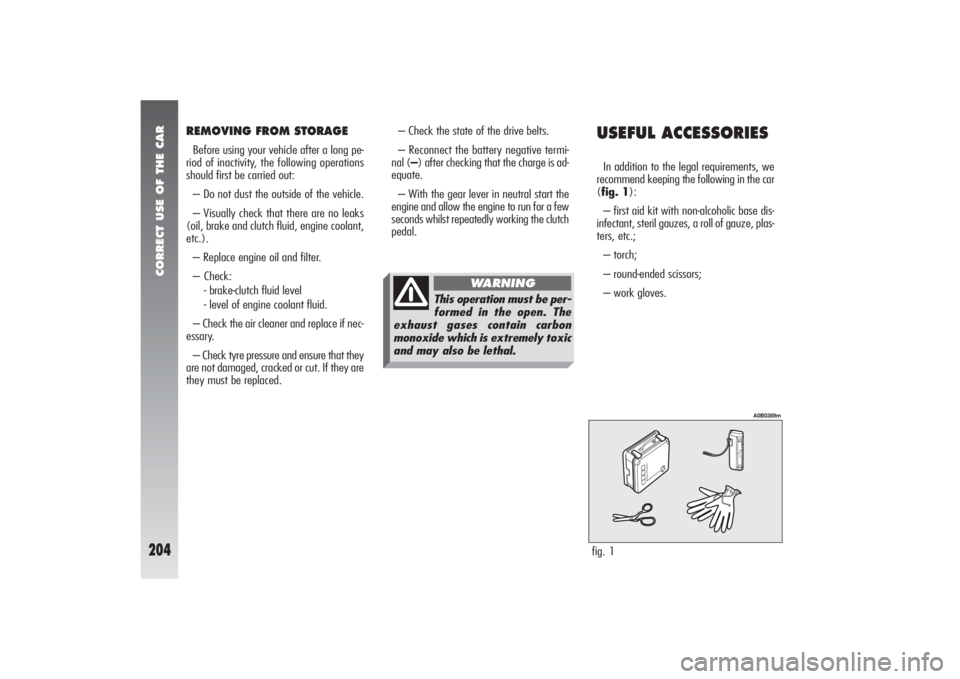
USEFUL ACCESSORIESIn addition to the legal requirements, we
recommend keeping the following in the car
(fig. 1):
– first aid kit with non-alcoholic base dis-
infectant, steril gauzes, a roll of gauze, plas-
ters, etc.;
– torch;
– round-ended scissors;
– work gloves.fig. 1
A0B0389m
This operation must be per-
formed in the open. The
exhaust gases contain carbon
monoxide which is extremely toxic
and may also be lethal.
WARNING
Page 239 of 357
IN AN EMERGENCY
237
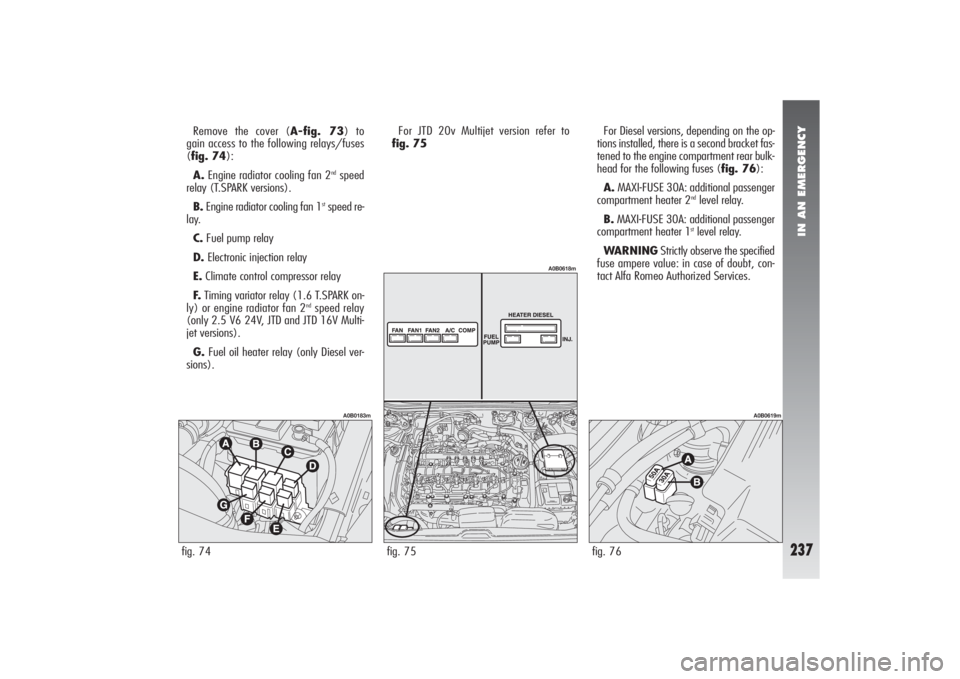
Remove the cover (A-fig. 73) to
gain access to the following relays/fuses
(fig. 74):
A.Engine radiator cooling fan 2
ndspeed
relay (T.SPARK versions).
B.Engine radiator cooling fan 1
stspeed re-
lay.
C.Fuel pump relay
D.Electronic injection relay
E.Climate control compressor relay
F.Timing variator relay (1.6 T.SPARK on-
ly) or engine radiator fan 2
ndspeed relay
(only 2.5 V6 24V, JTD and JTD 16V Multi-
jet versions).
G.Fuel oil heater relay (only Diesel ver-
sions).For JTD 20v Multijet version refer to
fig. 75For Diesel versions, depending on the op-
tions installed, there is a second bracket fas-
tened to the engine compartment rear bulk-
head for the following fuses (fig. 76):
A.MAXI-FUSE 30A: additional passenger
compartment heater 2
ndlevel relay.
B.MAXI-FUSE 30A: additional passenger
compartment heater 1stlevel relay.
WARNINGStrictly observe the specified
fuse ampere value: in case of doubt, con-
tact Alfa Romeo Authorized Services.
fig. 74
A0B0183m
fig. 76
A0B0619m
fig. 75
A0B0618m
Page 242 of 357
IN AN EMERGENCY
240
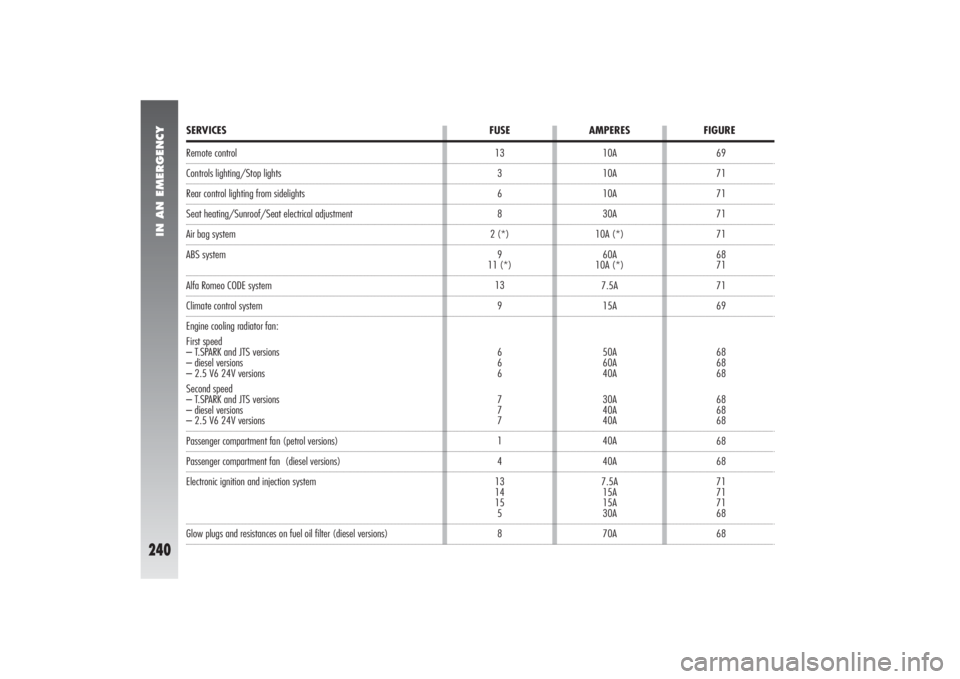
Remote controlControls lighting/Stop lightsRear control lighting from sidelightsSeat heating/Sunroof/Seat electrical adjustmentAir bag system
ABS systemAlfa Romeo CODE systemClimate control system
Engine cooling radiator fan:
First speed
– T.SPARK and JTS versions
– diesel versions
– 2.5 V6 24V versions
Second speed
– T.SPARK and JTS versions
– diesel versions– 2.5 V6 24V versionsPassenger compartment fan (petrol versions)Passenger compartment fan (diesel versions)
Electronic ignition and injection system Glow plugs and resistances on fuel oil filter (diesel versions)69
71
71
71
71
68
71
71
69
68
68
68
68
68
68
68
68
71
71
71
68
68 10A
10A
10A
30A
10A (*)
60A
10A (*)
7.5A
15A
50A
60A
40A
30A
40A
40A
40A
40A
7.5A
15A
15A
30A
70A 13
3
6
8
2 (*)
9
11 (*)
13
9
6
6
6
7
7
7
1
4
13
14
15
5
8SERVICES FUSE AMPERES FIGURE
Page 243 of 357
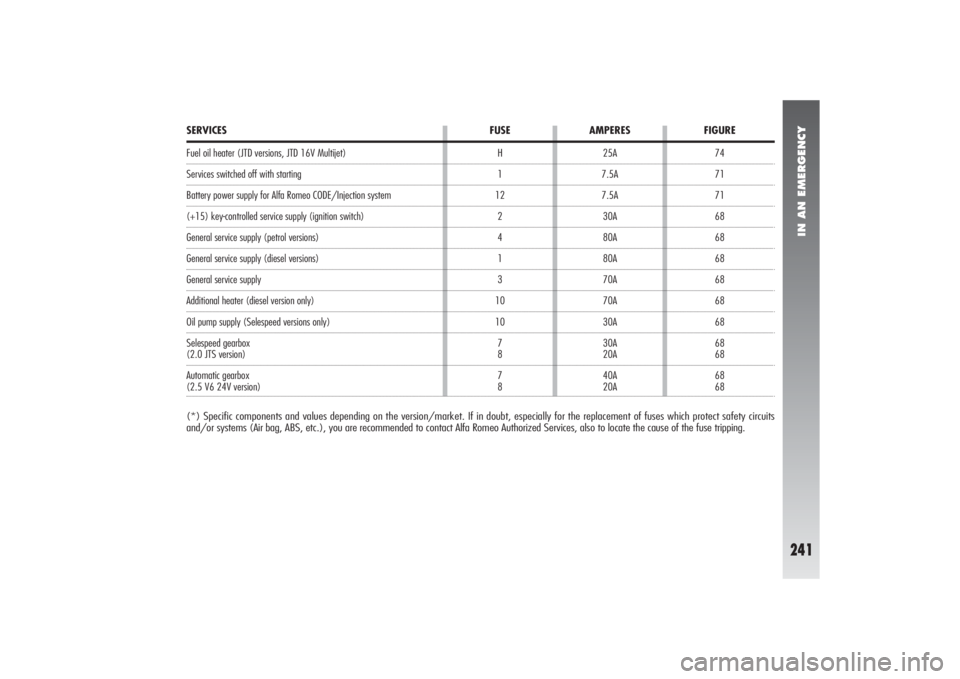
Fuel oil heater (JTD versions, JTD 16V Multijet)Services switched off with startingBattery power supply for Alfa Romeo CODE/Injection system(+15) key-controlled service supply (ignition switch)General service supply (petrol versions)General service supply (diesel versions)General service supplyAdditional heater (diesel version only)Oil pump supply (Selespeed versions only)
Selespeed gearbox(2.0 JTS version)
Automatic gearbox(2.5 V6 24V version)(*) Specific components and values depending on the version/market. If in doubt, especially for the replacement of fuses which protect safety circuits
and/or systems (Air bag, ABS, etc.), you are recommended to contact Alfa Romeo Authorized Services, also to locate the cause of the fuse tripping.
IN AN EMERGENCY
241
74
71
71
68
68
68
68
68
68
68
68
68
68 25A
7.5A
7.5A
30A
80A
80A
70A
70A
30A
30A
20A
40A
20A H
1
12
2
4
1
3
10
10
7
8
7
8
SERVICES FUSE AMPERES FIGURE
Page 252 of 357
CAR MAINTENANCE
250
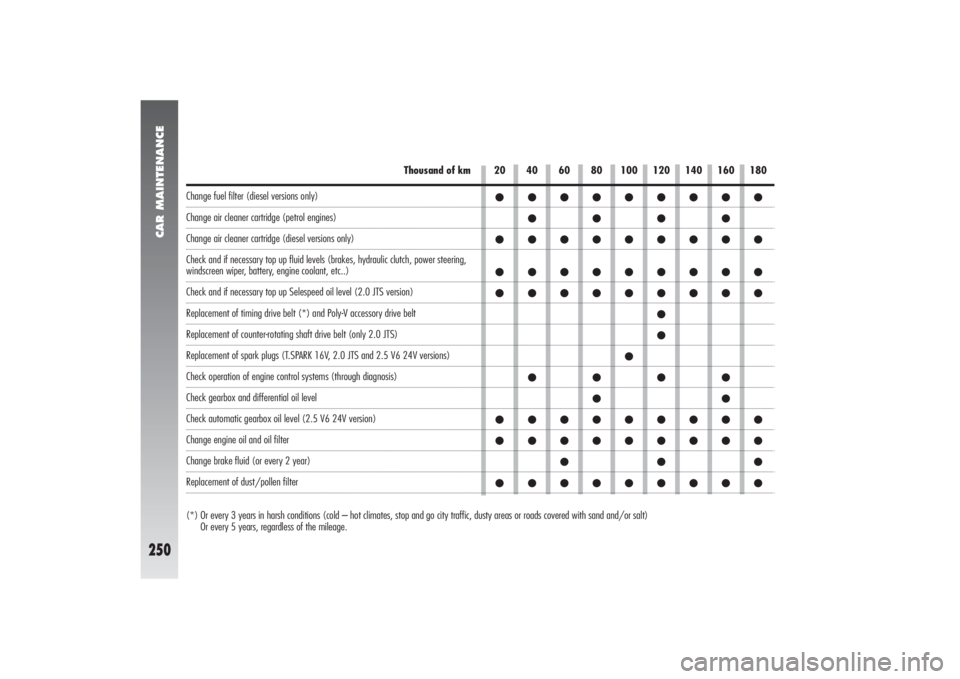
20 40 60 80 100 120 140 160 180
Thousand of km
Change fuel filter (diesel versions only)Change air cleaner cartridge (petrol engines)Change air cleaner cartridge (diesel versions only)
Check and if necessary top up fluid levels (brakes, hydraulic clutch, power steering, windscreen wiper, battery, engine coolant, etc..) Check and if necessary top up Selespeed oil level (2.0 JTS version)Replacement of timing drive belt (*) and Poly-V accessory drive beltReplacement of counter-rotating shaft drive belt (only 2.0 JTS)Replacement of spark plugs (T.SPARK 16V, 2.0 JTS and 2.5 V6 24V versions) Check operation of engine control systems (through diagnosis)Check gearbox and differential oil levelCheck automatic gearbox oil level (2.5 V6 24V version)Change engine oil and oil filterChange brake fluid (or every 2 year)Replacement of dust/pollen filter
●●●●●●●●●
●●●●
●●●●●●●●●
●●●●●●●●●
●●●●●●●●●
●
●
●
●●●●
●●
●●●●●●●●●
●●●●●●●●●
●●●
●●●●●●●●●
(*) Or every 3 years in harsh conditions (cold – hot climates, stop and go city traffic, dusty areas or roads covered with sand and/or salt)
Or every 5 years, regardless of the mileage.
Page 253 of 357
CAR MAINTENANCE
251
ADDITIONAL
OPERATIONSEvery 1000 kmor before long journeys
check and if necessary top up:
– engine coolant level
– brake fluid/hydraulic clutch control flu-
id level
– power steering fluid level
– windscreen washer and headlamp wash-
er fluid level
– tyre pressure and conditions.
Every 3000 kmcheck the level of the
engine oil and top up if necessary.
You are recommended to use products of
the FL Selenia, designed and developed
expressly for Alfa Romeo cars (see the table
“Specifications of fluids and lubricants” in
the “Technical specifications” chapter).
ANNUAL INSPECTION
PROGRAMMEAn annual inspection programme
has been established for cars thet
cover less than 20,000 km (e.g.
10,000 km). It consists of the fol-
lowing:
– Check tyre conditions/wear and adjust
pressure if required (including the compact
spare wheel)
– Check lighting system operation (head-
lights, direction indicators, hazard lights,
boot lights, passenger compartment lights,
glovebox light, warning lights of instrument
panel, etc.)
– Check windscreen and rear-screen
wiper/washer operation, adjust nozzles
– Check windscreen/rear-screen blade po-
sition/wear
– Check condition and wear of the front
brake pad
– Check for bonnet and boot lock clean-
ness, lever cleanness and lubrication– Visually check the following: engine,
gearbox, transmission, piping (exhaust - fu-
el - brakes) rubber components (casings -
sleeves - bushings, etc..), brake and fuel
hoses
– Check battery charge condition
– Visually check the condition of the belts
and various controls
– Check and top up if necessary, the flu-
id levels (coolant, brake fluid, windscreen
washer fluid, battery, etc.)
– Change engine oil
– Replace engine oil filter
– Change pollen filter.