brake Alfa Romeo 156 2007 Owner handbook (in English)
[x] Cancel search | Manufacturer: ALFA ROMEO, Model Year: 2007, Model line: 156, Model: Alfa Romeo 156 2007Pages: 357, PDF Size: 5.04 MB
Page 196 of 357
CORRECT USE OF THE CAR
194
DRIVING IN THE RAINRain and wet roads can be dangerous.
If the road is wet, the traction between
wheel and asphalt is greatly reduced, thus
increasing the stopping distance and de-
creasing road holding.
Here are few suggestions in the case of
rain:
– Reduce speed and keep further back
from the vehicle in front.
– If it is raining particularly heavily, visi-
bility is also reduced. In these cases, switch
on the dipped headlights even if it is still day-
light so you can be seen more easily.
– Do not drive through puddles at speed
and hold on tightly to the wheel if you do: a
puddle taken at high speed might cause you
to lose control of the car (“aquaplaning”).
– Position the ventilation controls for
demisting (see chapter “Getting to know
your car”), to prevent visibility from wors-
ening.
– Routinely check the conditions of the
windscreen wiper blades.
DRIVING IN THE FOG– If fog is very thick, avoid travelling
where possible. If travelling with mist,
ground fog or the possibility of fog banks:
– Drive at moderate speed.
– Also in the day turn on the dipped-beam
headlights, rear fog guards and front fog
lights. Do not use the main beam headlights.
WARNINGOn stretches of road with
good visibility, switch off your rear foglights;
the brightness of these lights could annoy
the people travelling in the cars behind.
– Remember that fog also involves wet
asphalt, thus greater difficulty in all types of
manoeuvres and longer stopping distances.
– Keep well away from the vehicle in
front.
– Where possible avoid sudden changes
in speed.
– Possibly avoid overtaking other vehicles.
– If the vehicle is forced to stop (faults,
impossibility to continue due to poor visi-
bility, etc.), firstly try to pull off the road.
Then turn on the hazard warning lights and,
if possible the dipped beam headlights. Ry-
thmically sound the horn if you note another
car coming.
MOUNTAIN DRIVING– When driving downhill, use the engine
braking by engaging a low gear, to prevent
the brakes from overheating.
– Never coast downhill with the engine off
or in neutral and especially not with the ig-
nition key removed.
– Drive at moderate speed and avoid “cut-
ting” corners.
– Remember that overtaking up hill is
slower and therefore requires a greater
length of clear road. If you are being over-
taken on a hill, move over to enable the
other vehicle to pass in safety.
Page 197 of 357
CORRECT USE OF THE CAR
195
DRIVING ON SNOW AND ICEHere are few suggestions for driving in
these conditions:
– Keep your speed down.
– On a snowy road, fit winter tyres or
snow chains; see the related paragraphs in
this section.
– Use exhaust brake where possible and
avoid abrupt braking.
– Avoid abrupt acceleration and changes
of direction.
– During cold weather even apparently dry
roads may be covered with occasional
patches of ice. Pay great attention therefore
when driving on roads which are in the
shade, or where rocks or trees line the road
and on which ice may persist.
– Keep further back from the vehicle in
front.
DRIVING WITH ABSThe ABS is a part of the braking system
which essentially offers two advantages:
1)It prevents wheel lock-up and conse-
quent skidding in emergency stops, partic-
ularly when the road does not offer much
grip;
2)It makes it possible to brake and steer
at the same time so you can avoid unex-
pected obstacles and direct the car where
you want while braking. The extent to which
this can be done will depend on the physi-
cal limits of the tyre’s sideways grip.
To make the most of the ABS:
– In emergency braking or when grip is
low, a slight pulsing can be felt on the brake
pedal: this means that the ABS has come
into action. Do not release the pedal, but
continue pressing it to give continuity to the
braking action.
– The ABS prevents the wheels from lock-
ing but it does not increase the physical lim-
its of grip between the asphalt and the road.
Therefore, also with a car fitted with ABS,
keep within a safety distance from the ve-
hicle in front and limit speed when ap-
proaching bends.
The ABS serves to increase car controlla-
bilty not to go faster.
REDUCING RUNNING
COSTS AND
ENVIRONMENT
POLLUTIONSome suggestions which may help you to
keep the running costs of your vehicle down
and lower the amount of toxic emissions re-
leased into the atmosphere are given below.GENERAL CONSIDERATIONSVehicle maintenance
The overalll state of the vehicle is an im-
portant factor which has a marked influence
over fuel consumption and driving comfort
and on the life span of your vehicle. For this
reason care should be taken to maintain
your vehicle by carrying out the necessary
checks and regulations in accordance with
specifications given in the “Scheduled Main-
tenance Programme” (see sections... spark
plugs, air cleaner, timing).
Page 201 of 357

CORRECT USE OF THE CAR
199
TOWING TRAILERSWARNINGS AND
SUGGESTIONS For towing caravans or trailers the vehi-
cle must be fitted with a certified tow hook
and an adequate electric system. Installa-
tion should be carried out by specialised per-
sonnel who release a special document for
circulation on the road.
Install any specific and/or additional rear-
view mirrors as specified by law. Remember
that when towing a trailer, steep hills are
harder to climb, the braking spaces increase
and overtaking takes longer depending on
the overall weight.
Engage a low gear when driving downhill,
rather than constantly using the brake.
The weight the trailer exerts on the vehi-
cle tow hook reduces by the same amount
the actual vehicle loading capacity. To make sure the maximum towable
weight is not exceeded (given in the log
book) account should be taken of the fully
laden trailer, including accessories and per-
sonal belongings.
Drive within the permitted speed limits for
vehicles with trailers. In any case the maxi-
mum speed should never exceed 100 km/h.
INSTALLING THE TOW HOOKThe towing device should be fastened to
the body by specialised personnel according
to the following instructions and any addi-
tional and/or integrative information sup-
plied by the Manufacturer of the device.
The towing device must meet current reg-
ulations with reference to 94/20/EC Di-
rective and subsequent amendments.
For any version the towing device used
must match the towable weight of the ve-
hicle on which it is to be installed.
For the electric connection a unified con-
nector should be used which is generally
placed on a special bracket normally fas-
tened to the towing device.
The ABS system with
which the car may be fitted
does not control the trailer braking
system. Particular care is therefore
necessary on slippery surfaces.
WARNING
Under no circumstances
should the vehicle brake
system be altered to control the
trailer brake. The trailer braking
system must be fully independent
of the vehicle’s hydraulic system.
WARNING
Page 202 of 357

CORRECT USE OF THE CAR
200
INSTALLATION LAYOUT
(fig. 1)
The tow hook structure must be fastened
in the points shown by the symbol
Ø
us-
ing 4 M8 screws and 7 M10 screws.
Inner plate (2) should be at least 6 mm
thick.
Inner plate (3) should be at least 4 mm
thick.
Outer plate (4) should be at least 5 mm
thick.
The fastening points (1) must be fitted
with spacers with 25 mm diameter and 6
mm thickness. For the electrical connection, a 7 pin
12VDC connection is to be used
(CUNA/UNI - 9128 Standard). Follow the
instructions provided by the car manufac-
turer and/or the tow hitch manufacturer.
An electric brake should be supplied directly
by the battery through a cable with a cross
section of no less than 2.5 mm
2. In addition
to the electrical branches, the car’s electric
system can only be connected to the supply
cable for an electric brake and to the cable
for an internal light, though not above 15W.WARNINGIt is compulsory to fasten a
label (clearly visible) of suitable size and
material at the height of the hook ball with
the wording:
MAX. LOAD ON BALL 60 kg
After assembly, the fas-
tening screw holes should
be sealed to prevent the infiltra-
tion of exhaust gas.
WARNING
Page 205 of 357

CORRECT USE OF THE CAR
203
Keep your speed
down when snow
chains are fitted.
Do not exceed 50 km/h. Avoid
potholes, steps and pavements and
avoid also to drive for long dis-
tances on roads not covered with
snow to prevent damaging the car
and the roadbed.
VEHICLE INACTIVITYIf the car is to be left inactive for long pe-
riods, the following precautions should be
noted:
– House the vehicle under cover in a dry
and possibly ventilated place.
– Engage a gear.
– Check that the handbrake is not en-
gaged.
– Clean and protect the painted parts us-
ing protective wax.
– Disconnect the negative terminal (–)
and check the battery charge. This check is
to be repeated every three months.
Recharge if the optical indicator shows a
dark colour without the central green area.
WARNINGWhere applicable, switch off
the electronic car alarm with the remote con-
trol.– Clean and protect the shiny metal parts
using special compounds readily available.
– Sprinkle talcum powder on the rubber
windscreen and rear window wiper blades
and lift them off the glass.
– Slightly open the windows.
– Cover the car with a cloth or perforated
plastic sheet. Do not use sheets of non-per-
forated plastic as they do not allow mois-
ture on the car body to evaporate.
– Inflate the tyres to 0.5 bar above the
normal specified pressure and check it at in-
tervals.
– If you don’t disconnect the battery from
the electric system, check its charge every
month and recharge it if the optical indica-
tor shows a dark colour without the central
green area.
– Do not drain the engine cooling system. Snow chains cannot be
fitted to the spare wheel
so, if a front (drive) tyre is
punctured and chains must be fit-
ted, the rear wheel should be fit-
ted to the front of the vehicle (in-
flate the tyres to the specified
pressure as soon as possible) and
the spare tyre should be fitted to
the rear. A snow chain can then be
safely fitted to the front wheel.
Page 206 of 357
CORRECT USE OF THE CAR
204
REMOVING FROM STORAGEBefore using your vehicle after a long pe-
riod of inactivity, the following operations
should first be carried out:
– Do not dust the outside of the vehicle.
– Visually check that there are no leaks
(oil, brake and clutch fluid, engine coolant,
etc.).
– Replace engine oil and filter.
– Check:
- brake-clutch fluid level
- level of engine coolant fluid.
– Check the air cleaner and replace if nec-
essary.
– Check tyre pressure and ensure that they
are not damaged, cracked or cut. If they are
they must be replaced.– Check the state of the drive belts.
– Reconnect the battery negative termi-
nal (–) after checking that the charge is ad-
equate.
– With the gear lever in neutral start the
engine and allow the engine to run for a few
seconds whilst repeatedly working the clutch
pedal.
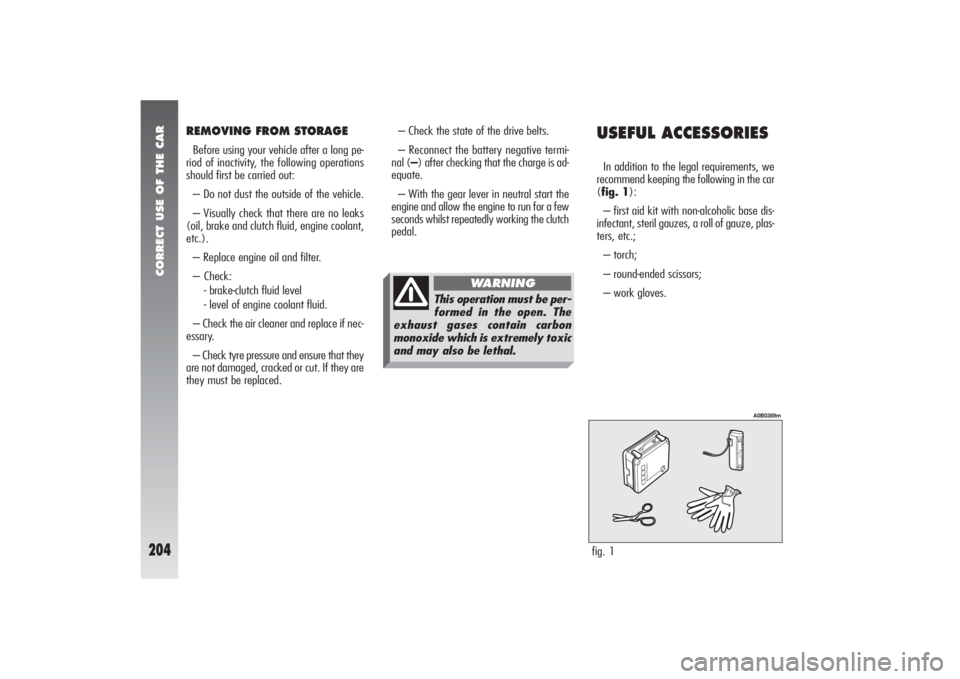
USEFUL ACCESSORIESIn addition to the legal requirements, we
recommend keeping the following in the car
(fig. 1):
– first aid kit with non-alcoholic base dis-
infectant, steril gauzes, a roll of gauze, plas-
ters, etc.;
– torch;
– round-ended scissors;
– work gloves.fig. 1
A0B0389m
This operation must be per-
formed in the open. The
exhaust gases contain carbon
monoxide which is extremely toxic
and may also be lethal.
WARNING
Page 209 of 357

IN AN EMERGENCY
207
STARTING BY INERTIA
IN THE EVENT OF A
PUNCTUREWARNINGIf the car is equipped with
“Fix&Go kit for tyre quick repair”, see the
instructions contained in the following
chapter.GENERAL INSTRUCTIONSWheel changing and correct use of the jack
and compact spare wheel call for some pre-
cautions as mentioned below. Never push, tow or coast
start the vehicle. This could
cause fuel to flow into the
catalyst damaging it irreversibly.
Remember that the engine
brake and power steering
are not operational until the engine
is started, therefore, much greater
effort than usual is needed on the
brake pedal and steering wheel.
WARNING
Signal the presence of the
stationary vehicle accord-
ing to the current regulations: haz-
ard warning lights, reflecting tri-
angle, etc.
Any passengers should leave the
car and wait for the wheel to be
changed out of harm of the traffic.
If parked on a slope or uneven road
surfaces, place wedges or other
suitable devices under the wheels
to prevent the car from rolling.
Never start the engine when the
car is raised on the jack.
When towing a trailer, always
remove the trailer before lifting
the car.
WARNING
Page 211 of 357
IN AN EMERGENCY
209
CHANGING A WHEEL(optional for versions/markets
where applicable)
You are informed that:
– The jack mass is 2,100 kg.
– The jack requires no adjustment.
– The jack cannot be repaired, in the event
of breakage it must be replaced by anoth-
er original one.
– No tools other than its operating crank
can be fitted to the jack.
To change the wheel proceed as follows:
– Stop the car in such a position that it is
not dangerous for the traffic, where it is pos-
sible to change the wheel safely. Where pos-
sible, park on a level, compact surface.– Stop the engine and engage the hand-
brake.
– Engage first gear or reverse.
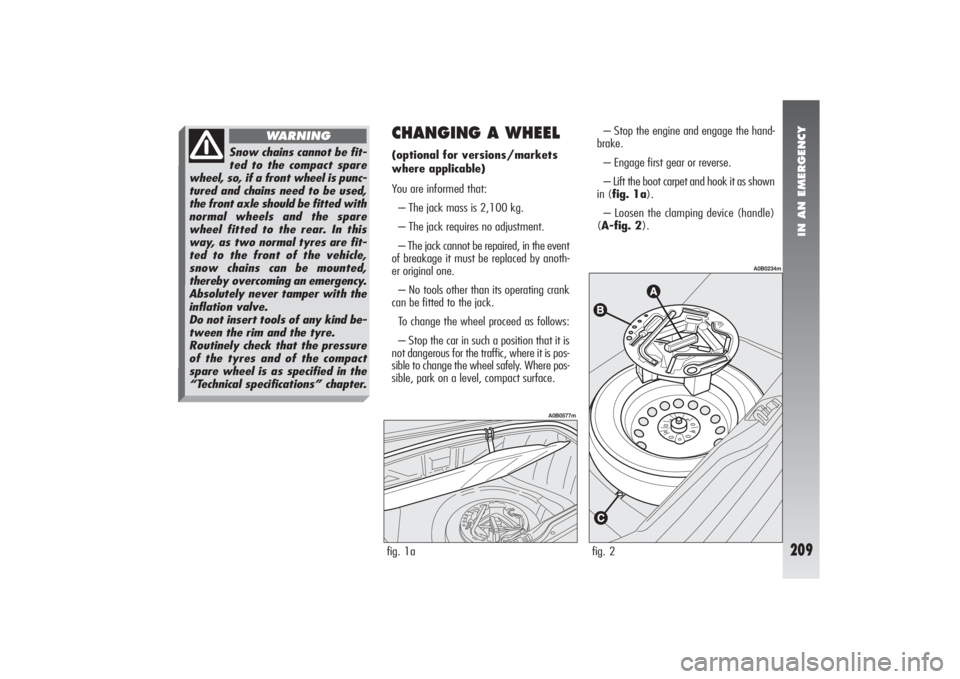
– Lift the boot carpet and hook it as shown
in (fig. 1a).
– Loosen the clamping device (handle)
(A-fig. 2).
fig. 2
A0B0234m
fig. 1a
A0B0577m
Snow chains cannot be fit-
ted to the compact spare
wheel, so, if a front wheel is punc-
tured and chains need to be used,
the front axle should be fitted with
normal wheels and the spare
wheel fitted to the rear. In this
way, as two normal tyres are fit-
ted to the front of the vehicle,
snow chains can be mounted,
thereby overcoming an emergency.
Absolutely never tamper with the
inflation valve.
Do not insert tools of any kind be-
tween the rim and the tyre.
Routinely check that the pressure
of the tyres and of the compact
spare wheel is as specified in the
“Technical specifications” chapter.
WARNING
Page 216 of 357

IN AN EMERGENCY
214
INFLATING PROCEDURE 1)Place the wheel in the position illus-
trated in the figure (A-fig. 13) for the op-
eration with the valve, then engage the
handbrake.
2)Screw the filling pipe (B-fig. 14) to
the bottle (C).
3)Unscrew the tyre valve plug, remove
the element inside the valve by using the
appropriate tool (D-fig. 15); be careful
not to place it on the sand or on a dirty sur-
face .
4)Introduce the filling pipe (B-fig. 16)
in the tyre valve, keep the bottle (C-fig.
16) with the pipe directed downwards, then
press it so that the whole sealer can get in-
to the tyre.5)Screw again the element inside the
valve with the tool (D-fig. 17).
6)Use the appropriate lever (E-fig. 18)
to insert and clamp the air compressor pipe
(F) to the tyre valve.
7)Start the engine, insert the plug (G-
fig. 19) in the lighter (or socket 12V) and
inflate the tyre according to the right pres-
sure value (see “Cold inflation pressures” in
the “Technical specification” chapter). You
are advised to check the tyre pressure val-
ue on the pressure gauge (H-fig. 18) with
the compressor off, in order to have a more
accurate reading.fig. 13
A0B0334m
fig. 14
A0B335m
IT IS NECESSARY TO KNOW
THAT:The sealer included in the quick repairing
kit, good for temperatures between –30°C
e +80°C, is not adequate for permanent
fixing.
The liquid inside the tyre can be easily re-
moved with water.
The sealer has no expire date.
Do not operate the com-
pressor for more than 20
minutes. Risk of overheating.
WARNING
Page 217 of 357

IN AN EMERGENCY
215
After about 10 minutes, stop and check
the tyre pressure once again; remember to
engage the handbrake.
fig. 15
A0B0336m
fig. 16
A0B0337m
If it is not possible to reach the prescribed
pressure, move the car forwards or back-
wards for about 10 metres, so that the seal-
er is distributed inside the tyre, then repeat
inflation.
If, in spite of the last operation, the pre-
scribed pressure is not achieved, do not
move the vehicle and contact Alfa Romeo
Authorized Services.
Once the correct tyre pressure has been
reached, start driving immediately so that
the sealer is distributed evenly inside the
tyre.
Place the sticker in a posi-
tion where it can be clear-
ly seen by the driver as a notice
that the tyre has been treated with
the quick repairing kit. Drive care-
fully especially in a bend. Do not
overcome 80 km/h. Avoid sudden
acceleration or braking.
WARNING
If the pressure is below
1,3 bars, do not drive any
further; FIX & GO cannot guaran-
tee proper hold because the tyre is
too much damaged. Contact Alfa
Romeo Authorized Services.
Conversely, if at least 1,3 bars are
detected, restore the correct pres-
sure (with the engine running and
the handbrake engaged) and start
driving the car with great care.
WARNING