roof Alfa Romeo 159 2006 Owner handbook (in English)
[x] Cancel search | Manufacturer: ALFA ROMEO, Model Year: 2006, Model line: 159, Model: Alfa Romeo 159 2006Pages: 299, PDF Size: 4.64 MB
Page 118 of 299

116
SAFETY
DEVICES
WARNING
LIGHTS AND
MESSAGES
IN AN
EMERGENCY
CAR
MAINTENANCE
TECHNICAL
SPECIFICATIONS
INDEX
CORRECT USE
OF THE CAR
DASHBOARD
AND
CONTROLS
Sound system presetting includes:
❒sound system power cables;
❒front and rear speakers cables;
❒aerial power cable;
❒sound system compartment;
❒aerial on car roof.
The sound system shall be installed in
the proper space occupied by the odd-
ment compartment that shall be re-
moved by pressing the two retaining
tabs set in the oddment compartment:
here you will find the power cables.
SOUND SYSTEM
PRESETTING
(where provided)
When the sound system has not been
requested the car is provided with two
oddment compartments on the instru-
ment panel.
If you decide to install
the sound system after
buying the car, contact
first Alfa Romeo Authorized
Services that will give you use-
ful advice about installation and
how to safeguard the battery.
Excessive loadless absorption
damages the battery and the
battery warranty can be inval-
idated.
Page 145 of 299
143
WARNING
LIGHTS AND
MESSAGES
IN AN
EMERGENCY
CAR
MAINTENANCE
TECHNICAL
SPECIFICATIONS
INDEX
CORRECT USE
OF THE CAR
DASHBOARD
AND
CONTROLS
SAFETY
DEVICES
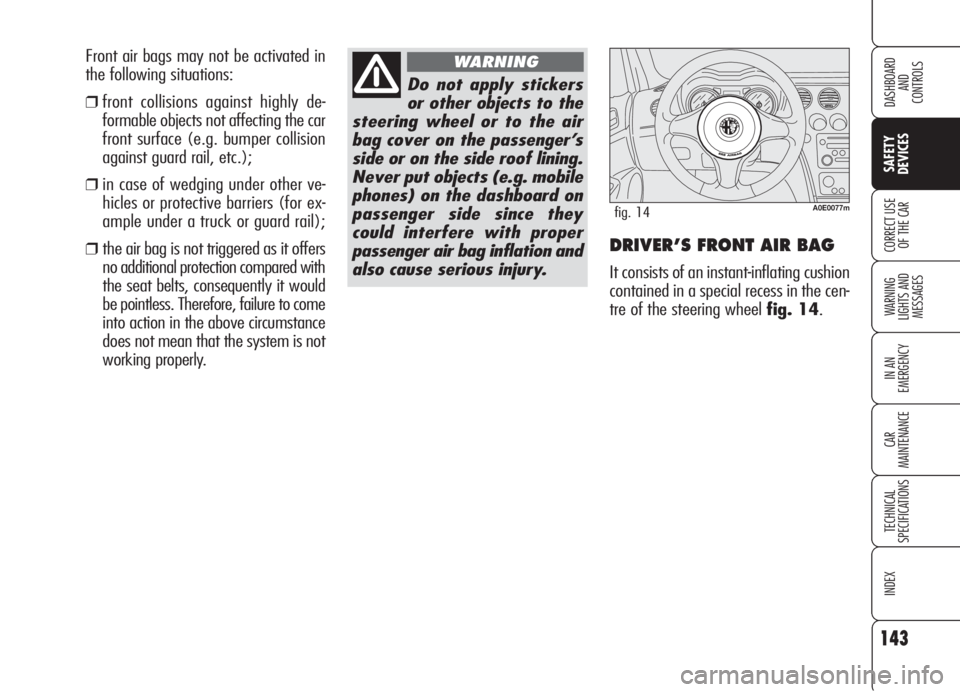
DRIVER’S FRONT AIR BAG
It consists of an instant-inflating cushion
contained in a special recess in the cen-
tre of the steering wheelfig. 14. Front air bags may not be activated in
the following situations:
❒front collisions against highly de-
formable objects not affecting the car
front surface (e.g. bumper collision
against guard rail, etc.);
❒in case of wedging under other ve-
hicles or protective barriers (for ex-
ample under a truck or guard rail);
❒the air bag is not triggered as it offers
no additional protection compared with
the seat belts, consequently it would
be pointless. Therefore, failure to come
into action in the above circumstance
does not mean that the system is not
working properly.
Do not apply stickers
or other objects to the
steering wheel or to the air
bag cover on the passenger’s
side or on the side roof lining.
Never put objects (e.g. mobile
phones) on the dashboard on
passenger side since they
could interfere with proper
passenger air bag inflation and
also cause serious injury.
WARNING
A0E0077mfig. 14
Page 149 of 299

147
WARNING
LIGHTS AND
MESSAGES
IN AN
EMERGENCY
CAR
MAINTENANCE
TECHNICAL
SPECIFICATIONS
INDEX
CORRECT USE
OF THE CAR
DASHBOARD
AND
CONTROLS
SAFETY
DEVICES
SIDE WINDOW BAGS -
HEAD PROTECTION
They are “curtain” cushions located be-
hind the side coverings of the roof fig.
20and covered by proper finishing.
Window bags have been designed for
protecting the head of front and rear oc-
cupants in the event of side crash,
thanks to the wide cushion inflation sur-
face.
In minor side crashes (for which the re-
straining action of the seat belts is suf-
ficient), the air bags are not deployed.Also in this case it is of vital importance
to wear the seat belts since in case of
side crash they guarantee proper posi-
tioning of the occupant and prevent the
occupants to be pitched out of the car in
case of violent crashes.
IMPORTANTIn the event of side
crash, you can obtain the best protec-
tion by the system keeping a correct po-
sition on the seat, allowing thus a cor-
rect window bag unfolding.
IMPORTANTThe front air bags
and/or side bags may be deployed if
the car is subject to heavy knocks or
accidents involving the underbody area,
such as for example violent shocks,
against steps, kerbs or low obstacles,
falling of the car in big holes or sags in
the road.
FRONT SIDE BAGS - CHEST
AND PELVIS ZONE
PROTECTION
They are composed by two types of in-
stant inflation cushions and are housed
in the back rest of the front seats fig.
19. The task of the side air bags is to
increase protection of the occupants’
chest and pelvis zone in the event of a
side crash of medium-high severity.
A0E0093mfig. 19A0E0185mfig. 20
Page 159 of 299
157
SAFETY
DEVICES
WARNING
LIGHTS AND
MESSAGES
IN AN
EMERGENCY
CAR
MAINTENANCE
TECHNICAL
SPECIFICATIONS
INDEX
DASHBOARD
AND
CONTROLS
CORRECT USE
OF THE CAR
Climate control
The air conditioner is an additional load
which greatly affects the engine leading
to higher consumption. When the tem-
perature outside the car permits it, use
the air vents where possible.
Spoilers
The use of aerodynamic optional extras
which are not certified for the specific
use on the vehicle, may reduce the aero-
dynamic penetration of the vehicle and
increase consumption. Unnecessary loads
Do not travel with too much luggage
stowed in the boot. The weight of the
car (especially when driving in town)
and its trim greatly affects consumption
and stability.
Roof rack/ski rack
Remove the roof rack or the ski rack
from the roof as soon as they are no
longer used. These accessories lower air
penetration and adversely affect con-
sumption levels. When needing to car-
ry particularly voluminous objects, prefer-
ably use a trailer.
Electric devices
Use electric devices only for the amount
of time needed. Rear heated window,
additional headlights, windscreen wipers
and heater fan need a considerable
amount of energy, therefore increasing
the requirement of current increases fu-
el consumption (up to +25% in the ur-
ban cycle).CONTAINING
RUNNING COSTS
Here are some suggestions which may
help you to keep the running costs of
your car down and lower the amount of
toxic emissions released into the at-
mosphere.
GENERAL CONSIDERATIONS
Car maintenance
Have checks and adjustments carried out
in accordance with the “Service sched-
ule”.
Tyres
Check the pressure of the tyres routine-
ly at an interval of no more than 4
weeks: if the pressure is too low, con-
sumption levels increase as resistance
to rolling is higher.
Page 207 of 299

205
SAFETY
DEVICES
WARNING
LIGHTS AND
MESSAGES
CAR
MAINTENANCE
TECHNICAL
SPECIFICATIONS
INDEX
CORRECT USE
OF THE CAR
DASHBOARD
AND
CONTROLS
IN AN
EMERGENCY
IF AN INTERIOR
LIGHT BURNS OUT
For the type of bulb and power rating,
see “When needing to change a bulb”.
FRONT CEILING LIGHT
Contact Alfa Romeo Authorized Services
to change the bulb.
❒turn the 2 bulb holders A-fig. 43
counter-clockwise, remove and re-
place bulbs.
A0E0183mfig. 42A0E0084mfig. 43
REAR CEILING LIGHT
Versions without sunroof
To change the bulb, proceed as follows:
❒remove the front ceiling light work-
ing in the points shown by the arrows
(seefig. 42);
Page 208 of 299

206
SAFETY
DEVICES
WARNING
LIGHTS AND
MESSAGES
CAR
MAINTENANCE
TECHNICAL
SPECIFICATIONS
INDEX
CORRECT USE
OF THE CAR
DASHBOARD
AND
CONTROLS
IN AN
EMERGENCY
Versions with sunroof
To replace the bulbs proceed as follows:
❒remove the ceiling light A-fig. 44
working in the points shown by the ar-
rows;
❒replace the bulb B-fig. 45releas-
ing it from the side contacts making
sure that the new bulb is correctly
clamped between the contacts.
A0E0098mfig. 44A0E0099mfig. 45
COURTESY MIRROR LIGHTS
(where provided)
To change the bulb, proceed as follows:
❒open the mirror cover A-fig. 46;
❒remove the bulb Blevering in the
points shown by the arrows;
A0E0118mfig. 46
Page 219 of 299
217
SAFETY
DEVICES
WARNING
LIGHTS AND
MESSAGES
CAR
MAINTENANCE
TECHNICAL
SPECIFICATIONS
INDEX
CORRECT USE
OF THE CAR
DASHBOARD
AND
CONTROLS
IN AN
EMERGENCY
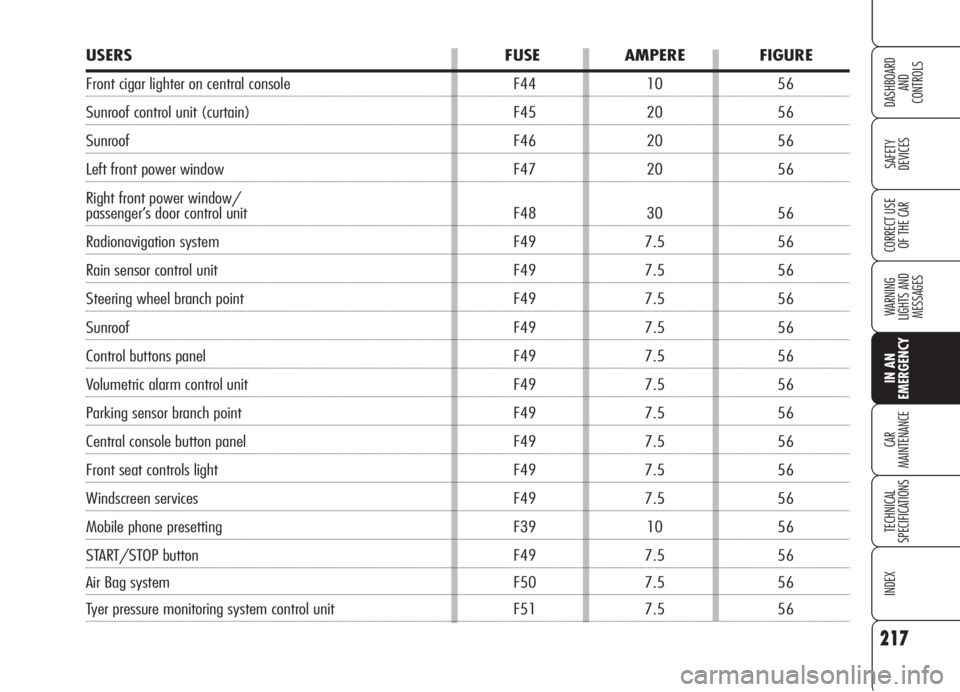
USERS FUSE AMPERE FIGURE
Front cigar lighter on central console F44 10 56
Sunroof control unit (curtain) F45 20 56
Sunroof F46 20 56
Left front power window F47 20 56
Right front power window/
passenger’s door control unit F48 30 56
Radionavigation system F49 7.5 56
Rain sensor control unit F49 7.5 56
Steering wheel branch point F49 7.5 56
Sunroof F49 7.5 56
Control buttons panel F49 7.5 56
Volumetric alarm control unit F49 7.5 56
Parking sensor branch point F49 7.5 56
Central console button panel F49 7.5 56
Front seat controls light F49 7.5 56
Windscreen services F49 7.5 56
Mobile phone presetting F39 10 56
START/STOP button F49 7.5 56
Air Bag system F50 7.5 56
Tyer pressure monitoring system control unit F51 7.5 56
Page 248 of 299

Exterior plastic parts must be cleaned in
the same way as the rest of the car.
Where possible, do not park under trees;
the resinous substance many species re-
lease give the paint a dull appearance
and increase the possibility of triggering
rust processes.
IMPORTANTBird droppings must be
washed off immediately and thorough-
ly as the acid they contain is particular-
ly aggressive.
246
SAFETY
DEVICES
WARNING
LIGHTS AND
MESSAGES
IN AN
EMERGENCY
TECHNICAL
SPECIFICATIONS
INDEX
CORRECT USE
OF THE CAR
DASHBOARD
AND
CONTROLS
CAR
MAINTENANCE
Windows
Use specific window cleaner products. Use
also clean cloths to avoid scratching the
glass or damaging the transparency.
IMPORTANTThe inside of the
rearscreen should be wiped gently with
a cloth in the direction of the filaments
to avoid damaging the heating device.
Front headlights
Front headlights shall be washed with
soft cloth moistened with water and car
detergent.
IMPORTANT Cleaning headlight lens-
es with a dry cloth will damage the
headlights with lack of performance as
a consequence. Solvents mat the lens-
es with lack of performance as a con-
sequence.
IMPORTANT When washing the front
headlights with a water monitor noz-
zle keep at least 2 cm away from the
lenses. To wash the car correctly proceed as fol-
lows:
❒remove the aerial from the roof to
prevent damage to it if the car is
washed in an automatic system;
❒wash the body using a low pressure
jet of water;
❒wipe a sponge with a slightly soapy
solution over the bodywork, fre-
quently rinsing with the sponge;
❒rinse well with water and dry with a
jet of air or a chamois leather.
When drying, take particular care with
the less visible parts like door surrounds,
bonnet and around the headlights where
water may stagnate. The car should not
be taken to a closed area immediately,
but left in the open so that residual wa-
ter can evaporate.
Do not wash the car after it has been left
in the sun or with the bonnet hot: this
may alter the shine of the paintwork.
Detergents cause water
pollution. Therefore the
car should be washed
in areas equipped for collecting
and purifying the liquid used in
the washing process.
Page 264 of 299

262
SAFETY
DEVICES
WARNING
LIGHTS AND
MESSAGES
IN AN
EMERGENCY
CAR
MAINTENANCE
INDEX
CORRECT USE
OF THE CAR
DASHBOARD
AND
CONTROLS
TECHNICALSPECIFICATIONS
Dimensions are
expressed in mm and
refer to the car
fitted with standard tyres.
Min. size variations
when optional tyres are
fitted.
The height refers to
the car unladen.
BOOT VOLUME
Boot volume .............. 445 dm3
A0E0307mfig. 7
Versions A B C D E (*) F G H
1.9 JTS - 2.2 JTS -
3.2 JTS - 1.9 JTD
M8v -4660 1000 2700 960 1422 1578 1828 1555
1.9 JTDM16v - 2.4 JTDM1417 (■) 1593 (■) 1573 (■)
(
■) With tyres 215/55 R16”
(*) With roof racks/ski racks (where provided): 1452/1447 (with 215/55 R16" tyres)
Page 266 of 299

264
SAFETY
DEVICES
WARNING
LIGHTS AND
MESSAGES
IN AN
EMERGENCY
CAR
MAINTENANCE
INDEX
CORRECT USE
OF THE CAR
DASHBOARD
AND
CONTROLS
TECHNICALSPECIFICATIONS
2.2 JTS
1490
1200
1100
2010
520
1500
70
80
3.2 JTS
1680
1300
1100
2200
520
1700
60
80
1.9 JTDM8v
1525
1200
1100
2045
520
1500
70
80
1.9 JTDM16v
1535
1200
1100
2055
520
1500
70
80
2.4 JTDM
1630
1300
1100
2150
520
1500
70
80
1.9 JTS
1480
1200
1100
2000
520
1500
70
80
WEIGHTS
Weights (kg)
Saloon versions
Kerb weight
Maximum admitted load (*)
– front axle
– rear axle
– total
Payload including
driver (**)
Towable loads
Max. load on ball
Maximum load on roof (***)
(*) Loads not to be exceeded. The driver is responsible for arranging the loads in the boot an/or on the roof so
that they comply with these limits.
(**) If special equipment is fitted (sunroof, tow hitch etc.) the unladen weight increases, thus reducing the payload as specified in
the maximum weight allowed.
(***) Lineaccessori Alfa Romeo roof rack, max capacity: 50 kg.