air condition Alfa Romeo 166 2006 Owner handbook (in English)
[x] Cancel search | Manufacturer: ALFA ROMEO, Model Year: 2006, Model line: 166, Model: Alfa Romeo 166 2006Pages: 272, PDF Size: 4.17 MB
Page 146 of 272

145
To ensure uniform wear between the
tyres on the front axle and those on the
rear axle, the tyres should be switched
around every 10,000 - 15,000 km keep-
ing the tyres on the same side of the ve-
hicle to avoid inverting the direction of ro-
tation (fig. 1).Note for one way tyres: There
are arrows on the side of one-way tyres
indicating the direction of rotation. When
a wheel is changed (for example after a
puncture, the direction of the arrow on
the spare wheel might not coincide with
the direction of rotation of the wheel to
be changed. Even in these conditions the
tyre is still safe but you are advised to
have the tyre repaired and refitted as
soon as possible, because top perfor-
mance is obtained when all the wheels
turn in the direction of the arrow.Tyre pressure and wear
The correct tyre pressure will not only
ensure that your tyres last longer but will
also make your vehicle safer as they have
a direct influence over road holding.
The pressure of each tyre, including that
of the spare tyre should be checked regu-
larly and always before a long journey.
The tyres should be checked when cold
using a pressure gauge and inflated to
the pressure given in the chapter “Techni-
cal specifications”.
Incorrect tyre pressure causes tyre wear
(fig. 2):
Do not cross the tyres
over.
WARNING
3212CAm
fig. 2
A0D0037m
fig. 1
Page 149 of 272
148ECONOMY AND
ENVIRONMENT-
FRIENDLY DRIVING
How you use and how you drive your
vehicle directly influence fuel consump-
tion and environmental impact.
By following a few simple guidelines
and without incising on the “liveliness”
of the vehicle, it is possible to avoid dam-
aging the environment and often, at the
same time, to limit fuel consumption.
The following helpful suggestions will al-
low you to save in running costs and re-
duce harmful emissions.
GENERAL CONSIDERATIONS
Vehicle maintenance
The conditions of the vehicle are an im-
portant factor which affects fuel consump-
tion as well as driving tranquillity and the
life of the car itself. For this reason, care
should be given to maintenance, having
the checks and adjustments given in the
scheduled maintenance programme car-
ried out (see ... spark plugs, idle speed,
air/fuel oil filter, timing).
Tyres
Check the tyre pressure at least every 4
weeks: if the pressure is too low, consump-
tion increases as resistance to rolling is
higher. It should also be underlined that in
these conditions, tyre wear increases re-
sulting in poor handling and lower safety. Drive at a moderate
speed when snow chains
have been fitted to the
wheels. Avoid potholes, steps and
pavements, and do not drive for
long stretches on snow-free roads,
otherwise you risk damaging the
tyres, suspension and steering.
Snow chains can be fit-
ted only on wheels with
6.5J x 16” rims and
215/55 R16 tyres or 7.5J x 17”
rims and 225/45 R17 tyres.
(*) Pour versions/marchè lorsqu’il
est prèvu pneus 205/55 R16.
Page 206 of 272
205
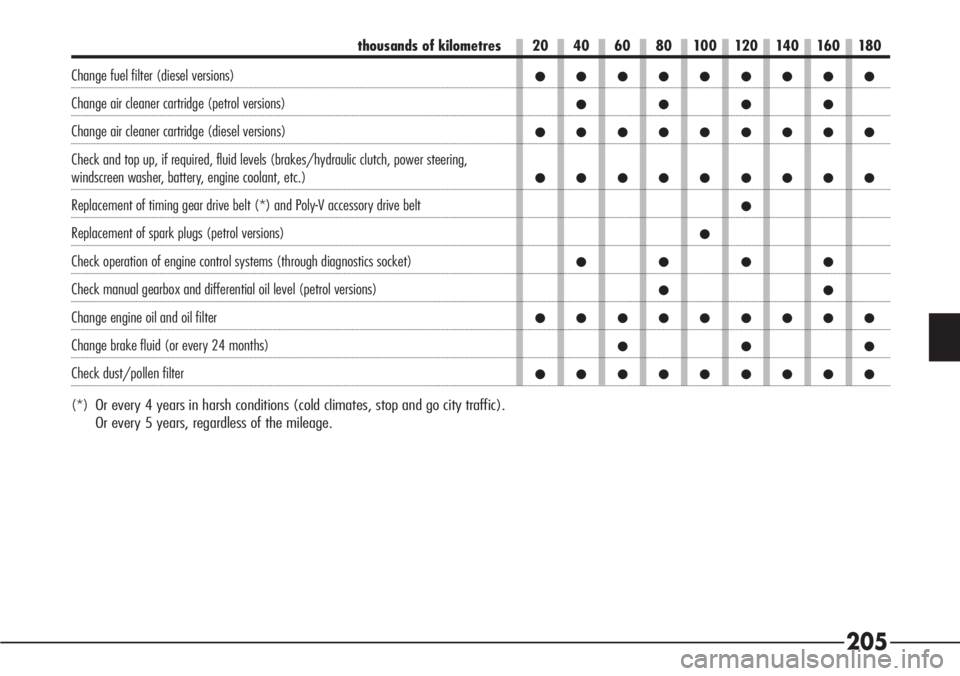
thousands of kilometres 20 40 60 80 100 120 140 160 180
Change fuel filter (diesel versions)•••••••••
Change air cleaner cartridge (petrol versions)••••
Change air cleaner cartridge (diesel versions)•••••••••
Check and top up, if required, fluid levels (brakes/hydraulic clutch, power steering,
windscreen washer, battery, engine coolant, etc.)•••••••••
Replacement of timing gear drive belt (*) and Poly-V accessory drive belt•
Replacement of spark plugs (petrol versions)•
Check operation of engine control systems (through diagnostics socket)••••
Check manual gearbox and differential oil level (petrol versions)••
Change engine oil and oil filter •••••••••
Change brake fluid (or every 24 months)•••
Check dust/pollen filter•••••••••
(*)Or every 4 years in harsh conditions (cold climates, stop and go city traffic).
Or every 5 years, regardless of the mileage.
Page 207 of 272
206 ANNUAL INSPECTION
PLAN
An annual inspection plan has
been established for cars that cov-
er less than 20,000 km a year
(e.g. 10,000 km). It consists of
the following:
– Checking the condition/wear of tyres,
and adjusting pressure (including the com-
pact spare wheel, where applicable).
– Checking the lighting system (head-
lights, turn indicators, hazard warning
lights, boot light, passenger compart-
ment, warning lights of instrument panel,
etc.).
– Checking the working order of the
windscreen wiper-washer and adjusting
the nozzles.
– Checking the positioning/wear of the
windscreen wipers.
– Checking the condition and wear of
the front brake pad.– Sight inspect the conditions of: en-
gine, gearbox, transmission, pipes and
hoses (exhaust - fuel - brakes), rubber
parts (boots, sleeves, bushes, etc.).
– Check for bonnet and boot lock clean-
ness, lever cleanness and lubrication.
– Check battery charge and fluid level
(electrolyte).
– Visually checking the condition of the
belts and various controls.
– Checking and topping up, if neces-
sary, the level of liquids (coolant, brake
fluid, windscreen washer fluid, battery
etc.).
– Change engine oil and oil filter, if re-
quired.
– Check and replace pollen filter, if re-
quired.
– Check and replace air cleaner, if re-
quired.
ADDITIONAL OPERATIONS
Every 1000 kmor before long jour-
neys check and if necessary top up:
– the engine coolant fluid level
– brake fluid/hydraulic clutch control
fluid level
– power steering fluid level
– windscreen washer and headlamp
washer fluid level
– tyre pressure and conditions.
– check light system operation (head-
lights, direction indicators, hazard lights,
etc.).
– check windscreen wiper/washer op-
eration and windscreen/rear window
blade position/wear.
Every 3000 kmcheck the level of
the engine oil and top up if necessary.
Every 5000 km(only for fuel oil en-
gines): drain the condensation water
from the filter. You are recommended to
use products of the FL Selenia, de-
signed and developed expressly for Alfa
Romeo cars (see the table “Fluids and lu-
bricants” in the Technical specifications”
chapter).
Page 208 of 272
207
IMPORTANT - Engine oil
Change the engine oil more frequently
than stated in the Scheduled Mainte-
nance Programme if the car is used pre-
vailingly in one of the following particular-
ly harsh conditions:
– trailer or caravan towing
– dusty roads
– short, repeated journeys (less than 7-
8 km) with an outside temperature of be-
low freezing point.
– engine idling frequently or driving
long distances at low speed (e.g. taxi or
door-to-door deliveries) or in the case of
prolonged inactivity.
IMPORTANT - Air cleaner
Using the car on dusty roads, change
the air cleaner more frequently than stat-
ed in the Scheduled Maintenance Pro-
gramme.
For any doubts about the intervals be-
tween engine oil and air cleaner changes
in relation to how the car is used, contact
Authorised Alfa Romeo Services.IMPORTANT - Fuel oil filter
The variety of the degree of purity of
the fuel oil in commerce may make it
necessary to change the fuel oil filter
more frequently than stated in the Sched-
uled Maintenance Programme. If the en-
gine is “sobbing” it is a sign that the fil-
ter needs changing.
IMPORTANT - Pollen filter
If the car is used frequently in dusty or
heavily polluted environments, you are
recommended to change the activated
carbon filtering element more frequently;
in particular, it should be changed if a
lower flow of air admitted to the passen-
ger compartment is noted.IMPORTANT - Batteries
You are recommended to have the bat-
tery charge conditions checked, prefer-
ably at the onset of winter, to avoid the
possibility of freezing the electrolyte.
This check should be carried out more
frequently if the car is used prevailingly
for short journeys, or if it is fitted with
services that absorb high amounts of cur-
rent permanently with the ignition key
off, especially if installed in the after mar-
ket.
In the case of use of the car in hot cli-
mates or particularly harsh conditions, it
is wise to check the level of the battery
fluid (electrolyte) at more frequent inter-
vals than stated in the Scheduled Mainte-
nance Programme.
IMPORTANT - Remote control
If when pressing the remote control but-
ton of the key, the operating led on the
key flashes briefly only once, the battery
need replacing with other of the same
type.
Page 219 of 272

218
Any attempt to clean
the air cleaner may
cause serious engine
damage.
If they are not carried
out correctly and with
the due precautions, the
operations involving cleaner re-
placement described herein may
compromise the safety of the
car. This operation should be car-
ried out by Alfa Romeo Autho-
rized Services.
AIR CLEANER
The air cleaner is connected to the tem-
perature and air flow sensors which send
the electrical signals needed for correct
operation of the injection and ignition sys-
tem to the control unit.
It must therefore always be in perfect
conditions to ensure correct operation of
the engine, low consumption and exhaust
emission levels.When the car is habitu-
ally driven in dusty ar-
eas, the cleaner should
be changed at shorter intervals
than those given in the Pro-
grammed Maintenance Schedule.
IMPORTANT When topping up use
the special detergents available in the
shops ensuring that they contain antis-
cale and antifreeze properties.
If in doubt contact Alfa Romeo Autho-
rized Services who will be able to recom-
mend the most suitable products.
Do not travel with the
windscreen washer
reservoir empty: the action of the
windscreen washer is fundamental
for improving vision.
WARNING
Page 227 of 272
226
The characteristics of these products are
compatible with the type of paint, gas-
kets and trim of all Alfa Romeo vehicles.
The application of these products should
however be carried out by Alfa Romeo
personnel who will be able to guarantee
the best results and avoid problems which
may compromise the bodywork warranty
cover.
To correctly wash the car, proceed as fol-
lows:
1) Spray the vehicle with a low pres-
sure jet of water.
2) Pass a sponge moistened with a
light detergent solution (2-4% shampoo
in water) over the bodywork rinsing the
sponge frequently.
3) Rinse well with water and dry with a
jet of air or chamois leather.Detergents cause water
pollution. The car should
therefore be washed in
areas equipped for the collection
and purification of the liquid used
in the washing processes.RECOMMENDATIONS TO
PRESERVE THE BODYWORK
Particular care should be taken to en-
sure that residual deposits of industrial
dust, tar spots, dead insects etc. do not
remain on the bodywork.
Where possible do not park under trees
as, during certain seasons, residues, buds
and leaves containing chemical sub-
stances which are harmful to the paint
may fall onto the vehicle.
When topping up ensure that petrol, lu-
bricating oil, brake fluid, liquid for the
cooling system, battery electrolyte solu-
tion etc. is not splashed onto the body-
work.
If this should occur however, clean the
area immediately and wash the vehicle
as soon as possible.
PAINT
The paintwork does not only serve an
aesthetic purpose but also protects the
underlying sheet metal.
In the case of deep scrapes or scores
you are advised to have the necessary
touching up carried out immediately by a
specialised workshop to avoid the forma-
tion of rust.
Normal paint maintenance consists in
washing at intervals depending on the
conditions and environment of use.
For example:
– in areas with high atmospheric pollu-
tion.
– Roads sprayed with salt.
– Parking under trees that release
resinous substances.
It is wise to wash the car more frequently.
Alfa Romeo markets a complete series
of products specifically designed for the
care and cleanliness of its vehicles (sham-
poo, wax, touch-up paint stick, stain re-
mover, polish etc.).
Page 264 of 272
263
ABS (system) ..............................114
Additional heater ..............................91
Air bags, front and side ....................50
Air cleaner ....................................218
Air conditioner ................................83
Air conditioning ................................80
Alfa Romeo CODE system ..................16
Alfa Romeo I.C.S. system ................14
Ashtray ..........................................99
ASR (system) ................................117
At the filling station ........................124
Automatic fuel cut-off switch
and power supply ......................127
Battery ......................................219
Body maintenance..........................225
Boot ............................................105
Boot light......................................185Brake Assist ............................116-141
Brakes..........................................241
Bulb replacement ....................165-181
Car maintenance......................201
Carrying children safety ....................45
Central locking ................................29
Changing the bulb
- Bulb types ........................165-166
- General instructions ..................165
Child safety ....................................30
Child safety device (doors) ................45
Cigar lighter ....................................98
CO
2emissions ................................241
Coin holder......................................98
Controls ..........................................93
Correct use of the car..............133
Courtesy light ................................101Cruise Control ..................................64
Dashboard ....................................68
Data plates....................................232
Diesel filter....................................219
Dimensions ..................................234
Direction indicators ..........................59
Door lights ....................................102
Doors ............................................28
Dust/pollen filter ......................90-219
Electronic alarm system ..................22
Electronic control units ....................223
Emission control devices ..................129
Engine ..........................................235
Engine codes – Body versions ..........233
Engine coolant temperature gauge ......74
Engine oil consumption ..................236
ALPHABETICAL INDEX