battery Alfa Romeo 166 2006 Owner handbook (in English)
[x] Cancel search | Manufacturer: ALFA ROMEO, Model Year: 2006, Model line: 166, Model: Alfa Romeo 166 2006Pages: 272, PDF Size: 4.17 MB
Page 71 of 272
70
IMPORTANT Depending on the trim
levels, the dial of the instruments may be
either light grey or black, with green or
red light.
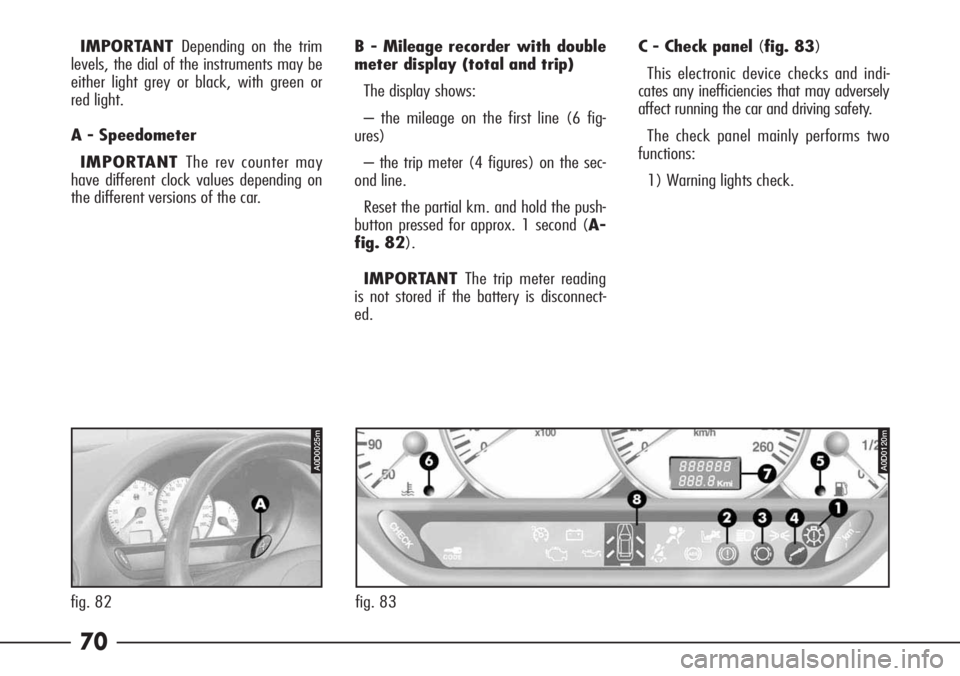
A - Speedometer
IMPORTANT The rev counter may
have different clock values depending on
the different versions of the car.B - Mileage recorder with double
meter display (total and trip)
The display shows:
– the mileage on the first line (6 fig-
ures)
– the trip meter (4 figures) on the sec-
ond line.
Reset the partial km. and hold the push-
button pressed for approx. 1 second (A-
fig. 82).
IMPORTANT The trip meter reading
is not stored if the battery is disconnect-
ed.C - Check panel (fig. 83)
This electronic device checks and indi-
cates any inefficiencies that may adversely
affect running the car and driving safety.
The check panel mainly performs two
functions:
1) Warning lights check.
A0D0025mA0D0120m
fig. 82 fig. 83
Page 72 of 272
71
D - Rev counter
The danger zone (red) indicates exces-
sively high engine revs. Do not drive for
long periods with the pointer in this area.
With the engine at idle speed, the rev
counter may indicate a gradual or sudden
speed increase depending on the cases;
this is normal as it occurs in the normal
operation, for example when the climate
control compressor is engaged or the fan.
In particular a slow change in speed helps
preserve the battery charge.
IMPORTANT Depending on the ver-
sions/markets of the car, the rev counter
may have danger sectors (red) of differ-
ent size and with different top of scale
values.
IMPORTANT The electronic ignition
control system gradually shuts off the
flow of fuel when the engine is “over-
revving” resulting in a gradual loss of en-
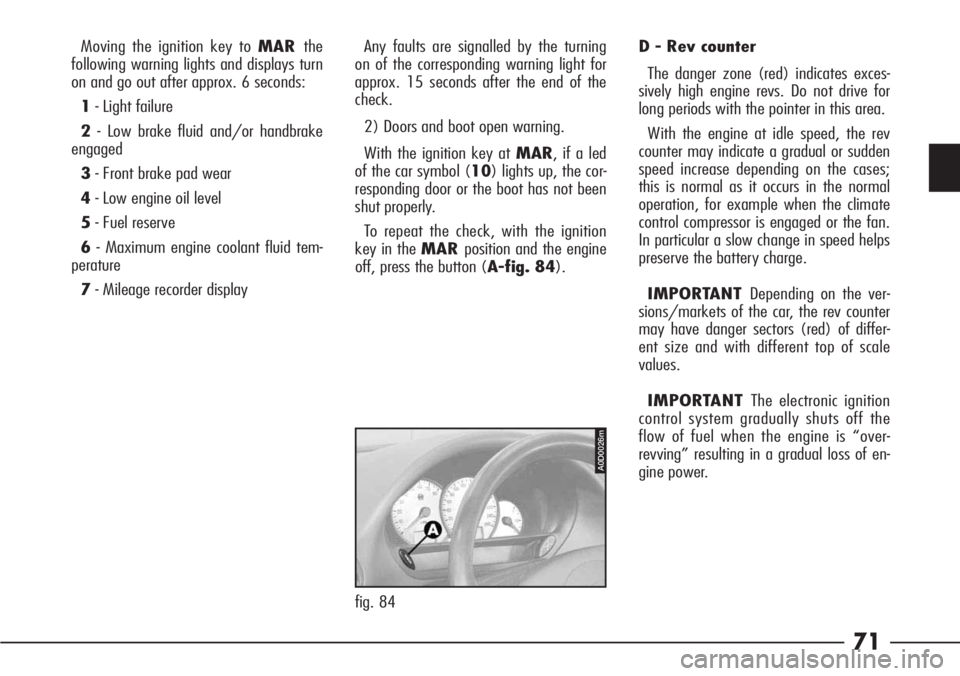
gine power. Moving the ignition key to MARthe
following warning lights and displays turn
on and go out after approx. 6 seconds:
1- Light failure
2- Low brake fluid and/or handbrake
engaged
3- Front brake pad wear
4- Low engine oil level
5- Fuel reserve
6- Maximum engine coolant fluid tem-
perature
7- Mileage recorder displayAny faults are signalled by the turning
on of the corresponding warning light for
approx. 15 seconds after the end of the
check.
2) Doors and boot open warning.
With the ignition key at MAR, if a led
of the car symbol (10) lights up, the cor-
responding door or the boot has not been
shut properly.
To repeat the check, with the ignition
key in the MARposition and the engine
off, press the button (A-fig. 84).
A0D0026m
fig. 84
Page 75 of 272
74
If the warning light
comes on when the ve-
hicle is in movement,
switch the engine off immediate-
ly and contact Alfa Romeo Au-
thorized Services.v
Low engine oil level
This warning light stays on for approx.
15 seconds, after the check, when the
engine oil level is low.
With the ignition key at MAR, pressing
the check button, the warning light turns
on but must go out after approx. 6 sec-
onds.
The oil level is checked only pressing
the check button with the engine
stopped. If the engine is started during
the check, the check procedure is inter-
rupted.k
If the warning light
stays on after the
check, do not try to get
peak performance out of the en-
gine and top up the oil as soon
as possible.k
Insufficient oil pressure
This warning light should be out when
the engine is running.
When the ignition key is turned to the
MARposition the warning light comes
on and should go out as soon as the en-
gine is started. vLow battery charge
This warning light should be out when the
engine is running (a slight delay is permitted
when the engine is running at idle speed).
If the warning light comes on, Alfa
Romeo Authorized services should be con-
tacted immediately.
When the ignition key is moved to the
MARposition the warning light comes
on and should go out as soon as the en-
gine is started.w
Page 108 of 272
107
The gas springs are cali-
brated to guarantee
correct operation with
loading specified by the manufac-
turer. Arbitrary additions to the
boot lid (spoiler etc.) may affect
its operation and safety.
EMERGENCY OPENING
The luggage compartment lock is re-
leased by a servocontrol when opening
the bonnet from inside or using the key.
However, it is always possible to open
the luggage compartment, even in case
of insufficient battery power: just rotate
the key wider and simultaneously press
the bonnet edge by the hand.
IMPORTANTApply a moderate pres-
sure only on the bonnet edge, immediate-
ly above the lock.
LIFTING AND CLOSING
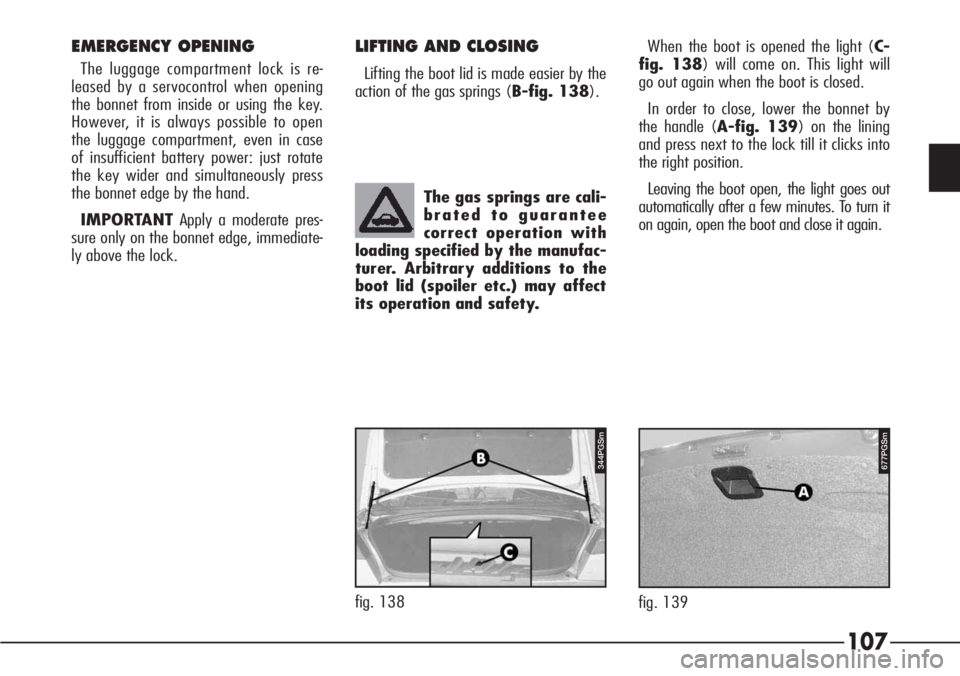
Lifting the boot lid is made easier by the
action of the gas springs (B-fig. 138).When the boot is opened the light (C-
fig. 138) will come on. This light will
go out again when the boot is closed.
In order to close, lower the bonnet by
the handle (A-fig. 139) on the lining
and press next to the lock till it clicks into
the right position.
Leaving the boot open, the light goes out
automatically after a few minutes. To turn it
on again, open the boot and close it again.
fig. 139
677PGSm344PGSm
fig. 138
Page 136 of 272
135
IMPORTANT If it is difficult to start the
engine do not insist with extended attempts
which may damage the catalyzer but con-
tact Alfa Romeo Authorized Services.
PROCEDURE FOR DIESEL
VERSIONS
1) Engage the handbrake.
2) Set the gearshift lever to neutral and
fully depress the clutch without pressing
the accelerator.
3) Turn the ignition key to the MAR
position. the
mwarning light on the in-
strument cluster will turn on.
4) Wait for the
mwarning light to go
off, which will depend on how warm the
engine is. If the engine is very warm the
turning on of the warning light may be so
fast as to go by unobserved.
5) Turn the ignition key to AVV as
soon as the
mwarning light goes off.
Waiting too long would make the glow
plug heating work pointless.IMPORTANT The electric devices that
absorb much energy (air conditioner,
rearscreen heating, etc.) are disengaged
automatically during engine starting.
If the engine does not start at the first
attempt, move the ignition key back to
theSTOPposition before repeating s-
tarting.
If starting is difficult (with the Alfa
Romeo CODE system efficient), do not in-
sist with prolonged attempts.
Only use an auxiliary battery if it is not-
ed that the cause is due to low charge of
vehicle’s battery. Never use a battery
charger to start the engine (see ”If the
battery is flat” in the chapter “In an e-
mergency”).
WARMING THE ENGINE
– Drive off slowly, at medium revs
without accelerating abruptly.
– Do not drive at full performance for
the initial kilometres of the journey. Wait
until the engine coolant temperature is
between 50 and 60°C.
SWITCHING OFF
– Release the accelerator pedal and
wait until the engine reaches idle speed.
– Turn the ignition key to the STOP
position and switch off the engine.
IMPORTANT After a hard journey, it
is advisable to allow the engine to “get
its breath back” before switching off, run-
ning it at idle speed to allow the tempera-
ture in the engine compartment to cool
down. For versions/markets
where applicable the
warning light m flashes
for about 30 seconds after start-
ing the engine meaning that
there is a fault to the glow plug
warming system, in which case,
contact Alfa Romeo Authorized
Services.
Page 137 of 272
136
EMERGENCY STARTING
Starting with an auxiliary
battery
If the engine does not start (with the Al-
fa Romeo CODE system efficient), use an
auxiliary battery as described in the chap-
ter “In an emergency”.
SAFE DRIVING
This paragraph supplies suggestions and
indications for the correct and safe use of
your vehicle in the most common situa-
tions.
In addition to this, suggestions are giv-
en concerning the main organs which en-
sure the safety of the vehicle and its pas-
sengers.
BEFORE DRIVING OFF
Before driving off, especially before a
long journey, the following procedures
should be carried out:
– Adjust the seat, steering wheel and
rear-view mirrors in order to obtain a cor-
rect position for driving.
– Check that nothing can get under the
foot pedals, especially under the brake
pedal.
– If children are present in the car ad-
here to the instructions given in the para-
graph “General instructions for the use of
the seat belts and child restraint system”
in the chapter “Getting to know your
car”. For vehicles equipped
with turbocharger in
particular and for other
vehicles in general, revving the
engine before switching off
should be avoided.
Revving the engine serves no
purpose and consumes fuel for
no reason. It may also cause
damage to the bearings on the
rotor.
Do not bump, tow or
coast start the vehicle
as this would irrepara-
bly damage the exhaust gas cat-
alyzer.
Page 139 of 272
138
PARKING
When the vehicle is parked, proceed as
follows:
– Switch off the engine.
– Engage the handbrake.
– Engage first gear if parking the car
uphill or reverse if parking the car on a s-
loping road. On cars with automatic gear-
box set the gear lever to P.
– Turn the front wheels so that the vehi-
cle will immediately come to a halt if the
handbrake slips.
NIGHT DRIVING
Night driving involves a greater degree
of concentration, both physical and ner-
vous. Some suggestions concerning night
driving follow:
– Drive with particular care, reducing
speed if necessary especially on unlit
roads.
– Maintain a greater distance from the
vehicle in front than during the day as it
is more difficult to judge the speed of a
vehicle when only the lights can be seen.
– If you become drowsy stop the car
and rest. continuing the journey when
sleepy is dangerous for yourself and for
others.
–Ensure that the headlights are correct-
ly aligned: if they are too low visibility is
reduced and if they are too high they
may cause disturbance to other users.
– use the main-beam outside built-up
areas and only when you are certain that
other drivers are not disturbed by their
use.
– When meeting vehicles coming in the
opposite direction, switch off the main-
beam and drive with the dipped-beam
headlights on.
– Keep the headlights and light units
clean at all times. – Do not coast the vehicle down hill
with the engine switched off as this elimi-
nates the engine braking effect thus re-
quiring a greater effort on the brake ped-
al, on the power steering and consider-
ably more effort on the steering wheel.
– If it is necessary to stop the vehicle
following a malfunction, park off the
road, switch on the hazard warning lights
and set up the warning triangle to alert
other road users of the presence of your
vehicle. At all times comply with the cur-
rent road traffic regulations.To avoid useless con-
sumption of power and
possible draining of the
battery, never leave the ignition
key in the MAR position when
the engine is not running.Ensure that both yourself
and your passengers are
wearing their seat belts. Travelling
without seat belts greatly in-
creases the risks of serious injury
or even death in the event of an
accident.
WARNING
Never leave children un-
attended in the vehicle.
Always remove the key from the
ignition when leaving the vehicle
and take it with you.
WARNING
Page 152 of 272
151
Use an auxiliary battery to start the ve-
hicle in an emergency.
If the engine is not “running smoothly”
when the vehicle is travelling, reduce the
request for performance to a minimum
and contact Alfa Romeo Authorized Ser-
vices as soon as possible.
When the fuel reserve warning light
comes on fill up as soon as possible. A
low fuel level may cause an irregular sup-
ply to the engine with inevitable increase
of the exhaust gas temperature.
When travelling downhill for long
stretches slightly rev the engine every
now and again. This action will extend
the life of the catalyzer.
Never run the engine, even as a test,
with one or more spark plugs disconnect-
ed.
During normal operation
the catalytic converter
reaches high temperatures. Do not
therefore park the vehicle over in-
flammable materials (grass, dry
leaves, pine needles etc.): fire haz-
ard. Do not install other heat
shields and do not remove the ex-
isting ones on the catalyst and on
the exhaust pipe.
Do not spray anything on the cat-
alyst, lambda sensor and exhaust
pipe.
WARNING
The failure to follow
these rules may cause a
fire hazard.
WARNING
Page 154 of 272
153
Apart from the electrical branches taken
off for the obligatory signalling devices,
the vehicle’s electrical system can only be
connected to the supply cable for an elec-
tric brake and to the cable for internal
light, though not above 15W, in the trailer.
The electric brake must be directly sup-
plied by the battery through a cable with
a cross-section of over 2.5 mm
2.
INSTALLING TOW HOOK
(fig. 3)
The chart shows the attachment points
for fixing the tow hook to the body.
These points must not be changed irre-
spective of the shape and size of the
hook. For mechanical connection the fol-
lowing must be used:
– “ISO 50” 2nd category ball hook
(CUNA Table NC 138-40)
– 2nd category ball eyelet model “CU-
NA 502” (CUNA Table NC 438-40)
The tow hook structure must be fas-
tened in the points shown by the symbol
Øwith a total of 12 M10 screws.
The inner plate (1) should be at least 4
mm thick.
The side plates (2) should be at least 5
mm thick.
The fastening points (3) must be fitted
with a spacer with a 25 mm diameter
and 6 mm thickness.IMPORTANTIt is compulsory to fas-
ten a label of suitable size and material
(clearly visible) at the height of the hook
ball with the wording:
MAX. LOAD ON BALL 60 kg.
ELECTRICAL CONNECTIONS
The attachment for the trailer wiring
connections are to be applied to the tow
hook support in the most suitable posi-
tion.
For the electrical connections a 13 pole,
12V connection must be used.
For vehicle-trailer electrical connections
contact Authorized Alfa Romeo Services.Do not connect any
trailer services (fan,
fridge, etc.) to the vehi-
cle’s electrical system.
After assembly, the fas-
tening screw holes
should be sealed to prevent the in-
filtration of exhaust gas.
WARNING
Page 156 of 272
155 VEHICLE INACTIVITY
If the vehicle is to be left inactive for
long periods the following precautions
should be noted:
– House the vehicle under a cover in a
dry and possibly ventilated place.
– Engage a gear.
– Release the handbrake.
– Clean and protect the paintwork by
applying silicon wax.
– Cover the rubber windscreen wiper
blades with talcum powder and raise
them off the glass.
– Open the windows slightly.
– Cover the vehicle with a cloth or per-
forated plastic cover. Do not use compact
plastic covers which prevent the humidity
on the surface of the vehicle from evapo-
rating.
– Inflate the tyres to a pressure of 0.5
bars above normal. If possible rest the
tyres on wooden planks and periodically
check the pressure.– Switch off the alarm system (if fit-
ted) with the remote control, then deacti-
vate it with the emergency key.
– Disconnect the terminals from the
battery poles (negative pole first) and
check the battery charge. When the vehi-
cle is in storage, this check should be car-
ried out once a month. If the no-load volt-
age is less than 12.5V, recharge the bat-
tery.
REMOVING FROM STORAGE
Before using your vehicle after a long
period of inactivity the following opera-
tions should first be carried out:
– Do not dust the outside of the vehi-
cle.
– Visually check that there are no
leaks (oil, brake and clutch fluid, engine
coolant etc.).
– Replace the engine oil and filter.
– Check:
Gearbox-differential oil level
Brake-clutch fluid level
Level of engine coolant fluid.– Check the air cleaner and replace if
necessary.
– Check tyre pressure and ensure that
they are not damaged, cracked or cut. If
they are they must be replaced.
– Check the state of the drive belts in
the engine bay.
– Connect the cables of the battery af-
ter checking that the charge is adequate.
– Re-activate the alarm system, if fit-
ted, using the emergency key.
– With the gear lever in neutral start
the engine and allow the engine to run
for a few seconds whilst repeatedly
pumping the clutch pedal.