lock Alfa Romeo 166 2006 Owner handbook (in English)
[x] Cancel search | Manufacturer: ALFA ROMEO, Model Year: 2006, Model line: 166, Model: Alfa Romeo 166 2006Pages: 272, PDF Size: 4.17 MB
Page 29 of 272
28 DOORS
AUTOMATIC DOOR LOCKING
The automatic door locking function acti-
vates automatically when the car speed
exceeds 20 km/h.
This function can be deactivated and re-
activated by the following procedure, to
be carried out with the car at a standstill,
key at STOPand doors closed:
- turn the key to MAR
- keep button (A-fig. 20) on the cen-
tral console pressed until completing a full
centralised door locking cycle (opening
and closing or vice versa).IMPORTANTDepending on the ver-
sions/markets the lock for the key may
only be present on the driver’s door.
– To close the door, turn the key in the
opposite direction.
Rear doors
– To open the door, only with the inner
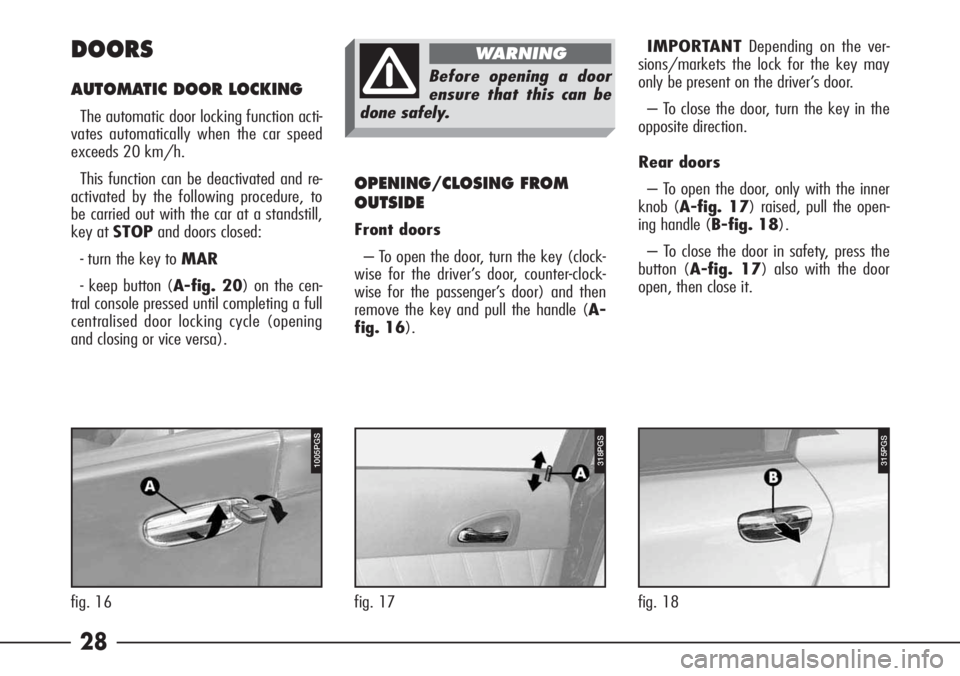
knob (A-fig. 17) raised, pull the open-
ing handle (B-fig. 18).
– To close the door in safety, press the
button (A-fig. 17) also with the door
open, then close it.
OPENING/CLOSING FROM
OUTSIDE
Front doors
– To open the door, turn the key (clock-
wise for the driver’s door, counter-clock-
wise for the passenger’s door) and then
remove the key and pull the handle (A-
fig. 16).
Before opening a door
ensure that this can be
done safely.
WARNING
315PGS1005PGS
fig. 16 fig. 18
318PGS
fig. 17
Page 30 of 272
29
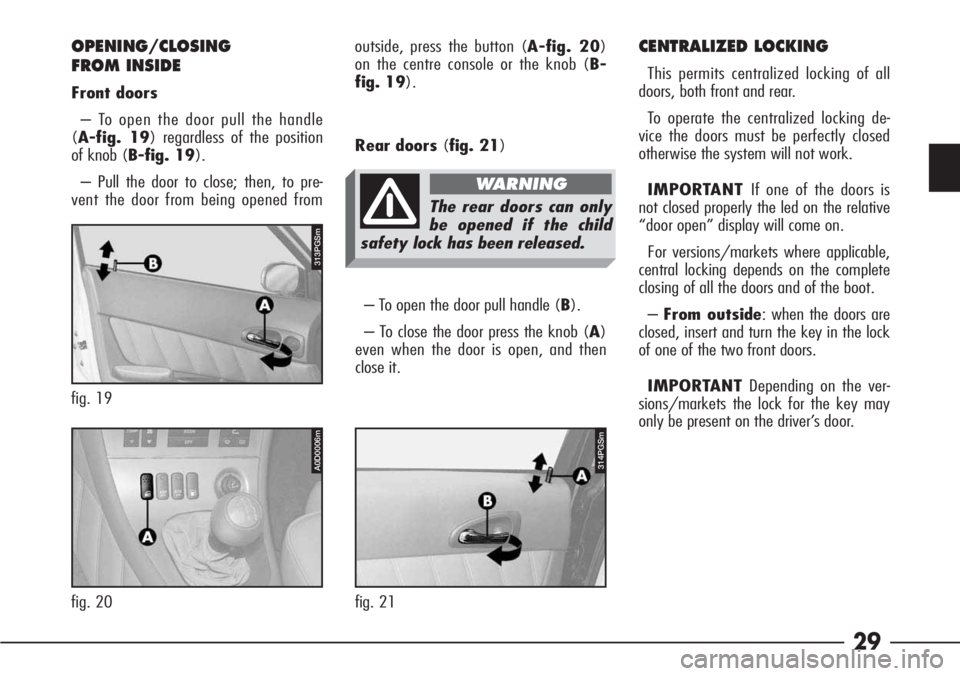
– To open the door pull handle (B).
– To close the door press the knob (A)
even when the door is open, and then
close it.
OPENING/CLOSING
FROM INSIDE
Front doors
– To open the door pull the handle
(A-fig. 19) regardless of the position
of knob (B-fig. 19).
– Pull the door to close; then, to pre-
vent the door from being opened from
CENTRALIZED LOCKING
This permits centralized locking of all
doors, both front and rear.
To operate the centralized locking de-
vice the doors must be perfectly closed
otherwise the system will not work.
IMPORTANT If one of the doors is
not closed properly the led on the relative
“door open” display will come on.
For versions/markets where applicable,
central locking depends on the complete
closing of all the doors and of the boot.
–From outside: when the doors are
closed, insert and turn the key in the lock
of one of the two front doors.
IMPORTANTDepending on the ver-
sions/markets the lock for the key may
only be present on the driver’s door. outside, press the button (A-fig. 20)
on the centre console or the knob (B-
fig. 19).
Rear doors (fig. 21)
The rear doors can only
be opened if the child
safety lock has been released.
WARNING
fig. 19
fig. 20
P4C00057313PGSm
A0D0006m
fig. 21
314PGSm
Page 31 of 272
30
–From inside: with the doors closed,
press the button (A-fig. 20) on the
centre console or one of the knobs
(B-fig. 19) on the front doors to en-
gage (lock) central locking.
By pressing the knob (A-fig. 21) on
one of the rear doors only that particular
door will be locked.
To unlock central locking press the button
again (A-fig. 20).
IMPORTANT For the front doors it is
not possible to keep the knob (B-
fig. 19) down if the door has not been
shut properly.
IMPORTANT If the power supply is
interrupted (burnt fuse, battery discon-
nected etc.) each door can be opened
manually from both inside and outside
the vehicle.
IMPORTANT The centralized locking
system can be deactivated, thus unlock-
ing all doors, by lifting the door opening
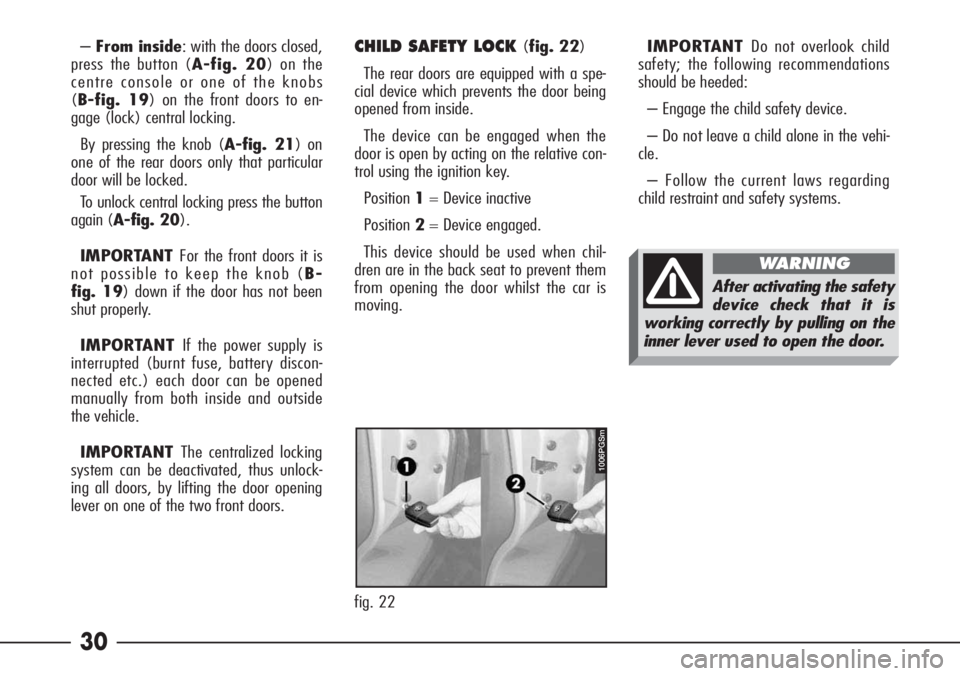
lever on one of the two front doors.CHILD SAFETY LOCK (fig. 22)
The rear doors are equipped with a spe-
cial device which prevents the door being
opened from inside.
The device can be engaged when the
door is open by acting on the relative con-
trol using the ignition key.
Position1= Device inactive
Position2= Device engaged.
This device should be used when chil-
dren are in the back seat to prevent them
from opening the door whilst the car is
moving.IMPORTANT Do not overlook child
safety; the following recommendations
should be heeded:
– Engage the child safety device.
– Do not leave a child alone in the vehi-
cle.
– Follow the current laws regarding
child restraint and safety systems.
After activating the safety
device check that it is
working correctly by pulling on the
inner lever used to open the door.
WARNING
fig. 22
1006PGSm
Page 32 of 272
31
SEATS
FRONT SEATS
Manual adjustment controls
Moving the seat backwards or
forwards
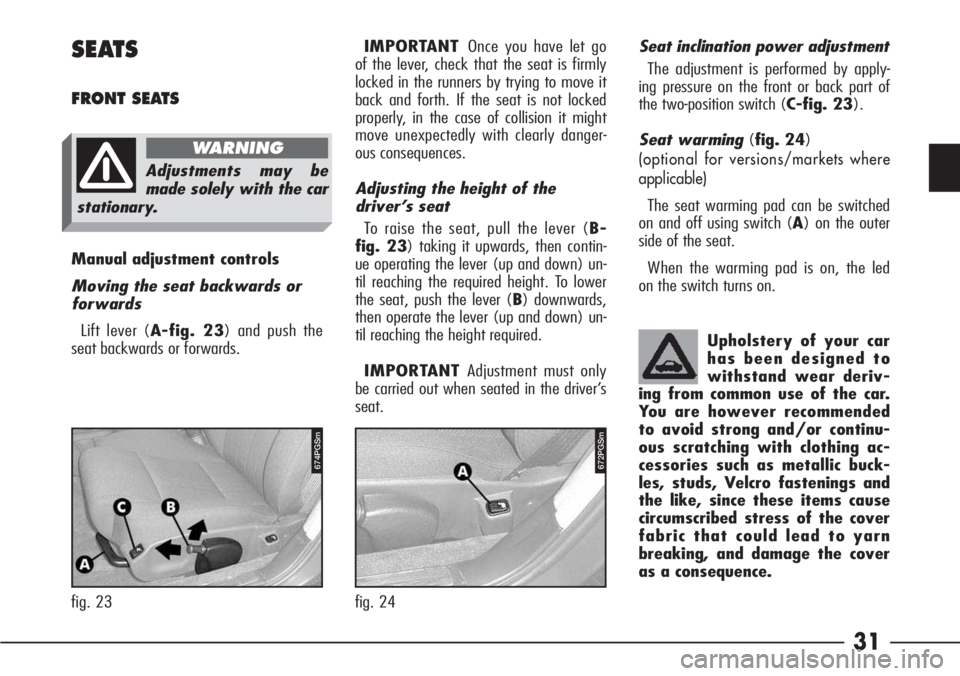
Lift lever (A-fig. 23) and push the
seat backwards or forwards. IMPORTANTOnce you have let go
of the lever, check that the seat is firmly
locked in the runners by trying to move it
back and forth. If the seat is not locked
properly, in the case of collision it might
move unexpectedly with clearly danger-
ous consequences.
Adjusting the height of the
driver’s seat
To raise the seat, pull the lever (B-
fig. 23) taking it upwards, then contin-
ue operating the lever (up and down) un-
til reaching the required height. To lower
the seat, push the lever (B) downwards,
then operate the lever (up and down) un-
til reaching the height required.
IMPORTANT Adjustment must only
be carried out when seated in the driver’s
seat.Seat inclination power adjustment
The adjustment is performed by apply-
ing pressure on the front or back part of
the two-position switch (C-fig. 23).
Seat warming(fig. 24)
(optional for versions/markets where
applicable)
The seat warming pad can be switched
on and off using switch (A) on the outer
side of the seat.
When the warming pad is on, the led
on the switch turns on.
Adjustments may be
made solely with the car
stationary.
WARNING
fig. 23
674PGSm
fig. 24
672PGSm
Upholstery of your car
has been designed to
withstand wear deriv-
ing from common use of the car.
You are however recommended
to avoid strong and/or continu-
ous scratching with clothing ac-
cessories such as metallic buck-
les, studs, Velcro fastenings and
the like, since these items cause
circumscribed stress of the cover
fabric that could lead to yarn
breaking, and damage the cover
as a consequence.
Page 34 of 272
33
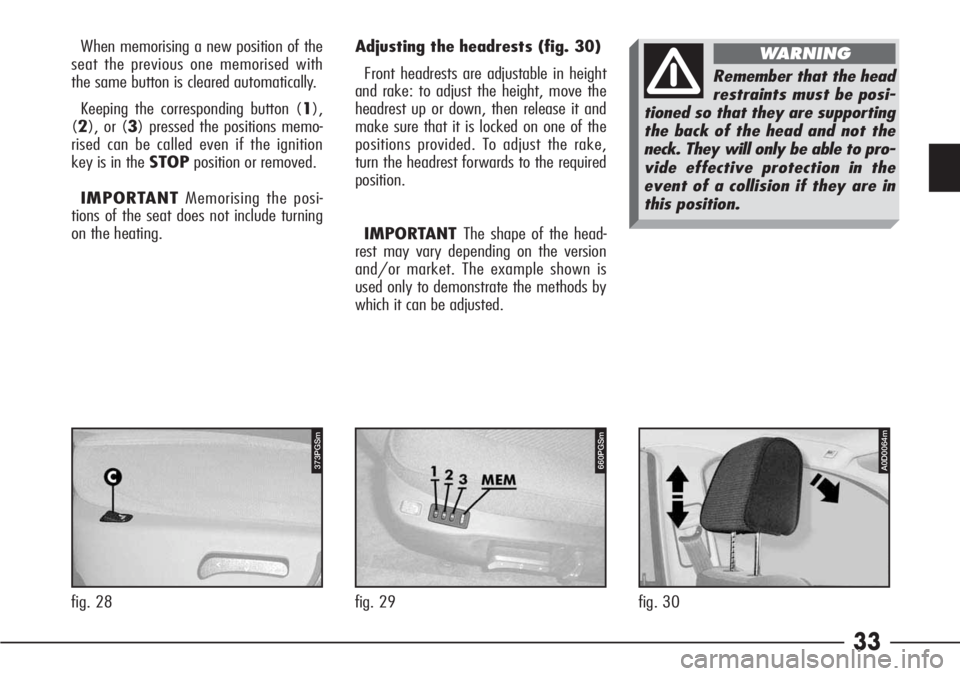
Adjusting the headrests (fig. 30)
Front headrests are adjustable in height
and rake: to adjust the height, move the
headrest up or down, then release it and
make sure that it is locked on one of the
positions provided. To adjust the rake,
turn the headrest forwards to the required
position.
IMPORTANT The shape of the head-
rest may vary depending on the version
and/or market. The example shown is
used only to demonstrate the methods by
which it can be adjusted. When memorising a new position of the
seat the previous one memorised with
the same button is cleared automatically.
Keeping the corresponding button (1),
(2), or (3) pressed the positions memo-
rised can be called even if the ignition
key is in the STOPposition or removed.
IMPORTANTMemorising the posi-
tions of the seat does not include turning
on the heating.
Remember that the head
restraints must be posi-
tioned so that they are supporting
the back of the head and not the
neck. They will only be able to pro-
vide effective protection in the
event of a collision if they are in
this position.
WARNING
fig. 28
373PGSm
fig. 30
A0D0064m
fig. 29
660PGSm
Page 35 of 272
34
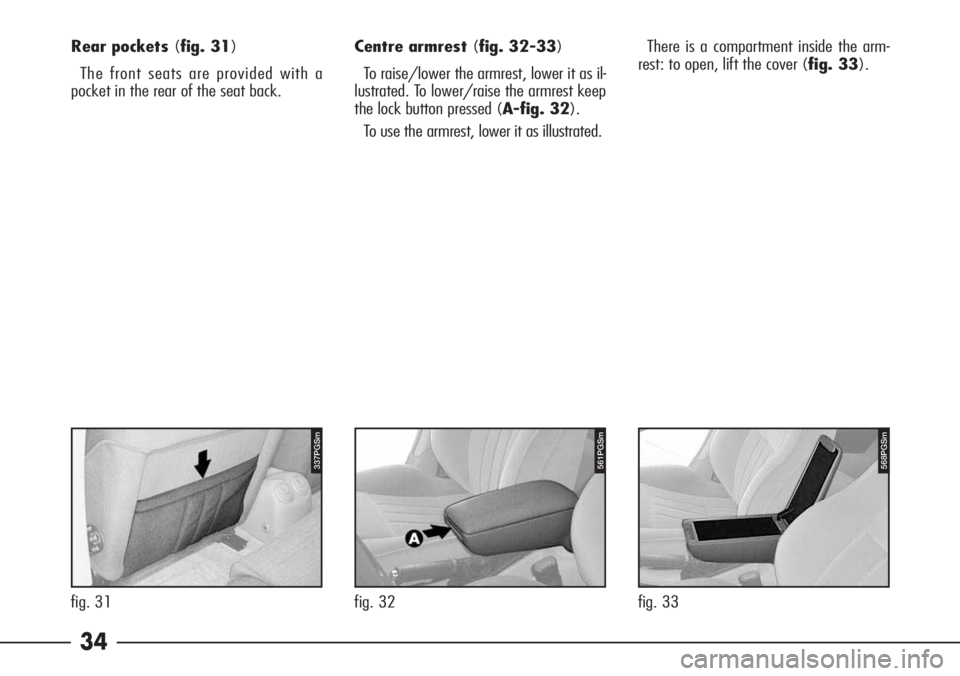
Centre armrest (fig. 32-33)
To raise/lower the armrest, lower it as il-
lustrated. To lower/raise the armrest keep
the lock button pressed (A-fig. 32).
To use the armrest, lower it as illustrated.There is a compartment inside the arm-
rest: to open, lift the cover (fig. 33). Rear pockets (fig. 31)
The front seats are provided with a
pocket in the rear of the seat back.
568PGSm
fig. 33
561PGSm
fig. 32
337PGSm
fig. 31
Page 37 of 272
36 STEERING WHEEL
ADJUSTMENT
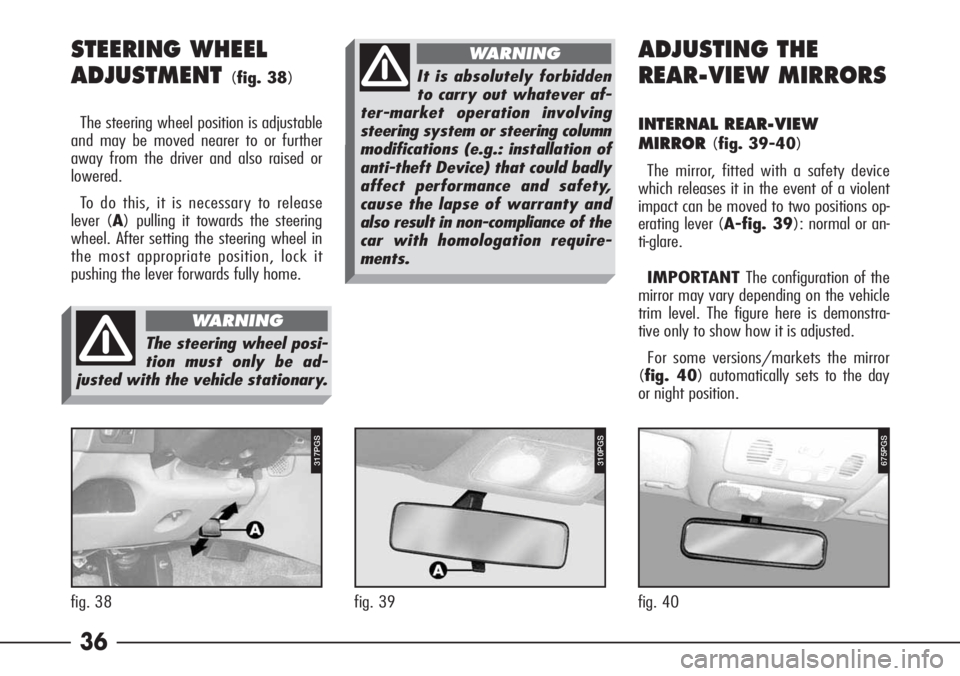
(fig. 38)
The steering wheel position is adjustable
and may be moved nearer to or further
away from the driver and also raised or
lowered.
To do this, it is necessary to release
lever (A) pulling it towards the steering
wheel. After setting the steering wheel in
the most appropriate position, lock it
pushing the lever forwards fully home.
ADJUSTING THE
REAR-VIEW MIRRORS
INTERNAL REAR-VIEW
MIRROR
(fig. 39-40)
The mirror, fitted with a safety device
which releases it in the event of a violent
impact can be moved to two positions op-
erating lever (A-fig. 39): normal or an-
ti-glare.
IMPORTANT The configuration of the
mirror may vary depending on the vehicle
trim level. The figure here is demonstra-
tive only to show how it is adjusted.
For some versions/markets the mirror
(fig. 40) automatically sets to the day
or night position.
The steering wheel posi-
tion must only be ad-
justed with the vehicle stationary.
WARNING
fig. 39 fig. 38
317PGS310PGS
fig. 40
675PGS
It is absolutely forbidden
to carry out whatever af-
ter-market operation involving
steering system or steering column
modifications (e.g.: installation of
anti-theft Device) that could badly
affect performance and safety,
cause the lapse of warranty and
also result in non-compliance of the
car with homologation require-
ments.
WARNING
Page 38 of 272
37
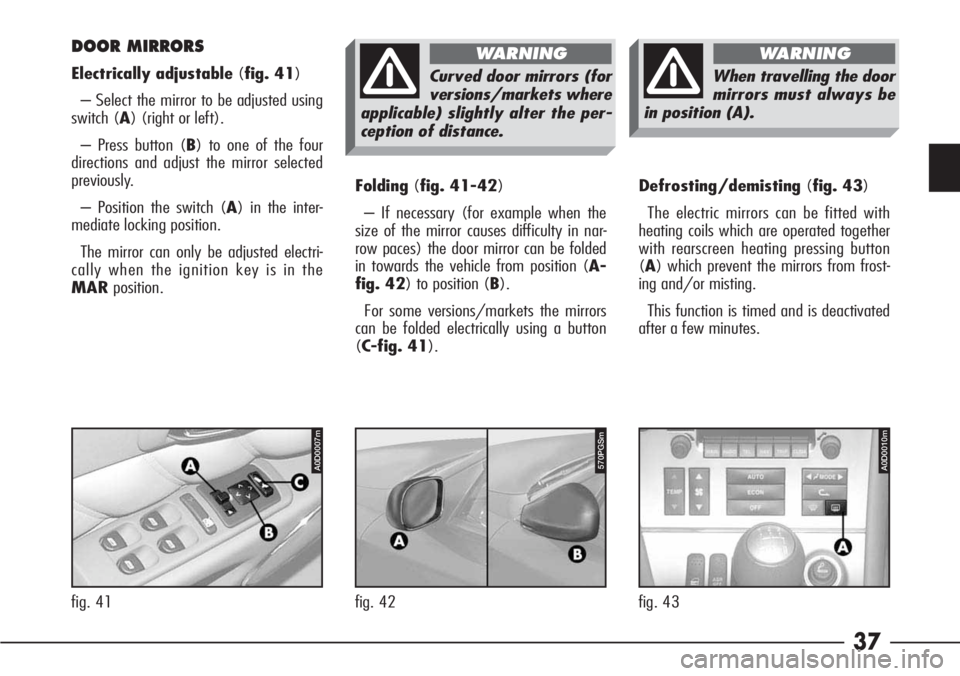
Folding(fig. 41-42)
– If necessary (for example when the
size of the mirror causes difficulty in nar-
row paces) the door mirror can be folded
in towards the vehicle from position (A-
fig. 42) to position (B).
For some versions/markets the mirrors
can be folded electrically using a button
(C-fig. 41).Defrosting/demisting(fig. 43)
The electric mirrors can be fitted with
heating coils which are operated together
with rearscreen heating pressing button
(A) which prevent the mirrors from frost-
ing and/or misting.
This function is timed and is deactivated
after a few minutes.
DOOR MIRRORS
Electrically adjustable (fig. 41)
– Select the mirror to be adjusted using
switch (A) (right or left).
– Press button (B) to one of the four
directions and adjust the mirror selected
previously.
– Position the switch (A) in the inter-
mediate locking position.
The mirror can only be adjusted electri-
cally when the ignition key is in the
MARposition.Curved door mirrors (for
versions/markets where
applicable) slightly alter the per-
ception of distance.
WARNING
When travelling the door
mirrors must always be
in position (A).
WARNING
fig. 41
570PGSm
fig. 42fig. 43
P4C00057A0D0007mA0D0010m
Page 41 of 272
40 SEAT BELTS
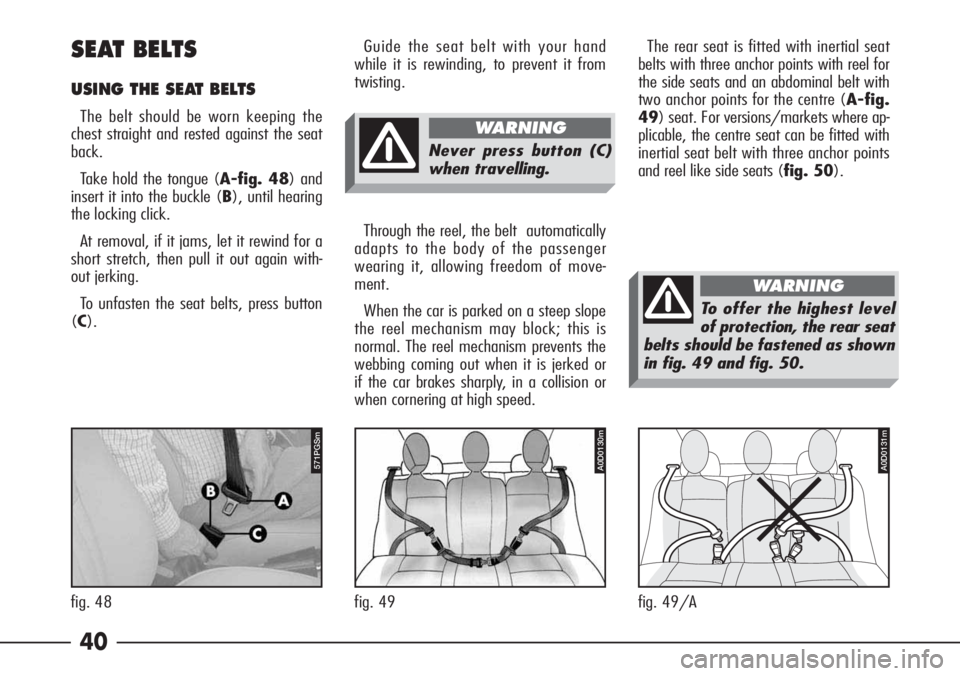
USING THE SEAT BELTS
The belt should be worn keeping the
chest straight and rested against the seat
back.
Take hold the tongue (A-fig. 48) and
insert it into the buckle (B), until hearing
the locking click.
At removal, if it jams, let it rewind for a
short stretch, then pull it out again with-
out jerking.
To unfasten the seat belts, press button
(C).Guide the seat belt with your hand
while it is rewinding, to prevent it from
twisting.
Through the reel, the belt automatically
adapts to the body of the passenger
wearing it, allowing freedom of move-
ment.
When the car is parked on a steep slope
the reel mechanism may block; this is
normal. The reel mechanism prevents the
webbing coming out when it is jerked or
if the car brakes sharply, in a collision or
when cornering at high speed.The rear seat is fitted with inertial seat
belts with three anchor points with reel for
the side seats and an abdominal belt with
two anchor points for the centre (A-fig.
49) seat. For versions/markets where ap-
plicable, the centre seat can be fitted with
inertial seat belt with three anchor points
and reel like side seats (fig. 50).
Never press button (C)
when travelling.
WARNING
571PGSm
fig. 48fig. 49
A0D0130mA0D0131m
fig. 49/A
To offer the highest level
of protection, the rear seat
belts should be fastened as shown
in fig. 49 and fig. 50.
WARNING
Page 43 of 272
42
PRETENSIONERS
To increase the efficiency of the front
seat belts, the Alfa 166is fitted with
pretensioners.
These devices “feel”, through a sensor,
that a violent crash is in progress and
rewind the seat belts a few centimetres.
In this way they ensure that the seat belt
adheres perfectly to the wearer before
the restraining action begins.
The seat belt locks to indicate that the
device has intervened; the seat belt can-
not be drawn back up even when guiding
it manually.
IMPORTANTTo obtain the highest
degree of protection from the action of
the pretensioning device, wear the seat
belt keeping it firmly close to the chest
and pelvis.
A small amount of smoke may be pro-
duced. This smoke is in no way toxic and
presents no fire hazard.The pretensioner does not require any
maintenance or greasing. Anything that
modifies its original conditions invalidates
its efficiency. If due to unusual natural
events (floods, sea storm, etc.) the de-
vice has been affected by water and
mud, it must necessarily be replaced.
After adjustment, always
check that the slider is
anchored in one of the positions
provided. To do this, with the but-
ton (A-fig. 52) released, exert a
further pressure to allow the an-
chor device to catch if release did
not take place at one of the preset
positions.
WARNING
The pretensioner can only
be used once. After a col-
lision that has triggered it, have it
replaced at an Alfa Romeo Autho-
rized Services. The validity of the
device is 10 years starting from
the date of production, the preten-
sioners should be replaced at an
Alfa Romeo Authorized Services as
this date approaches.
WARNING
This precaution could greatly reduce the
risk of injury in case of collision.
Correct adjustment is obtained when the
belt passes half way between the end of
the shoulder and the neck.
4 different adjustments in height are
provided.
To adjust the attachment raise or lower
the grip (A-fig. 52) and ring (B-
fig. 52) to one of the set positions.