window Alfa Romeo 166 2006 Owner handbook (in English)
[x] Cancel search | Manufacturer: ALFA ROMEO, Model Year: 2006, Model line: 166, Model: Alfa Romeo 166 2006Pages: 272, PDF Size: 4.17 MB
Page 83 of 272

SIDE VENTS (fig. 93)
The front door panels contain fixed side
vents (A) for defrosting or demisting the
side windows.
422PGSm
fig. 93
338PGSm
fig. 92
82
ADJUSTABLE AND MOVABLE
OUTLETS
(fig. 90-91-92)
To open the round air vents, press on
the fins (A) in point (B).
The air flow is directed by turning the
outlets using the fins or changing their
slope.
Fig. 90: front seats (in the middle of
the dashboard)
fig. 91
421PGSm
A0D0028m
fig. 90Fig. 91: front seats (at the ends of the
dashboard)
Fig. 92: rear seats (on the centre con-
sole).
Page 85 of 272
84
EQUIVALENT TEMPERATURE
The system makes it possible to control
the passenger compartment climate main-
taining the “equivalent temperature” lev-
el required by the driver. This “equivalent
temperature” is an estimator of the ideal
temperature (obtained through the devel-
opment of a complex mathematical algo-
rithm) needed to obtain the best temper-
ature and well-being in the passenger
compartment.
To bring about this operating condition,
select:
– the “equivalent temperature” re-
quired pressing the button (B-fig. 94);
– the AUTOposition pressing the but-
ton (D).
IMPORTANT The compressor can be
engaged automatically or manually. To
switch from one operating mode to the
other see the “Compressor on/off but-
ton” paragraph in this chapter.
DESCRIPTION OF CONTROLS
(fig. 94)
A- Climate control dedicated screen se-
lector button.
B- Rocker button for adjusting the “e-
quivalent temperature”.
C- Rocker button for fan speed adjust-
ment.
D- Automatic system operation selector
button.
E- Climate control compressor off/on
button.
F- Climate control system off/on but-
ton.
G- Rocker button for selecting air distri-
bution.
H- Air recirculation on/off button.
I- On/off button for maximum defrost-
ing/demisting windscreen and front side
windows, rearscreen heating, door mirror
resistances and resistances at windscreen
base (where applicable).
J- On/off button for rearscreen heating
and mirror defrosting and resistances in
windscreen wiper blade parking are at the
base of the windscreen (where applica-
ble).Adjustment button for
required equivalent
temperature
Pressing this rocker button up or down
respectively raises or lowers the equiva-
lent temperature required in the passen-
ger compartment.
Pressing the button upwards or down-
wards to the extreme HIGHorLOW
positions, the functions with the highest
heating or cooling power are engaged.
Page 86 of 272
85
Fan speed adjustment button
Pressing this rocker button up or down
respectively increases or lowers the fan
speed (thus the amount of air admitted
to the passenger compartment), while
maintaining the objective of the equiva-
lent temperature required.
Automatic operation
button
Pressing the AUTObutton the system
automatically adjusts the amount and dis-
tribution of air admitted to the passenger
compartment.
Compressor off/on
button
Pressing the ECONbutton turns the cli-
mate control compressor on/off.
IMPORTANT With the compressor off
it is not possible to admit air to the pas-
senger compartment at a temperature be-
low the outside temperature, in particular
environment conditions, the windows
may quickly steam.Climate control off/on
button
Pressing the OFFbutton turns the cli-
mate control on/off (including ventilation
only.
IMPORTANT With the climate control
off and in particular environment condi-
tions, the windows may steam quickly.
Passenger compartment
air distribution button
Pressing the MODErocker button to-
wards the left or right manually selects
air distribution in the passenger compart-
ment, while maintaining the objective of
the equivalent temperature required.
Page 87 of 272
86
Air recirculation on/off
button
Pressing this button engages/disen-
gages recirculation of the air admitted to
the passenger compartment.
IMPORTANT Depending on how the
system is working (heating or cooling the
passenger compartment) the recirculation
function makes it possible to reach the re-
quired conditions faster. It is however in-
advisable to use this function on
rainy/cold days as it would considerably
increase the possibility of misting the win-
dows, especially if the conditioner is off.
It is advisable to use this function when
the vehicle is stationary in a queue or tun-
nel to prevent polluted air from entering
the passenger compartment. Prolonged
use of this function should however be
avoided, especially if there are several
persons aboard.Windscreen and front side
windows demisting/
defrosting button
Pressing this button the climate control
automatically activates the necessary
functions (quantity, distribution, tempera-
ture of the air admitted to the passenger
compartment) to quicken demisting/de-
frosting of the windscreen and front side
windows. Rearscreen heating, door mirror
heating and the resistances at the base of
the windscreen (in the wiper blade park-
ing area) are also automatically engaged
(for a determinate length of time) where
applicable.Rearscreen demisting/
defrosting on/off button
Pressing this button engages demist-
ing/defrosting of the rearscreen, door
mirrors and (optional for versions/mar-
kets where applicable) the resistances at
the base of the windscreen (in the wiper
blade parking area).
IMPORTANT Do not stick stickers on
the inside of the rearscreen over the heat-
ing filaments to prevent damage that
might adversely affect the system.
Page 89 of 272
88
Pressing the button turns
the compressor on/off. With the com-
pressor off, the air admitted to the pas-
senger compartment can not be cooled or
dehumidified and recirculation is switched
off automatically to avoid misting the
windows: when wanting to activate recir-
culation in the condition, press the corre-
sponding button.
Pressing the button again
with the compressor off, will restore the
operating conditions of before the com-
pressor was turned off.
Pressing the button turns
off/back on the climate control, in the
former case air is no longer admitted to
the passenger compartment which is thus
isolated from outside, in the latter, the
previous operating mode is restored.Pressing the button selects
the possible air distributions to the pas-
senger compartment:
Flow of air towards the windscreen
and front side windows
Distribution of the flow between
the windscreen /front side windows and
lower part of the passenger compartment
Flow of air to the lower part of the
passenger compartment and secondary
flow of air towards the windscreen and
front side windows
Distribution of the flow between
the upper centre, centre, side and rear
outlets and the lower part of the passen-
ger compartment
Flow of air towards the centre up-
per vent, centre and side dashboard out-
lets and rear outlets.If the system was in the FULL AUTO
mode, pressing the button
passes to the simple automatism condi-
tion: i.e. the system chooses the fan
speed and mixing to obtain the equiva-
lent temperature required, but will not
change the distribution selected manually.
Pressing the recirculation button
, the system automatically reac-
tivates the compressor if it was deactivat-
ed manually; to maintain recirculation
with the compressor of, it is necessary to
press the button to deacti-
vate the compressor.
Page 90 of 272
89
IMPORTANT In this condition (recir-
culation on and compressor off), remem-
ber that the windows may steam up very
quickly.
Pressing the button the climate
control automatically activates the func-
tions required to quicken demisting/de-
frosting of the windscreen and side win-
dows. Rearscreen heating and door mirror
heating are also automatically engaged
(for a determinate length of time).
Pressing the button engages
rearscreen heating and door mirror heat-
ing for a determinate length of time.Manually setting one of the climate con-
trol functions, the others continue to be
controlled automatically; in particular the
air temperature is always controlled auto-
matically to reach the required “equiva-
lent temperature” in the passenger com-
partment.
IMPORTANT When working in the
FULL AUTOcondition, the system can
automatically engage recirculation or de-
activate the compressor to cool/heat the
passenger compartment faster or
demist/defrost the windscreen and side
windows.IMPORTANT When the engine is
turned off the system memorises the cli-
mate control operating condition, which
will be automatically resumed when the
engine is started again.
Page 140 of 272
139
DRIVING UNDER ADVERSE
WEATHER CONDITIONS
Rain and fog can be extremely danger-
ous if the style of driving is not adapted
to suit these conditions. Some sugges-
tions are given below:
– if the road is wet, the friction be-
tween wheel and asphalt is greatly re-
duced thus increasing the stopping dis-
tance and decreasing road holding when
cornering.
Reduce speed and keep further back
from the vehicle in front.
– Heavy rain and fog reduce visibility.
Headlights should be switched on as the
road traffic laws and common sense dic-
tate, above all to render yourself visible
to others.
– Do not drive over puddles or flooded
roads at high speed as the aquaplaning
phenomenon may cause you to loose
control over the vehicle.
– If visibility is already reduced prevent
it from worsening by ensuring that the
windows do not steam up. Use the heat-
ing-ventilation controls as indicated in the
chapter “Know your vehicle”.– Check the condition of the windscreen
wiper blades.
– If fog is very thick avoid travelling
where possible. If travelling cannot be
avoided drive with extreme care and
moderate your speed. Avoid overtaking.
– If the vehicle is forced to stop owing
to a malfunction or zero visibility condi-
tions, pull off the road, switch on the haz-
ard warning lights and if possible, the
dipped-beam headlights.
MOUNTAIN DRIVING
Mountain driving requires a greater de-
gree of concentration. Some practical
hints follow:
– Before driving off check the level of
fluids (engine oil, brakes, coolant) and
the state of the tyres.
– When travelling down hill use the en-
gine braking by engaging lower gears to
prevent the brakes from overheating.
– Never coast downhill with the engine
off or in neutral and especially not with
the ignition key removed.
– Drive at a moderate speed and avoid
cutting corners.– Remember that overtaking uphill is
slower and therefore requires a greater
length of clear road. If you are being
overtaken on a hill move over to enable
the other vehicle to pass in safety.
WINTER DRIVING
If the temperature falls below 0°C or in
the presence of snow or ice the following
recommendations should be followed:
– Before driving off check that the
windscreen wipers are not frozen to the
windscreen.
– Remove the snow from the air intake
(grille) at the base of the windscreen.
– Do not stop long on deep snow with
the engine running: the snow might di-
vert the exhaust gas carbon monoxide in-
to the passenger compartment.
– Ensure that brakes and tyres are in
perfect working order.
–Ensure that the detergent liquid locat-
ed in the windscreen/headlight washers
has been topped up with anti-freeze and
anti-scale additives.
– Use engine braking where possible
and avoid abrupt braking.
Page 143 of 272
142
POWER STEERING
The hydraulic power steering is only ac-
tive when the engine is running. If the en-
gine is switched off greater effort will be
required to turn the wheel.
As the steering system is a mechanical
organ which is closely tied to driving
safety, the vehicle should be stopped and
Alfa Romeo Authorized Services contacted
if an anomaly is detected.
IMPORTANT Keep the steering wheel
turned at the end of its stroke, in both di-
rections, only for the strictly indispensable
time.
WINDOWS
Do not apply stickers or similar adhe-
sives to the windows as these may dis-
tract the driver and block his vision. The VDC system turns on automatically
when the car is started and cannot be
switched off. It is however possible to cut
off operation of the ASR system pressing
the corresponding button on the centre
console.
ASR FUNCTION (ANTISLIP
REGULATION): GENERAL
The ASR system integrates the VDC sys-
tem controlling the vehicle drive and com-
ing into operation automatically each
time one or both driving wheels skid.When changing the
wiper blades follow the
instructions contained in
the package which is available as
a spare part and read the indica-
tions given in the “Car mainte-
nance “ chapter of this booklet.
WINDSCREEN WIPER BLADES
The windscreen wiper blades should be
checked periodically. Dirty or worn blades
greatly reduce visibility. The windscreen
and windows should be cleaned regularly
and grease, dirt and tar removed. In this
way the life of blades will be extended
considerably.The VDC system helps
the driver to keep control
of the car in the event of loss of
tyre grip.
The forces induced by the VDC sys-
tem to control the lack of stability
of the car always and anyway de-
pend on the grip between the tyre
and the road surface.
WARNING
Before operating the windscreen wipers,
remove snow or ice from the windscreen
and check that the wiper blade is not
frozen to the windscreen. Use an an-
tifreeze product if necessary.
Do not operate the windscreen wipers
on dry glass.
Page 156 of 272
155 VEHICLE INACTIVITY
If the vehicle is to be left inactive for
long periods the following precautions
should be noted:
– House the vehicle under a cover in a
dry and possibly ventilated place.
– Engage a gear.
– Release the handbrake.
– Clean and protect the paintwork by
applying silicon wax.
– Cover the rubber windscreen wiper
blades with talcum powder and raise
them off the glass.
– Open the windows slightly.
– Cover the vehicle with a cloth or per-
forated plastic cover. Do not use compact
plastic covers which prevent the humidity
on the surface of the vehicle from evapo-
rating.
– Inflate the tyres to a pressure of 0.5
bars above normal. If possible rest the
tyres on wooden planks and periodically
check the pressure.– Switch off the alarm system (if fit-
ted) with the remote control, then deacti-
vate it with the emergency key.
– Disconnect the terminals from the
battery poles (negative pole first) and
check the battery charge. When the vehi-
cle is in storage, this check should be car-
ried out once a month. If the no-load volt-
age is less than 12.5V, recharge the bat-
tery.
REMOVING FROM STORAGE
Before using your vehicle after a long
period of inactivity the following opera-
tions should first be carried out:
– Do not dust the outside of the vehi-
cle.
– Visually check that there are no
leaks (oil, brake and clutch fluid, engine
coolant etc.).
– Replace the engine oil and filter.
– Check:
Gearbox-differential oil level
Brake-clutch fluid level
Level of engine coolant fluid.– Check the air cleaner and replace if
necessary.
– Check tyre pressure and ensure that
they are not damaged, cracked or cut. If
they are they must be replaced.
– Check the state of the drive belts in
the engine bay.
– Connect the cables of the battery af-
ter checking that the charge is adequate.
– Re-activate the alarm system, if fit-
ted, using the emergency key.
– With the gear lever in neutral start
the engine and allow the engine to run
for a few seconds whilst repeatedly
pumping the clutch pedal.
Page 191 of 272
190
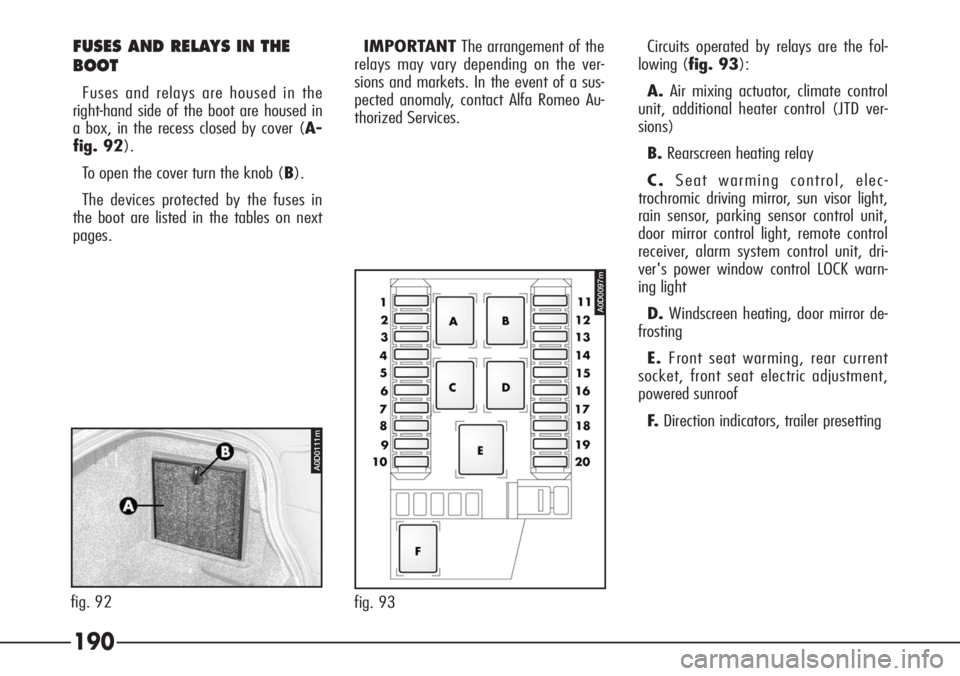
FUSES AND RELAYS IN THE
BOOT
Fuses and relays are housed in the
right-hand side of the boot are housed in
a box, in the recess closed by cover (A-
fig. 92).
To open the cover turn the knob (B).
The devices protected by the fuses in
the boot are listed in the tables on next
pages.IMPORTANTThe arrangement of the
relays may vary depending on the ver-
sions and markets. In the event of a sus-
pected anomaly, contact Alfa Romeo Au-
thorized Services.Circuits operated by relays are the fol-
lowing (fig. 93):
A.Air mixing actuator, climate control
unit, additional heater control (JTD ver-
sions)
B.Rearscreen heating relay
C.Seat warming control, elec-
trochromic driving mirror, sun visor light,
rain sensor, parking sensor control unit,
door mirror control light, remote control
receiver, alarm system control unit, dri-
ver's power window control LOCK warn-
ing light
D.Windscreen heating, door mirror de-
frosting
E.Front seat warming, rear current
socket, front seat electric adjustment,
powered sunroof
F.Direction indicators, trailer presetting
518PGS
fig. 93
A0D0097m
A0D0111m
fig. 92