heating Alfa Romeo 4C 2015 Owner handbook (in English)
[x] Cancel search | Manufacturer: ALFA ROMEO, Model Year: 2015, Model line: 4C, Model: Alfa Romeo 4C 2015Pages: 199, PDF Size: 7.67 MB
Page 11 of 199
.
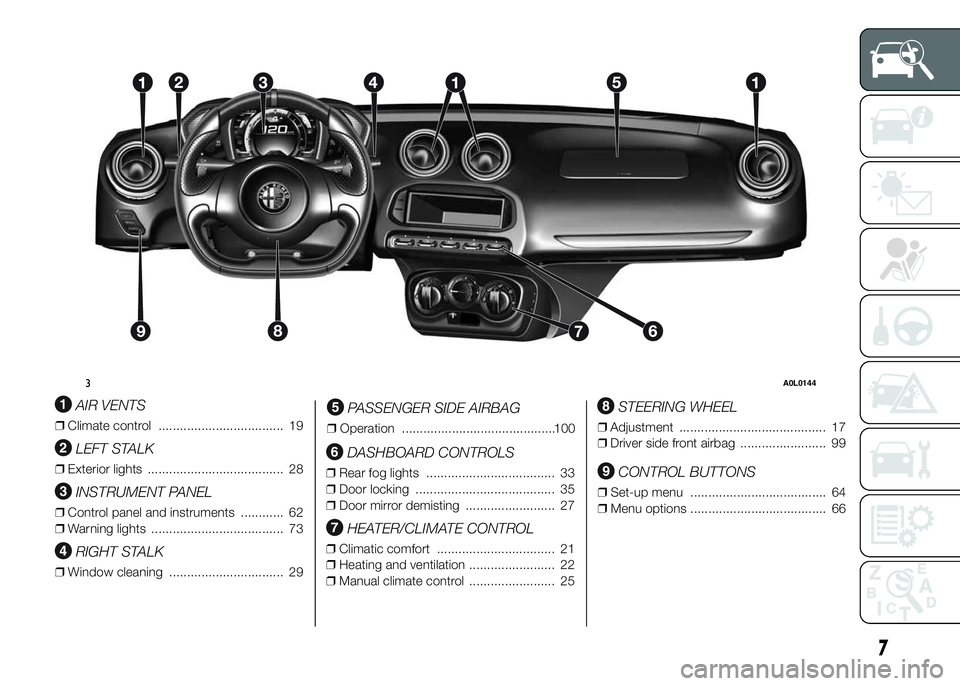
AIR VENTS
❒Climate control ................................... 19
LEFT STALK
❒Exterior lights ...................................... 28
INSTRUMENT PANEL
❒Control panel and instruments ............ 62
❒Warning lights ..................................... 73
RIGHT STALK
❒Window cleaning ................................ 29
PASSENGER SIDE AIRBAG
❒Operation ...........................................100
DASHBOARD CONTROLS
❒Rear fog lights .................................... 33
❒Door locking ....................................... 35
❒Door mirror demisting ......................... 27
HEATER/CLIMATE CONTROL
❒Climatic comfort ................................. 21
❒Heating and ventilation ........................ 22
❒Manual climate control ........................ 25
STEERING WHEEL
❒Adjustment ......................................... 17
❒Driver side front airbag ........................ 99
CONTROL BUTTONS
❒Set-up menu ...................................... 64
❒Menu options ...................................... 66
3A0L0144
7
Page 13 of 199

GETTING TO KNOW YOUR CAR
In-depth knowledge of your new car
starts here.
The booklet that you are reading simply
and directly explains how it is made
and how it works.
That’s why we advise you to read it
seated comfortably on board, so that
you can see what is described here for
yourself.SYMBOLS ...................................... 10
ALFA ROMEO CODE SYSTEM ....... 10
THE KEYS....................................... 11
ALARM ........................................... 13
IGNITION SWITCH .......................... 14
SEATS ............................................ 15
STEERING WHEEL ......................... 17
REAR VIEW MIRRORS .................... 18
CLIMATE CONTROL ....................... 20
CLIMATIC COMFORT ..................... 20
HEATING AND VENTILATION.......... 22
MANUAL CLIMATE CONTROL........ 25
EXTERIOR LIGHTS ......................... 28
WINDOW CLEANING ...................... 29
CRUISE CONTROL ......................... 30
ROOF LIGHT................................... 32
CONTROLS .................................... 33
INTERIOR FITTINGS ....................... 34
DOORS ........................................... 37
ELECTRIC WINDOWS .................... 38
LUGGAGE COMPARTMENT /
ENGINE COVER.............................. 39
HEADLIGHTS.................................. 41
ESC (ELECTRONIC STABILITY
CONTROL) SYSTEM ....................... 42
“ALFA DNA” SYSTEM (DYNAMIC
CAR CONTROL SYSTEM)............... 46EOBD SYSTEM (EUROPEAN ON
BOARD DIAGNOSIS) ...................... 49
RADIO SYSTEM .............................. 50
ACCESSORIES PURCHASED BY
THE OWNER .................................. 50
PARKING SENSORS....................... 51
TPMS (TYRE PRESSURE
MONITORING SYSTEM) ................. 54
REFUELLING THE CAR .................. 58
PROTECTING THE
ENVIRONMENT .............................. 59
9
Page 26 of 199

HEATING AND VENTILATION.
CONTROLS
20A0L0003
22
GETTING TO KNOW YOUR CAR
Page 27 of 199

Aair temperature adjustment knob
(hot/cold air mixing);
Binternal air recirculation on/off cursor;
Cfan activation/adjustment knob;
Dair distribution knob:
air from central and side vents and
side diffusers;
air from central and side vents,
side diffusers and footwell
diffusers;
air from footwell diffusers;
air from footwell and side diffusers
and from windscreen diffuser;
air from windscreen diffuser and
side diffusers;
HEATING
To heat the passenger compartment,
proceed as follows:
❒turn knob A to the red section;
❒turn knob C to the desired speed;
❒turn knob D to
.
This air distribution allows the
passenger compartment to be heated
quickly.
Then operate the controls to maintain
the desired comfort conditions.IMPORTANT When the engine is cold, it
takes a few minutes to achieve
optimum passenger compartment
heating.
FAST DEMISTING /
DEFROSTING OF
WINDSCREEN AND SIDE
WINDOWS
Proceed as follows:
❒turn knob A to the red section;
❒turn knob C to 4 (maximum fan
speed);
❒turn knob D to
;
❒bring cursor B to
.
After demisting/defrosting, operate the
controls as normal to restore the
required comfort conditions.
Window demisting
In the event of considerable external
moisture and/or rain and/or large
differences in temperature inside and
outside the passenger compartment,
perform the following preventive
window demisting procedure:
❒bring cursor B to
;
❒turn knob A to the red section;
❒turn knob C to 2 (intermediate fan
speed);❒turn knob D to
with the possibility
of moving it to position
if window
misting does not occur.
VENTILATION
To ventilate the passenger
compartment properly, proceed as
follows:
❒fully open the vents and direct them
appropriately;
❒turn knob A to the blue section;
❒bring cursor B to
;
❒turn knob C to the desired speed;
❒turn knob D to
;
23
Page 28 of 199

IMPORTANT The internal air
recirculation system makes it possible
to reach the required heating or
ventilation conditions more quickly. Do
not use the internal air recirculation
function on rainy/cold days to avoid the
possibility of the windows misting.
24
GETTING TO KNOW YOUR CAR
INTERNAL AIR
RECIRCULATION
ACTIVATION
Bring cursor B to
.
It is advisable to switch the internal air
recirculation on while standing in
queues or in tunnels to prevent the
introduction of polluted air.
Do not use the function for a long time,
particularly if there are two people on
board, to prevent the windows from
misting.
Page 30 of 199

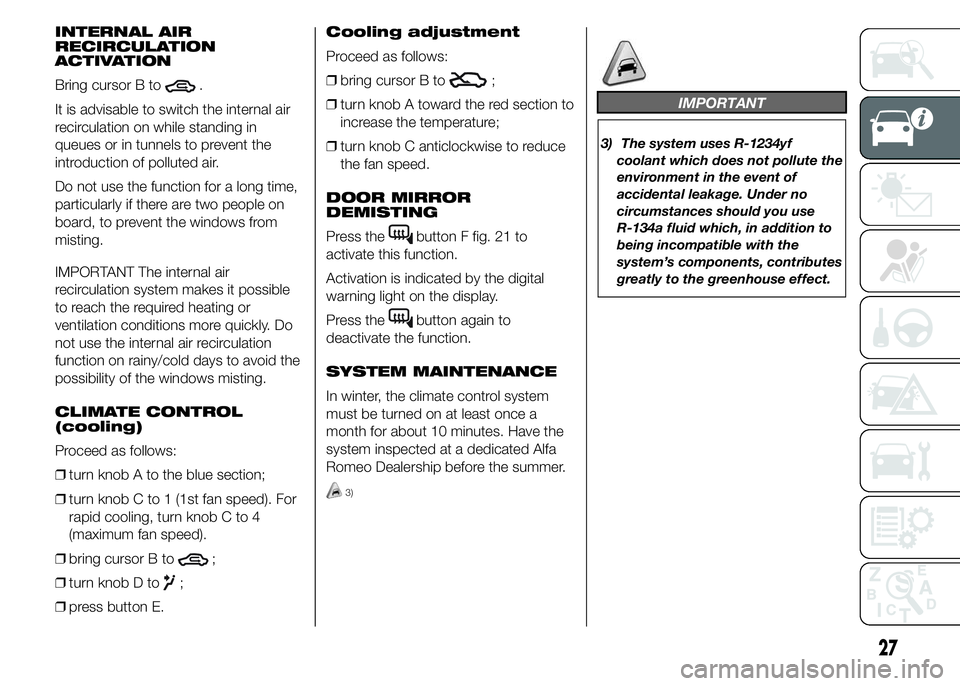
Aair temperature adjustment knob
(hot/cold air mixing);
Binternal air recirculation on/off cursor;
Cfan activation/adjustment knob;
Dair distribution knob;
Eclimate control compressor on/off
button;
Fdoor mirror demisting button.
Knob D enables the air introduced into
the vehicle to reach all areas of the
passenger compartment through five
distribution options:
air from central and side vents and
side diffusers;
air from central and side vents,
side diffusers and footwell
diffusers;
air from footwell diffusers;
air from footwell and side diffusers
and from windscreen diffuser;
air from windscreen diffuser and
side diffusers;
HEATING
To heat the passenger compartment,
proceed as follows:
❒turn knob A to the red section;
❒turn knob C to the desired speed;
❒turn knob D to
.This air distribution allows the
passenger compartment to be heated
quickly.
Then operate the controls to maintain
the desired comfort conditions.
IMPORTANT When the engine is cold, it
takes a few minutes to achieve
optimum passenger compartment
heating.
FAST DEMISTING /
DEFROSTING OF
WINDSCREEN AND SIDE
WINDOWS
Proceed as follows:
❒turn knob A to the red section;
❒turn knob C to 4 (maximum fan
speed);
❒turn knob D to
;
❒bring cursor B to
.
After demisting/defrosting, operate the
controls as normal to restore the
required comfort conditions.
IMPORTANT The climate control
system is very useful for speeding up
and maintaining demisting since it
dehumidifies the air. Adjust the controls
as described previously and switch
on the climate control system by
pressing button E.Window demisting
In the event of considerable external
moisture and/or rain and/or large
differences in temperature inside and
outside the passenger compartment,
perform the following preventive
window demisting procedure:
❒bring cursor B to
;
❒turn knob A to the red section;
❒turn knob C to 2 (intermediate fan
speed);
❒turn knob D to
with the possibility
of moving it to position
if window
misting does not occur.
VENTILATION
To ventilate the passenger
compartment properly, proceed as
follows:
❒fully open the air diffusers and vents;
❒turn knob A to the blue section;
❒bring cursor B to
;
❒turn knob C to the desired speed;
❒turn knob D to
;
26
GETTING TO KNOW YOUR CAR
Page 31 of 199
INTERNAL AIR
RECIRCULATION
ACTIVATION
Bring cursor B to
.
It is advisable to switch the internal air
recirculation on while standing in
queues or in tunnels to prevent the
introduction of polluted air.
Do not use the function for a long time,
particularly if there are two people on
board, to prevent the windows from
misting.
IMPORTANT The internal air
recirculation system makes it possible
to reach the required heating or
ventilation conditions more quickly. Do
not use the internal air recirculation
function on rainy/cold days to avoid the
possibility of the windows misting.
CLIMATE CONTROL
(cooling)
Proceed as follows:
❒turn knob A to the blue section;
❒turn knob C to 1 (1st fan speed). For
rapid cooling, turn knob C to 4
(maximum fan speed).
❒bring cursor B to
;
❒turn knob D to
;
❒press button E.Cooling adjustment
Proceed as follows:
❒bring cursor B to
;
❒turn knob A toward the red section to
increase the temperature;
❒turn knob C anticlockwise to reduce
the fan speed.
DOOR MIRROR
DEMISTING
Press the
button F fig. 21 to
activate this function.
Activation is indicated by the digital
warning light on the display.
Press the
button again to
deactivate the function.
SYSTEM MAINTENANCE
In winter, the climate control system
must be turned on at least once a
month for about 10 minutes. Have the
system inspected at a dedicated Alfa
Romeo Dealership before the summer.
3)
IMPORTANT
3) The system uses R-1234yf
coolant which does not pollute the
environment in the event of
accidental leakage. Under no
circumstances should you use
R-134a fluid which, in addition to
being incompatible with the
system’s components, contributes
greatly to the greenhouse effect.
.
27
Page 58 of 199

TPMS (Tyre
Pressure
Monitoring System)
(for versions/markets, where provided)
DESCRIPTION
The tyre pressure monitoring system
(TPMS) warns the driver of low tyre
pressure on the basis of the cold
inflation pressure prescribed for the car.
Changes in outside temperature may
cause tyre pressure to vary. This means
that a decrease in the outside
temperature corresponds to a decrease
in the tyre pressure.
Tyre pressure must always be adjusted
according to the cold inflation pressure.
Cold tyre inflation pressure is the tyre
pressure after letting the car at a
standstill for at least three hours or a
travel shorter than 1.6 km after an
interval of three hours.
The cold tyre inflation pressure must
not exceed the maximum inflation
pressure value printed on the side of
the tyre.
The tyre pressure also increases while
driving the car: this is a normal
condition and does not require any
adjustment of the pressure.The TPMS continues to advise the
driver of the low tyre pressure condition
until this is corrected; the warning
continues until the pressure
corresponds or exceeds the pressure
prescribed for the cold tyres. When the
tyre low pressure control warning
light
switches on constantly, the
inflation pressure must be adjusted until
it reaches the pressure prescribed for
cold tyres. After the automatic update
of the system, the tyre pressure control
warning light switches off. You may
need to drive the car for about 20
minutes at a speed higher than 20
km/h to allow the TPMS to receive this
information.
NOTE
❒The TPMS does not replace the
normal tyre maintenance service and
does not indicate any fault in a tyre.
❒Therefore, the TPMS should not be
used as pressure switch while
adjusting the tyre inflation pressure.
❒Driving with insufficient tyre pressure
causes their overheating and can
result in tyre failure. The low inflation
pressure reduces fuel efficiency
and tyre tread life and may also affect
handling and braking performance
of the car.❒The TPMS does not replace the
correct tyre maintenance. It is up to
the driver to maintain the correct tyre
pressure level measuring it with a
suitable pressure switch. This is
necessary even if the decrease in the
inflation pressure value does not
cause the tyre pressure control
warning light to switch on.
❒The TPMS warns the driver of any
condition of insufficient tyre pressure
If this drops below the insufficient
pressure limit for any reason including
low temperature and normal
pressure loss of the tyre.
❒The seasonal temperature changes
affect tyre pressure.
The TPMS uses wireless devices with
electronic sensors mounted on the
wheel rims to constantly monitor the
value of tyre pressure. The sensors
mounted on each wheel as part of the
valve stem transmit various information
of the tyres to the receiver module, in
order to calculate the pressure.
IMPORTANT Monitoring and
maintaining the correct pressure in all
four tyres are particularly important.
54
GETTING TO KNOW YOUR CAR
Page 88 of 199

Warning lights on
displayWhat it means What to do
redGEARBOX FAILURE
The digital warning light switches on when the
key is turned to MAR-ON, but it should switch off
after a few seconds.
The digital warning light flashes (together with a
message in the display and an acoustic signal) to
indicate that the gearbox/transmission is faulty.
The digital warning light can light up even in the
event of transmission overheating, after a
particularly demanding use. In this case an engine
performance limitation is performed.Contact the dedicated Alfa Romeo Dealership as
soon as possible.
If it is necessary to start the engine with a
gearbox/transmission failure, follow the procedure
described in the "Using the gearbox/
transmission" paragraph, "Starting the engine"
section in the "Starting and driving" chapter.
redINCOMPLETE DOOR LOCKING
(for versions/markets, where provided)
The digital warning light on the display switches
on when one or more doors are not properly shut.
An acoustic signal is emitted with the doors open
and the car in motion.
amberWORN BRAKE PADS
(for versions/markets, where provided)
The digital warning light on the display switches
on when the front or rear brake pads are worn.
The display shows the dedicated message.Have them replaced as soon as possible.
amberALFA ROMEO CODE SYSTEM FAILURE
(for versions/markets, where provided)
The digital warning light switches on in the display
(together with a message) to indicate Alfa Romeo
CODE system failure.Contact the dedicated Alfa Romeo Dealership as
soon as possible.
84
KNOWING THE INSTRUMENT PANEL
Page 91 of 199

Warning lights on
displayWhat it means What to do
GENERAL FAILURE
(for versions/markets, where provided)
The symbol lights up in the display in the
circumstances indicated below.
Engine oil pressure sensor failure
The symbol lights up when the engine oil pressure
sensor is faulty. The display shows the dedicated
message.In these case contact the dedicated Alfa Romeo
Dealership to have the fault fixed as soon as
possible.
"Clutch overheating" message
The
symbol, along with a message on the
display, lights up to indicate clutch overheating.
If the driver continues, the
symbol will switch
off and the
warning light will light up (on some
versions together with a message on the display)
to indicate a transmission failure.If the
symbol lights up along with a message
on the display, reduce gear shifting and/or
change usage conditions, until the normal
operating conditions are restored.
If the
warning light lights up (a message will
appear on the display, on some versions) stop
immediately, operate the handbrake, stop the
engine and wait 5 minutes: after this, normal
transmission operating conditions will be
restored.
Should the transmission failure condition persist,
contact the dedicated Alfa Romeo Dealership
FUEL CUT-OFF
The symbol and the corresponding message are
shown on the display in the following cases:
❒fuel cut-off system intervention: the yellow
symbol lights up;
❒fuel cut-off system failure: the red symbol lights
up.For the fuel cut-off system reactivation procedure,
refer to the "Fuel Cut-Off System" section of the
"Controls" paragraph, in the "Knowing your car"
chapter. If it is still not possible to restore the fuel
supply, contact the dedicated Alfa Romeo
Dealership.
87