transmission Alfa Romeo 4C 2016 Owner handbook (in English)
[x] Cancel search | Manufacturer: ALFA ROMEO, Model Year: 2016, Model line: 4C, Model: Alfa Romeo 4C 2016Pages: 182, PDF Size: 9.49 MB
Page 97 of 182
STARTING AND DRIVING
Let’s get to the core of the vehicle:
seeing how you can exploit all of its
potential to the full.
We’ll look at how to drive it safely in any
situation, so that it can be a welcome
companion, with our comfort and our
wallets in mind.STARTING THE ENGINE........95
PARKING..................96
USING THE TRANSMISSION.....96
SAVING FUEL..............101
SNOW TYRES..............102
SNOW CHAINS.............103
CAR INACTIVITY............103
94
STARTING AND DRIVING
Page 99 of 182
PARKING
Always remove the ignition key when
leaving the car.
When parking and leaving the car,
proceed as follows:
engage a gear (first gear if parked
uphill or reverse if facing downhill) and
leave the wheels turned;
stop the engine and engage the
handbrake.
Block the wheels with a wedge or a
stone if the car is parked on a steep
slope.
Wait until the indication of the gear
engaged disappears on the display
before releasing the brake pedal.
87)
IMPORTANT:NEVERleave the car with
the gearbox in neutral.
HANDBRAKE
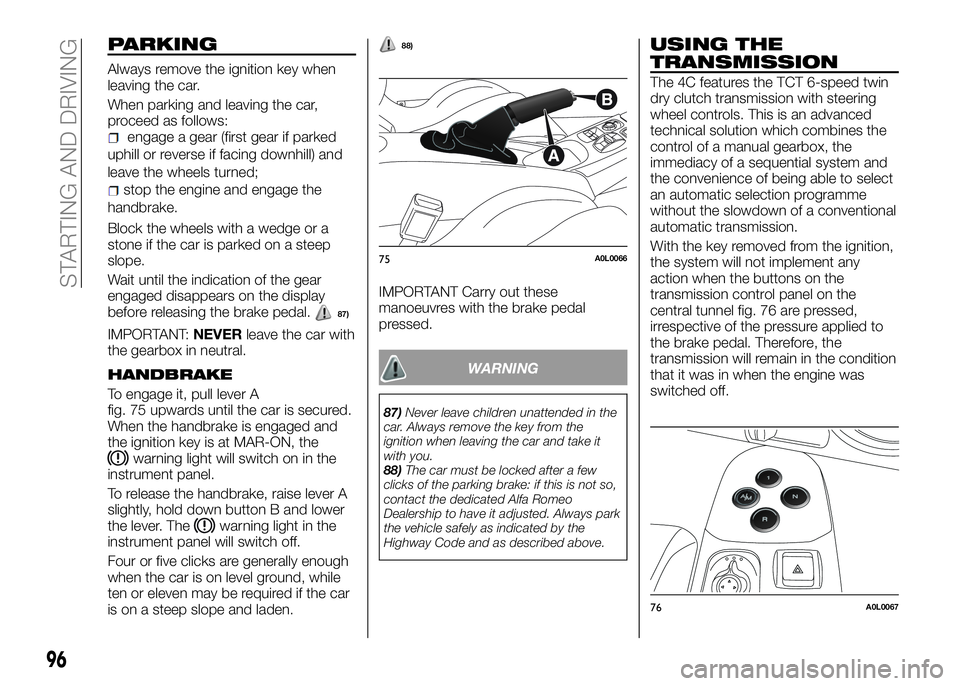
To engage it, pull lever A
fig. 75 upwards until the car is secured.
When the handbrake is engaged and
the ignition key is at MAR-ON, the
warning light will switch on in the
instrument panel.
To release the handbrake, raise lever A
slightly, hold down button B and lower
the lever. The
warning light in the
instrument panel will switch off.
Four or five clicks are generally enough
when the car is on level ground, while
ten or eleven may be required if the car
is on a steep slope and laden.
88)
IMPORTANT Carry out these
manoeuvres with the brake pedal
pressed.
WARNING
87)Never leave children unattended in the
car. Always remove the key from the
ignition when leaving the car and take it
with you.
88)The car must be locked after a few
clicks of the parking brake: if this is not so,
contact the dedicated Alfa Romeo
Dealership to have it adjusted. Always park
the vehicle safely as indicated by the
Highway Code and as described above.
USING THE
TRANSMISSION
The 4C features the TCT 6-speed twin
dry clutch transmission with steering
wheel controls. This is an advanced
technical solution which combines the
control of a manual gearbox, the
immediacy of a sequential system and
the convenience of being able to select
an automatic selection programme
without the slowdown of a conventional
automatic transmission.
With the key removed from the ignition,
the system will not implement any
action when the buttons on the
transmission control panel on the
central tunnel fig. 76 are pressed,
irrespective of the pressure applied to
the brake pedal. Therefore, the
transmission will remain in the condition
that it was in when the engine was
switched off.
75A0L0066
76A0L0067
96
STARTING AND DRIVING
Page 100 of 182
With car stationary and key at MAR-ON
(ignition-operated electrical services
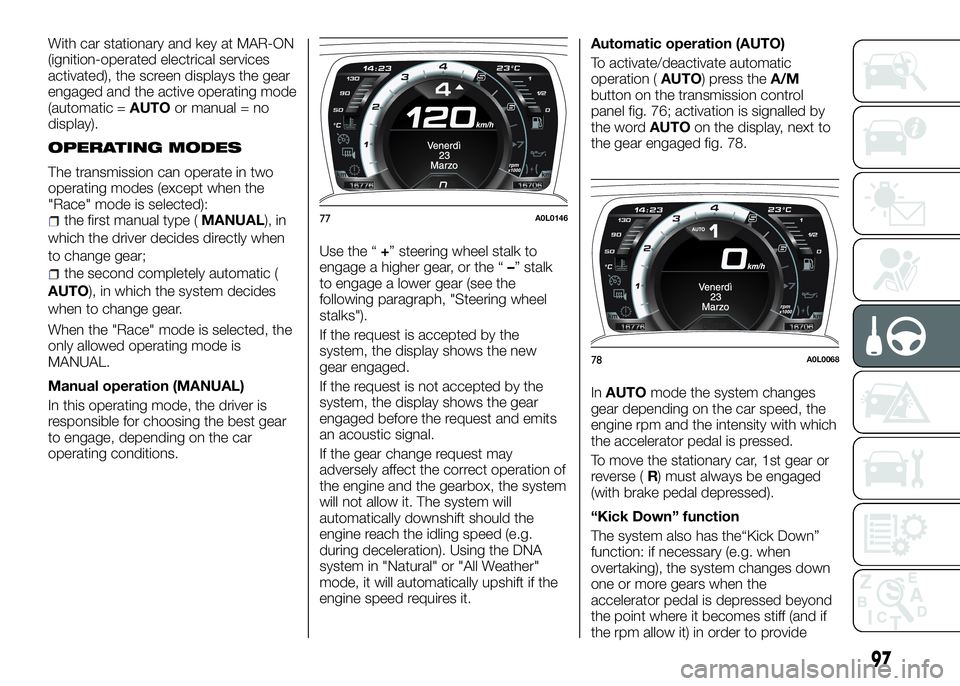
activated), the screen displays the gear
engaged and the active operating mode
(automatic =AUTOor manual = no
display).
OPERATING MODES
The transmission can operate in two
operating modes (except when the
"Race" mode is selected):
the first manual type (MANUAL), in
which the driver decides directly when
to change gear;
the second completely automatic (
AUTO), in which the system decides
when to change gear.
When the "Race" mode is selected, the
only allowed operating mode is
MANUAL.
Manual operation (MANUAL)
In this operating mode, the driver is
responsible for choosing the best gear
to engage, depending on the car
operating conditions.Use the “+” steering wheel stalk to
engage a higher gear, or the “–” stalk
to engage a lower gear (see the
following paragraph, "Steering wheel
stalks").
If the request is accepted by the
system, the display shows the new
gear engaged.
If the request is not accepted by the
system, the display shows the gear
engaged before the request and emits
an acoustic signal.
If the gear change request may
adversely affect the correct operation of
the engine and the gearbox, the system
will not allow it. The system will
automatically downshift should the
engine reach the idling speed (e.g.
during deceleration). Using the DNA
system in "Natural" or "All Weather"
mode, it will automatically upshift if the
engine speed requires it.Automatic operation (AUTO)
To activate/deactivate automatic
operation (AUTO) press theA/M
button on the transmission control
panel fig. 76; activation is signalled by
the wordAUTOon the display, next to
the gear engaged fig. 78.
InAUTOmode the system changes
gear depending on the car speed, the
engine rpm and the intensity with which
the accelerator pedal is pressed.
To move the stationary car, 1st gear or
reverse (R) must always be engaged
(with brake pedal depressed).
“Kick Down” function
The system also has the“Kick Down”
function: if necessary (e.g. when
overtaking), the system changes down
one or more gears when the
accelerator pedal is depressed beyond
the point where it becomes stiff (and if
the rpm allow it) in order to provide
77A0L0146
78A0L0068
97
Page 101 of 182
suitable power and torque for the
acceleration requested by the driver.
When implementing the "Kick Down"
function, the system ensures varying
transmission management in
accordance with the selected DNA
mode.
LEVERS ON THE
STEERING WHEEL
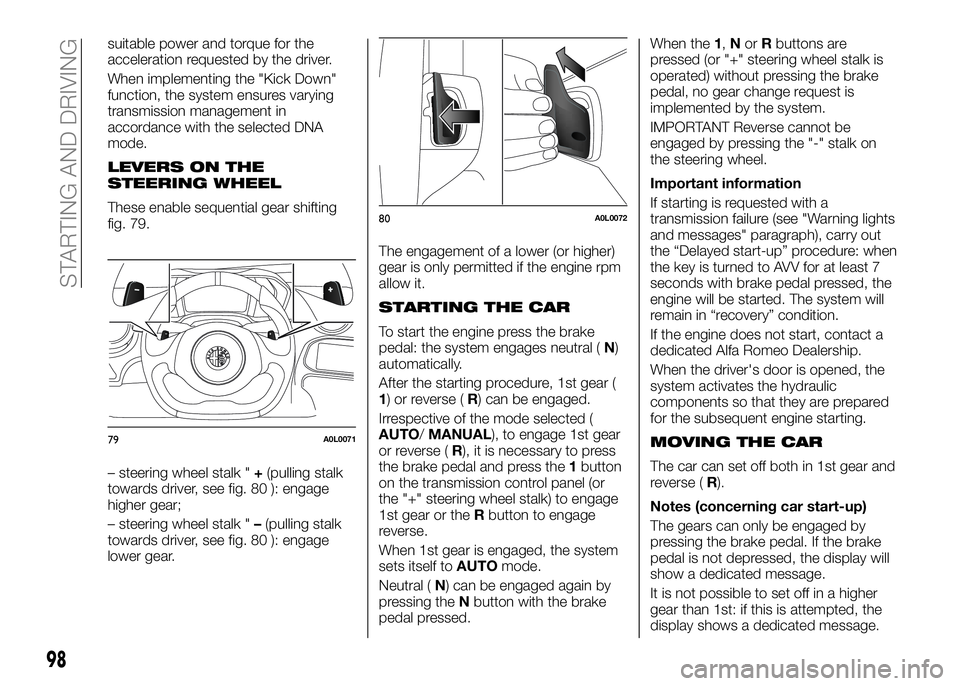
These enable sequential gear shifting
fig. 79.
– steering wheel stalk "+(pulling stalk
towards driver, see fig. 80 ): engage
higher gear;
– steering wheel stalk "–(pulling stalk
towards driver, see fig. 80 ): engage
lower gear.The engagement of a lower (or higher)
gear is only permitted if the engine rpm
allow it.
STARTING THE CAR
To start the engine press the brake
pedal: the system engages neutral (N)
automatically.
After the starting procedure, 1st gear (
1) or reverse (R) can be engaged.
Irrespective of the mode selected (
AUTO/MANUAL), to engage 1st gear
or reverse (R), it is necessary to press
the brake pedal and press the1button
on the transmission control panel (or
the "+" steering wheel stalk) to engage
1st gear or theRbutton to engage
reverse.
When 1st gear is engaged, the system
sets itself toAUTOmode.
Neutral (N) can be engaged again by
pressing theNbutton with the brake
pedal pressed.When the1,NorRbuttons are
pressed (or "+" steering wheel stalk is
operated) without pressing the brake
pedal, no gear change request is
implemented by the system.
IMPORTANT Reverse cannot be
engaged by pressing the "-" stalk on
the steering wheel.
Important information
If starting is requested with a
transmission failure (see "Warning lights
and messages" paragraph), carry out
the “Delayed start-up” procedure: when
the key is turned to AVV for at least 7
seconds with brake pedal pressed, the
engine will be started. The system will
remain in “recovery” condition.
If the engine does not start, contact a
dedicated Alfa Romeo Dealership.
When the driver's door is opened, the
system activates the hydraulic
components so that they are prepared
for the subsequent engine starting.
MOVING THE CAR
The car can set off both in 1st gear and
reverse (R).
Notes (concerning car start-up)
The gears can only be engaged by
pressing the brake pedal. If the brake
pedal is not depressed, the display will
show a dedicated message.
It is not possible to set off in a higher
gear than 1st: if this is attempted, the
display shows a dedicated message.
79A0L0071
80A0L0072
98
STARTING AND DRIVING
Page 102 of 182
When setting off on a medium-steep
incline, it is advisable to engage the
handbrake.
Engaging 1st gear
Proceed as follows:
press the brake pedal;
press the1button on the
transmission control panel;
release the brake pedal and press
the accelerator pedal.
Engaging reverse (R)
Reverse (R) can only be engaged with
car stationary and brake pedal pressed.
Proceed as follows:
press the brake pedal (car
completely stationary);
press the R button on the
transmission control panel;
release the brake pedal and press
the accelerator pedal. When reverse is
engaged, the system emits an acoustic
signal (for versions/markets, where
provided).
If the brake pedal is not depressed (and
the car is stationary), the display will
show a dedicated message and the
system will automatically engage
neutral (N).
IMPORTANT With the car running, the
request is accepted and executed if the
car speed drops below 3 km/h within 3
seconds from the request: if the request
is not executed, the system will
maintain the gear engaged or, if thespeed of the car drops below 10 km/h,
will put the transmission in neutral (N)
and the manoeuvre will have to be
repeated.
ENGAGING NEUTRAL (N)
With car stationary and ignition key at
MAR-ON (irrespective of the condition
of the engine), neutral (N) can only be
engaged with the brake pedal pressed.
If the car is in motion, neutral (N) can
always be engaged, irrespective of the
pressure applied to the brake and
accelerator pedals.
The display will show the letterN
together with the active operating
mode.
With car in motion, to engage a gear
from the neutral (N) position, press the
1button on the transmission control
panel (it is not necessary to press the
brake pedal): the transmission will
immediately engage the correct gear
according to the car’s speed.
With car stationary and ignition key at
MAR-ON (irrespective of the condition
of the engine), 1st gear can only be
engaged with the brake pedal pressed.
LAUNCH CONTROL
The "Launch Control" strategy permits
high-performance starting.
This strategy can be activated with
vehicle at a standstill, "Race" mode
selected and 1st gear engaged.The sequence of operations to perform
is as follows:
press the brake pedal and hold it
down;
press the accelerator pedal and hold
it down;
press the "–" stalk behind the
steering wheel;
When the brake pedal is released, the
car will start with maximum
acceleration. Keeping the accelerator
pressed, the system will automatically
upshift once the best engine speed has
been achieved for shifting gears.
................................. 0
To abandon the strategy, simply
interrupt the above sequence of
operations or release the accelerator
pedal.
DISPLAYED
INFORMATION
When the key is turned to MAR-ON,
after about 1 second, the display
shows the transmission in neutral
indication (N). When driving, the display
shows the gear engaged and the active
mode (AUTOorMANUAL). The
indications on the display have the
following meanings:
N = neutral;
1 = first gear;
2 = second gear
3 = third gear;
4 = fourth gear;
99
Page 103 of 182
5 = fifth gear;
6 = sixth gear;
R = reverse.
The car always starts in neutral. When
1st gear is requested, the system
forces the selection ofAUTOmode.
IMPORTANT If 10 seconds elapse with
the ignition key in theMAR-ON
position and the display does not show
the gear engaged, turn the key to the
STOPposition, wait for the display to
switch off and then repeat the
procedure. If the fault persists, contact
a dedicated Alfa Romeo Dealership.
ACOUSTIC SIGNAL
For safety reasons, an acoustic signal is
emitted when the car is parked with the
transmission in neutral (N) (the signal
can be heard when the ignition key is
turned toSTOP).
With the car stationary, the engine
started and (1st) gear or (R) engaged,
the system activates the acoustic signal
and automatically places the
transmission in neutral (N) when:
the accelerator and/or brake pedal
are not operated for at least 3 minutes;
the brake pedal is pressed for longer
than 10 minutes;
the driver's door is opened and the
accelerator pedal or the brake pedal are
not operated for at least one and a half
seconds;
a fault has been detected in the
transmission.
PARKING THE CAR
When parking and leaving the car,
proceed as follows:
engage a gear (1st gear if facing
uphill or reverse if facing downhill) and
leave the wheels turned;
stop the engine and engage the
handbrake.
Block the wheels with a wedge or a
stone if the car is parked on a steep
slope.
Wait until the indication of the gear
engaged disappears on the display
before releasing the brake pedal.
IMPORTANT:NEVERleave the car with
the transmission in neutral.
GENERAL WARNINGSWith car stationary and gear
engaged, always keep the brake pedal
pressed until you decide to set off, then
release the brake and accelerate
gradually.
During prolonged stops with the
engine running, it is advisable to keep
the transmission in neutral (N).
In order to safeguard the efficiency of
the clutch, do not use the accelerator
to keep the car stationary (e.g. when
stopped on an incline). The clutch could
overheat and be damaged: use the
brake pedal or the handbrake and onlyoperate the accelerator pedal when you
decide to set off.
If, with reverse gear (R) engaged,
you have to engage 1st gear or vice
versa, only do this when the car is
completely stationary and with the
brake pedal pressed.
If it is necessary to proceed downhill
with transmission in neutral (N) for
unexpected reasons, bearing in mind
that this practice is highly inadvisable,
remember that when gear engagement
is requested, the system will
automatically engage the best gear to
permit the correct transmission of drive
torque to the wheels, according to the
speed of the car.
When necessary, it is possible to
engage 1st gear, reverse (R) or neutral (
N) with the engine off, the key at
MAR-ON and the brake pressed. In this
case, change gear leaving at least 5
seconds between one gear change and
the next, in order to safeguard the
operation of the hydraulic system, and
the pump in particular.
For uphill departures, it is advisable
to accelerate gradually but fully
immediately after releasing the
handbrake or the brake pedal; this
allows the engine to temporarily
increase the number of revs and tackle
the steepest gradients with more torque
at the wheels.
100
STARTING AND DRIVING
Page 108 of 182
STARTING THE
ENGINE
Contact the dedicated Alfa Romeo
Dealership immediately ifwarning
light stays on constantly on the
instrument panel.
JUMP STARTING
If the battery is flat, start the engine
using an auxiliary battery with the same
capacity or a little higher than the flat
one.
Proceed as follows to start the car:connect the positive terminals (+ sign
near the terminal) of the two batteries
with a jump lead fig. 81;
with a second lead, connect the
negative terminal(−)oftheauxiliary
battery to an earthing point
on the
engine or the gearbox/transmission of
the car to be started;
start the engine; when the engine
has started, remove the leads, reversing
the order above.
If after a few attempts the engine does
not start, do not persist but contact the
dedicated Alfa Romeo Dealership.
IMPORTANT Do not connect the
negative terminals of the two batteries
directly! If the auxiliary battery is
installed on another car, check that
there is no accidental contact between
metallic parts of the two cars.
BUMP STARTING
Never, under any circumstances, jump
start the engine by pushing, towing or
coasting downhill.
IMPORTANT
12)Never use a fast battery-charger to
start the engine as this could damage the
electronic systems of your vehicle,
particularly the ignition and engine fuel
supply control units.
WARNING
91)This starting procedure must be
performed by expert personnel because
incorrect actions could cause electrical
discharge of considerable intensity.
Furthermore, battery fluid is poisonous and
corrosive: avoid contact with skin and
eyes. Keep naked flames and lighted
cigarettes away from the battery and do
not cause sparks.
81A0L0116
105
91)12)
Page 125 of 182
ENGINE COMPARTMENT FUSE BOXfig. 114
DEVICE PROTECTEDFUSE AMPERE
Headlight beam switch (for versions/markets, where provided) F09 5
Single tone hornF10 10
12 V socket / cigar lighter F86 15
External mirror defrosters F88 7.5
DASHBOARD FUSE BOXfig. 116
DEVICE PROTECTEDFUSE AMPERE
Central lockingF38 15
Two-way windscreen washer pump F43 20
+30 Driver side electric windows F47 20
+30 Passenger side electric windows F48 20
WARNING
110)If a fuse blows again, contact a dedicated Alfa Romeo Dealership.
111)Never replace a fuse with another with a higher amp rating; DANGER OF FIRE.
112)If a general protective fuse (MAXI-FUSE, MEGA-FUSE, MIDI-FUSE) blows, contact a dedicated Alfa Romeo Dealership.
113)Before replacing a fuse, make sure that the ignition key has been removed and that all the other services are switched off and/or
disengaged.
114)Contact a dedicated Alfa Romeo Dealership if a safety system (airbags, brakes), transmission system (engine, gearbox) or steering
system general protection fuse blows.
122
IN AN EMERGENCY
Page 128 of 182
IMPORTANT
19)Be careful to position the lift arms
correctly at the points illustrated, in order to
prevent damage to the carbon fibre chassis
and the bodywork components.
20)To avoid damage to the carbon fibre
chassis, the car cannot be raised with
standard hydraulic jacks, only with suitable
lowered hydraulic jacks. Contact a
dedicated Alfa Romeo Dealership.
TOWING THE CAR
21)
The tow hook provided with the car is
located in the tool box in the luggage
compartment.
ATTACHING THE TOW
HOOK
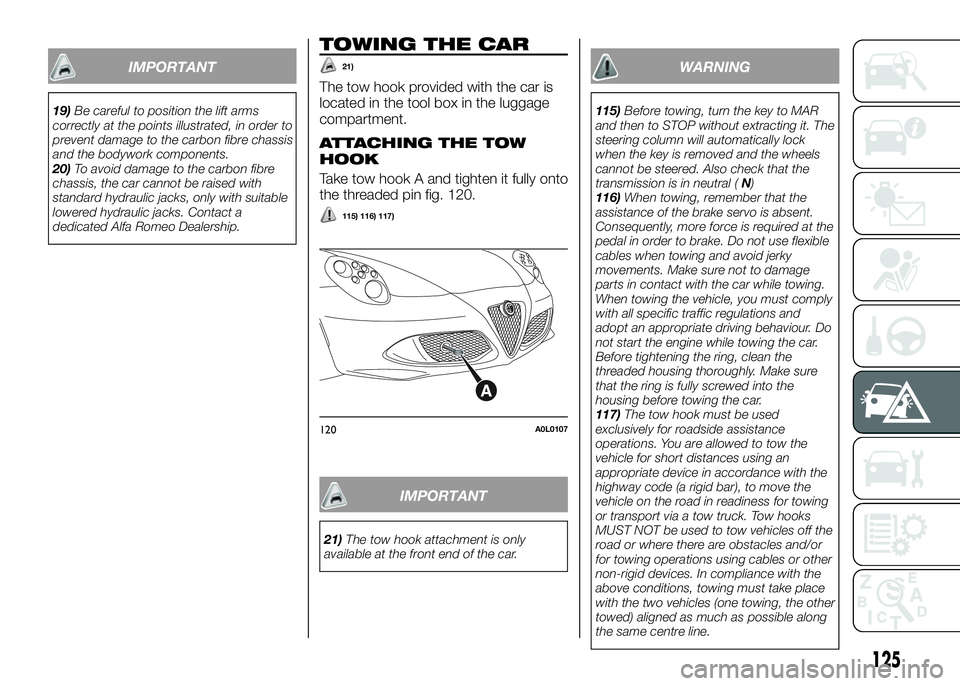
Take tow hook A and tighten it fully onto
the threaded pin fig. 120.
115) 116) 117)
IMPORTANT
21)The tow hook attachment is only
available at the front end of the car.
WARNING
115)Before towing, turn the key to MAR
and then to STOP without extracting it. The
steering column will automatically lock
when the key is removed and the wheels
cannot be steered. Also check that the
transmission is in neutral (N)
116)When towing, remember that the
assistance of the brake servo is absent.
Consequently, more force is required at the
pedal in order to brake. Do not use flexible
cables when towing and avoid jerky
movements. Make sure not to damage
parts in contact with the car while towing.
When towing the vehicle, you must comply
with all specific traffic regulations and
adopt an appropriate driving behaviour. Do
not start the engine while towing the car.
Before tightening the ring, clean the
threaded housing thoroughly. Make sure
that the ring is fully screwed into the
housing before towing the car.
117)The tow hook must be used
exclusively for roadside assistance
operations. You are allowed to tow the
vehicle for short distances using an
appropriate device in accordance with the
highway code (a rigid bar), to move the
vehicle on the road in readiness for towing
or transport via a tow truck. Tow hooks
MUST NOT be used to tow vehicles off the
road or where there are obstacles and/or
for towing operations using cables or other
non-rigid devices. In compliance with the
above conditions, towing must take place
with the two vehicles (one towing, the other
towed) aligned as much as possible along
the same centre line.
120A0L0107
125
Page 132 of 182
Thousands of kilometres 20 40 60 80 100 120
Months 12 24 36 48 60 72
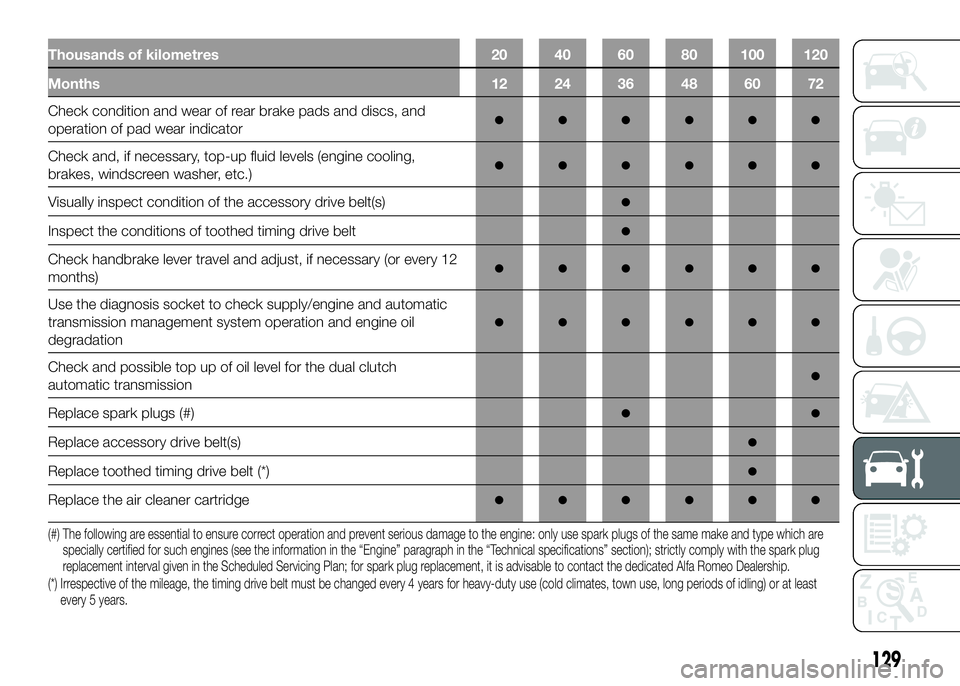
Check condition and wear of rear brake pads and discs, and
operation of pad wear indicator●●●●●●
Check and, if necessary, top-up fluid levels (engine cooling,
brakes, windscreen washer, etc.)●●●●●●
Visually inspect condition of the accessory drive belt(s)●
Inspect the conditions of toothed timing drive belt●
Check handbrake lever travel and adjust, if necessary (or every 12
months)●●●●●●
Use the diagnosis socket to check supply/engine and automatic
transmission management system operation and engine oil
degradation
●●●●●●
Check and possible top up of oil level for the dual clutch
automatic transmission●
Replace spark plugs (#)●●
Replace accessory drive belt(s)●
Replace toothed timing drive belt (*)●
Replace the air cleaner cartridge●●●●●●
(#) The following are essential to ensure correct operation and prevent serious damage to the engine: only use spark plugs of the same make and type whichare
specially certified for such engines (see the information in the “Engine” paragraph in the “Technical specifications” section); strictly comply with the spark plug
replacement interval given in the Scheduled Servicing Plan; for spark plug replacement, it is advisable to contact the dedicated Alfa Romeo Dealership.
(*) Irrespective of the mileage, the timing drive belt must be changed every 4 years for heavy-duty use (cold climates, town use, long periods of idling) or at least
every 5 years.
129