fuel Alfa Romeo 4C 2016 Owner handbook (in English)
[x] Cancel search | Manufacturer: ALFA ROMEO, Model Year: 2016, Model line: 4C, Model: Alfa Romeo 4C 2016Pages: 182, PDF Size: 9.49 MB
Page 5 of 182
READ THIS CAREFULLY
REFUELLING
Only refuel with unleaded petrol with octane rating (RON) not less than 95, in compliance with the European specification EN228. In particular,
the 4C’s engine has been designed to comply with all emission limits while simultaneously guaranteeing minimal consumption and maximum
performance, using premium-quality unleaded petrol with octane rating (RON) of 98 or higher. The use of petrol that does not conform to the
specification indicated may cause the
warning light to switch on and the irregular operation of the engine.
STARTING THE ENGINE
Make sure that the handbrake is engaged. Press the brake pedal and, without pressing the accelerator, turn the ignition key to AVV; release it
as soon as the engine has started.
PARKING ON FLAMMABLE MATERIAL
The catalytic converter develops high temperatures during operation. Do not park the car on grass, dry leaves, pine needles or other flammable
material: fire hazard.
RESPECTING THE ENVIRONMENT
The car is fitted with a system that carries out a continuous diagnosis of the emission-related components in order to help protect the
environment.
ELECTRICAL ACCESSORIES
If, after purchasing the car, you want to install accessories that require an electrical supply (with the risk of gradually draining the battery),
contact the dedicated Alfa Romeo Dealership which will calculate the overall electrical consumption and check that the car’s electrical system
can support the required load.
SCHEDULED SERVICING
Correct maintenance of the car is essential for ensuring that it maintains its performance and its safety features, its environmental friendliness
and low running costs for a long time to come.
THE OWNER HANDBOOK CONTAINS…
... important information, advice and warnings for correct use, driving safety and maintenance of your car over time. Special attention must be
paid to the symbols provided(personal safety)(environmental protection)(car integrity).
Page 13 of 182
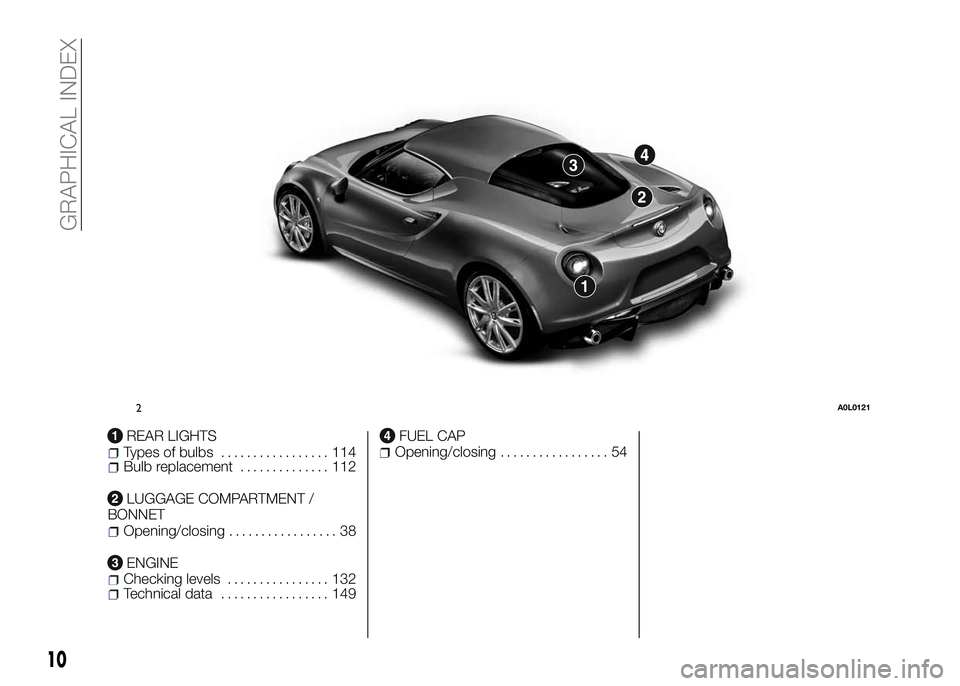
REAR LIGHTSTypes of bulbs................. 114Bulb replacement.............. 112
LUGGAGE COMPARTMENT /
BONNET
Opening/closing................. 38
ENGINEChecking levels................ 132Technical data................. 149
FUEL CAPOpening/closing................. 54
2A0L0121
10
GRAPHICAL INDEX
Page 16 of 182
GETTING TO KNOW YOUR CAR
In-depth knowledge of your new car
starts here.
The booklet that you are reading simply
and directly explains how it is made and
how it works.
That’s why we advise you to read it
seated comfortably on board, so that
you can see what is described here for
yourself.SYMBOLS.................14
ALFA ROMEO CODE SYSTEM....14
THE KEYS.................15
ALARM...................16
IGNITION SWITCH............18
SEATS....................18
STEERING WHEEL............20
REAR VIEW MIRRORS.........20
CLIMATE CONTROL...........22
CLIMATIC COMFORT..........23
HEATING AND VENTILATION.....24
MANUAL CLIMATE CONTROL....26
EXTERIOR LIGHTS............28
WINDOW CLEANING..........29
CRUISE CONTROL............30
ROOF LIGHT................31
CONTROLS................32
INTERIOR FITTINGS...........33
DOORS...................36
ELECTRIC WINDOWS..........37
LUGGAGE COMPARTMENT / ENGINE
COVER...................38
HEADLIGHTS...............39
ESC (Electronic Stability Control)
SYSTEM..................40
“Alfa DNA” SYSTEM (Dynamic car
control system)..............44
EOBD SYSTEM (European On Board
Diagnosis)..................46
RADIO SYSTEM..............47ACCESSORIES PURCHASED BY THE
OWNER..................47
PARKING SENSORS...........48
TPMS (Tyre Pressure Monitoring
System)...................50
REFUELLING THE CAR.........54
PROTECTING THE ENVIRONMENT .56
13
Page 18 of 182
THE KEYS
KEY WITHOUT REMOTE
CONTROL
Operation
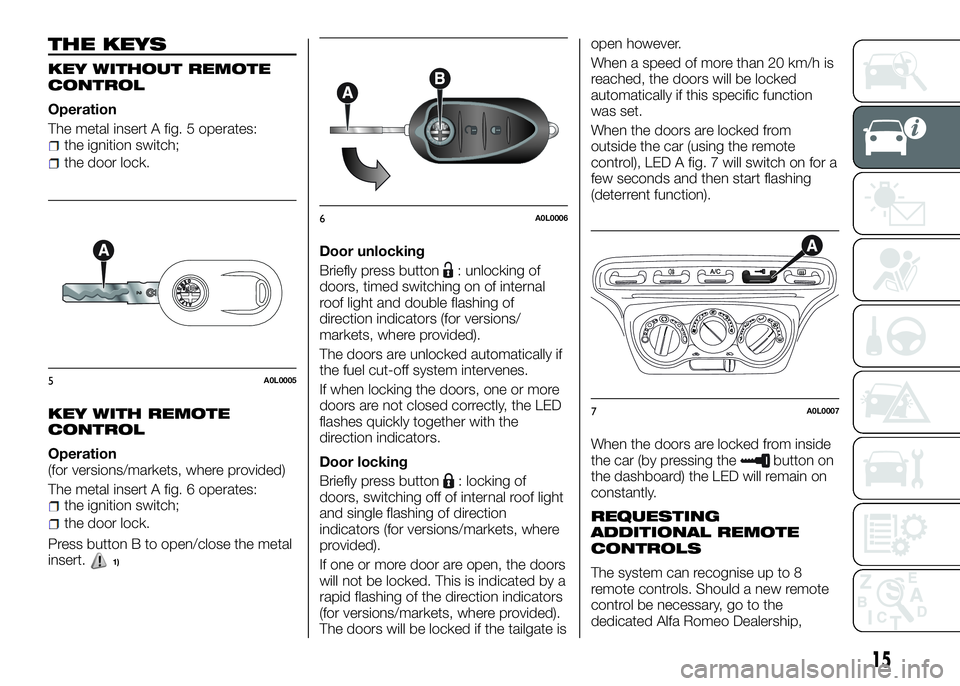
The metal insert A fig. 5 operates:
the ignition switch;
the door lock.
KEY WITH REMOTE
CONTROL
Operation
(for versions/markets, where provided)
The metal insert A fig. 6 operates:
the ignition switch;
the door lock.
Press button B to open/close the metal
insert.
1)
Door unlocking
Briefly press button
: unlocking of
doors, timed switching on of internal
roof light and double flashing of
direction indicators (for versions/
markets, where provided).
The doors are unlocked automatically if
the fuel cut-off system intervenes.
If when locking the doors, one or more
doors are not closed correctly, the LED
flashes quickly together with the
direction indicators.
Door locking
Briefly press button
: locking of
doors, switching off of internal roof light
and single flashing of direction
indicators (for versions/markets, where
provided).
If one or more door are open, the doors
will not be locked. This is indicated by a
rapid flashing of the direction indicators
(for versions/markets, where provided).
The doors will be locked if the tailgate isopen however.
When a speed of more than 20 km/h is
reached, the doors will be locked
automatically if this specific function
was set.
When the doors are locked from
outside the car (using the remote
control), LED A fig. 7 will switch on for a
few seconds and then start flashing
(deterrent function).
When the doors are locked from inside
the car (by pressing the
button on
the dashboard) the LED will remain on
constantly.
REQUESTING
ADDITIONAL REMOTE
CONTROLS
The system can recognise up to 8
remote controls. Should a new remote
control be necessary, go to the
dedicated Alfa Romeo Dealership,
5A0L0005
6A0L0006
7A0L0007
15
Page 36 of 182
Locking takes place irrespective of the
position of the ignition key.
FUEL CUT-OFF SYSTEM
Operation
This intervenes in the event of impact,
causing:
fuel supply cut-off with the engine
consequently switching off;
the automatic unlocking of the doors;
the switching on of the interior lights;
the switching on of the hazard
warning lights.
The digital
warning light and the
dedicated message on the display
indicate the intervention of the system.
Carefully check the car for fuel leaks, for
instance in the engine compartment,
under the car or near the tank area.
17)
After a collision, turn the ignition key to
STOP to prevent the battery from
running down.
To restore the correct operation of the
car, proceed as follows:
bring the left exterior light control
stalk to central position (neutral);
turn the ignition key to the MAR-ON
position;
activate the right direction indicator;
deactivate the right direction
indicator;
activate the left direction indicator;
deactivate the left direction indicator;
activate the right direction indicator;
deactivate the right direction
indicator;
activate the left direction indicator;
deactivate the left direction indicator;
turn the ignition key to the STOP
position;
turn the ignition key to the MAR-ON
position.
WARNING
16)The use of hazard warning lights is
governed by the Highway Code of the
country you are driving in: comply with
legal requirements.
17)If, after an impact, you smell fuel or
notice leaks from the fuel system, do not
reactivate the system to avoid the risk of
fire.
INTERIOR FITTINGS
STORAGE
COMPARTMENTS
Front
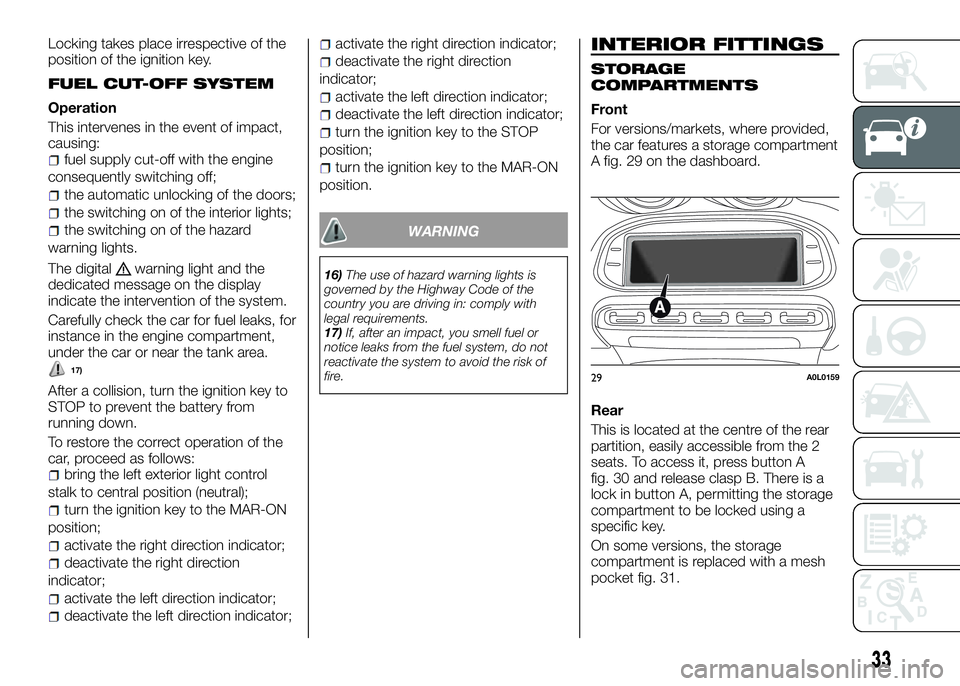
For versions/markets, where provided,
the car features a storage compartment
A fig. 29 on the dashboard.
Rear
This is located at the centre of the rear
partition, easily accessible from the 2
seats. To access it, press button A
fig. 30 and release clasp B. There is a
lock in button A, permitting the storage
compartment to be locked using a
specific key.
On some versions, the storage
compartment is replaced with a mesh
pocket fig. 31.
29A0L0159
33
Page 54 of 182
tyre low pressure control warning lightswitches on constantly, the inflation
pressure must be adjusted until it
reaches the pressure prescribed for
cold tyres. After the automatic update
of the system, the tyre pressure control
warning light switches off. You may
need to drive the car for about 20
minutes at a speed higher than 20 km/h
to allow the TPMS to receive this
information.
NOTE
The TPMS does not replace the
normal tyre maintenance service and
does not indicate any fault in a tyre.
Therefore, the TPMS should not be
used as pressure switch while adjusting
the tyre inflation pressure.
Driving with insufficient tyre pressure
causes their overheating and can result
in tyre failure. The low inflation pressure
reduces fuel efficiency and tyre tread life
and may also affect handling and
braking performance of the car.
The TPMS does not replace the
correct tyre maintenance. It is up to the
driver to maintain the correct tyre
pressure level measuring it with a
suitable pressure switch. This is
necessary even if the decrease in the
inflation pressure value does not cause
the tyre pressure control warning light
to switch on.
The TPMS warns the driver of any
condition of insufficient tyre pressure Ifthis drops below the insufficient
pressure limit for any reason including
low temperature and normal pressure
loss of the tyre.
The seasonal temperature changes
affect tyre pressure.
The TPMS uses wireless devices with
electronic sensors mounted on the
wheel rims to constantly monitor the
value of tyre pressure. The sensors
mounted on each wheel as part of the
valve stem transmit various information
of the tyres to the receiver module, in
order to calculate the pressure.
IMPORTANT Monitoring and
maintaining the correct pressure in all
four tyres are particularly important.
Tyre pressure
monitoring system low
pressure warnings
46) 47) 48) 49) 50) 51) 52) 53) 54)
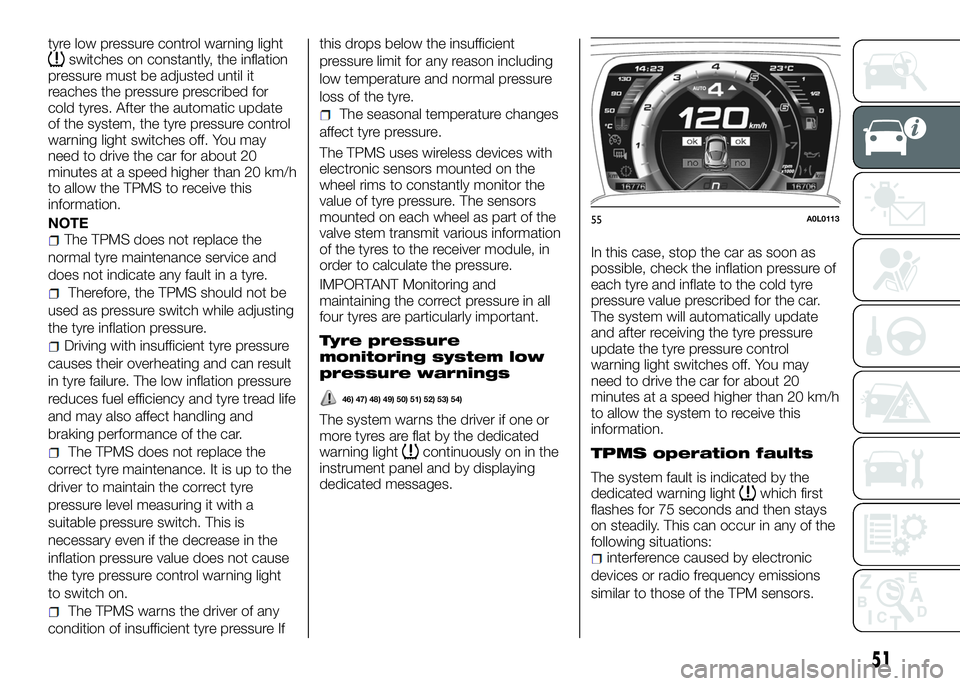
The system warns the driver if one or
more tyres are flat by the dedicated
warning light
continuously on in the
instrument panel and by displaying
dedicated messages.In this case, stop the car as soon as
possible, check the inflation pressure of
each tyre and inflate to the cold tyre
pressure value prescribed for the car.
The system will automatically update
and after receiving the tyre pressure
update the tyre pressure control
warning light switches off. You may
need to drive the car for about 20
minutes at a speed higher than 20 km/h
to allow the system to receive this
information.TPMS operation faults
The system fault is indicated by the
dedicated warning lightwhich first
flashes for 75 seconds and then stays
on steadily. This can occur in any of the
following situations:
interference caused by electronic
devices or radio frequency emissions
similar to those of the TPM sensors.
55A0L0113
51
Page 57 of 182
54)The tyre repair kit (Fix&Go) provided
with the car (for versions/markets, where
provided) is compatible with the TPMS
sensors; using sealants not equivalent with
that in the original kit may adversely affect
its operation. If sealants not equivalent with
the original one are used, it is
recommended to have the TPMS sensors
checked by a qualified repair centre.REFUELLING THE
CAR
The car features the "Fast Fuel" system,
which prevents refuelling with incorrect
fuels (e.g. diesel for a petrol engine).
Stop the engine before refuelling.
Only refuel with unleaded petrol with
octane rating (RON) not less than 95, in
compliance with the European
specification EN228. In particular, the
4C’s engine has been designed to
comply with all emission limits while
simultaneously guaranteeing minimal
consumption and maximum
performance, using premium-quality
unleaded petrol with octane rating
(RON) of 98 or higher.
In order to prevent damage to the
catalytic converter never introduce even
the smallest amount of leaded petrol,
even in the event of an emergency.
IMPORTANT An inefficient catalytic
converter leads to harmful exhaust
emissions, thus contributing to air
pollution.
IMPORTANT Never introduce leaded
petrol to the tank, even in small
amounts in an emergency, as this
would damage the catalytic converter
beyond repair.
FILLING THE TANK
To ensure that you fill the tank
completely, top up twice after the first
click of the fuel supply gun. Avoid
further top-ups, which could cause
faults in the fuel supply system.
REFUELLING
PROCEDURE
The car features a "Fast Fuel" device,
integrated with the opening for the fuel
tank: it opens and recloses
automatically when the fuel supply gun
is inserted/removed.
The "Fast Fuel" device is provided with
an inhibitor which prevents refuelling
with incorrect fuel.
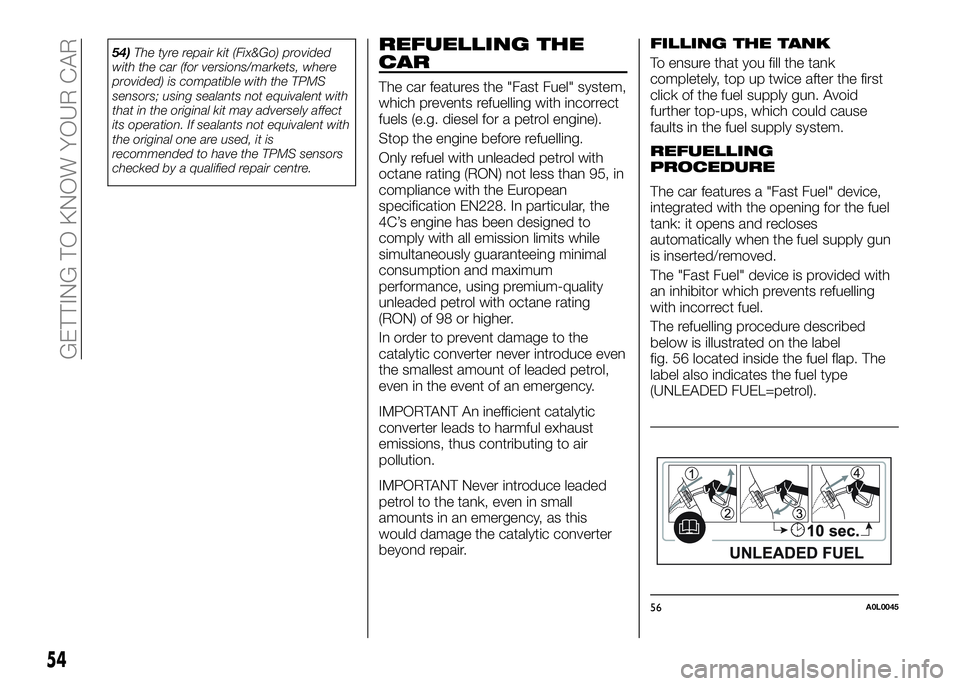
The refuelling procedure described
below is illustrated on the label
fig. 56 located inside the fuel flap. The
label also indicates the fuel type
(UNLEADED FUEL=petrol).
56A0L0045
54
GETTING TO KNOW YOUR CAR
Page 58 of 182
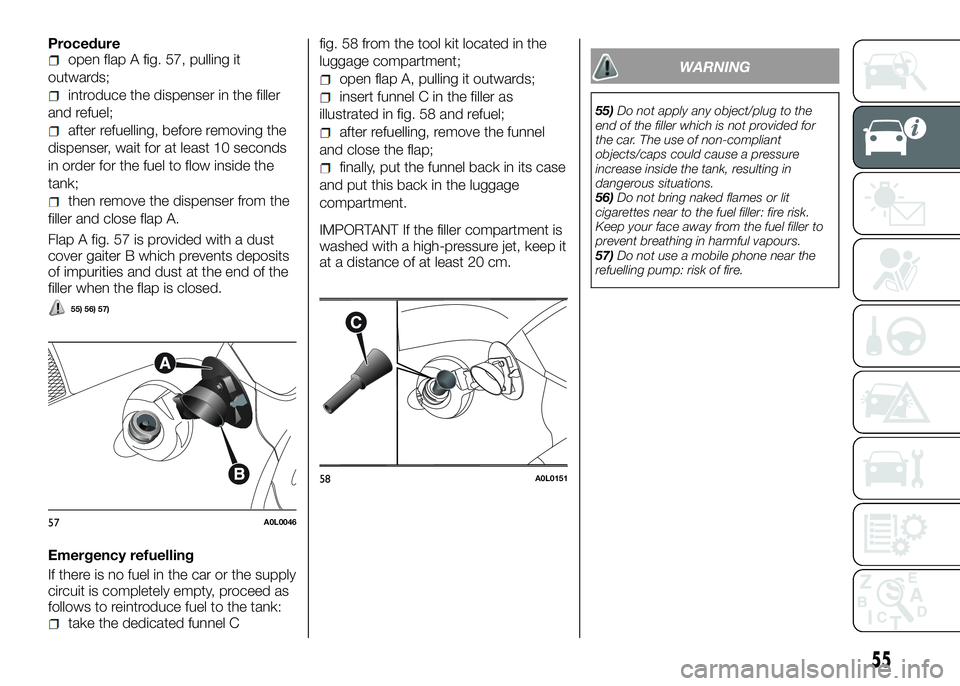
Procedureopen flap A fig. 57, pulling it
outwards;
introduce the dispenser in the filler
and refuel;
after refuelling, before removing the
dispenser, wait for at least 10 seconds
in order for the fuel to flow inside the
tank;
then remove the dispenser from the
filler and close flap A.
Flap A fig. 57 is provided with a dust
cover gaiter B which prevents deposits
of impurities and dust at the end of the
filler when the flap is closed.
55) 56) 57)
Emergency refuelling
If there is no fuel in the car or the supply
circuit is completely empty, proceed as
follows to reintroduce fuel to the tank:
take the dedicated funnel Cfig. 58 from the tool kit located in the
luggage compartment;
open flap A, pulling it outwards;
insert funnel C in the filler as
illustrated in fig. 58 and refuel;
after refuelling, remove the funnel
and close the flap;
finally, put the funnel back in its case
and put this back in the luggage
compartment.
IMPORTANT If the filler compartment is
washed with a high-pressure jet, keep it
at a distance of at least 20 cm.
WARNING
55)Do not apply any object/plug to the
end of the filler which is not provided for
the car. The use of non-compliant
objects/caps could cause a pressure
increase inside the tank, resulting in
dangerous situations.
56)Do not bring naked flames or lit
cigarettes near to the fuel filler: fire risk.
Keep your face away from the fuel filler to
prevent breathing in harmful vapours.
57)Do not use a mobile phone near the
refuelling pump: risk of fire.
57A0L0046
58A0L0151
55
Page 59 of 182
PROTECTING THE
ENVIRONMENT
The following devices are used for
reducing petrol fuel engine emissions:
catalytic converter, oxygen sensors and
evaporation control system.
Do not let the engine run, even for a
test, with one or more spark plugs
disconnected.
58)
WARNING
58)Under operating conditions, the
catalytic converter becomes very hot.
Therefore, do not park the car on
flammable materials (grass, dry leaves,
pine needles etc.) to avoid the risk of fire.
56
GETTING TO KNOW YOUR CAR
Page 61 of 182
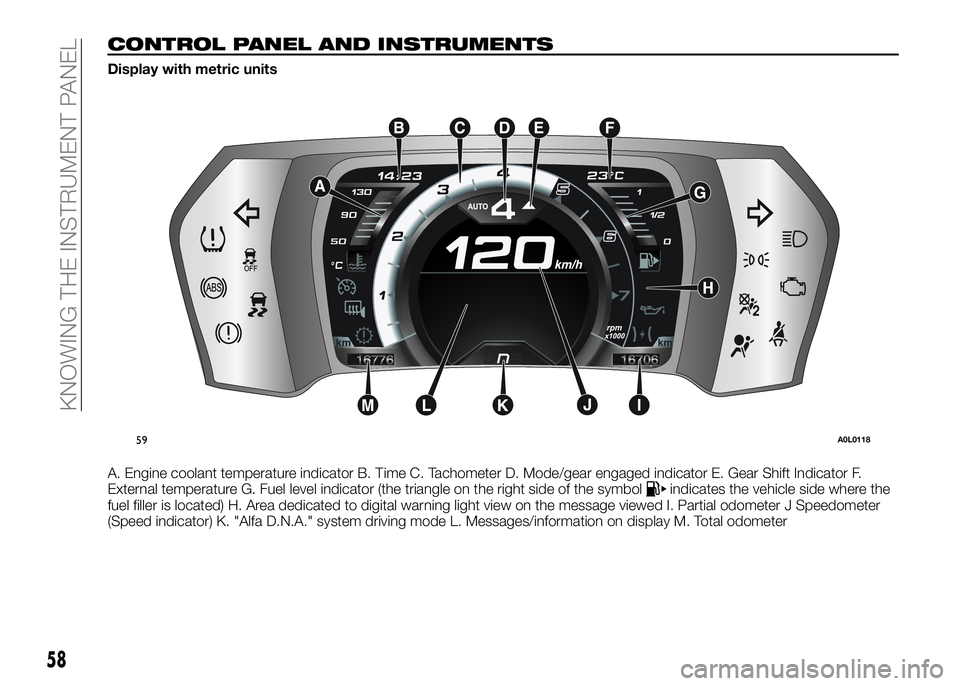
CONTROL PANEL AND INSTRUMENTS
Display with metric units
A. Engine coolant temperature indicator B. Time C. Tachometer D. Mode/gear engaged indicator E. Gear Shift Indicator F.
External temperature G. Fuel level indicator (the triangle on the right side of the symbol
indicates the vehicle side where the
fuel filler is located) H. Area dedicated to digital warning light view on the message viewed I. Partial odometer J Speedometer
(Speed indicator) K. "Alfa D.N.A." system driving mode L. Messages/information on display M. Total odometer
59A0L0118
58
KNOWING THE INSTRUMENT PANEL